
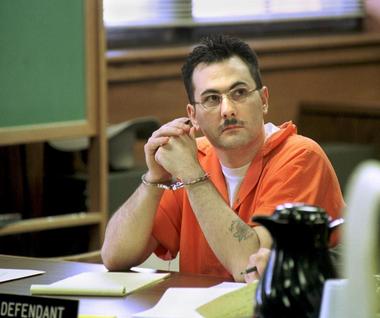
Scott Baldwin, convicted of murder in 2002 and now represented by the Wisconsin Innocence Project
This story about a Wisconsin Innocence Project client Scott Baldwin (convicted in 2002 of murder in Michigan) discusses how the judge recently granted DNA testing of hairs that were found clutched in the murder victim’s hand (the evidence suggested there had been a struggle between the perpetrator and the victim). What was striking to me in the article (although sadly, not surprising) is that the prosecutors opposed DNA testing of the hairs on the ground that the hairs had been microscopically examined at the time of trial, and determined to have come from the victim himself. Thus, the prosecutors argued, there is no need for DNA testing to further confirm what we all already know.
If anything has proven to be unreliable junk science, however, it’s microscopic hair comparison (it’s perhaps up there with bite mark evidence in terms of unreliability). We recently had a case in Ohio, for example, where the state’s “expert” testified at the time of trial in the early 1990s that the 7 hairs found on the rape victim’s clothing had come from multiple and various sources, none of which was the defendant. The “expert” claimed that a couple of the hairs belonged to the rape victim herself, but the rest came from random other, unknown people. He further explained how the rape victim might have gotten the hairs of random other people on her clothing, testifying that the hairs could have gotten on her clothing when she sat on couches, rode in cars, etc.
We DNA tested the 7 hairs to see if any of them came from our alternative suspect. A match of one of the hairs to the alternative suspect–who didn’t know the victim and had no business being at the scene–would have clearly exonerated our client. Unfortunately, it didn’t work out, because none of the hairs matched the alternate suspect (although we eventually won the case on Brady grounds). What was interesting, though, is that DNA testing proved that all 7 hairs came from the rape victim herself. Thus, the “expert’s” testimony at trial that these hairs came from several different people was all complete nonsense.
This anecdote is not out of the norm. For a detailed academic piece outlining the unreliability of microscopic hair comparison, including a discussion of the NAS report, go here. What is so disturbing about the Kalamazoo case, though, is how prosecutors–who are charged with the life and liberty of citizens in their jurisdictions–can remain so willfully ignorant of scientific advances relevant to their field. To in this day and age still naively cling to the supposed infallibility of a totally obsolete method of identifying the source of hairs–and to actively oppose more reliable methods such as DNA testing–is inexcusable. And the number of times I’ve had discussions with prosecutors who are completely oblivious to the problems revealed in the past 20 years with eyewitness identification, and who keep marching forward with shaky prosecutions based solely on an eyewitness without ever pausing or questioning what they are doing, is equally disturbing.
We have to do better. Fortunately, the judge in Kalamazoo does not live in the stone age with the prosecutors, and granted DNA testing of the hairs. I will update the story as DNA test results are released and made public in the future.
UPDATE: Sample motion to exclude microscopic hair comparison from evidence based on unreliability (thanks to Innocence Project New Orleans)…











 Wrongful Convictions Blog
MG, Esq.:
“… we eventually won the case on Brady grounds …”
* * * * *
“This anecdote is not out of the norm.
* * * * *
“… who keep marching forward with shaky prosecutions based solely on an eyewitness without ever pausing or questioning what they are doing, is equally disturbing.”
— — — — — — — — — — — —
I respectfully suggest that one of the reasons for the above is that Ohio does not use its existing sanction tools to REALLY protect the public from prosecutors whose conduct ranges from willfully obtuse to evil.
Q.1 Did you win the Ohio case you mention in appeal or at trial ?
Q.2 May you ID the above Brady violation case you won ?
Docile Jim Brady, PO Box 91018 Columbus, OH 43209-7018
Associate member, Ohio Association of Criminal Defense Lawyers
Typing ONLY for DJB and NOT OACDL ‼
Pingback: Prosecutor in DC Calls for Review of All Convictions Based on Microscopic Hair Comparison | Wrongful Convictions Blog
It’s such a disappointment that innocent people get put behind the walls of prison just so someone can get a pat on the back. Had the DNA testing been done way back when, Scott would be home with his family!
Pingback: Reflections on System Resistance to Innocence Part II | Wrongful Convictions Blog