Author Archives: Mark Godsey

New Trial in Non-DNA Case in New York on Grounds of Possible Innocence…

The Exoneration Initiative reported yesterday that the Appellate Division in New York granted a new trial to Derrick Deacon based on post-conviction newly discovered evidence.  Derrick has now served 23 years for a homicide he did not commit.

In reversing the hearing court’s denial of relief, the Appellate Division found the recantation of a key trial witness to be “credible and compelling,” despite the hearing court’s opinion to the contrary.  It also considered a declaration against penal interest by the true killer.  The decision, attached here, is significant for non-DNA litigants because it stresses the cumulative impact of multiple pieces of evidence of innocence.

An article about the case from last week is available here….

Wednesday’s Quick Clicks…

  • Virginia exoneree Arthur Whitfield charged in domestic violence case
  • More on the new study out of Virginia showing a wrongful conviction rate in sexual assault cases of 15%
  • Scant hope for Pennsylvania’s wrongly convicted
  • Larry Sims of Texas, freed by DNA, deserves to have name cleared even in death
  • A review of the musical The Scottsboro Boys
  • In Ireland, Justice Minister David Ford must reconsider his decision to refuse compensation to a west Belfast man whose conviction for possessing explosives was overturned, the High Court has ruled.

67 Wrongful Convictions, Zero Accountability at Chicago Police Department

From HuffingtonPost.com:

By Locke Bowman, Director, The Roderick MacArthur Justice Center, Northwestern University

The City’s top lawyer, Chicago Corporation Counsel Steve Patton, sounded giddy after the Chicago Police failed to riot in opposition to NATO protesters last month. Talking within earshot of a group of civil rights attorneys in the federal courthouse the day after the diplomats left town, Patton announced that the City’s Police Department had finally overcome the dark reputation it earned during the televised brutality of the 1968 Democratic National Convention. “We really put that behind us,” he said. Patton was firmly on message. The media largely bought in to the proposition that the Police performance during the NATO meeting had “erased the stain of 1968.”

It was a less-than-perfect performance, certainly. Writing for ReutersAndrew Stern described a line of cops advancing on protesters: “As the police line advanced, batons swinging, protesters at the edge of the crowd suffered head wounds and others lost teeth and absorbed body blows, but no one was killed.” (No one was killed? Good to hear.) Police Superintendent Gerry McCarthy, whose media star has certainly ascended, was on the front lines himself, where he was seen conspicuously shouting commands, fist bumping with his troops and coming to the aid of an officer who had been knocked down by a protester.

Things could have been much, much worse. And it’s good for Chicago and our city’s international reputation that they weren’t. The Police did not break ranks during last month’s demonstrations, despite being jeered at, taunted and having stuff thrown at them. By and large, the guys in uniform kept their cool. They may have looked like enforcers for a police state (not the best image for Chicago to broadcast across the international airwaves, if you ask me), but at least the Police didn’t riot. A plan was developed at the highest levels and the rank and file Continue reading

Spotlight On University of Chicago Exoneration Project…

From press release:

More than 17 years ago, Harold Richardson was arrested and later convicted for a crime he did not commit.

Kristin McKeon was then a grade school student in Connecticut.

Their paths crossed late last year when McKeon, JD’12, became part of a team of lawyers who won Richardson’s release from prison, using DNA evidence to show another man had committed the crime.

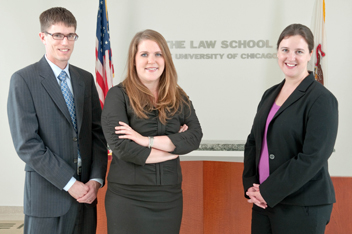
McKeon is one of about a dozen students each quarter who participate in the University of Chicago Law School’s Exoneration Project, a clinic that gives students hands-on experience representing prisoners seeking post-conviction relief. Students do it all — from voting on which cases the clinic should accept to writing briefs to standing before a judge — under the supervision of experienced, licensed attorneys.

“You’re doing something to help people,” says McKeon, who argued before a judge that Richardson, now 34, should be released. “With my other classes, you’re taking in information and being analytical, and it will all come in handy down the road.”

Since 2008, the Exoneration Project has helped earn the release of four prisoners — most recently, the May 30 dismissal of charges against James Kluppelberg, who had been convicted of arson and murder based on flawed evidence.

Students are guided by the project’s staff attorneys Tara Thompson, JD’03, Elizabeth Wang, JD’05, and Russell Ainsworth. Thompson explains that the goal of the clinic is to engage students in cases that many full-time attorneys simply don’t take, and to instill the importance of pro-bono work.

“There are very few people in the private bar who represent these people,” Thompson says, adding that the typical client is someone without means. “Students are learning how to do the work that needs to be done. But for the University and the students, they wouldn’t have an avenue for relief.”

Learning Duty and Providing Dignity

The clinic got its start thanks to the efforts of Jon Loevy, who staffs the clinic with attorneys from his Chicago civil rights firm Loevy & Loevy. But the students do most of the heavy lifting, which is no easy task: Witnesses are hard to find or their memories have faded, the legal process can move at a snail’s pace, writing briefs can be challenging, and standing before a judge for the very first time can make even the brightest law student weak-kneed.

But in arguing before the judge, McKeon says: “I know that what I was saying was really mattering in the moment.”

McKeon and others receive course credit for their efforts. But both McKeon and Continue reading

Tuesday’s Quick Clicks…

  • The Innocence Network UK has long used the Simon Hall cases as an example of a wrongful conviction that the CCRC has done nothing about.  Read an open letter to the CCRC from Simon’s supporters
  • Weeks before an expected shutdown for lack of funding, the Illinois Torture Inquiry and Relief Commission issued three decisions last Wednesday supporting inmates’ claims that Chicago Police detectives coerced their murder confessions
  • Lessons from the Chamberlain case in Australia:  the human cost of wrongful conviction

Breaking News: Virginia Study Demonstrates Scale of Wrongful Conviction Problem in the U.S.

From the WashingtonPost.com:

RICHMOND, Va. — New DNA testing in hundreds of old Virginia homicide and sexual assault cases supports the exoneration of at least 38 suspects, according to a study released Monday by a national policy group that examined the test results.The Urban Institute’s study is the first to say how many exonerations are likely from Virginia’s stash of archived, decades-old biological samples that so far have cleared at least five men who were convicted of sexual assaults. Officials with the state Department of Forensic Science, which is conducting the testing project, have said their job is not to suggest who should be exonerated, but to test the samples and deliver the results to law enforcement officials who determine whether they believe someone is innocent.

The institute’s researchers found that in 5 percent of homicide and sexual assault cases, DNA testing ruled out the convicted person. If the scope is narrowed to just the sexual assault convictions, DNA testing eliminated between 8 percent and 15 percent of convicted offenders. The wrongful conviction rate previously had been estimated at 3 Continue reading

Monday’s Quick Clicks…

  • Does innocence matter in Florida?
  • The Kentucky Innocence Project says it would be a “gross miscarriage of justice” not to free Susan Jean King, who is serving a 10-year sentence, in light of the confession by Richard Thomas Jarrell Jr., who offered details of the homicide that presumably only the killer would know
  • North Carolina makes it tougher for exonerees who originally pleaded guilty to obtain compensation
  • Michael Morton wrongful conviction case out of Texas to be subject of documentary film
  • Conference on the role journalists can play in exonerating the innocent

New Article Spotlight: The Pursuit of Innocence Compensation in Canada

Myles Frederick McClellan has posted the above-titled article on SSRN.  Download full article here.  The abstract states:

There is no doubt that the issue of wrongful convictions has grown in public awareness over the past twenty years, yet there is no legislated right to compensation in Canada for those who have suffered tremendous personal and financial damage as a result of a wrongful incarceration. The available remedies include the expensive and time consuming routes of litigation for malicious prosecution, negligent investigation, a Charter breach; a petition to a United Nations Human Rights Committee or the highly politicized exercise of mercy by government to make an ex gratia payment. Except for the very few, none of these remedies are efficacious. The need is great to employ a specialist tribunal that provides accessibility and transparency within a reasoned legislative framework.

Sunday’s Quick Clicks…

Saturday’s Quick Clicks…

  • New Zealand exoneree Lindy Chamberlain thanks her Kiwi supporters, and outlines how she wants those who wrongfully convicted her to pay their debt to society
  • Exoneree David Jonathan Quindt is still haunted by his wrongful conviction
  • Group fights for pardon for Britain’s last “witch,” Helen Duncan, convicted more than 70 years ago
  • A dog in Scotland sentenced to death for attacking a cat, sought exoneration from the CCRC but was turned down
  • Recent exoneree Brian Banks’ NFL future unclear

Minnesota Innocence Project Trains Defense Lawyers on How To Avoid Wrongful Convictions…

From MPRnews.com:

ST. PAUL, Minn. — A man in a bathtub filled with blood. A dead woman, half-naked, lying face down in her kitchen. A child stabbed with a knife.

The photos, part of a lecture by the Hennepin County medical examiner, horrified the defense attorneys who had gathered in the dimly lit room. But they knew they needed to look. The lives of their clients depended on it.

The attorneys had gathered for a crash course on forensic science, organized by the Innocence Project of Minnesota, to help prevent wrongful convictions. Many in the room had followed media coverage of cases in which innocent people went to prison based on junk science and false testimony from forensic experts. The cases alarmed defense attorneys, who worried they lack the right kind of training to detect problems with science in the courtroom.

“You look at cases, and you wonder, if I got a report like that, would I have caught that problem?” said Mankato criminal defense attorney Allen Eskens, who attended the June 8 training at the Bureau of Criminal Apprehension in St. Paul.

In wrongful conviction cases, defense attorneys often blame the shoddy work of a handful of scientists and doctors, said public defender Christine Funk, one of the training instructors. The real question, she said, is how that shoddy work ended up in the courtroom in the first place.

“We need to be investigating when we get science,” Funk told the group.

Funk used the example of a Michigan man, David Gavitt, who was convicted of setting a fire that killed his wife and two daughters. Decades later, students at the University of Michigan’s Innocence Clinic reviewed his case and found problems Continue reading

Friday’s Quick Clicks…

  • Recent UK exoneree Sam Hallam was at the King’s Head in Islington last week as the play that tells the story of his life, Someone to Blame, was played out in front of his closest friends and family inside the venue’s auditorium.
  • Chicago exoneree Oscar Walden settles his wrongful conviction suit
  • USA Today finds “scores” of innocent men in North Carolina, many of whom are unaware of the evidence proving their innocence

Jason Puracal on CNN Last Night…

Watch the video, which includes Anderson Cooper doing a phone interview with Jason here.

Story:

(CNN) — An American being held in a Nicaraguan prison said he is innocent and described his treatment in a “hellhole” in an exclusive phone interview with CNN’s Anderson Cooper on Thursday.

“I don’t know the reason that I’m here,” Jason Puracal said. “That’s been a mystery from the very beginning. What the motives behind the police and the prosecution have been.”

Puracal, a 35-year-old from Washington state, has been behind bars since August 2010, when Nicaraguan authorities raided his real estate office in the coastal tourist city of San Juan del Sur.

CNN profiled Puracal in February.

In November, a Nicaraguan judge found Puracal guilty of money laundering, drug trafficking and organized crime and sentenced the American to 22 years. But a chorus of supporters say that there is no evidence to support the charges and Continue reading

Exoneration in Argentina..

Here is an email sent yesterday by Justin Brooks, director of the California Innocence Project:

I am so pleased to report that the Argentinian Supreme Court has reversed the conviction of Fernando Carerra.  Carerra’s case was championed by Enrique Pinero, an Argentinian film director and co-founder of our newest innocence project in South America. The Carerra case was the subject of Pinero’s film “The Rati Horror Show.”
http://www.youtube.com/watch?v=xx538juk1KI which we will premiere in Santiago, Chile in 2 weeks at our First Latin American Innocence Conference.
There is an incredible amount of media attention on this case, mostly in Spanish, but here is a short article in English.

http://www.argentinaindependent.com/tag/fernando-carrera/

Jason Puracal Case on Anderson Cooper Live Tonight in U.S….

The case has been covered many times on this blog, including here, here and here.

The case will be featured on Anderson Cooper 360 Tonight at 8:00 and against at 10:00 EST.

Judge: I’ll Never Forget The Innocent Person I Sentenced to Prison…

From the Mercury News:

I will always remember Bobby Herrera, the man whom I wrongfully sentenced to prison.

It was a serious case. The victim had been shot at a graduation party in San Jose. Two people identified Herrera, a 17-year-old mechanic with no criminal record, as the shooter. Herrera’s attorney told him if he went to trial, he would risk 25 years in prison. On the attorney’s advice, Herrera pleaded no contest and accepted a shorter prison sentence. As the presiding judge, I approved the plea bargain and sentenced him to five years.

I subsequently learned that Herrera’s attorney was suspended from the practice of law when he represented Herrera. With the support of the district attorney, I returned Herrera to my court, appointed the public defender to represent him and released him from custody. By then he had served 11 months in prison. His new attorney found evidence of his innocence. The charges were dismissed.

Herrera’s case is one of 873 individual exonerations profiled in the National Registry of Exonerations, a joint project unveiled in May by the University of Continue reading

Thursday’s Quick Clicks…

  • Casey Anthony breaks her silence and claims innocence in the death of her daughter  
  • Overbrook Foundation gives Innocence Project a $40,000 grant
  • Campaigners who battled to free Sam Hallam are demanding Mayor of London Boris Johnson seeks urgent answers to the “many questions” arising from the wrongful conviction
  • On-line petition asks University of Southern California to honor the 4-year scholarship it had given to Brian Banks before his wrongful conviction
  • Sam Hallam case in the UK proves that miscarriages of justice are as prevalent as ever

Wednesday’s Quick Clicks…

In Australia, Dingo Caused Death that Led to Wrongful Conviction…

From theage.com:

A dingo was responsible for the death of Azaria Chamberlain in 1980, a Northern Territory coroner has found.

Coroner Elizabeth Morris told a packed courtroom on Tuesday that a dingo was to blame for the attack at Uluru, which originally saw Azaria’s mother Lindy Chamberlain-Creighton jailed for murder and her husband Michael given a suspended sentence for being an accessory after the fact.

Both were later exonerated after a royal commission in 1987.

In the final moments of handing down her finding, an emotional Ms Morris apologised to the Chamberlain family.

Ms Morris said she was satisfied the evidence was ‘‘adequate, clear, cogent and exact and excluded all other reasons possible’’.

She told the court: ‘‘(Azaria) died at Uluru on 17th August 1980 as a result of being attacked and taken by a dingo.’’

She said an amended death certificate was available immediately to them.

Outside the court, an emotional Mrs Chamberlain-Creighton thanked lawyer Continue reading

Prosecutors often challenge DNA evidence that could clear the convicted

From the ChicagoTribune.com:

When Terrill Swift was released from prison after serving 15 years for rape and murder, he sought DNAtesting because he wanted to prove his innocence. Cook County prosecutors opposed his efforts but relented last year after the Tribune made inquiries about Swift’s request.

After the DNA from semen in the victim’s body was matched to a convicted murderer and rapist, Swift went to court to get his conviction thrown out. But prosecutors opposed that effort, saying the DNA was meaningless, especially when considered against Swift’s confession.

A judge turned aside prosecutors’ arguments, saying the DNA was powerful evidence, and earlier this year the judge vacated Swift’s conviction.

And last month, when Swift went to court to obtain a certificate of innocence to expunge the record of his arrest and conviction and clear the way for him to seek Continue reading