Category Archives: Commissions/Innocence Commissions/Governmental Case Review Agencies

Friday’s Quick Clicks…

click

NY murder convictions vacated; wrongful convictions scandal called “metastasizing”

Brooklyn (NY) Supreme Court Justice Raymond Guzman vacated the murder convictions of Antonio Yarbough, 39, and Sharrif Wilson, 37, Thursday after the two had served 21 years in prison for a 1992 triple murder—that of Mr. Yarbough’s mother, his twelve-year-old sister, and her friend. The two men, who were 15 and 18 at the time of the murders, have long claimed they did not commit them. Brooklyn District Attorney Ken Thompson dismissed the cases against the men.

No physical evidence had connected the two men to the crime. The post-conviction breakthrough came last year when DNA testing of evidence found under the fingernails of Mr. Yarbough’s mother matched DNA from a subsequent rape and murder that occurred in 1999 when Yarbough and Wilson were in prison. Family members cheered as the decision was announced in court. Continue reading

Wednesday’s Quick Clicks…

click
  • The unintended consequences of compensating the exonerated
  • Canada’s system for reviewing alleged wrongful convictions “failing miserably”
  • West Virginia University Law Innocence Project pushes interrogation recording bill
  •  What does a record number of U.S. exonerations in 2013 tell us?
  • ESPN video on the wrongful accusation against Richard Jewel for the 1996 Atlanta Olympics bombing
  • Ex-cop exonerated after 20 years in prison awarded $9 million
  • Mexican lawyers turned filmmakers win civil suit against them brought by family of victim in wrongful conviction case they exposed through the documentary Presumed Guilty
  • Planned changes in UK’s compensation laws for exonerees will make it nearly impossible to obtain compensation after wrongful conviction
  • New Zealand Innocence Project re-ignites debate about the need for a wrongful convictions commission
  • Idaho Innocence Project client Sarah Pearce may soon be released—settlement discussions ongoing

Friday’s Quick Clicks…

click

Victor Nealon’s conviction overturned by UK Court of Appeal after his spending 17 years in jail

Carole McCartney previously blogged about Victor Nealon’s case here and the set-backs he and his lawyer had encountered trying to get his conviction referred to the UK Court of Appeal via the UK Criminal Cases Review Commission (CCRC), the latter which had repeatedly refused Nealon’s request for DNA testing. Subsequently, independent DNA testing commissioned by Nealon’s lawyer found new DNA evidence belonging to another unknown man on the victim’s clothes. The Court of Appeal finally heard Nealon’s case today and ordered his release. Nealon has spent 17 years in jail. Read the Guardian’s write-up of the case here.

Monday’s Quick Clicks…

click

Monday’s Quick Clicks…

click

Ruling marks historic week in Brooklyn D.A.’s Office: Discredited detective’s files to be reviewed by judge

As reported (here) in the New York Daily News, New York Supreme Court Justice Desmond Green yesterday denied a motion by the Brooklyn District Attorney to suppress a subpoena, submitted by lawyers for inmate Shabaka Shakur, to obtain the files of former police Detective Louis Scarcella. The retired detective is implicated in possible tampering in nearly 40 cases that may have resulted in wrongful convictions. In addition to the denied motion, the judge ordered the Brooklyn D.A. to provide the files of all the identified cases, two at a time, to the judge himself for review.

District Attorney Charles “Joe” Hynes had called for the review of Scarcella’s cases, after his Convictions Integrity Unit had cleared the conviction of David Ranta. Mr. Ranta had spent 23 years in prison for a murder he did not commit. Continue reading

More calls in New Zealand for independent justice review committee

In light of this week’s decision at the Privy Council to overturn the murder conviction of New Zealand citizen Mark Lundy (see earlier post here….), ongoing debate surrounding the need for an independent review commission, along the lines of the UK’s Criminal Cases Review Commissions, has again been sparked. An earlier post here…. detailed how New Zealand authorities have long been contemplating the creation of a post-appeal review body, but they have so far resisted calls. See an interesting news piece here…. untitled

Call for justice review committee for miscarriages

New Zealand judge: ‘Case for Independent body to investigate miscarriages of justice even stronger now’

untitledA retired New Zealand judge is arguing, 10 years after conducting an inquiry into miscarriages of justice in New Zealand, that the country is still in dire need of an independent body to investigate cases. This article outlines his conclusions then, and now, and the political concerns surrounding the establishment of such a body.

Read more here: A decade after he recommended New Zealand set up an independent commission to investigate claims of miscarriages of justice, Sir Thomas Thorp says the case is even stronger.

Obama’s poor clemency record under attack

The ultimate safety valve for miscarriages of justice in the United States, be they wrongful convictions or unjust sentences, is the clemency process. But as politicians escalated the ”war on crime” over the past 40 years, the number of convicts receiving pardons or commuted sentences at both the state and federal level has plummeted.

President Barack Obama’s promise to change the skyrocketing incarceration rate during his 2008 campaign never materialized in his first term. While the recent promise of Obama’s attorney general, Eric Holder, to reduce the federal incarceration rate by not pursuing as many stiff sentences offers hope, Radley Balko notes here that Obama could easily help correct injustices by issuing commutations, but his record is depressingly dismal.

Balko quotes a ProPublica report that while an applicant for commutation’s chance for success under Presidents Reagan and Clinton was 1 in 100, it fell to 1 in 1,000 under President George W. Bush and is only slightly less than 1 in 5,000 under Obama. It may be time for Obama to walk the walk and not just talk the talk.

Tuesday’s Quick Clicks…

click
  • The National Center for Reason and Justice’s response to DA Kathleen Rice’s self-serving report on the Jesse Friedman case.
  • Irish Innocence Project students intern in the U.S.
  • A killer from Ipswich, England, who spent a decade claiming he was the victim of a miscarriage of justice has finally admitted his guilt.  Simon Hall, 35, was convicted and jailed for life in 2003 after murdering Joan Albert, 79, in her home in Capel St Mary, Suffolk. She was found in her hallway on December 16, 2001, after being stabbed five times.  He had protested his innocence ever since, launching a series of appeals, winning the backing of MPs and appearing in the BBC documentary Rough Justice.  But now it has emerged Hall, previously of Hill House Road, Ipswich, had admitted his guilt to prison authorities, bringing his campaign to an end.
  • An exonerated Durham man said Monday that the State Bureau of Investigation has agreed to pay him $4.6 million after he was wrongfully convicted of murder and spent 17 years behind bars.  Greg Taylor sued the agency after an independent review found questionable practices at its state crime lab. Taylor’s conviction was bolstered in part by blood evidence analysis from the lab that has since been discredited.
  • In New Orleans, police avoid turning over public records to Innocence Project New Orleans
  • Exoneree Brian Banks cherishes preseason debut with Atlanta Falcons

Australasia: New calls for criminal cases review body

New Zealand media are again focussing attention on the case of Teina Pora (read about his case here) , a man convicted 21 years ago of a rape and murder that he maintains he did not commit. Pora is now awaiting a pardon, having lost all his appeals and reached the end of the line. Many groups including politicians and police support his claims of innocence. However, the Premier of New Zealand (John Key) is rejecting calls for the government to set up an inquiry into the conviction. Instead, the case may (if refused a pardon) have to go to the Privy Council in London.

SCCZEN_A_110413SPLPORA1_220x147

Read more here:  Key, Collins shy off action on Pora case

The case is attracting sufficient criticism that it is heightening calls for a criminal case review body specifically created to look at potential miscarriages of justice. Commentators are looking to renew previous calls in New Zealand to set up a review bodysimilar to the CCRC in the UK. With Pora’s case featuring so heavily in the news, the calls may get greater political and public support.  Read more here: Criminal conviction review system long overdue

Meanwhile, similar calls are being made just across the Tasman Seain Tasmania (a state of Australia). They too are demanding new appeal rights for those alleging a miscarriage of justice. Similar to many of the States in Australia, once you have your appeal in Tasmania, 

Unknown-1

you cannot have a subsequent one, even if new evidence is produced. Civil Liberties Australia are now calling for greater appeal rights in Tasmania, a call that could similarly be made all across Australia. Read more here:  Calls mount for retrial ruling

Wednesday’s Quick Clicks…

click
  • Exoneree Brian Banks launches blog on Atlanta Falcons training camp
  • DOJ waives procedural bars in FBI hair analysis case reviews with Innocence Project
  • The Oklahoma Innocence Project is working to overturn the conviction of a man imprisoned for the 1984 kidnapping and murder of convenience store clerk in Ada.  The Innocence Project at Oklahoma City University’s School of Law announced Wednesday its plan to file an application for post-conviction relief in the case of 48-year-old Karl Fontenot, one of two men initially sentenced to die for the 1984 killing of Donna Haraway. It is the first case the project has sought to overturn since it was created in 2011.  After two separate trials, Fontenot is currently serving life without parole.
  • Forensics on trial

How sloppy fire investigations send innocents to prison

Excellent commentary from http://www.thecrimereport.com

By Paul Bieber

For George Souliotes, this 4th of July was an Independence Day like no other. It was his first full day of freedom, after 16 years behind bars in California for crimes he did not commit.

Seventeen hundred miles away in Texas, Ed Graf spent his 4th of July in the same manner he has for the past 27 years—an innocent man confined in a state prison. His celebration of freedom will have to wait.

George Souliotes and Ed Graf do not know each other, but they share an unenviable bond: they were both wrongfully convicted of arson and murder and were both sentenced to life without parole.

Souliotes was tried in Modesto, CA for a 1997 blaze in his rental property that killed a mother and her two young children. Graf went to court in Waco, TX for a 1986 fire in his backyard shed that killed his two step-sons. In each case an amateurish fire investigation quickly escalated into a full-fledged witch hunt.

Fire investigators testified with absolute certainty in both cases that deep charring, holes burned into the wooden floors and “pour patterns” could only have been caused by an ignitable liquid, such as gasoline or paint thinner, intentionally used to start the fire. They also testified that each fire burned “abnormally hot,” further suggesting to investigators that the fires were fueled by a liquid accelerant.

The forensic expert testimony in these cases has been shown to be fundamentally unreliable.

The 1992 publication of NFPA 921 Guide for Fire and Explosion Investigation warns investigators not to rely on burn pattern analysis as proof of the presence of an ignitable liquid. A 1997 study by the United States Fire Administration demonstrated that the suspicious burn patterns listed above are created in any fully involved compartment fire, regardless of ignitable liquids, and that the heat of a fully developed fire has nothing to do with the use of a liquid accelerant.

More recently, blind study research by the Arson Research Project has shown the accuracy of experienced fire investigators in determining the presence of a liquid accelerant under these circumstances to be no better than a random guess.

Unreliable burn pattern analysis was so prevalent in the 1980s and 1990s that the Texas Forensic Science Commission recently recommended that all arson convictions in Texas be reviewed in order to determine which of the convictions are based on unreliable forensic evidence. The Texas Innocence Project took up the call and in conjunction with the Texas State Fire Marshall’s Office has reviewed hundreds of the state’s arson convictions.

The review has narrowed the field to less than a dozen cases, among over a thousand Texas arson convictions, where the presence of unsound forensic fire science is mixed with strong claims of actual innocence.

While fire investigators across the country slowly came to grips with the reality that many previous conclusions might have landed innocent people in prison, the Souliotes and Graf cases moved through the crushingly slow process of appellate review.

With the tenacious efforts of the Northern California Innocence Project and pro bono attorneys, Souliotes’ case found its way through state and federal courts. It landed in an evidentiary hearing in front of U.S. Magistrate Judge Michael Seng, who concluded that “no reasonable jury would have found him guilty beyond a reasonable doubt.” In a confirming opinion, U.S. District Judge Anthony Ishii said that Souliotes had shown “actual innocence.”

Late last month, the independent Texas fire review panel convened by the State Fire Marshal’s Office concluded that the original determination of arson by Texas fire investigators in the case of Ed Graf was mistaken. Speaking of the Graf case, Texas State Fire Marshal Chris Connealy said the original investigators “failed to meet the present day standard of care.”

The Souliotes and Graf cases represent far more than simply not meeting a basic standard of care. They represent a nationwide travesty: accidental fires continue to be misidentified as arson leading to wrongful convictions and at least one execution.

Convicted of arson and murder for the 1991 fire that killed his three young children in Corsicana, TX, Cameron Todd Willingham was executed in 2004. His conviction was based on the same discredited evidence present in the cases of Souliotes and Graf. Review of the Willingham case by the Texas Forensic Science Commission and independent experts has confirmed that the fire leading to his conviction was almost certainly accidental, not arson, and that the forensic determinations of the state’s experts were not based on science.

In the case of Willingham, sloppy fire science, mixed with a good dose of bias and speculation, led to the execution of an innocent man.

In spite of the presence of undisputedly flawed forensic evidence, a complete lack of reliable evidence to support a determination of arson, and strong showings of actual innocence, local prosecutors in California and Texas promised to go forward with retrials in both cases.

After protracted negotiations with Souliotes’ attorneys, on the eve of trial the Stanislaus County District Attorney agreed to drop the charges of arson and murder in exchange for a no-contest plea to involuntary manslaughter for failure to maintain the smoke detectors in the rental property where the fire occurred.

Under the terms of the plea, Souliotes did not admit guilt; but he did acknowledge that prosecutors had sufficient evidence to prove their allegation that the smoke detectors were not properly maintained.

The re-trial of Ed Graf is scheduled to begin in Waco in the coming weeks.

Two things must be done. First, charges should be dropped against Ed Graf and he should be immediately and unconditionally freed. Like George Souliotes, Ed Graf has been in prison for dozens of years for a crime that was never a crime at all.

Second, the same type of arson review conducted in Texas should be performed in arson cases nationally. The Texas Innocence Project and State Fire Marshal’s Office are proactive and forward thinking in their review of Texas’ arson convictions. Convictions outside of Texas deserve no less.

On Wednesday afternoon, July 3rd, George Souliotes walked through the lobby of the Stanislaus County jail towards the front doors that separated him from his first steps of freedom. After hugging his family and defense attorneys, while wiping tears from his eyes, he pointed through the glass of the front door.

“I see the sun,” he said. “It’s beautiful”.

It is time for Ed Graf and others languishing in prison on wrongful arson convictions to see the sun.

Paul Bieber is a private investigator specializing in indigent defense investigation and the founder and director of the Arson Research Project. He welcomes comments from readers


Monday’s Quick Clicks…

click
  • In China, efforts to exonerate an executed inmate underway; more from China here
  • Michigan Innocence Clinic wins case based on junk arson science
  • CCRC in England receives a 10% budget increase because of growing number of applications
  • Life after death row for Damien Echols of the West Memphis 3
  • More on exoneree Brian Banks and his journey to the NFL; Banks’ false accuser ordered to pay back her $2.6 million settlement against the school where she alleged Banks had raped her
  • The New York-based Innocence Project has assembled an Artists’ Committee which consists of writers, directors, actors, visual artists and musicians who support the innocence movement and are helping raise awareness about wrongful convictions. Members lend their talent and voice to the vital work of innocence organizations in a variety of ways, such as raising awareness and money, speaking out about the need to prevent wrongful convictions, and integrating these issues into their art. Several household names sit on the committee, including Yoko Ono, Sarah Jessica Parker, Stephen Colbert, Zooey Deschanel, and the late James Gandolfini, whose sudden death this past week shocked the nation.
  • Uriah Courtney of California embraces freedom
  • Kirk Bloodsworth marks 20 years since exoneration

New Scholarship Spotlight: International Perspectives on Correcting Wrongful Convictions: The Scottish Criminal Cases Review Commission

Pace law professor Lissa Griffin has posted the above-titled article on SSRN.  Download full article here.  The abstract states:

Part I of this Article traces the history of the Scottish Criminal Cases Review Commission (SCCRC) and outlines the procedures employed by the SCCRC after an application is received, with particular attention to its extensive investigatory procedures. It also describes and analyzes the standards for referral of an application to the Scottish court. Part II briefly sets forth the statistics concerning applications, referrals, and judicial decisions. Part III includes an analysis of the SCCRC’s work by looking at the cases that have been referred and decided by the court. Those cases are divided into several categories: fresh evidence referrals, referrals based on a newly raised legal issue, and historic cases. It also includes a discussion of two sui generis, but very important decisions, and a consideration of how the SCCRC and the court deal with cases that do not involve any new factual or legal claims. Part IV reflects on and attempts to draw some conclusions about the SCCRC’s role in the correction of wrongful convictions.


The NAS Report – Aftermath

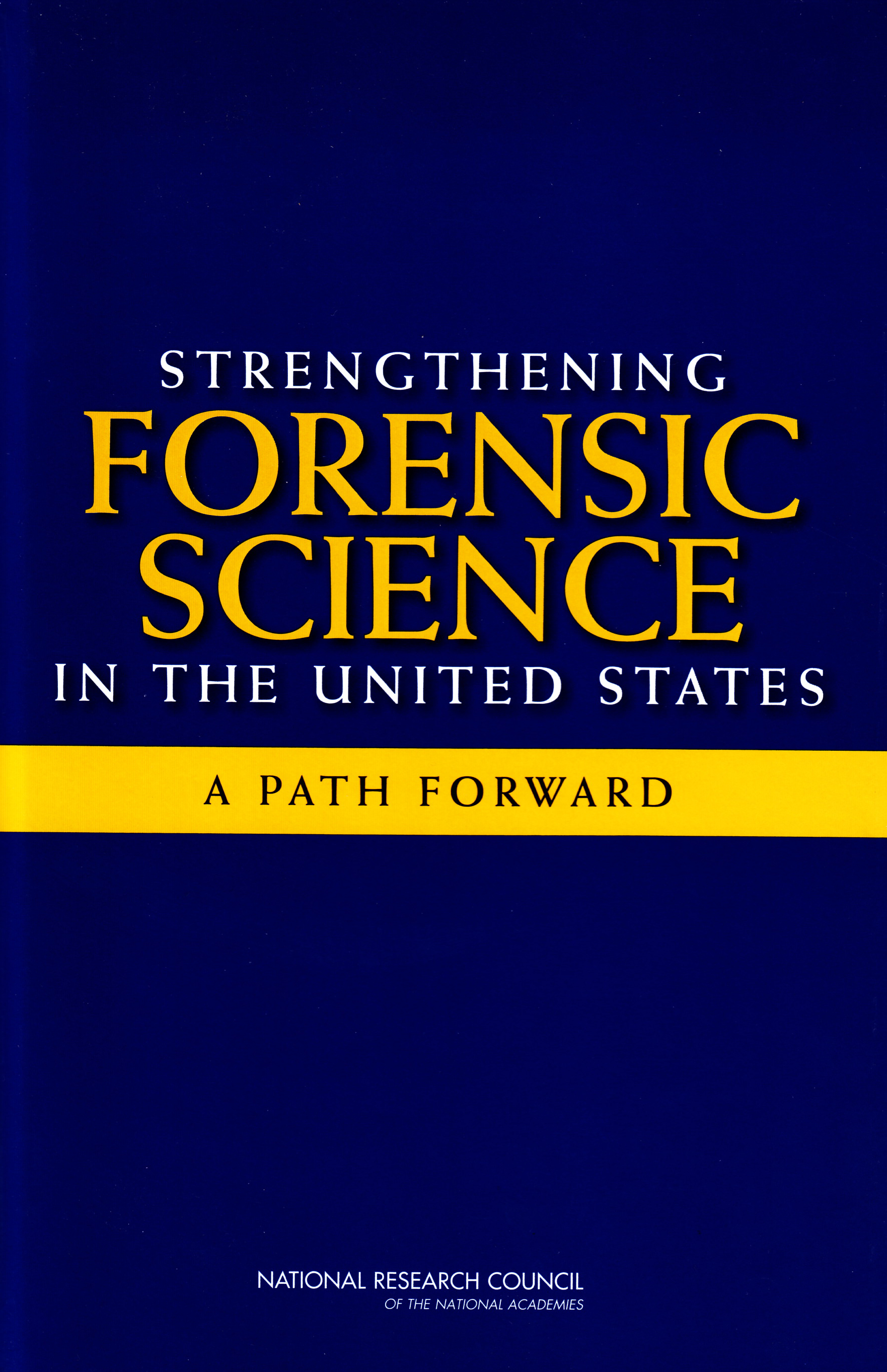
NASIt’s been four years since the National Academy of Sciences published its landmark study of forensics in the US —  Strengthening Forensic Science in the United States – A Path Forward (commonly known as ‘the NAS report’).  The report was nothing short of a “bombshell,” detailing the substantial scientific deficiencies of essentially all forensic disciplines, with the exception of DNA.  A report by the National Registry of Exonerations, covering 873 wrongful convictions from 1989 to 2012, shows that “false or misleading forensics” was a contributing cause in 24% of those cases.  The NAS report has been previously covered on this blog here and here.

The NAS report was met with “stonewall” and dismissive resistance by the extant forensic community, as well as the National Association of District Attorneys.  This is not surprising, since the members of these groups have much personally invested in the existing (but scientifically invalid) methods of forensics – not the least of which is careers.  The inertia to be overcome in “fixing” forensics is monumental, and for this reason, many of us in the innocence world (this editor included) feared that the NAS report would languish on the bookshelves of the legislators.

I am happy to report, however, that a significant first-step action is now underway at the federal level.  The Justice Department has announced that, in cooperation with the National Institute of Standards and Technology (NIST), it is forming the National Commission on Forensic Science.  The commission will have responsibility for developing guidance concerning the intersections between forensic science and the courtroom and developing policy recommendations, including uniform codes for professional responsibility and requirements for training and certification.

Now, before jubilation sets in, note that the commission’s responsibilities are described as “guidance” and “recommendations.”  The commission has not been endowed with the powers of oversight, enforcement, or establishing standards.  So, clearly, this is just a first step in the journey toward “fixing” forensics.  But as the old proverb says, “A journey of a thousand miles begins with but a single step.”  Nothing is going to happen quickly, but it is a start, and we’ll take it.

Continue reading

Thursday’s Quick Clicks…

click
  • Scotland may get rid of 300 year old corroboration rule, which requires multiple pieces of corroborating evidence before a conviction can be obtained.  It was implemented to avoid wrongful convictions
  • A review of Michael Naughton’s The Innocent and the Criminal Justice System
  • A Texas fire review panel flagged two quarter-century-old arson cases on Wednesday, saying investigators were mistaken in finding that the defendants set intentional fires.
  • Exoneree Brian Banks:  the best revenge is success

Tuesday’s Quick Clicks…

click