Category Archives: Prosecutorial conduct (good and bad)

The Untouchables: America’s misbehaving prosecutors, and the system that protects them

Radley Balko, a longtime critic of the American justice system, has just posted a lengthy article on prosecutorial misconduct here.

Judge fires 34-year court veteran for helping man wrongfully convicted of rape

From deseretnews.com:

KANSAS CITY, Mo. — A Kansas City man freed from prison three decades after being wrongfully convicted of rape considers Sharon Snyder his “angel” for giving him a public document that showed him how to properly seek DNA tests. A Jackson County Circuit judge considers the 34-year court employee an insubordinate for offering legal advice and being too chatty about courthouse matters.

Sharon Snyder, a 70-year-old great-grandmother who was fired nine months before she was scheduled to retire, sees herself somewhere in the middle and insists she would provide the same help if she had a chance to do it again.

Robert Nelson, 49, was convicted in 1984 of a Kansas City rape that he insisted he didn’t commit and sentenced to 50 years for forcible rape, five years for forcible sodomy and 15 years for first-degree robbery. The judge ordered the sentence to start after he finished serving time for robbery convictions in two unrelated cases prior to the rape conviction.

Those sentences ended in 2006.

In August 2009, Nelson filed a motion seeking DNA testing that had not been available at his trial 25 years earlier, but Jackson County Circuit Judge David Byrn denied the request. Two years later Nelson asked the judge to reconsider, but again Byrn rejected the motion because it fell short of what was required under the statute Nelson had cited.

After the second motion failed in late October 2011, Snyder gave Nelson’s sister, Sea Dunnell, a copy of a motion filed in a different case in which the judge sustained a DNA request.

Nelson used that motion — a public document Dunnell could have gotten if she had known its significance and where to find it — as a guide for a motion he filed Feb. 22, 2012, again seeking DNA testing. That August, Byrn sustained the motion, found Nelson to be indigent and appointed Laura O’Sullivan, legal director of the Midwest Innocence Project, to represent him.

The Kansas City Police Department’s crime lab concluded last month that DNA tests excluded Nelson as the source of evidence recovered from the 1983 rape scene and he was freed June 12.

“She gave me a lot of hope,” Nelson said of Snyder. “She and my sister gave me strength to go on and keep trying. I call her my angel. She says she’s not, but she truly is.”

Five days after Nelson was released, Court Administrator Jeffrey Eisenbeis took Snyder into Byrn’s office near closing time and told her the prosecutor and defense attorney “had a problem” with her involvement in the case. She was suspended without pay, ordered to stay out of the courthouse unless she had permission to be there and scheduled to meet with a human resources investigator June 20.

“At first I didn’t know if my pension was going to be intact, and all I could do was curl up in a fetal position and cry,” said Snyder, who had been planning to retire in March. She later found out her pension would be just fine.

Byrn fired her June 27, telling her she had violated several court rules by providing assistance to Nelson and talking about aspects of the case, even while under seal, to attorneys not involved in the matter.

The judge’s dismissal letter cites numerous recorded phone conversations between Dunnell and Nelson in which they discussed Snyder’s efforts, including the document she provided that Nelson used in his successful DNA motion.

“The document you chose was, in effect, your recommendation for a Motion for DNA testing that would likely be successful in this Division,” Byrn wrote. “But it was clearly improper and a violation of Canon Seven … which warns against the risk of offering an opinion or suggested course of action.”

Court spokeswoman Valerie Hartman said Byrn and other court officials wouldn’t comment on the story for a number of legal and ethical reasons, in addition to it being a personnel matter. Nelson’s attorney, O’Sullivan, also declined to comment.

“I lent an ear to his sister, and maybe I did wrong,” Snyder said. “But if it was my brother, I would go to every resource I could possibly find.

“I think I might have been the answer to his prayers.”

Scientists Applaud FBI’s Decision To Review Reliability Of Forensic Hair Analysis

From Mintpressnews.com:

The FBI announced last week it would reexamine thousands of once-closed cases in which a person was convicted — and in some cases put to death —  based on hair samples. Known as microscopic hair comparison analysis, this type of testing was often used to link a criminal defendant to a crime, but its reliability has now been called into question.

The FBI said that in more than 2,000 cases from 1985 to 2000, analysts may have exaggerated the significance of hair analyses or reported them inaccurately. All defendants affected by the inaccurate analyses will be notified and offered free DNA testing if errors in are found in the FBI’s lab work or testimony.

According to a report from The Washington Post, more than 120 convictions have been flagged as suspicious in the FBI’s review thus far. Of those cases, 27 defendants received the death penalty as their punishment.

In addition to reviewing individual cases, the FBI is also using the review process to improve lab training, testimony, audit systems and research.

“There is no reason to believe the FBI Laboratory employed ‘flawed’ forensic techniques,” Special Agent Ann Todd, a spokeswoman for the FBI, said. “The purpose of the review is to determine if FBI Laboratory examiner testimony and reports properly reflect the bounds of the underlying science.”

The review includes every case between 1985 and 2000 in which the FBI found a positive association between hair taken from defendants and hair found at a crime scene.

Those who pushed for the review included the national nonprofit Innocence Project, the National Association for Criminal Defense Lawyers and its partners, which included pro bono attorneys.

Since DNA testing can cost several thousand dollars, hair analysis is often used to link a defendant to a crime scene. However, the practice was deemed “highly unreliable” in 2009 by a National Academy of Sciences report that concluded hair sample analyses cannot be linked to one person, but only categories of people.

Despite the poor reliability, Todd says microscopic hair analysis is “a valid forensic technique and one that is still conducted at the lab” along with DNA testing.

Peter Neufeld, co-director of the Innocence Project, applauded the FBI’s admission that there may be an issue with the validity of some of the findings in the cases.

“The government’s willingness to admit error and accept its duty to correct those errors in an extraordinarily large number of cases is truly unprecedented,” he said in a press release.

The review “signals a new era in this country that values science and recognizes that truth and justice should triumph over procedural obstacles,” Neufeld said. “Unfortunately hair analysis is only one of many flawed forensic practices that are still used that pose the threat of infecting criminal trials across the nation.”

“It is possible to conduct hair microscopy and find similarities among various samples. But it appears that in many cases the FBI analysts were overstating the significance of these similarities, often leaving juries with the false impression that a hair recovered from the crime scene must have come from the defendant and could not have come from anyone else,” he added. “The government is now acknowledging that this was wrong and that the science does not support such conclusions,”

Until all of the cases can be analyzed and verified for accuracy, officials from the Justice Department have waived the deadlines and procedural hurdles for those inmates who are currently on death row.

Steven D. Benjamin, a Virginia attorney and the president of the National Association for Criminal Defense Lawyers, said the Justice Department’s decision to delay the execution of those defendants whose innocence is once again up for debate is a critical step in “giving wrongly convicted people a fair chance at a fair review.”

“We hope that the actions taken by the FBI and DOJ will serve as a model for state law enforcement and crime laboratories throughout the country to respect ethical obligations to reverse wrongful convictions when learning about improper evidence,” said Norman Reimer, executive director of the association.

Though groups like the Innocence Project don’t often find themselves endorsing the FBI’s efforts, the organization’s leaders have all publicly applauded the FBI for the review. They say it is an important first step in “bringing together the law enforcement and defense communities in pursuit of the shared objective of ensuring that only the guilty are convicted and that only scientifically valid forensic science is used in our criminal justice system.”

Wednesday’s Quick Clicks…

click
  • Exoneree Brian Banks launches blog on Atlanta Falcons training camp
  • DOJ waives procedural bars in FBI hair analysis case reviews with Innocence Project
  • The Oklahoma Innocence Project is working to overturn the conviction of a man imprisoned for the 1984 kidnapping and murder of convenience store clerk in Ada.  The Innocence Project at Oklahoma City University’s School of Law announced Wednesday its plan to file an application for post-conviction relief in the case of 48-year-old Karl Fontenot, one of two men initially sentenced to die for the 1984 killing of Donna Haraway. It is the first case the project has sought to overturn since it was created in 2011.  After two separate trials, Fontenot is currently serving life without parole.
  • Forensics on trial

Tuesday’s Quick Clicks…

click
  • Wisconsin exoneree Joseph Frey sadly now homeless
  • Taxpayers will pay nearly $500,000 for legal fees in the Michael Morton case
  • The Innocence Project (Cardozo), the National Association for Criminal Defense Lawyers (NACDL) and its partners announced a groundbreaking and historic agreement with the FBI and the Department of Justice (DOJ) to review more than 2,000 criminal cases in which the FBI conducted microscopic hair analysis of crime scene evidence.
  • Andrew Johnson exonerated by DNA in Wyoming

New Scholarship Spotlight: Gideon’s Amici: Why Do Prosecutors So Rarely Defend the Rights of the Accused?

Fordham law professor Bruce Green has posted the above-titled article on SSRN.  Download article here.  The abstract states:

In Gideon v. Wainwright, twenty-three state attorneys general, led by Walter F. Mondale and Edward McCormack, joined an amicus brief on the side of the criminal accused, urging the Supreme Court to recognize indigent defendants’ Sixth Amendment right to appointed counsel in felony cases. This was a unique occurrence. Although amicus filings by public entities have increased significantly since then, including in criminal cases, government lawyers rarely submit amicus briefs in the Supreme Court supporting criminal defendants’ procedural rights, and never en masse as in Gideon. The states’ public support for Gideon’s position points up the special nature of the right to a defense lawyer — a right that is fundamental to a fair trial and to avoiding wrongfulconvictions and which most states had already recognized as a matter of state law by the time Gideon was argued. Although Gideon was special, there have been recent Supreme Court criminal cases in which progressive government lawyers might similarly have supported recognition of the procedural right in issue. This Essay identifies philosophical, practical, and political reasons that might explain government lawyers’ unwillingness to take the defense side on questions before the Court, but argues that these rationales are not entirely convincing. The Essay concludes that, consistent with their duty to seek justice, government lawyers should play a stronger role in promoting criminal procedural fairness by occasionally serving as Supreme Court amici on the defense side.

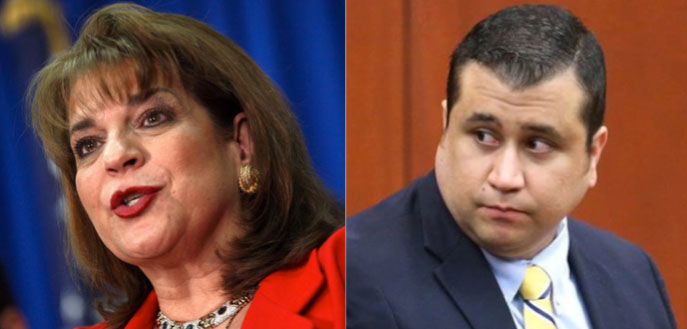
What About the Prosecutor in the Zimmerman Case?

corey-zimm

As expected, the verdict in the Zimmerman case has created a furor.  My belief is that this is largely (as we have lamented several times before on this blog) because the case was openly tried in the media.  EVERYBODY had an opinion that was primarily a consequence of their own prejudices.  Unfortunately, all the public hears from the media is sound bites filled with spin.  The public doesn’t get to read all the reports, analyze all the evidence, and hear all the testimony.  I’ll make no judgement about whether the verdict was ‘right’ or ‘wrong,’ but I will point out that this case has been a horrible example of how the justice system is supposed to work – particularly on the part of the prosecution.

Just as with the Casey Anthony case, the prosecution got greedy.  Spurred by career and political ambition, they “over charged” with second degree murder; a charge that the court allowed to be entered as the result of a false affidavit being filed by the prosecutor.  And just as with the Anthony case, the jury didn’t agree.  A manslaughter charge “could”  have been achievable.

Here is a fascinating interview with Harvard law professor Alan Dershowitz about the conduct of the prosecutor in the case, Angela Corey.  He even goes so far as to say that Angela Corey should be disbarred.  See it here.

Prosecutors in Zimmerman Trial Circle Their Wagons and Send a Message……

From source:

State Attorney Angela Corey fired her office’s information technology director Friday after he testified last month about being concerned prosecutors did not turn over information to George Zimmerman’s defense team in the shooting death of Trayvon Martin.

On the same day attorneys finished their closing arguments in that nationally watched trial, a state attorney investigator went to Ben Kruidbos’ home about 7:30 a.m. to hand-deliver a letter stating Kruidbos “can never again be trusted to step foot in this office.”

The letter contended Kruibos did a poor job overseeing the information technology department, violated public records law for retaining documents, and noted he was questioned in March when the office was trying to determine who had leaked personnel information obtained through a computer breach.

In an interview Friday, Kruidbos denied the allegations in the letter, which was written by Cheryl Peek, the managing director of the State Attorney’s Office.

He said he had acted in good faith about “genuine concerns.” He said he had been proud to work at the State Attorney’s Office and feared the letter would cripple his chances at finding another job to support his family, including a 4-month-old son.

“I don’t have any regrets,” he said, “but I am terrified about the future and what that will end up being.”

His attorney Wesley White — who resigned from the State Attorney’s Office in December and is a critic of Corey — said the firing was aimed at sending a message to office employees “that if they feel like there is wrongdoing,” they should not disclose it or seek legal guidance from a private attorney.

“If they do speak to an attorney, then they are dead,” he said. “The State Attorney’s Office will do whatever is necessary to not only terminate them, but destroy their reputations in the process.”

Jackelyn Barnard, spokeswoman for Corey and the State Attorney’s Office, did not return phone calls or emails for comment.

Kruidbos, 42, had been on paid administrative leave since May 28 from his $80,892 job.

In January, he used computer software technology to extract photographs and text messages from the source file in Martin’s cellphone. Kruidbos was able to recover more information than the Florida Department of Law Enforcement obtained previously.

GETTING LEGAL ADVICE

Kruidbos said he became concerned that lead prosecutor Bernie de la Rionda might not have turned over Kruidbos’ report to defense attorneys. Kruidbos asked White in April for legal advice and described some contents of his report such as a photo of an African-American hand holding a gun, a photo of a plant resembling marijuana and a text message referring to a gun transaction.

White then contacted one of Zimmerman’s attorneys and learned the defense had not received the report generated by Kruidbos. The defense did receive the source file from the cellphone and used its own experts to extract data.

Last month, Zimmerman’s attorneys subpoenaed both White and Kruidbos during a pretrial hearing on their motion seeking sanctions against prosecutors. Circuit Judge Debra Nelson deferred a ruling until after the trial.

Before Kruidbos’ name surfaced in the Martin trial proceedings, he received a pay raise for “meritorious performance,” according to a document dated May 16 in his personnel file.

But the dismissal letter written by Peek contends he did his job poorly as information technology director and said he should have asked someone in the office about his concerns regarding the Martin case.

“Your egregious lack of regard for the sensitive nature of the information handled by this office is completely abhorrent,” Peek wrote. “You have proven to be completely untrustworthy. Because of your deliberate, wilful and unscrupulous actions, you can never again be trusted to step foot in this office.”

The letter said Kruidbos “apparently questioned the ethics” of de la Rionda, who has been an assistant state attorney since 1983. “His record as an honorable and respected attorney is unblemished and beyond reproach,” Peek wrote.

Kruidbos said the question of de la Rionda’s ethics “is not really my place to decide.”

He said he asked White for legal advice because he was concerned he could face “legal exposure” if the cellphone report wasn’t turned over to the defense before the trial started.

He said he did not feel comfortable posing that question to anyone within the office because the State Attorney’s Office had just conducted an in-house probe of whether someone was leaking personnel information.

OFFICE ‘PARANOIA’

“It felt like everyone was on heightened sensitivity,” Kruidbos said. “It felt like the paranoia in the office had gotten worse.”

In March, the office investigated a security breach involving someone hacking computers to obtain disciplinary matters and personal health information about employees, according to Peek’s letter. That investigation followed news reports in February that Corey approved using about $342,000 in taxpayer dollars to upgrade pensions for herself and de la Rionda. Kruidbos said the investigation might have stemmed from the stories about the pensions.

Kruidbos said office administrators told him that he and Richard Komando, who was executive director of the office, were suspected of improperly obtaining the information. Komando resigned April 4. Kruidbos said he does not believe Komando was involved because “it makes no sense. He worked very hard to get to where he was. He had nothing to gain from that.”

Kruidbos had his job duties changed on April 3, removing eight employees from his supervision and curtailing his access to the computer system. But the investigation did not find he was involved in the computer breach or leaking any information. He has denied any involvement and testified last month to that effect.

As for why he did not approach Corey about his concerns in the Martin case, Kruidbos said Corey has a close relationship with de la Rionda and “any attempt by me to go to them and say I think something wrong has happened would not have been taken seriously, and then ultimately held against me.”

“I consulted an attorney, which is my right,” he said. “I had concerns about what I had seen at work, and this was just how it ended up playing out.”

Corey and others learned Kruidbos had hired White as his attorney when White, subpoenaed by the defense, identified Kruidbos by name at a May 28 hearing. Corey put Kruidbos on paid leave that same day.

Peek’s letter contends that on May 24, Kruidbos wiped clean the information on a computer assigned to him, thereby violating public records law. Kruidbos said he does not know what computer is referred to by the letter.

He said the computer network stores information on a number of backup systems in addition to personal computers.

White has a contentious relationship with Corey, but Kruidbos said that wasn’t a factor in him hiring White, whom he described as a “good lawyer who does the right thing.”

White said he and Kruidbos are reviewing their legal options in response to the dismissal.

White said he wants an outside review by a state attorney from another circuit.


California Innocence Project Wins Exoneration in Sexual Assault Case

An emotional Uriah Courtney, 33, became the eleventh person to be exonerated through the efforts of the California Innocence Project (CIP), with assistance from students at the California Western School of Law, yesterday. Courtney had served eight years of a life sentence in prison for a 2004 rape and kidnapping of a sixteen-year old girl in Lemon Grove, California.

The exoneration was possible because evidence from the crime was retained and could be retested with more advanced DNA technology. The results not only eliminated Courtney but linked to another man, who closely resembled Courtney, and lived within three miles of the crime. Continue reading

Parolee Charges Authorities for Forcing False Confessions — Sayama Case

From the Japan Times:

Parolee in 1963 Saitama girl’s slaying hits authorities for lying, forcing confessions

by Tomohiro Osaki

Staff Writer, Jun 14, 2013

Investigators will lie, grill for hours on end and withhold exonerating evidence — in effect do anything — to extract a confession from a suspect they have pegged for a crime, a 1994 parolee seeking a retrial to clear his name in the 1963 kidnap-murder of a Saitama Prefecture girl said Thursday in Tokyo.

Speaking at the Foreign Correspondents’ Club of Japan, Kazuo Ishikawa, who appeared with his lawyer, Taketoshi Nakayama, pointed to discrepancies in the kanji used in an apparent ransom demand for ¥200,000 and an earlier document he wrote and also alleged that the state looked to him as a usual suspect because of his roots in Japan’s former outcast class known as the “burakumin.” He continues to claim he is innocent.

Ishikawa was arrested in 1963 for the kidnap-slaying of Yoshie Nakata in the town of Sayama. An autopsy carried out on her corpse at the time concluded she had been raped and strangled.

In a notorious case that would become known as the “Sayama Incident,” Ishikawa was initially sentenced to hang. Continue reading

Thursday’s Quick Clicks…

click

Cleveland prosecutor fired after posing as an accused killer’s girlfriend on Facebook to try to get alibi witnesses to change their testimony

Aaron Brockler

Aaron Brockler


[Editor’s note:  I have no idea whether the alibi witnesses were telling the truth or not, but notice the rationale offered by the fired prosecutor–“I had to break the alibis, otherwise a guilty man could be walking the streets.”  This is his thought before he even spoke to the alibi witnesses on Facebook.  No thought by him whatsoever to the fact that the alibi witnesses might be telling the truth (even if a 1% chance), and he might want to approach them in a fair and neutral way to get an honest reaction from them.  Instead, he made up a lie that made them “go crazy” before he started trying to get them to give up their alibi testimony.]

From Cleveland.com:  A Cuyahoga County prosecutor was fired this week after he admitted posing as a woman in a Facebook chat with an accused killer’s alibi witnesses in an attempt to persuade them to change their testimony.

Former Assistant County Prosecutor Aaron Brockler insisted in an interview at his Lakewood home Thursday that he had done nothing wrong and shouldn’t have been fired.

“Law enforcement, including prosecutors, have long engaged in the practice of using a ruse to obtain the truth,” said Brockler, 35, a county prosecutor since 2006. “I think the public is better off for what I did.”

County Prosecutor Timothy J. McGinty said he fired Brockler for good cause.

“This office does not condone and will not tolerate such unethical behavior,” McGinty said. “He disgraced this office and everyone who works here.”

McGinty continued: “By creating false evidence, lying to witnesses as well as another prosecutor, Aaron Brockler has damaged the prosecution’s chances in a murder case where a totally innocent man was killed at his work.”

Brockler was the lead prosecutor in the aggravated murder case of Damon Dunn, 29, of Cleveland, who was scheduled to stand trial for the shooting death of Kenneth “Blue” Adams on May 18, 2012, at an East Side car wash.

When the opposing attorneys exchanged witness lists in April in preparation for trial, Dunn provided the names of two women whom he said could testify that at the time of the shooting, Dunn actually was on the other side of the city at Edgewater Park.

Brockler said he considered the alibi witnesses the keys to the case, and talked with the lead homicide detective about strategies.

“I didn’t share my technique with him, but we talked about the importance of breaking the alibis,” Brockler said. “Unless I could break this guy’s alibi a murderer might be walking on the street. There was such a small window of opportunity, I had to act fast.”

Brockler said he engaged in Internet chats via Facebook with the alibi witnesses. He said he posed as a fictitious former girlfriend of Dunn’s who had given birth to Dunn’s child, which Brockler said caused the women “to go crazy”.

Brockler spoke with both of the women the following day, but did not divulge that he had been their Facebook chat partner.

He claims one woman told him, “This is bogus, I’m not going to lie for him.”

He also claims the other woman also changed her story, according to Brockler. “She said she wasn’t at the beach with him and she wasn’t going to lie for him. They both wanted the truth to be known,” Brockler said. The women couldn’t be reached for comment. Both are still listed as alibi witnesses by Dunn’s lawyers.

Brockler said he told Dunn’s defense lawyer, Myron Watson, that his client’s alibi had fallen apart.

He printed transcripts of the Facebook chats and put them in his file, with no intention of keeping them secret, he said.

Then, several days later he left the office for a two-month medical leave to have eye surgery.

While Brockler was away, he received a call from Assistant County Prosecutor Kevin Filiatraut, who had replaced Brockler on the Dunn case during his absence and questioned him about the Facebook chat transcripts that he found in the file.

“I told him that was me,” said Brockler.

Filiatraut informed his supervisors. McGinty said he acted immediately.

“As soon as we learned of Aaron Brockler’s actions we removed this office from Continue reading

Friday’s Quick Clicks…

click

Thursday’s Quick Clicks…

click

Wisconsin Innocence Project’s Work Prompts Judge to Overturn Rape Conviction

Winnebago County (Wisconsin), Circuit Court Judge Daniel Bissett has overturned the 1994 rape conviction of Joseph Frey, who has been serving a 102-year sentence for the crime, which involved the rape at gunpoint of a University of Wisconsin student in her apartment. According to a Wisconsin State Journal report (here), the judge said Frey’s “conviction must be vacated ‘in the interest of justice.’” Frey remains in jail as prosecutors decide whether or not to retry him. Continue reading

Prosecutorial Misconduct – What’s to be Done? A Call to Action

pros-scale

                                                        (Graphic:  The Veritas Initiative,  link)

Let me begin this post with an apology to all the prosecutors out there who are personally committed to upholding the highest standards of ethics and the law.  That being said, you know what they say about “a few bad apples.”

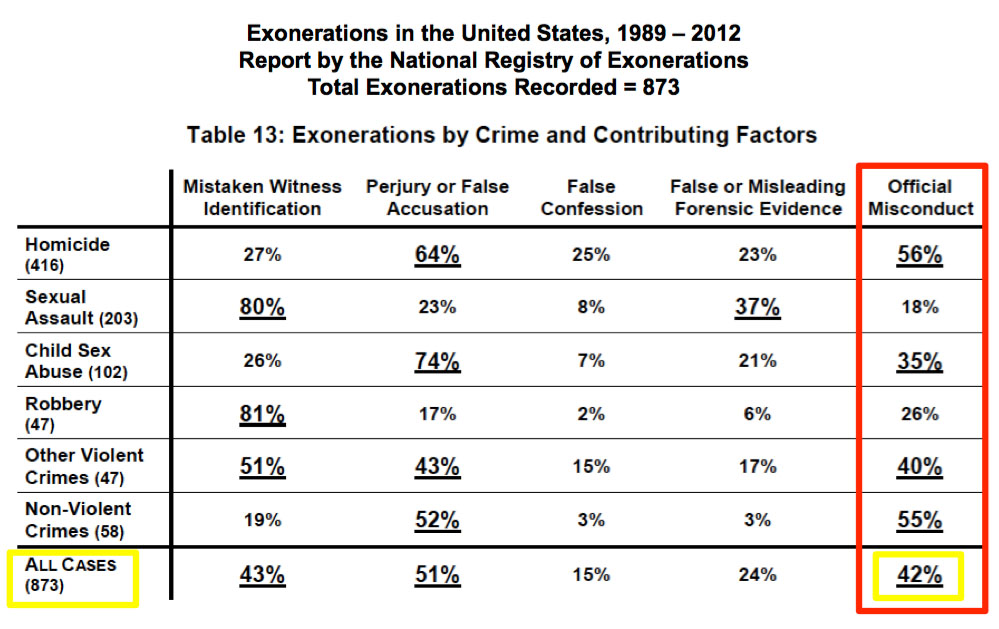
Prosecutorial misconduct.  Well folks, this one is a hot button of mine.  Ask the average citizen, and they are totally unaware that such a thing ever happens.  After all, prosecutors are honorable people who are committed to ethics, justice, upholding the law, and to helping protect the public by ensuring that the  “bad guys” are sternly dealt with, and if necessary, isolated from society, or even put to death.  At least this is what they tell us in their campaign speeches when they’re running for election or re-election.  But prosecutorial misconduct and misdeeds happen, and they happen more frequently than any normal citizen would imagine.  Let’s look at some data.  The National Registry of Exonerations has compiled detailed data for 873 exonerations (wrongful convictions) for the period 1989-2012.  You can see the full report here – exonerations_us_1989_2012_full_report.  Here is Table 13 from that report showing frequency of causes contributing to wrongful convictions:

Exoneration Table

The red box highlights the cause of “official misconduct.” (Note that the percentages for each type of case total to more than 100%.  This is because any wrongful conviction can have more than one contributing cause.)  The average for all 873 cases in which “official misconduct” was a contributing factor is 42%.  This figure includes both police misconduct and prosecutorial misconduct, and the table does not separate the data for the two.  However, if we assume a 50/50 split, this yields an occurrence of prosecutorial misconduct in 21% of wrongful convictions.  And keep in mind, this data set includes only data for known wrongful convictions.  Who knows how many more times this happens, and it doesn’t “get caught?”  I think we can safely say that prosecutorial misconduct is not an “ignoreably rare” phenomenon.

Continue reading

Open-discovery rules won’t necessarily stop prosecutors from cheating

Sunday’s New York Times hits the nail on the head in an editorial here in which it laments that violations of the U.S. Supreme Court’s 50-year-old Brady rule, which requires prosecutors to disclose exculpatory evidence to the defense, remain ”widespread.” The Times might be overly optimistic, however, in its belief that open-files reforms like those adopted in North Carolina and Ohio that require full disclosure of law enforcement’s investigative files in a case will necessarily solve the problem.
 
Such rules will work only if prosecutors and law enforcement agencies follow them, and that’s far from guaranteed. In an Ohio case I am currently investigating, for example, information about the identification of an uncharged suspect was disclosed only after we learned from a witness that she had picked the man out of a photo lineup. The identity of a second suspect, which a co-defendant says she gave to both a detective and the prosecutor before she pleaded guilty, has still not been disclosed, nor has a summary of her statement that the only other person charged in the crime was not involved.
 
Defense attorneys and investigators should remain skeptical that prosecutors will always follow open-discovery rules any more than they always follow the Brady rule.
 
They should also be aware that another reform — the use of blindly administered sequential photo lineups — can still lead to misidentifications in the era of social media. In this same case, a witness admitted that she and others looked up the defendant’s photo on Facebook once they learned his name, which made picking out his photo later fairly easy. She now admits she was wrong.

Wednesday’s Quick Clicks…

click
  • David Onek named Executive Director of Northern California Innocence Project
  • In Washington state, a new law grants the wrongfully convicted $50,000 for each year spent behind bars, but an apology is harder to come by
  • In Canada, a man who spent decades behind bars on a wrongful murder conviction has lost his bid to sue the police involved.  In a recent decision, the Ontario Superior Court of Justice dismissed a $14-million lawsuit for damages filed by Romeo Phillion.  The defendants included two Ottawa police officers and Ontario’s attorney general.  In his suit, Phillion alleged “malicious, reckless and negligent conduct” led to conviction for the 1967 murder of an Ottawa firefighter.
  • A new advocacy group is launching a national advertising campaign calling for prosecutor accountability and the importance of conviction integrity.  The nonprofit group, Blind Justice, says it wants to “ensure that elected officials don’t turn a blind eye to prosecutors who trample on the rights of the accused to get a conviction.”  The television ads will feature an alleged wrongful conviction case involving local district attorneys and will begin airing Wednesday on television networks in Manhattan, Brooklyn and Houston, Texas.

With Only Hours to Go, MIssissippi Stays Execution of Man Who Has Been Denied DNA Testing..

Source:

Hours before his scheduled execution at 6 p.m. today, the Mississippi Supreme Court hasissued a stay to Willie Jerome Manning, whose death sentence was upheld in a 5-4 court ruling last week even though the state refused to test available DNA evidence, and the FBIdeemed major pieces of evidence in the case “unscientific” and “invalid.” As a consequence, Manning will not be executed tonight and will have more time to continue arguing his case.

Late Tuesday afternoon, an 8-1 majority granted Manning’s last-ditch motion, which included new letters from the Department of Justicedescribing how crucial hair samples were improperly tested, and testimony improperly linked bullets near Manning’s home to bullets at the crime scene. Manning was convicted in the 1992 abduction and murder in part based on testimony that the hair samples were likely his because both he and the hair strands were African American. The trial also featured testimony from a jailhouse informant, which studies have shown is particularly unreliable.


Tuesday’s Quick Clicks…

click
  • Statute of limitations issues may haunt prosecution of former prosecutor now judge Ken Anderson, charged with criminal offenses for his conduct leading to the wrongful conviction of Michael Morton.
  • After 24 years in prison, Wyoming man gets retrial, taste of freedom, and a cookie
  • Georgia needs a method to compensate the wrongfully convicted.
  • Yesterday, the Texas House voted on HB 166, a bill that would create the Timothy Cole Exoneration Review Commission.  This so-called innocence commission would investigate past exoneration cases to find out why the wrongful conviction happened in the first place. The group would not intervene in pending cases or open cases without an exoneration.

  • A Vancouver man suing for compensation for 27 years in prison for sex assaults he didn’t commit has won a preliminary round in court against the provincial government.  The government opposed Ivan Henry’s application in B.C. Supreme Court to change his legal claim that would spell out the circumstances where the province can be held liable for breaching his rights under the Charter of Rights and Freedoms.  The government claimed the rule of prosecutorial immunity only allows claims for charter breaches to succeed if they arose from malicious conduct by the prosecutor.  But Justice Richard Goepel ruled in Henry’s favour, finding “that a claim lies against the province for charter damages if the plaintiff can establish that Crown counsel acted in a marked and unacceptable departure from the reasonable standards expected of Crown counsel.”

  • Nice profile of Donna McKneelen of the Innocence Project at Cooley