
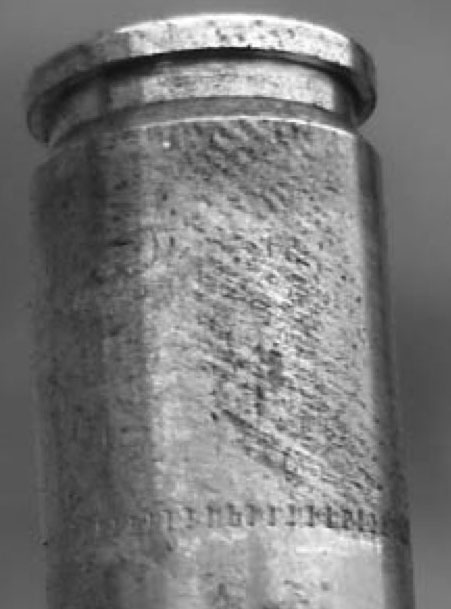
 Ask any latent print examiner about imaging fingerprints from expended shell casings, and they will tell you it’s most likely futile. Any latent prints that have been deposited on cartridges before, or during, loading into the firearm are “erased” by the firing temperatures experienced by the shell casing. Studies with thermal imaging cameras have shown that the exterior of a brass 9mm cartridge casing will reach approximately 145° F. This is apparently enough to break down or vaporize the skin oils of which a fingerprint is comprised.
However, a new technology has recently become available. It relies on the fact that the acidity level in the skin fluids of a latent print is enough to “micro-etch” the surface of the brass shell casing; leaving the brass surface with a very slightly etched image of the latent print.
Dr. John W. Bond, head of the Forensic Science Unit of the Northamptonshire, UK Police and Senior Lecturer in Forensic Sciences at the University of Leicester, developed a method for imaging these micro-etched prints by bringing the shell casing to a high voltage static charge and cascading tiny graphite spheres over the casing while it is rotated.
Here is a journal article by Dr. Bond describing the process:
The patent and commercial rights to the process and equipment design were acquired by a UK company called Consolite. They have productized the design, and have made an initial product offering which includes software for imaging the result. Consolite has named the process ‘CERA’, Cartridge Electrostatic Recovery Analysis.
The machine looks like this:
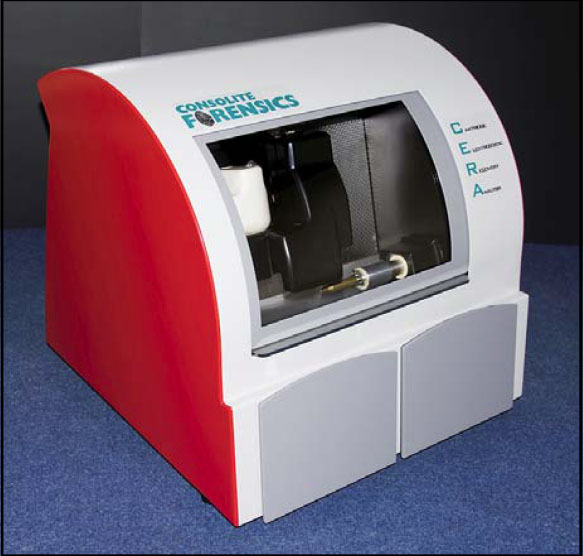
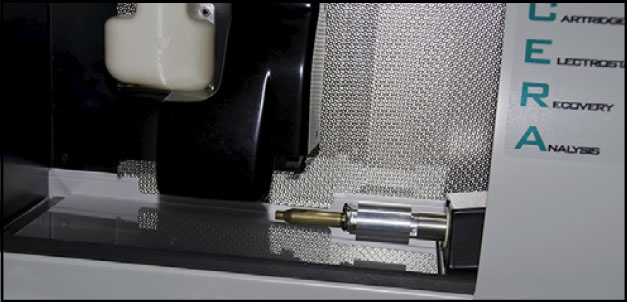
Here is a descriptive bulletin published by Consolite:
Consolite currently has machines under evaluation by the US ATF and the UK NaBIS (National Ballistics Intelligence Service).
A Few Comments from the Editor:
1) Because of the size and shape of cartridges, any latent prints on them will be, almost by definition, partials. As with any latent print process, the result can only be as good as the originally deposited latent print.
2) If you are also going to be analyzing the shell casings for DNA, you MUST do this before latent print processing; otherwise, you will compromise the DNA extraction process.
3) Please refer to my earlier post “Let’s Talk About Fingerprints” stating that fingerprints are not infallible, and identification mistakes can be made – particularly with partials.











 Wrongful Convictions Blog
Wow, that seems like a lot of work. A better way and much easier way which I have discovered is placing the shell casing into the freezer for 30 minutes. This reapplies moister to the print. Then fum the shell immediately. Done. I have had great sucess and no need for fancy eletric machines.
How do I get the police to test a shell casing for fingerprints when they absolutely refuse?