
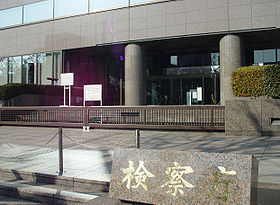
The Entrance of Public Prosecutors Office in Tokyo
One of the critical tasks for the Japanese prosecutors is to interrogate the suspects themselves. I posted here about how police interrogations are partially recorded in some cases today. So what about interrogation by prosecutors? Are they recorded?
The answer is yes and no. Yes, they are sometimes recorded but only a few cases are recorded entirely, and most cases are not recorded at all.
In May 2006, the Supreme Public Prosecutor’s Office announced that they will start recording some interrogations on an experimental basis. Only serious cases were chosen, and the final part of the interrogation – the scenes where the suspect has confessed and signs the dossier – was recorded. It was up to the prosecutors’ discretion which cases and which part of those cases should be recorded.
Then there was an unprecedented scandal in 2009, involving a public prosecutor by the Special Investigation Division in Osaka Public Prosecutors Office . A Special Investigation Division is a division in the Prosecutors Office which investigates and prosecutes the most high-profile white-collar crime cases. Public prosecutors who work there are supposed to be “elites” within Prosecutors Office. So when it became clear that public prosecutors in charge of a high profile case fabricated a data on a piece of evidence and coerced incriminating statements from witnesses in the case, no wonder it became a target of a public outrage.
Investigations followed, and the Ministry of Justice established an Advisory Panel, which, among other reforms, recommended the expansion of recording of interrogations by prosecutors in 2011. Read the recommendation by the Advisory Panel here (in Japanese). Measures were taken within the Public Prosecutors Office according to this recommendation from April 2011.
Recently, the Supreme Public Prosecutors Office (SPPO) revealed that in 67 cases out of 69 cases (97 percent) handled by Special Investigation Units since last year, interrogations were recorded. Of these cases, 28 cases (40%) had the entire interrogation recorded. Interrogations in two cases were not recorded at all because the suspects refused. Though the percentage seems relatively high, it is important to remember that these are only a small part of all the cases that the Prosecutors Office across the country deal with.
Public Prosecutors Office also expanded the partial recording in the most serious cases that are subject to a mixed-judge panel trial (with lay-judge participation) in August 2011. Since August, 277 cases / 5792 interrogations were recorded, and of those cases, interrogations in 208 cases were recorded entirely. There were 456 cases with no recordings. They also expanded the recordings in cases where the suspect has intellectual disabilities.
Read here the report by the Ministry of Justice on reforms of the Public Prosecutors Office issued on April 5th, 2012 (in Japanese).
Even though recording interrogations is not nearly enough to solve many problems in the Japanese criminal justice system, it can be an effective way to solve many issues in interrogation.
Read here (at page 27) an article which summarizes the problems surrounding interrogation by police officers and prosecutors in Japan, written by Professor Makoto Ibusuki in 2009 (in English).
前回、警察による取調べの録音録画に関する日本の状況を紹介した。今回のポストは、検察庁における取調べの録音録画に関するものである。
検察庁は、2006年から非常に限定的に取調べの録音録画を開始した。しかし、2009年の大阪地検特捜部による証拠改ざん事件及びそれを受けた「検察の在り方検討会議」の提言(2011年)を受けて、2011年4月より、録音録画の範囲が拡大された。その結果は、2012年4月5日に公表され、特捜部においては全事件の97%の取調べ録音録画が行われたこと等が明らかにされた。ただし、従来から主張されてきた取調べの全面的な可視化(全過程の録音・録画)はいまだ実現されていない。











 Wrongful Convictions Blog
What , if anything , happened to those who fabricated the data ?
KANA SASAKORA
So when it became clear that public prosecutors in charge of a high profile case fabricated a data on a piece of evidence and coerced incriminating statements from witnesses in the case, no wonder it became a target of a public outrage.
Thanks for your question! The prosecutor who fabricated the evidence (he altered the data on a floppy disk) was charged and sentenced to 18 months in prison in April 2011. His two bosses were both given a sentence of 18 months in prison (suspended for three years) on March 30th this year. You can read the news in English here. http://ajw.asahi.com/article/behind_news/social_affairs/AJ201203300020
Pingback: False Confessions as Major Cause of Wrongful Convictions in Japan | Wrongful Convictions Blog
Pingback: Audio and Visual Recording of Interrogations by Public Prosecutors, Part II | Wrongful Convictions Blog