Author Archives: Kana Sasakura

Washington Supreme Court Grants a New Trial to a Death Row Inmate

The Supreme Court of the State of Washington handed down this morning a decision to grant a new trial to a death row inmate, Darold Stenson.   Read: In re PRP of Darold Stenson.

Stenson raised a due process claim based on alleged violations of  Brady v. Maryland. The Court held that the State violated Stenson’s rights under the mandates of Brady and its progeny, and it reversed his aggravated first degree murder conviction as well as the sentence of death and remanded for a new trial. Read the news here.

Excerpt:  Stenson, convicted in the 1993 slayings of his wife and business partner, is due a new trial because prosecutors failed to share evidence with his attorneys prior to trial, the eight-justice majority ruled.

Stenson will not be released following Thursday’s decision, which was authored by Justice Gerry Alexander. He is expected to face a second trial in Clallam County.

“We are left with the fact that constitutionally significant mistakes were made in Stenson’s trial, resulting in imposition of the ultimate punishment without the full benefit of due process protections,” Alexander wrote in the majority opinion. “The question here is not whether Stenson has proved his innocence.” ….

Implicated by DNA, Exonerated by DNA – The Ashikaga Case

I once had a conversation with a retired judge in Japan. He said that although there seems to be a strong belief that the DNA testing is a new golden solution, he thinks we still need to be careful. He suggested that the fact that there was a “match” of DNA evidence found at the crime scene (or from the body of the victim etc.) alone should be used to exonerate someone, but not to implicate someone.

Yes, there is always a possibility that the state-of-the-art DNA testing result is faulty: there might have been a contamination of the materials or the testing might not have been conducted properly, and there have definitely been mistakes made in the past that were revealed later.

Indeed, there is a very well known case in Japan (Ashikaga Case)  where a man was implicated by faulty DNA evidence and later exonerated by more sophisticated DNA evidence.

In May of 1990, the body of a 4-year-old girl was found dead near the Watarase River in Ashikaga City. The clothing of the victim was found from the river. The clothing had the perpetrator’s semen on.

Many became suspects until in November 1990 the police began to suspect Toshikazu Sugaya, who was a school bus driver. Continue reading

A New Decision by the Washington Supreme Court Regarding the Admissibility of a Confession

Though a very disappointing one.

It will make the admission of confessions obtained during police interrogations easier.

At least the Dissent excellently points out the problematic issues surrounding confessions obtained at police interrogations…

Washington v. Abdulle (Filed May 3, 2012)

Summary by Justia:

The Supreme Court granted the State’s petition to review a decision of the Court of Appeals which reversed Respondent Yussuf Abdulle’s first degree theft and forgery convictions based on “Washington v. Davis” (438 P.2d 185 (1968)). Continue reading

Still a Long Way to Abolishing Death Penalty in Japan?

As Carole posted today, it has been 10 years since the signing of European Protocol 13, which abolished the death penalty. According to Amnesty International, more than two thirds of the countries in the whole world are either abolitionist or abolitionist in practice.

There is (I’d like to say) a trend in the United States towards abolition. So where is Japan at?

As I have posted here through Mark, Justice Minister Toshio Ogawa sent three people to gallows in March this year.

Just before he signed the order for the executions, he terminated Justice Ministry’s internal study panel on death penalty. In 2010, the then Justice Minister Keiko Chiba set up the panel to review whether to retain or abolish the death penalty and discuss about the conditions on death row. It aimed to get the debate going in the country, and was supported by Chiba’s successors.

However, Ogawa terminated the study panel and cancelled the plans to set up another discussion panel with experts on the matter. Continue reading

Exoneree Ted Bradford Speaks about False Confessions

Exoneree Ted Bradford from Washington State  spoke about his experience on false confessions last Friday at the Annual Conference for Washington Defender Association.

On September 29, 1995, a woman was raped in her home in Yakima, Washington.  Six months later, on April 1, 1996, Bradford was arrested on an unrelated charge.

The detectives interrogated Bradford for over eight hours and obtained his confession to the crime. Only the last 38 minutes of the interrogation was recorded, after Bradford had finally confessed to the crime he did not commit.

I don’t know why I confessed”, Bradford said, “I just wanted to be out of that situation. I wish I could take my confession back, but I can’t. Continue reading

A Dubious Arson Case – Higashi-Sumiyoshi Case (Part 2 of 2)

A Picture of the Experiment in 2011.

Continued from Part 1

Aoki and Boku’s appeals to the Supreme Court were rejected in 2006, but their supporters continued the fight to get a retrial for them.

Boku filed a petition for retrial to the Osaka District Court on July 7, 2009. Aoki also filed her petition one month later.

The Criminal Procedure Code of Japan states that one of the instances where a retrial should be granted is “When clear evidence has been newly discovered that in regard to a person pronounced guilty Continue reading

A Dubious Arson Case – Higashi-Sumiyoshi Case (Part 1 of 2)

ImageThe excellent documentary film “Incendiary” (read more about the film here) reminded me of an arson case in Japan, the so-called Higashi-Sumiyoshi Case. Its retrial petition is currently being reviewed by Osaka High Court.

In the late afternoon of July 22, 1995, an 11 year old girl was killed in her own house in Higashi-Sumiyoshi Ward, Osaka, when a fire broke out. She was taking a shower and could not escape from the fire. The house was built mainly with wood and the fire was said to have broken out from the car parked on the first floor in the garage of the house. Her mother (Keiko Aoki), Aoki’s common-law husband (Tatsuhiro Boku) and Aoki’s son were able to escape from the fire.

The initial investigation by the fire department concluded that the cause of the fire was unknown. However, since (1) Aoki and Boku had life insurance coverage on the girl, and (2) the house was locked from the inside, the police suspected that it was an arson case. Their theory was that Aoki and Boku conspired together to get the insurance money by killing the girl. Thus, they tried to get the evidence by interrogating the couple.

The police arrested Aoki and Boku on September 10, 1995, after “voluntarily” taking them to the police station and obtaining their confession after a “voluntary” interrogation which took place from the morning. Aoki recanted her confession before the indictment Continue reading

International Conference on Investigative Interviewing in Toronto, Canada

Courtesy of Professor Makoto Ibusuki (Seijo University, Japan).

There will be an international conference on investigative interviewing in May in Toronto, Canada, hosted by a worldwide network for investigative interviewing professionals (iIIRG).  Details here.

A masterclass will be held on 22nd and 23rd of May, which will focus on suspect interviewing Continue reading

Creation of a Specialized Unit for Investigating Allegations of Abuse by Police in Russia

From Human Rights Watch.

Full article here.

Excerpt:

On April 18, 2012, the head of Russia’s Investigation Committee, Alexander Bastrykin, signed an order to establish a special unit responsible for investigating allegations of abuse committed by police and other law enforcement officials. The decision to establish such a specialized unit was largely based on recommendations by a coalition of leading Russian nongovernmental organizations that have long advocated measures to prevent torture and other abuses by law enforcement officers and effective prosecution when abuses occur. 

..“Victims of police torture in Russia have been waiting a long time for justice,” said Hugh Williamson,director for Europe and Central Asia at Human Rights Watch. “Creating the capacity for effective, independent investigations into police abuses – and the independence it needs to do the job – is an important step forward, but the proof will be in the pudding.”…

Watch an International Symposium on Death Penalty Online!

The delegation of the European Union (EU) to Japan will hold an International Symposium “Towards Death Penalty Abolition: European Experience and Asian Perspectives” at Waseda University (Tokyo) tomorrow. You can watch the symposium online here!

The symposium will start at 13:30 on Wednesday, 18 April, 2012 (Japan Standard Time =5:30 on 18 April GMT, 0:30 on 18 April EST).

There will be speakers from EU, Asia and the USA. Speakers will include former Japanese Justice Minister Hideo Hiraoka, Mongolia’s Presidential Advisor Sosormaa Chuluunbaatar, Professor William Schabas (National University of Ireland), David T. Johnson (University of Hawaii) and more. Simultaneous interpretation is available.

Click here for details of the Symposium.


One More Reason to Worry about Death Penalty in Japan

Many facts surrounding death penalty in Japan are unclear, including how exactly the candidates for the next execution are chosen and when they will be executed. It is up to the Justice Minister to sign the final death warrant. Read here and here about recent executions in Japan.

The following news was revealed yesterday. (Courtesy of Professor Kenji Takeuchi (Kyushu University))

Former Justice Minister Eisuke Mori, while in office in 2009, ordered senior officials of the Ministry to consider putting death row inmates on the list of candidates for execution, even if they were seeking retrial. Fortunately, his intensions were not fulfilled at the time.

The factors that Ministry of Justice takes into consideration when picking candidates are not clear. Nevertheless, it has been indicated in the past Continue reading

Recent Developments in 46 Year-Old Hakamada Case

Iwao Hakamada is a 76 year old death row inmate at Tokyo Detention Center, who was convicted of the 1966 murder of a family of four, a crime he claims he did not commit. He has been held in confinement for over 45 years.

Recent developments have given Hakamada and his supporters a beacon of hope. The result of a DNA analysis on bloodstains found on a T-shirt came back. The T-shirt was claimed to have been worn by Hakamada at the time of the crime and was a crucial piece of evidence at the original trial. Although the stains on the right shoulder of the T-shirt were alleged to have come from him at the original trial, the new findings by DNA experts stated that the DNA type did not match his.

Supporters for Hakamada claim that this finding very well supports the long claimed theory: the main pieces of evidence were planted by the prosecution during his original trial. The prosecutors say they reserve comment until they finish analyzing results.

Hakamada was sentenced to death in 1968 Continue reading

Audio and Visual Recording of Interrogations by Public Prosecutors

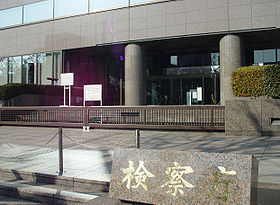
The Entrance of Public Prosecutors Office in Tokyo

The Entrance of Public Prosecutors Office in Tokyo

One of the critical tasks for the Japanese prosecutors is to interrogate the suspects themselves. I posted here about how police interrogations are partially recorded in some cases today. So what about interrogation by prosecutors? Are they recorded?

The answer is yes and no. Yes, they are sometimes recorded but only a few cases are recorded entirely, and most cases are not recorded at all.

In May 2006, the Supreme Public Prosecutor’s Office announced that they will start recording some interrogations on an experimental basis. Only serious cases were chosen, and the final part of the interrogation – the scenes where the suspect has confessed and signs the dossier – was recorded. It was up to the prosecutors’ discretion which cases and which part of those cases should be recorded.

Then there was an unprecedented scandal in 2009, involving a public prosecutor by the Special Investigation Division in Osaka Public Prosecutors Office . Continue reading

More Executions will Follow — Justice Minister Says

An execution chamber at the Tokyo Detention Center which was revealed in 2010 for the first time

Justice Minister Toshio Ogawa, talking about his recent decision  to execute three inmates, says that he will not hesitate to send more death row inmates to the gallows.

He stated that there is a broad support for death penalty in the Japanese society and as a justice minister he has a duty to issue executions. He emphasized that lay judge trials have resulted in death sentences and the majority of the population supports capital punishment in recent surveys.

His two predecessors had different views on execution, which resulted in a 20-month blank period of executions. Satsuki Eda, then Justice Minister expressed reservations in August 2011 that it is time to consider the issue. Ogawa’s immediate predecessor Hideo Hiraoka also emphasized the need for a national debate. Read more about Ogawa’s views on death penalty here.

Although Ogawa suggested that those death row inmates who are seeking retrial are unlikely to be executed, the standard for determining who will be executed is still unclear. Recently, it was revealed that there was an instance in 2004 where an inmate who was preparing to request a retrial became a candidate, and execution was averted at the last minute. Read more about this news here (in Japanese).

小川敏夫法相は、3月29日の死刑執行後、法務大臣としての職責として、今後も死刑を執行することを検討すると話した。法相は、裁判員裁判でも死刑が言い渡されていること、世論調査において死刑制度への支持が高いことを強調した。

再審請求中の死刑確定者については、執行の対象としないことも示唆された。しかし、2004年には、再審請求に向けて準備中の死刑確定者が死刑執行の候補者リストに入れられ、執行命令直前になって法務省が事実を確認し、候補者から除外したという事件があったことも最近明らかにされている(中国新聞2012年4月3日報道)。

Proposed “Expansion” of Partial Recordings of Police Interrogations

The National Police Agency (NPA) started audiovisual recordings of parts of police interrogations on an experimental basis in 5 police departments across Japan back in September 2008. NPA extended the experiment to include all police departments from April 2010. Recently in March, it expanded the partial recordings to interrogations in more cases.

Previously, partial recordings of interrogations aimed to strengthen the prosecution’s case in proving the voluntariness of confessions at trial. They only recorded in those cases where 1. the trial was subject to a mixed-judge panel trial (with lay judge participation = most serious cases), 2. the suspect had already confessed, 3. the “truth-finding” function of the interrogation was not compromised, 4. there was no difficulty in recording, and 5. the voluntariness of the confession might be challenged at future trial.

In these cases, interrogations by police were partially recorded, only after suspects confessed: there was no recording during the process leading up to the confession itself. Read the NPA report on these experimental recordings in June 2011 here (in Japanese).

An internal study panel of the National Public Safety Commission issued a report in February 2012. It called for the expansion of partial recordings, although it did not recommend the recordings of the entire process of interrogation. Read the report here (in Japanese).

As recommended by the February report, Continue reading