Author Archives: Phil Locke

Are There Geographic “Hotspots” for Shaking Babies? Shaken Baby Syndrome.

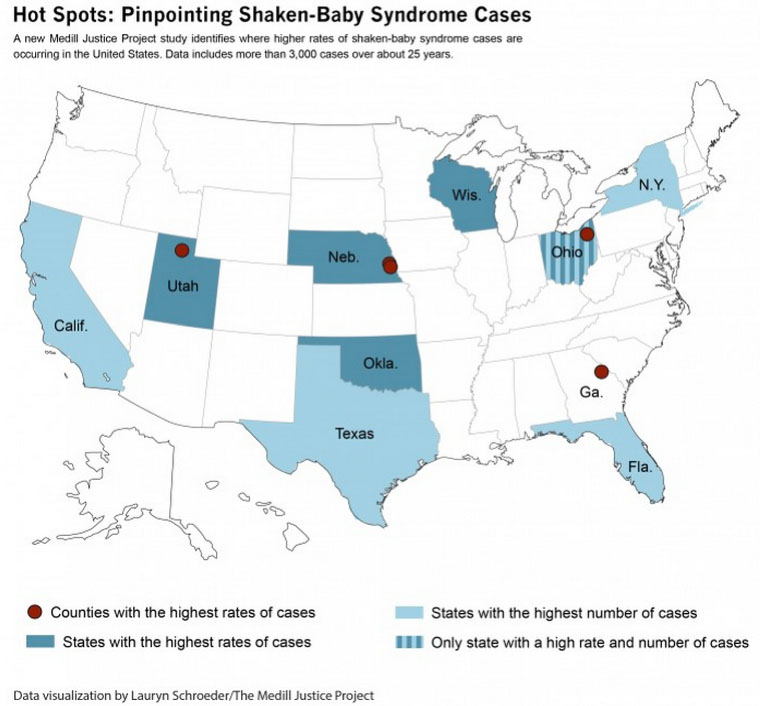
The Medill Justice Project, in its now year-long effort to build a database of SBS cases, has published a portion of that data relating to the geographic occurrence of SBS.  The report identifies several SBS geographic “hotspots.”

Medill Map

What could cause this?  As Innocence Project co-founder Barry Scheck has jokingly suggested, maybe it’s “in the water.”  But this data does NOT support a theory that certain localities have higher percentages of more violent people who are more likely to shake their babies.  It DOES, however, support a theory that certain localities have higher concentrations of aggressive and dogmatic prosecutors and child abuse pediatricians* who ARE more likely to (wrongfully) accuse and prosecute someone for shaking their baby.  And given this, it raises serious questions with respect to the concept of “equal justice.”  What I mean by this is – if your baby experiences a short fall, and you take it to the hospital, and the baby presents with any or all of the triad symptoms, you are much more likely to go to prison if you live in Summit County, Ohio than if you live in Kane County, Illinois – even though you did NOT shake your baby.

You can read the Medill report here.

Sue Luttner has posted an article looking at this geography lesson on her blog OnSBS.  She has done a little more research on how rate of occurrence relates to geography.  You can read it here.

* (More about child abuse pediatricians in a future post.)

Prosecutorial Misconduct “Double Feature”

Thanks to E. Everett Bartlett of the Center for Prosecutor Integrity for passing this along.

Here is a link to an Anderson Cooper 360 web page that contains two video’s.

The first tells the story of New Orleans exoneree John Thompson, and how the prosecutor withheld critical evidence in his case that eventually freed him from death row.

The second is a “debate” between a criminal defense lawyer and a former federal prosecutor about the issue of prosecutorial immunity.

When is a Lawyer not a Lawyer?

We’ve written before about how bad defense lawyers are responsible for as many wrongful convictions as anything else (see the section on “bad lawyers” in Why I Think the US Justice System is Broken – and Why It’s Not Getting Fixed).  But what about on the prosecution side?  The thought of legally unqualified prosecution attorneys – and this includes staff – is scary.

So this brings us to the question – when is a lawyer not a lawyer?  Apparently, the answer may be – when they practice in Arizona.  Get this — it’s actually not illegal to practice law in Arizona without a license.

Karyl Krug is a highly regarded Texas attorney who was transplanted to Arizona.  What she encountered in the Arizona legal system was cause for profound dismay.  She tells her own story here.

Misbehaving Prosecutors Almost Always Get Off Scotfree

The Center for Prosecutor Integrity, in December 2013, published a white paper titled An Epidemic of Prosecutor Misconduct.

Appendix B from that paper is a table listing documented cases of prosecutorial misconduct and in how many of those cases sanctions were imposed.

Appendix B

(For the sources footnoted, please refer to the paper.)

Out of 3,625 documented cases of prosecutorial misconduct, sanctions were imposed in only 63 of them – 1.7%.

Isn’t it about time for some prosecutorial accountability and sanctions for misconduct?

Center for Prosecutor Integrity to Establish ‘Registry of Prosecutorial Misconduct’

This (in my opinion) is huge.  By now, you’re probably familiar with the National Registry of Exonerations which has established a mechanism for collecting and documenting data about wrongful convictions across the US.  To date, it has logged data on 1,250 exonerations.  The registry will be a very powerful tool for justice system reform and improvement, because it provides incontrovertible, hard data that can be used to make known and describe the errors that can, and do, happen in this very imperfect system of ours.

Data from the National Registry of Exonerations has already revealed that “official misconduct” (by both police and prosecutors) is a contributing factor in 42% of wrongful convictions.  In a previous WCB post, Prosecutorial Misconduct – What’s to be Done?  A Call to Action, it was pointed out that one of the very first things needed to begin addressing the prosecutorial misconduct cause of wrongful convictions is DATA.  We know that prosecutorial misconduct happens, but our understanding of the problem, and its extent, has been only anecdotal up until now.  This new Registry of Prosecutorial Misconduct is a significant step forward in building a base of data that can be used by legislators, policy makers, and advocates in defining and implementing necessary changes to the laws and rules that govern prosecutorial behavior.

The press release from the Center for Prosecutor Integrity follows:

Continue reading

Sentenced to a Slow Death – Only in America?

Wrongful Conviction

Excessively long prison terms that are way out of proportion to the crime they’re supposed to be punishing have become more and more common in the US.  We already know, largely because of this, that even though the US has only 5% of the world’s population, it has 25% of the world’s prisoners.  (See previous WCB post here.)

The NY Times Editorial Board recently published this commentary on criminal court sentencing in the US titled ‘Sentenced to a Slow Death.’  The opening sentence of this editorial is, “If this were happening in any other country, Americans would be aghast.”

This situation is well characterized by the so-called “three strikes” laws.  Texas was the first state to enact such a law, doing so in 1974 with a mandatory life sentence.  In1993; Washington.  In 1994; California, Colorado, Connecticut, Indiana, Kansas, Maryland, New Mexico, North Carolina, Virginia, Louisiana, Wisconsin, Tennessee, and Georgia.  In 1995; Arkansas, Florida, Montana, Nevada, New Jersey, North Dakota, Pennsylvania, South Carolina, Utah, and Vermont.  In 2006; Arizona.  In 2012; Massachusetts.  And on top of all these are the draconian sex offender laws which can make registered sex offenders out of anyone for the crime of “touching.”  See previous WCB post here.

A platform of “tough on crime” has always been a “bread & butter” issue for politicians.  They’ve discovered it can help get them elected.  This started in the 1980’s, and has been getting progressively more severe as the years roll by.  It’s easy for the electorate to shrug this off as “the criminals get what they deserve,” but until you personally, or someone close to you, gets unjustly shredded by this meat grinder we call “justice,” you just can’t comprehend how insane this all is.  And this is exacerbated by prosecutors looking for more and more convictions, so they can get re-elected. However, study after study has confirmed that more severe sentencing laws DO NOT correlate with crime deterrence.  All they do is fill up the prisons at staggering tax payer expense.  Here is just one such study by Dr. Valerie Wright of The Sentencing Project – study by Dr. Valerie Wright.  This telling quote from the conclusion of that study:  “Existing evidence does not support any significant public safety benefit of the practice of increasing the severity of sentences by imposing longer prison terms.”

The bottom line here, folks, is that the problem is “us.”  As long as we keep electing legislators who continue to pass harsh mandatory sentencing laws that allow judges no discretion; and as long as we keep electing prosecutors and judges who disregard logic, fairness, and justice in favor of getting re-elected; we’ll continue to have a justice system that is perfectly willing to also scoop in the innocent to make sure that NO guilty people escape.  And while we’re at it, we’ll make sure that all those convicted, whether innocent or guilty, receive the most vengeful punishment we can visit upon them.

Texas Prosecutor, Ken Anderson, Out of Jail After Only 5 Days.

Former Texas prosecutor, Ken Anderson, sentenced to 10 days jail time for criminal contempt in his prosecution of the Michael Morton case has been released after only 5 days.  See previous WCB post here.

Read the story here.

And the irony is – he was released early for “good behavior.”

Please tell me this is not rubbing salt in the wounds of the wrongfully convicted.

James Bain Exonerated in Florida After 35 Years in Prison

Bain

After spending 35 years in prison for a rape he did not commit, James Bain, after numerous pro se motions, was ultimately assisted by the Innocence Project of Florida, and finally exonerated by DNA evidence.

Read the Business Insider story here.

The CNN story includes an interview with Mr. Bain here.

Prosecutor Jail Time – An Emerging Trend? We Can Only Hope.

Prosecutors A&N

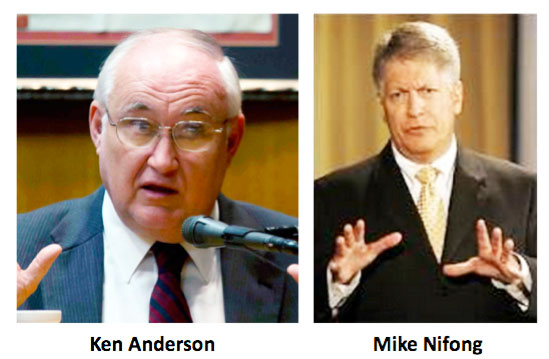
We’ve read much recently about former Texas prosecutor Ken Anderson being sentenced to jail time for his conduct in the Michael Morton case.  You can read Mark Godsey’s excellent editorial on the subject here.

The NY Times Editorial Board recently published a commentary on the sanctions against Ken Anderson – read that NY Times editorial here.  One of the points made in the opening paragraph of the editorial is, “the 10-day jail sentence for the prosecutor, Ken Anderson, is insultingly short.”  After all, Michael Morton spent 25 years in prison as a result of the wrongful conviction by Anderson.  I’m sure most would agree that this punishment certainly doesn’t come close to fitting the crime. Continue reading

Texas to Execute Jamie McCoskey Tomorrow

The Texas execution bandwagon just keeps rolling along.

Texas plans to execute a man Tuesday whose sentencing hearing included a presentation by a prosecution psychologist whose testing methods for developmental disability have since been debunked as unscientific. Execution Watch will air coverage of the state killing, plus a taped interview with the condemned, Jamie McCoskey.  Spread the word.

RADIO SHOW PREVIEW, EXECUTION WATCH – Unless a stay is issued, we’ll broadcast live:  Tuesday, 12 November 2013, 6-7 PM Central Time, KPFT FM Houston 90.1 and Online…

http://executionwatch.org > Listen

Updates and discussion onFacebook: Execution Watch

TEXAS PLANS TO EXECUTE:  JAMIE McCOSKEY, a Houston bartender convicted in the 1991 kidnapping and stabbing death of a 20-year-old man. McCoskey was one of 16 defendants sentenced to death in separate cases after the now-disgraced psychologist George Denkowski used his own, non-standard methods to conclude that none was developmentally disabled. His determination sank the defendants’ chances of having their death sentences declared unconstitutional.  Denkowski’s punishment included being barred from performing such evaluations in future.

Kash Delano Register Free After Judge Overturns Decades-Old Murder Conviction

Register

After 34 years in prison for a murder he did not commit, Kash Delano Register is a free man.  How could this perversion of justice have happened?

This quote from the HuffPost story pretty much says it all.  “Superior Court Judge Katherine Mader threw out the conviction on Thursday, ruling that prosecutors used false testimony at trial and failed to disclose exculpatory evidence.”

Read the HuffPost story here.

With news of wrongful convictions occurring at a steady pace these days, it really causes one to ponder – how many more are out there?

Press Release: Center for Prosecutor Integrity Calls on Prosecutors to Root out Misconduct After AZ Report of Widespread Unethical Practices

WASHINGTON / November  6, 2013 – Following revelations that 22% of death sentence cases in Arizona involve judicial findings of impropriety, the Center forProsecutor Integrity is calling on prosecutors nationwide to take a proactive approach to hold unethical prosecutors accountable and restore public confidence in the criminal justice system.

The finding of widespread prosecutor misbehavior is based on a review of all death sentence convictions in Arizona in the past decade. These sentences are routinely seen by the state Supreme Court. Since 2002, there have been 82 death sentence cases reviewed by the state high court. In 18 of the cases – 22% of the total — the Supreme Court made a finding of impropriety.

Examples of unethical practice include presenting false testimony, resorting to emotional appeals in closing arguments, referring to mitigating evidence as “excuses,” and removing a jacket worn by a victim from a plastic evidence bag for the jury’s “smelling pleasure.”

The cases were assembled in an online database as part of a four-part investigative report by Michael Kiefer of the Arizona Republic newspaper:http://www.azcentral.com/news/projects/prosecutorial-conduct/

The Arizona study is important because previous analyses of prosecutorial misconduct focused on cases that were pre-selected based on defense counsel’s allegation of misconduct or a judicial determination of a wrongful conviction. The Arizona findings likely underestimate the true extent of wrong-doing because the most egregious cases of misconduct triggered a mistrial or led to a last-minute plea deal not carrying a death sentence.

“In the past, some prosecutors have insisted that unethical conduct is so rare that it doesn’t even deserve attention,” notes CPI spokesperson Sheryl Hutter. “But when a high court concludes more than one in five cases involve impropriety, taxpayers should be demanding accountability and lawmakers should be convening hearings.”

The CPI report, An Epidemic of Prosecutor Misconduct, concludes unethical conduct has become widespread throughout the country: http://www.prosecutorintegrity.org/wp-content/uploads/EpidemicofProsecutorMisconduct.pdf

The Center for Prosecutor Integrity is working to preserve the presumption of innocence, assure equal treatment under law, and bring an end to wrongful conviction through the enhancement of prosecutorial ethics.

Prosecutorial Misconduct – Spotlight on Arizona

Gray Area copy

Michael Kiefer covers courts and the death penalty for The Arizona Republic.  He has recently written a four-part series of articles about prosecutorial misconduct in the Arizona courts titled “The Gray Area of Courtroom Conduct.”

Here is an excerpt from the opening section of the Part 1 article:

“There seldom are consequences for prosecutors, regardless of whether the miscarriage of justice occurred because of ineptness or misconduct.  In fact, they are often congratulated.  Since 1990, six different prosecutors who were named prosecutor of the year by the Arizona Prosecuting Attorneys Advisory Committee also were later found by appeals courts to have engaged in misconduct or inappropriate behavior during death-penalty trials, according to The Republic’s examination of court documents.”

You can read Michael Kiefer’s four-part series here.

In editorial fairness, a group of Arizona prosecutors wrote a response to Mr. Kiefer’s articles, which was posted on azcentral.com, and you can read their letter here.  Now, exercising editorial privilege, I will have to say this letter could be one of the biggest crocks of BS I have ever read.  I particularly like this sentence from the prosecutors’ letter: “The system is designed for the defense in that there are ethical rules that apply only to prosecutors.”  So … never mind that prosecutors often pay no attention to those “ethical rules.”   The position of prosecutor is endowed with more power of discretion than almost any other elected position.  There are things prosecutors can decide and do that even governors cannot decide and do.  Additionally, the prosecution has the police, the crime labs, a staff of attorneys, and they are funded by the taxpayers; while the defendant has to pay for his own investigators, forensic testing, and attorneys.

In Mr. Kiefer’s articles, you’ll find frequent mention of Maricopa County.  You know, the place where Joe Arpaio is sheriff.  More about Maricopa County in future posts.

Texas Death Row Exoneree Endows Scholarship to Honor His Attorney

Anthony Graves

Anthony Graves spent 18 years in prison – 12 years on death row – for a murder he did not commit.

Thanks to the tireless efforts of his attorney, Nicole Casarez, and her students at Houston’s University of St. Thomas, he was eventually exonerated.  He was awarded $1.4 million by the state of Texas for wrongful incarceration.

Anthony wanted to recognize her efforts with something that would “live on,” and so created an endowed scholarship at the University of Texas Law School in her name.

Read the full story here.

“Scenes of a Crime” – Documentary of a False Confession

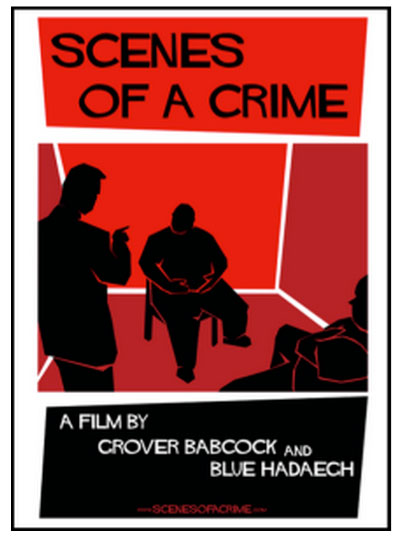
ScenesOfaCrimeSue Luttner posted a commentary on this film yesterday on her blog On SBS.

If you want to have a better understanding of how false confessions can happen, and why an innocent person would confess to something they didn’t do, here’s an ‘eye opener.’   The opening paragraph of Sue’s post:  “After watching “Scenes of a Crime” over the weekend, I now know why this potent documentary has garnered so much praise.  Filmmakers Grover Babcock and Blue Hadaegh have interspersed actual footage from the lengthy police interrogation of an accused father in Troy, New York, with excerpts from Reid Technique training films and commentary by key players in the case. The result is a clean, careful, and gripping illustration of how a man can be manipulated into confessing to a crime he didn’t commit.”

While this particular case involves SBS (shaken baby syndrome), the methods are the same as those used in general by law enforcement, and the Reid Technique for interrogation is prominent.  We’ve reported on the Reid Technique on this blog here, herehere, and here.

You can read Sue’s full post here.

Texas to Execute Michael Yowell Tomorrow

RADIO SHOW PREVIEW – EXECUTION WATCH  Unless a stay is issued, we’ll broadcast live:  Wednesday, 9 October 2013, 6-7 PM Central Time, KPFT FM Houston 90.1 HD3 channel, and Online… http://executionwatch.org >Listen

Updates and discussion on Facebook: Execution Watch

TEXAS PLANS TO EXECUTE:  MICHAEL YOWELL, convicted in a 1998 triple murder in Lubbock, in which Yowell’s father, mother and grandmother died of injuries sustained before or during a fire at their home. Yowell’s execution date has been delayed in the past, based on the contention that his trial lawyers did not provide effective representation. At the time of the slayings, Yowell had a history of mental illness.

Featured Interview: MICHAEL YOWELL, who accepted Execution Watch’s invitation to be interviewed, with the understanding that the audio recording would air unedited, in its entirety, and only in the event of his execution. The interview took place Aug. 28 on death row.

NEXT SCHEDULED EXECUTION:  On Oct. 16, Texas plans to kill LARRY HATTEN. If it does, Execution Watch will air coverage.

One of ‘Angola 3’ Dies Days After Release

Herman WallaceHerman Wallace, one of the Angola 3, died October 4, just three days after release from 41 years in solitary confinement.

The Angola 3 were three young black men who tried to raise awareness of the horrific, disgusting conditions that prevailed at Angola state prison in Louisiana in the early 1970’s – known at that time as “Bloody Angola.”  You can read the background story here.

As a consequence of their actions, they were singled out for retribution, and were framed for the murder of a prison guard.

You can read coverage here and here.

The Shame of Lorain – Redux

Smith & Allen

The case of Nancy Smith and Joseph Allen of Lorain, OH is a tragic tale of a badly broken justice system gone haywire.  Their story has been reported on this blog here and here.  And the fact that this sordid tale involves the Ohio Supreme Court makes it even worse.  They both spent almost 15 years in prison until a judge confirmed the charges against them were bogus, and had them released.  But the prosecution wouldn’t acknowledge this, and wouldn’t give up.  The Ohio Supreme Court ruled that the judge didn’t have jurisdiction, and another judge was assigned to the case.  The outcome was that “deals” were struck by the defense and the prosecution, and the results of those “deals” are reported below.

Any rational person who examines the facts of this case will conclude that Nancy and Joseph are absolutely innocent.  However, to avoid being sent back to prison after initial release, Nancy had to plead to a lesser charge and was given credit for time served, but had to give up any future possibility of exoneration.  Unfortunately, Joseph did not have even this option.  He is being sent back to prison and has to give up his right to further appeals.

You can read the story by Bob Chatelle here.

Ladies and gentlemen, this is shining example of the fact that for (most) prosecutors, it’s not about justice, it’s just about winning; and doesn’t that just suck.

Update on the National Registry of Exonerations

In Mark Godsey’s ‘Quick Clicks’ yesterday, there was a piece titled “an update from the National Registry of Exonerations,” which currently has logged data on 1,219 exonerations nationwide so far.  I hope you were able to check it out, and were able to navigate through the Registry’s updated website.

To me, the most important value of the Registry is that it’s a rich source of real, hard data on the occurrence of wrongful convictions – something that we have historically not had.  The registry has been able to publish a statistical analysis of 873 exonerations from 1989-2012, and you can see that report here.

I am a self-admitted data junkie, and when I saw the Registry’s new site, was thrilled to see that they have presented data in graphical form that will be continuously updated.  I thought I would highlight two examples for you here.

NatRegExon Charts

And congratulations to both Nancy and Jim Petro on being named to the Registry’s Advisory Board.  I’m sure you’re aware that Nancy is a contributing editor to this blog.

Texas Plans to Execute Arturo Diaz Tomorrow

For the second time in as many weeks, Texas plans to execute a poor Hispanic man from the Rio Grande Valley Thursday. Unless Arturo Diaz wins a stay, Execution Watch will provide live coverage and commentary on the state killing, starting at 6 p.m. Central Time. Spread the word.

RADIO SHOW PREVIEW, EXECUTION WATCH:  Unless a stay is issued, we’ll broadcast live:Thursday, 26 September 2013, 6-7 PM Central Time KPFT FM Houston 90.1 and Online…  http://executionwatch.org > Listen                     Updates and discussion on Facebook: Execution Watch

TEXAS PLANS TO EXECUTE:  ARTURO DIAZ, convicted in the stabbing death of a McAllen man during a 1999 robbery in which Diaz and another man reportedly went to an apartment seeking drugs. Diaz is set to become the 10th person executed for crimes in the Rio Grande Valley since 1982. Another 13 people are in Texas Death Row for crimes in the Valley. On appeal, Diaz complained that his trial lawyers failed to call relatives to testify about a childhood filled with poverty, neglect and violence. The courts rejected the argument, saying the attorneys were following Diaz’s instructions.

NEXT SCHEDULED EXECUTION:  On Oct. 9, Texas plans to kill MICHAEL YOWELL. If it does, Execution Watch will air coverage.