Category Archives: Editorials/Opinion

False confessions no relic of past

Joshua Tepfer, a staff attorney with the Center on Wrongful Convictions at Northwestern University and co-director of the center’s Youth Project, presents a powerful argument in today’s Chicago Sun-Times that false confessions remain a serious problem in Chicago. (Things aren’t much better in the rest of the United States, but Chicago always seems to lead the way.)

You can read Tepfer’s commentary here.

The Dark Side of Crime Stoppers – False Information and Police Tunnel Vision

CS LogoYou’re probably familiar with Crime Stoppers.  Crime Stoppers first began in Albuquerque, NM during July 1975.  Two weeks after a fatal shooting, the police had no information, when out of desperation, Detective Greg MacAleese approached the local television station requesting a reconstruction of the crime. The re-enactment offered $1,000 for information leading to the arrest of the killers.  Within 72 hours, a person called in identifying a car leaving the scene at high speed, and he had noted its registration. The person calling said that he did not want to get involved, so he had not called earlier. Detective MacAleese then realized that fear and apathy were the primary reasons why the public tended not to get involved. So he helped establish a system where the public could anonymously provide details of crime events that offered cash rewards for information leading to an arrest and/or conviction.  Since its first chapter was officially formed in Albuquerque in 1976, Crime Stoppers has spread across the United States, and has been responsible for more than half a million arrests and more than $4 billion in recovered property.

This all sounds very good, and I support the organization, but let’s dig deeper into the motivational aspects of why someone would phone in an anonymous tip to Crime Stoppers.  Someone who really wanted to do their “civic duty” would go directly to the police, and if they’re afraid of “involvement” or retribution, they can still remain anonymous.  Given that anyone can provide an anonymous tip directly to the police, the real attraction of Crime Stoppers is the cash.  Here are some examples from Crime Stoppers organizations across the country.  The payouts are all conditioned upon either an arrest or an indictment or both.

This from the Topeka, KS Crime Stoppers website:

Topeka Crimestoppers

And  here is a random sampling of the rewards offered by Crime Stoppers organizations across the country:

Crime Stoppers of Michigan$1,000

Texas Crime Stoppers – $50,000

Crime Stoppers of Tampa Bay$1,000

NYPD Crime Stoppers – $10,000, $2,000, $1,000, or $500 – depending on the crime

The problem here is that people can be tempted to provide information, even if it’s false, just to get the payout.  It happens – just like jailhouse snitches will provide false information to get a deal from the prosecutor.

Continue reading

Compromised Justice? Selling Case Details to Would-be Snitches

A must-read USA Today report published on December 14 (here) places a spotlight on a process rarely revealed to those outside the justice system: The role of the snitch in making federal cases…and in reducing sentences. While DNA proven wrongful convictions have shown that snitches can be a questionable source for information, the use of snitches continues to be widespread. So much so that credible case information is a currency for getting out of jail sooner.

Imprisoned bank robber Marcus Watkins is not the first to recognize that there could be a profitable business in selling case details to defendants and convicts desperate to reduce their sentences. Continue reading

National Registry of Exonerations Grows Steadily, with Little Fanfare

About six weeks ago, the National Registry of Exonerations reached the milestone of  1,000. Today the tally is 1,033. Each added case is accompanied by a name, a photo, and the story of a life completely disrupted or virtually destroyed by a miscarriage of justice. As the number grows, it sounds a wake-up call ever louder, but the sheer numbers can also numb us to the human impact of each wrongful conviction and hard-won exoneration. A recently added name is Alfonso Gomez. His story sounds all too familiar, and the lack of attention in the media may be an indication that cases like this are no longer particularly newsworthy. Continue reading

Executed Serial Killer’s DNA May Solve Cold Cases

Did serial killer John Wayne Gacy commit other murders still unsolved? Thanks to Cook County (IL) sheriff’s detective Jason Moran, who located evidence vials of Gacy’s blood, some old cold cases may soon be solved. Moran and his department are pursuing an innovative strategy of procuring DNA profiles of Gacy and other executed serial murderers for submission into the national CODIS database. It is hoped that the DNA will match biological evidence from unsolved cold cases, and this will prompt other departments nationwide to submit DNA profiles from those executed in their state as well as DNA evidence from still unsolved cold cases.

An added bonus: Whenever DNA definitively solves a crime, the likelihood of convicting an innocent person is greatly diminished.

The A.P. broke this story (here).

First Innocence Project Dedicated to Women Launched Today in Chicago

The Center on Wrongful Convictions (CWC) at Northwestern Law has been instrumental in exonerating four persons in a category that represents less than seven percent of the more than 1,000 persons who have been exonerated in the United States: Women. Today, the Center will launch its new Women’s Project, the first Innocence Project dedicated to the special needs and circumstances of women who have been wrongfully convicted.

A press conference at 10:00 a.m. in Northwestern Law’s Bluhm Legal Clinic will be followed by an event and reception at the law school at 6:00 p.m. tonight in Lincoln Hall. CWC Lawyer Karen Daniels, one of the leaders of the project, and exonerees Audrey Edmunds, Gloria Killian, Joyce Ann Brown, and Julie Rea, as well as others who have been instrumental in establishing the Center, will discuss its work and goals.

“Women fighting wrongful convictions face special challenges,” said Rob Warden, executive director of the Center on Wrongful Convictions. Continue reading

Lawmakers Need to Heed the Lessons of Wrongful Conviction

Last week Virginia’s Governor and the state’s Attorney General scrambled to find a legal way to release Jonathan Montogmery from prison after his accuser admitted the sexual assault—for which he had served four years—never happened. The Washington Post railed against “balky officials in Richmond who will not move off the dime to free him” in a published opinion (here). However, the editorial also properly identified the “root problem”: Virginia’s 21-day rule.

In states across the country existing laws indicate an unacceptable lack of awareness or concern over the lessons of wrongful conviction. Continue reading

Conviction Reversal Illustrates Importance of Competent Defense Counsel

Rafael Madrigal, Jr. embraced his children—Kimberly, 8, Raphael, 11, and Andrew, 15—and his wife Veronica after his release in October 2009 from a California prison. See video (here). A federal judge overturned his conviction for attempted murder related to a drive-by shooting after Madrigal had served 9 years in prison. The reversal was based on evidence supporting Madrigal’s innocence that his attorney never presented to the jury. Continue reading

Lawyers, Officials, Work Through Legalities to Free Innocent Man

Mid-Atlantic Innocence Project lawyers are working through this weekend to prepare a request of Virginia Gov. Bob McDonnell for a conditional pardon for Johnathon Montgomery, 26. Montgomery has served four years in prison following his 2008 conviction of sexual assault. The crime allegedly happened eight years earlier, in 2000, when Montgomery was 14 and the victim was 10. Montgomery was convicted on the testimony of the victim who was 17 at the time she raised the accusation. Now 22, Elizabeth Coast has recanted her testimony and admitted the assault never happened.

Coast says she made up the assault as a defense and explanation to her parents who discovered her looking at sexually explicit sites on the Internet. The Daily Press first reported on this case. This ABC report also indicates that Coast is being charged with perjury for the false accusation. Continue reading

SBS – Shaken Baby Syndrome. Politics and “Religion” vs. New Science

Sue Luttner is the editor of a blog called OnSBS.  (OnSBS.com)  After reading a recent Quick Click on the Wrongful Convictions Blog, she was inspired to author a post on her blog.  The Quick Click in question is one about the San Antonio Four – four young women who were wrongfully convicted and incarcerated for what was described as “Satanic cult child abuse”; even though the theory of Satanic cult child abuse had been debunked years prior to that.  You can read the Quick Click article here.  [Sidebar:  You may remember the McMartin Preschool case from the 80’s, which was driven, at least in part, by a wave of “Satanic cult ritualistic abuse” paranoia that had taken the country.  This was the longest and most expensive criminal trial in US history, and eventually, all charges against all defendants were dismissed; although, one of the defendants had already spent 5 years in prison.  This was truly a black mark on the US justice system.]

In the post, Sue draws an insightful parallel between the debunking of the old Satanic cult theories and those of the entrenched medical dogma of SBS and the “triad” (a combination of three symptoms said to be uniquely indicative of SBS).  See Sue’s OnSBS post here.  She very appropriately titles the post Old Theories Die Hard.

I’d like to leverage off the message of that title within the context of SBS.  I once heard pathologist and anti-triad crusader Dr. John Plunkett say, “It takes 10 years to get a new idea into medicine, but it takes 100 years to get a bad idea out of medicine.”  I believe he was speaking from experience.  There has been much recent, new, and still emerging research that clearly calls into question the 100% validity of the triad.  There’s lots of other stuff that can cause a child to present with retinal hemorrhage, subdural hematoma, or diffuse edema.  And the old theories that triad symptoms can’t be caused by short falls, and that there’s no such thing as “lucid invertal” have been proven absolutely untrue.  However, the vast majority of the medical community seems to turn a blind eye to it.  How can that be?

Continue reading

Texas Wrongful Conviction Continues to Reveal Tragic Human Costs

Yesterday, a Travis County (TX) grand jury indicted Mark Norwood on capital murder charges in the 1988 death of Debra Baker. Norwood is currently awaiting trial on murder charges in the 1986 death of Christine Morton. The apprehension of the man whose DNA is allegedly linked to both murders was delayed more than two decades by the wrongful conviction of Michael Morton, Christine’s husband, who served 25 years in prison for the crime he always said he did not commit.

The lesson is painfully clear: If Norwood is guilty of both murders, Debra Baker would likely be alive today had Norwood, and not Michael Morton, been Continue reading

Wrongful Conviction and Innocence Work Have No Boundaries

Last year the University of Cincinnati College of Law’s Rosenthal Institute for Justice/Ohio Innocence Project (OIP) hosted the 2011 Innocence Network Conference: An International Exploration of Wrongful Conviction at Freedom Center in Cincinnati (details here). It was the first international conference focusing on the global human rights problem of wrongful conviction. The four-day event (April 7-10, 2011) was an extraordinary gathering of 500 attendees, including scholars, lawyers, and more than 100 exonerees from around the world who met, networked, participated in seminars, and attended addresses on wrongful conviction. Continue reading

School-to-Prison Pipeline in Mississippi

Talk about wrongful convictions!

The school district in Lauderdale County Mississippi is being sued by the Justice Department for maintaining a “school-to-prison” pipeline.  For minor infractions, which includes things like talking back to teachers or violating dress codes, students are arrested, processed through a juvenile court without rights, and incarcerated.  It’s reported that all the victims of this process are minorities.

Here are some examples of the unconstitutional actions taken by the school district and the court:

• Children are handcuffed and arrested in school and incarcerated for days at a time without a probable cause hearing.

• Children detained wait more than 48 hours for a hearing, in violation of constitution requirements.

• Children make admissions to formal charges without being advised of their Miranda rights.

• Children are not routinely granted legal representation during the juvenile justice process.

Read the story here.

We talk a lot here about flaws in the justice system, but what do you do when there is no justice system?  How can this happen in this day and age – in this country?

In Arizona, Drayton Witt’s SBS Murder Charges Dismissed – “With Prejudice”

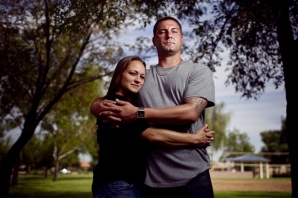
Drayton Witt stands with his wife Maria Witt. Drayton’s 2002 second degree murder conviction was vacated recently after the Arizona Justice Project helped secure his release.

Thanks to the tireless work of the Arizona Justice Project, Drayton Witt has had 2nd degree murder charges against him for the shaking death of his 4 month old son dismissed, with prejudice.  “With prejudice” means that the state can never again bring charges against him related to the death of his son.

Read the story here.

This is another case of the pediatric medical community blindly relying on the “triad” to diagnose death by shaking.  Someday …. someday …. they will creep out of the Stone Age, and acknowledge the reality that the “triad” is NOT pathognomonic (uniquely indicative) of shaking, or as they call it today – abusive head trauma.

For more on the “triad”, see previous post here.

The National Registry of Exonerations Quickly Reaches 1,000 Milestone

When the University of Michigan Law and Northwestern Law School announced their joint project—the National Registry of Exonerations (here)—earlier this year on May 21, the initial tally of exonerations in  the United States since 1989 was 891. Today, five months later, the number of exonerated in the registry is 1,000. No one knows how high the number will go. The only certainty is that this milestone will soon be surpassed. Continue reading

Lessons Learned by Texas D.A. Should Not be Lost on Others

The once powerful Williamson County (TX) District Attorney John Bradley is looking for a new job. He was the definition of a hard-nosed prosecutor and had served at the voters’ pleasure since his appointment by Governor Rick Perry in 2001 until his stunning defeat in the primary for his re-election earlier this year.

Bradley became high profile nationally when Governor Perry appointed him to chair the Texas Forensic Science Commission during the contentious discussions regarding arson forensic evidence in general and the Todd Willingham case in particular. Willingham, who always claimed innocence in the fire death of his Continue reading

Federal Prosecutorial Misconduct – Can There Be Any Difference at the State and Local Level?

USA Today just published a story about Nino Lyons, who was exonerated of drug trafficking charges for which he was convicted in 2001.  It’s a very “telling” article.  Here is the lead-in to the story:

“For more than a week in 2001, the jurors listened to one witness after another, almost all of them prison inmates, describe how Lyons had sold them packages of cocaine. One said that Lyons, who ran clothing shops and nightclubs around Orlando, even tried to hire him to kill two drug suppliers.

But the federal prosecutors handling the case did not let the jury hear all the facts.

Instead, the prosecutors covered up evidence that could have discredited many of Lyons’ accusers. They never revealed that a convict who claimed to have purchased hundreds of pounds of cocaine from Lyons struggled even to identify his photograph. And they hid the fact that prosecutors had promised to let others out of prison early in exchange for their cooperation.”

See full story here.

Quoted in the article is Pace University law professor Bennett Gershman, an expert on misconduct by prosecutors. “It’s systemic now, and … the system is not able to control this type of behavior. There is no accountability.”  (emphasis is mine)

The article focuses on federal prosecutors, but why would this situation be any different at state and local levels?  My expectation is that it’s not.  I’ve heard prosecutors quoted as saying “We will win at all cost.”

There has to be some accountability for these people who are invested with so much power, but it seems there is not.

PBS Nova – “Forensics on Trial” – a Review

If you were not able to watch PBS Nova’s presentation of “Forensics on Trial” last night, you can stream it here.

To sum up my overall reaction, I was quite disappointed.  They failed to educate the audience about the actual underlying scientific shortcomings of forensics, and for a good portion of the show, I felt like I was watching an episode of CSI in which the investigator sits down at a computer and some magical software application solves the crime.

They did say that there needs to be more “science” in “forensic science”, but did not address what or how.  They did say that most all forensics is subject to an examiner’s interpretation of the evidence, and that it can be wrong.  Beyond that, I found little value in the program.  My impression is that it was clearly produced more to entertain than to educate.

The program addressed three areas of current forensics – fingerprints, blood spatter, and bite marks.  Let’s look at some specifics.

Continue reading

Eyewitness Scientific Research Persuasive in Federal Court Ruling

In a ruling that may influence other courts in evaluating eyewitness testimony, the U.S. Court of Appeals for the Second Circuit unanimously upheld Western District U.S. Magistrate Judge Victor Bianchini’s decision to grant defendant Rudolf Young’s petition for a writ of habeas corpus and vacate his conviction of robbery and burglary.

According to Joel Stashenko writing in the New York Law Journal (here), the Circuit ruled in Young v. Conway (here) that prosecutors could not use the eyewitness testimony of Lisa Sykes, whose home was broken into in March 1991. While Continue reading

Murder Conviction Overturned: Questions Remain Unanswered Fifteen Years After Crime

In a troubling example of a bungled and costly case that ill-served the victim, her family, and Tennessee taxpayers, Shelby County Judge James C. Beasley Jr. overturned the murder conviction of Tennessee death row inmate Michael Dale Rimmer late Friday afternoon in a 212-page order in which he concluded that Rimmer’s 1998 counsel and his resentencing counsel “provided ineffective assistance of counsel by failing to properly investigate and present evidence…” The result: “…the court’s confidence in the verdicts has been undermined and reliability in the verdicts cannot be had.”

The prosecution was less than forthcoming about witness evidence that was contrary to their theory of Rimmer as perpetrator. Testimony from a man who Continue reading