Category Archives: Editorials/Opinion

Sports world’s justice system often unfair to the accused

As hard as the presumption of guilt can be to overcome in the world’s court systems, it apparently is even harder in the international anti-doping bureaucracy headed by the Court of Arbitration for Sport, where even high-profile athletes like Lance Armstrong don’t stand a chance.

As Sally Jenkins of The Washington Post notes:

“Anyone who thinks an athlete has a fair shot in front of CAS should review the Alberto Contador case. Contador was found to have a minuscule, insignificant amount of clenbuterol in his urine during the 2010 Tour de France. After hearing 4,000 pages of testimony and debate, CAS acknowledged that the substance was too small to have been performance-enhancing and that its ingestion was almost certainly unintentional.

Therefore he was guilty. He received a two-year ban.”

Even worse, Jenkins said, one year of that ban was exacted because the prime minister of Spain dared to defend Contador’s innocence. You can read Jenkins’ full commentary here.

Texas Man Not Bitter After Two Decades of Wrongful Imprisonment

After serving 23 years in prison for a rape DNA proved he didn’t commit, David Lee Wiggins, 48, walked out of prison and into freedom via courthouse doors in Fort Worth, Texas, yesterday with his brother, his sister, and Innocence Project attorney Nina Morrison. As has been the case with many other exonerees, he expressed no bitterness after his long ordeal.

As reported here on Monday, the Wiggins case was one of misidentification, a contributor in about 75 percent of DNA-proven wrongful convictions. He was Continue reading

Mother Released from Prison Pending State’s Decision on New Trial

After serving 16 years in prison, Kristine Bunch, 38, was freed Wednesday, following the Indiana Court of Appeals March ruling that granted her a new trial in the state-alleged arson murder of her young son in a mobile home fire.

The Appeals court found that the forensic evidence used to convict Bunch was outdated and discredited and that prosecutors withheld from the defense a lab Continue reading

Sentencing “Rules” and “Guidelines” – Have Things Gone Too Far?

Anders Breivik, the Norwegian who meticulously planned and carried out an attack that killed 77 people, has been found sane, and sentenced to 21 years.  See the NY Times article here.

Meanwhile, this past May, Marissa Alexander, a Florida woman, who was in a fight with her abusive husband, fired a warning shot into a wall without injuring anyone, and was sentenced to 20 years.  See GlobalPost article here.

Does anybody else see a problem here?

And then there are the “three strikes” laws.  Under these laws people who have committed three felonies, albeit non-violent and minor, can be sentenced to life in prison.  24 states currently have some form of “three strikes” law.  The intention was to reduce crime from repeat offenders, but no statistically valid causal correlation with reduced crime has been shown.  However, it has been observed that offenders in jeopardy of a “third strike” are more likely to violently attack police.

Something is seriously out of kilter here.

Long Ordeal of Son’s Wrongful Conviction is Over for Hash Family

Earlier this week murder charges against Michael Hash, 31, were dismissed 12 years after he had been convicted of the murder of Thelma B. Scroggins, 74, in Virginia. Hash was 15 at the time of the crime, 19 when accused. He was convicted and sentenced to life without parole. Last February, citing numerous examples of police and prosecutorial misconduct, U.S. District Judges James Turk tossed out Continue reading

Prosecutors Agree: Imprisoned Man is Innocent; Should be Freed

Steve Conder, the prosecutor in charge of post-conviction DNA motions for Tarrant County (TX), filed a motion yesterday that will put David Lee Wiggins, 48, a giant step closer to freedom. Wiggins was convicted of raping a 14-year-old girl in 1988. He has always claimed innocence. Wiggins is expected to be freed on bail this Friday.

The Innocence Project worked on the case for years. Testing of partial sperm cell Continue reading

Early DNA Testing Could Prevent Nightmare of Wrongful Charges

The Innocence Project reports that DNA has proven the innocence of nearly 300 people who spent 13 years on average in prison for crimes they didn’t commit. K’vaughn Hines, 19, is not one of them because multiple charges—including first-degree murder and rape—were dropped before trial and conviction. DNA testing eventually excluded him and Sheldon Sneed, 19, from a violent gang rape committed in a Metro station in Maryland. As reported in the Maryland Gazette.net here, Hines, who did not have as much as a traffic ticket prior to this charge, spent four months in jail without bond and a month on house arrest before the charges were dropped. It was a life-changing experience.

A witness at the Metro station spotted Hines and Sneed at the station and said they had committed the crimes, but they were not identified at the scene of the crime. What followed rarely makes headlines, but it was a nightmare for Hines Continue reading

Alabama says “No” to DNA Testing as Execution Day Approaches

Oprah’s “Our America” episode “Innocent Behind Bars” features Ohio Innocence Project Director Mark Godsey, editor of this blog and international expert on the topic, in this video clip published yesterday. Godsey is speaking here about the execution of Thomas Arthur, scheduled soon in Alabama. Arthur was convicted of the 1982 murder of Troy Wicker. On death row for more than 20 years, he’s always claimed innocence. Godsey freely admits that he doesn’t know if Arthur is guilty or not. He’s not alone in that stance, which is why he’s Continue reading

Re Wrongful Conviction: Katie Monroe Seeks Policy, Cultural Change

“What we would like to see is change in the culture in the way government officials respond to wrongful convictions,” says Katie Monroe. “We’d like it to grow to a place where government officials realize that correcting mistakes is good for all of us and not just the person in prison.” Monroe, longtime leader of the Rocky Mountain Innocence Project (RMIP), is leaving her RMIP post, as reported here,  to become the Innocence Project’s first person in Washington, D.C. dedicated to working with prosecutor and police groups to shape policy that can reduce wrongful conviction.

She takes helpful experience to the challenge. The RMIC authored with the Utah Attorney General’s office Utah’s 2008 non-DNA factual innocence statute, which Continue reading

The Buffalo News urges New York to Compensate for Wrongful Conviction

DeJac Peters, who was convicted of second degree murder in the strangulation death of her 13-year-old daughter in 1993, is listed in the National Registry of Exonerations compiled by Northwestern Law’s Center on Wrongful Convictions and Michigan Law. Maurice Possley’s Registry report provides details of the case that resulted in Peters’ 14 years of wrongful imprisonment and her ongoing pursuit of state compensation in New York.

Peters was convicted on the testimony of a friend who was facing a potential life sentence in another crime and Dennis Donahue, a man she had dated, who was an early suspect in the case. When, in late 2007, testing revealed male DNA in a blood Continue reading

Update on Wisconsin Innocence Project Case: The Rape that Wasn’t

Jarrett Adams was 17 years old when he was accused of rape. Never having been in trouble with the law, he and his family trusted their court-appointed lawyer who advised him to take a “no defense strategy.” This prevented Jarrett from calling the one witness whose testimony would have likely prevented his conviction.

report on the case by (Wisconsin) Law School News, submitted on August 8, 2012, includes an excellent video featuring both Adams and his attorney. It’s a study in how accusations can stick even with very thin evidence. It also Continue reading

Discredited Arson Theories Open Prison Doors to New World

David Gavitt, 54, is thankful Michigan doesn’t have a death penalty. He’s trying to come to grips with his newfound freedom. Convicted of arson in the fire that took his wife and two daughters, Gavitt spent 16 years in prison and always proclaimed his innocence. Mark Godsey reported on this case earlier here. A follow-up article here updates Gavitt’s efforts to cope with his loss and a world that has changed dramatically.

Gavitt’s conviction was based on expert testimony that has now been discredited. New technology could not find the presence of alleged Continue reading

Breaking News: Exonerative DNA Test Results Announced in High-Profile “Bite Mark” Murder Case in Ohio

Former Police Captain Douglas Prade

Douglas Prade, a former police captain from Akron, Ohio, was convicted of killing his ex-wife in 1998 based primarily on “bite mark” evidence (i.e., an expert testified at trial that the bite mark impression left on his ex-wife’s skin matched Douglas’ teeth).  Doug’s ex-wife, Margo Prade, was a prominent doctor in Akron at the time she was murdered in her van in the parking lot of her office.  The case received significant national media attention at the time of trial, including from Dateline NBC and other  national programs.

The law firm of Jones Day and the Ohio Innocence Project have teamed up for several years now on the case, seeking DNA testing of the bite mark (the bite occurred through the lab coat Margo was wearing when she was killed; DNA testing was sought of the bite mark area of the lab coat).  DNA testing at the time of trial in 1998 was not sensitive enough to obtain meaningful results.  At the time of trial, experts testified that the killer would have “slobbered” all over the part of the lab coat where the intense bite occurred, and the state’s own expert testified at trial that future testing  of the bite mark area of the lab coat would be the best place to find the killer’s DNA (presumably assuming DNA testing continued to become more advanced and sensitive).

The OIP and Jones Day announced today that DNA testing of the bite mark area of the lab coat found male DNA, and Captain Prade was excluded as the source of that DNA.   Prade was also excluded from all other DNA found at the crime scene, including the male DNA found under the victim’s fingernails.  Despite the prosecution’s claims that the lab coat might have been contaminated, months of DNA testing on various parts of the lab coat, pursued by the prosecution, failed to show any male DNA profiles anywhere on the coat except in the bite mark area where the killer bit so hard that he left a deep, lasting impression.

The litigation in this case has been under seal until today.  Prade’s opening brief is here; the Innocence Network’s amicus brief is here; the State’s response is here, and Prade’s reply brief is here.

Upon his conviction in 1998, Prade immediately stood, addressed the court, and stated: ”I didn’t do this…  I am an innocent convicted person. God, myself, Margo and the person who killed Margo all know I’m innocent.”  Prade also stated that Continue reading

Shaken Baby Syndrome (SBS) Expert Testimony – This HAS to get fixed.

I was planning to post an article about the minefields and pitfalls involved in expert testimony in general, but after thinking about it, I decided that there is a specific area that deserves special consideration – expert medical testimony in SBS cases.  The “general case” I will save for another day.

I cannot say that I’m deeply experienced, but over the last 4+ years, I’ve been personally involved in five separate SBS cases (all still ongoing), and have become a student of the subject in general.  I’m not an attorney, and I’m not a doctor.  I’m an engineer by training, and have spent a 42 year career deeply involved in a broad range of sciences and technologies, which has taught me the value of “cause and effect” and “root cause” analysis, as well as for the “scientific method” and “design of experiments”.  So I think I can kind of figure out what’s going on.

My study of the early medical literature on the subject, tells me that the origins of the “triad” theory of SBS causation (reference) were founded on conclusions from “studies” (by Drs. Guthkelch and Caffey) that resulted from logically flawed inductive reasoning and experimental sample sizes that were so small as to be statistically meaningless.  But somehow, the “triad” became embedded in pediatric medical dogma, and has been so for the last 30 years.

Continue reading

Exoneree Critiques Innocence Project’s Compensation Report…

From the VeritasInitiate.org:

Jeffrey Deskovic, who spent 16 years in prison before being exonerated in 2006, wrote an article for the Examiner.com critiquing the New York-based Innocence Project’s recent report “Making Up for Lost Time: What the Wrongfully Convicted Endure and How to Provide Fair Compensation.”

The report recommends replacing civil lawsuits with compensation statutes that give exonerees $50,000 per year of wrongful incarceration. The report reasons “The financial awards exonerees receive through lawsuits often surpass those available through state compensation statutes. However, lawsuits are also more expensive, and part of the award money will be spent on litigation fees. In addition, lawsuits are more time-consuming and take longer to finalize. After years of fighting to prove their innocence, exonerees need a safety net, not another long legal battle. Winning a lawsuit can’t help exonerees find jobs, counseling, medical care, educational aid and other essentials they need for a successful transition.” The report also recommends immediate assistance with transportation, education, job training and physical and mental health services.

While Deskovic agrees with the report’s recommendations for services, he disagrees with the Innocence Project’s compensation statute proposal. He claims that $50,000 per year is an inadequate amount to make up for lost wages, pain and suffering, and injustice. Deskovic urges state legislatures to forgo implementing the Innocence Project’s model compensation law and instead create a statute that requires the state to pay the costs of a compensation lawsuit if they are found to be liable.

He says “In terms of exonerees not ‘needing another long legal battle’, the answer is to try to quicken the time needed to litigate the compensation case, and providing immediate reintegrative services; not giving the exoneree an inadequate amount of money that does not take into account the above mentioned factors in the name of speed.”

Read his full article here.


The Perfect Storm of Wrongful Convictions

The video of William Dillon, 52, singing the national anthem for the Tampa Bay Rays swept the Internet. He was invited to do the opening honors, including throwing the first pitch, because, of course, he could sing. But in doing so, he delivered another powerful message. As is often the case, Dillon, who spent more than 27 years in prison for a crime he did not commit, refuses to let bitterness ruin his newfound freedom. He accepted the invitation to sing about the land of the free and the home of the brave because his love of country—and the promise of America—has never wavered.

“Words cannot even explain how I feel,” he said just  prior to singing (see Tampa Bay Times report and video). “It is so emotional and so deep-ingrained in my Continue reading

Why Do Some Counties Have More Identified Wrongful Convictions Than Others?

In the article below, a reporter has interviewed a prosecutor from Tarrant County, which has had only 1 DNA exoneration, and which borders Dallas County, which has had many, many wrongful convictions identified through DNA.  The prosecutor claims that the prosecutors in Tarrant County simply has been more careful than prosecutors in Dallas County, and cites one good fact:  Tarrant County had open-file discovery for decades, while Dallas County didn’t institute it until 2006.   But I also know that Dallas County is rare in that it has actually saved the DNA in old cases at a much higher rate than most other counties.   The question I’m left asking about Tarrant County is whether it has save all the DNA in all the old rape and murder cases like Dallas County.  If not, then that, to me, is the biggest factor.  You can’t have many DNA exonerations in your jurisdiction if you haven’t saved the DNA.

From the Star-Telegram.com:

Whenever people hear about the exoneration of another wrongly convicted person in Texas, the odds are the case is out of Dallas County.

Just three months ago, two more Dallas men were freed after serving almost 30 years of their 99-year sentences for a rape they did not commit. James Curtis Williams and Raymond Jackson became the 31st and 32nd men to be cleared by DNA testing in Dallas County since 2001.

In that same time period a total of 41 people in Texas had been exonerated as a result of post-conviction DNA testing, proving — as in the case of Williams and Jackson — that the victim or witness who identified them as the perpetrator was wrong.

The sickening statistics in Dallas County got me wondering why things were so different in the adjoining county of Tarrant, where there has been only one exoneration since 2001, the year Mark Amos Webb was freed after serving 13 years of a 30-year sentence for a sexual assault he did not commit.

My first suspicion was that Tarrant County was routinely and arbitrarily denying inmates’ requests for DNA testing. What else could explain the difference?

While it is true that Tarrant County has denied the vast majority of requests for post-DNA testing, there is nothing arbitrary about it, Assistant Criminal District Attorney Steven Conder explained to me.

In the last 11 years, Conder said, 170 convicted inmates have asked for DNA testing in their cases. Of those, 141 were denied and 25 have been granted so far. Five of those granted are still in the testing or further analysis process, but results from the other 20 tests show 12 were determined “inclusion” (confirmed defendant’s guilt), one was “exclusion” (not guilty), and seven were inconclusive.

Among those still being tested are two cases brought by the Innocence Project of Texas, which has been a driving force in fighting wrongful convictions in the state.

Under Texas law “the trial judge makes the decision whether to grant a defendant’s request for post-conviction forensic DNA testing,” Conder said. “The statute sets out five requirements for testing, but most litigation involves only Continue reading

Convictions by the Numbers

.

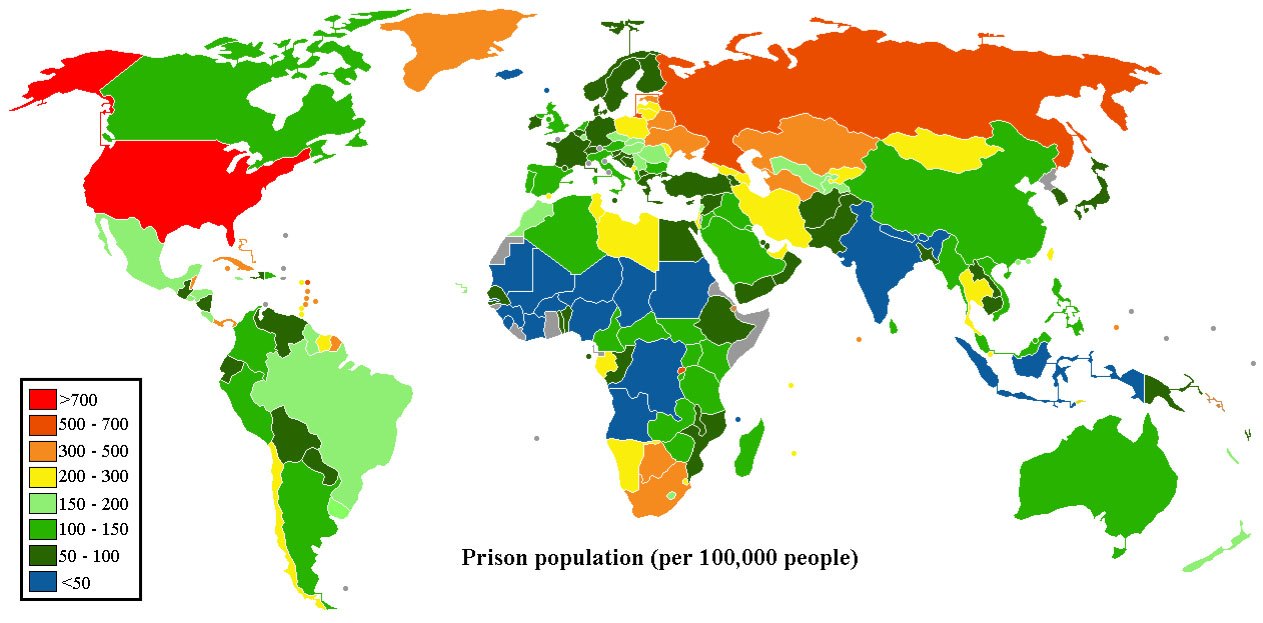
The United States has 4.47% of the world’s population (2012).  The United States has (depending upon which study you use) 23%-25% of the world’s prisoners.  The incarceration rate in the US is 5 times the average for the rest of the world.  In the graphic above, the US is the only country in the world colored bright red at greater than 750 per 100,000 population.

At an incarceration rate of 750 per 100,000, 1 out of every 133 adults in the US is in prison/jail.  Now, considering the fact that the incarceration rate for males in the US is 13 times higher than for females, this means that approximately 1 out of 67 adult males in the US is in prison.

The actual number of people in prison in the US is approximately 2.3 million.  But get this – there are an additional 5 million on probation or parole!

Does anybody else find find these to be staggering statistics?

Take a look at the chart below:

.

The incarceration rate in the US is 6-10 times that of other industrialized countries with which we typically compare ourselves – Europe, Canada, Australia, Japan.

Continue reading

Former Supreme Court Justice’s Work for Wrongfully Convicted Sheds Light on Justice

Among the many misconceptions about the criminal justice system revealed through DNA exonerations is the myth that conviction errors will get corrected on appeal.  The Innocence Project now lists 292 DNA-proven wrongful convictions. Many of these unfortunate people had exhausted a lengthy appeals process before DNA finally proved their innocence. Former New Jersey Supreme Court Justice Virginia Long, who has committed to working for the wrongfully convicted, recently provided insights into why the courts do not Continue reading

Lessons from Abroad: Reforming the Nigerian Police

In Nigeria, the police is vilified virtually by everybody that have had the ‘misfortune’ to come into contact with them. Much of this vilification, hinges on their lack of professionalism, indiscipline, corruption and bad policing strategies. The response of the police to this, has always been lack of resources, proper training, and the fact that they are also a mirror, reflecting the values – positive or negative – of the larger Nigerian society. The truth of the matter lies in-between both contentions.

The Police Service Commission is the apex Commission charged with the discipline, promotion and regulation of all police officers in Nigeria. They have the statutory responsibility of shaping the values, ethos as well as enforcing those good and bad conducts of the police. The Commission ironically is still obscured to many Nigerians, except of course during elections and electioneering campaigns, when they put out warning and information notices to appeal to Nigerians.

Reading the article by A. M. Blackmore entitled – Correcting Miscarriages of Justice http://www.odpp.nsw.gov.au/speeches/CORRECTING%20MISCARRIAGES%20OF%20JUSTICE.html you cannot but get the feeling that the Nigerian Police Service Commission needs to be re-jigged; in concert with the Office of the Federal Attorney General of the Federation. As identified by Blackmore in the said article, the usefulness of the outcomes of the Royal Commission in the New South Wales Police Service, cannot be over emphasised; same can be deployed to deal with the Nigerian situation. Of course, with necessary modifications to suit the Nigerian clime.

A top to bottom strategy will ensure proper reform is achieved, which can then be passsed down the line to the rank and file. The recurring cases of miscarriages of justice in Nigeria leaves much to be desired. Without prejudice to the numerous Commissions, Committees and ‘White Paper’, there is the urgent need to shake up the Nigerian police force. With the recent confirmation of the new Inspector General of Police, M.D. Abubakar, there is no better time than now, to start re-thinking alternative policing strategies that will deliver for the Nigerian people. Read report here http://saharareporters.com/news-page/md-abubakar-confirmed-inspector-general-police-photos

The root causes of miscarriages of justice and wrongful convictions in Nigeria, can be tackled in large part with a functional and professional police force.