Category Archives: Exonerations

Arizona Justice Project Secures Release of Man Convicted in Alleged ‘Shaken Baby’ Death

The Arizona Justice Project has great news to share about a win in a shaken baby case.  Last week, Drayton Witt walked out of jail after the State agreed to vacate his conviction.   He was convicted back in 2002 of second-degree murder after being accused of shaking Steven, his son who was only 4 months 28 days old, to death.

Steven Witt was born a “blue baby” with the umbilical cord wrapped tightly around his neck, had aspirated meconium (fecal matter), and was in respiratory distress.  Steven suffered medical problems almost every day of his short life and was in and out of doctors’ offices and hospitals.  After being prescribed medicine (Cefzil), Steven began to suffer from seizures.   After the first seizure, Steven was taken to the hospital and spent 6 days in care of doctors.   On June 1, 2000, Steven suffered a catastrophic seizure, which led to his death.

The State charged Drayton Witt with second degree murder.  The State’s witnesses relied on the SBS triad – subdural hematoma, retinal hemorrhages, and cerebral edema to conclude that the baby must have been shaken by his father, the only adult with him at the time.  No cuts, no bruises, no grip marks, no fractures, no dislocations, nor spinal cord injuries – but the doctors at the children’s hospital in 2000 believed the “triad” of injuries meant an SBS homicide.

The Justice Project began working on this case in 2008 under the leadership of Carrie Sperling.   Five different experts in somewhat different fields reviewed the case and wrote their conclusions:

Dr. A. Norman Guthkelch, famed British pediatric neurosurgeon who authored the seminal paper on SBS and neurological injury acknowledged that aspects of SBS are now “open to serious doubt” and that a diagnosis of SBS as cause of death in Witt’s case was “inappropriate”.

Dr. Patrick Barnes, chief of pediatric neurology at Stanford, believed Steven Witt did not die of SBS but rather the medical records suggest a “classic picture of venous thrombosis” with no indicators of non-accidental trauma.

Dr. Horace Gardner (an ophthalmologist), Dr. John Lloyd (a biomechanics expert), Dr. Waney Squier (pediatric neuropathologist) and Dr. John Plunkett (forensic pathologist), all noted no evidence of the child being shaken to death, and – like Dr. Barnes – believed the child died of natural causes – most likely venous thrombosis, a condition the doctors at the Children’s Hospital in 2000 never even considered.

Perhaps most notably, the medical examiner at the time of Steven’s autopsy in 2000, re-examined the case and swore an affidavit stating:

“Based on my review of these materials from an expansive body of post-2000
SBS literature, as well as the significant developments in the medical and
scientific community’s understanding of SBS and several of the conditions
that mimic its symptoms, I have determined that I cannot stand by my
previous conclusion and trial testimony that Steven Witt’s death was a
homicide.  Steven had a complicated medical history, including unexplained
neurological problems. He had no outward signs of abuse. If I were to
testify today, I would state that I believe Steven’s death was likely the result
of a natural disease process, not SBS. It is my hope that the court will see fit to
revisit Drayton Witt’s conviction.”
Although the State is still considering a re-trial, our hearing last Wednesday – regarding Drayton’s conditions of release – was promising.   After hearing compelling testimony from Drayton and his wife (Steven’s mother), the judge released Drayton without bond and without conditions. We know that the battle is not over yet.  The State has until August to decide whether to try Drayton again.  We are encouraged, however, by this turn of events, and we hope this case is part of a growing trend.

A HUGE thank you to the phenomenal (pro bono) legal team – Carrie Sperling, Randy Papetti, Christina Rubalcava, and Erin Ronstadt.

Tuesday’s Quick Clicks…

  • Winston Strawn associate in Chicago volunteered time to free James Kluppelberg, who was exonerated last week after wrongfully convicted of arson
  • After deciding that a fountain was too expensive, the city of Lubbock, Texas still determined to find a way to honor exoneree Timothy Cole; attorney offers to pay for bronze sculpture of Cole
  • Exonerees press hard for reform in New York at legislative session starts to wind down

Informative New Video on Exoneration Registry….

Last week, we posted quite a bit about the new National Registry of Exonerations, which details more than 2,000 wrongful convictions in the U.S. since 1989.

Now there’s a video that summarizes and outlines the findings…..It’s an excellent piece to send around to friends and supporters interested in the movement….

Video here….

Saturday’s Quick Clicks…

Friday’s Quick Clicks…

Exoneration in Arson Case Today

From CBS.com:

Freedom is in the offing for a man wrongfully convicted of a deadly arson fire.

As WBBM Newsradio’s Bob Conway reports, it has been a long wait for James Kluppelberg, 46, who has been in prison for 24 years for a crime he did not commit.

Kluppelberg was convicted and sentenced to life in prison for setting fire to a building at 4448 S. Hermitage Ave. in the Back of the Yards neighborhood March 1984, leaving Elva Lupercio and her five children – Santos Jr. 10; Sonia, 8; Cristobel, 6; Yadira 4; and Anabel, 3 – dead, the Chicago Tribune recalled.

The initial investigation determined the fire to be accidental, but four years later, a supposed witness testified that he saw Kluppelberg at the scene, while a Fire Department investigator said the fire was arson.

A Tribune article from July 15, 1989, said Criminal Court Judge Loretta Hall Morgan found Kluppelberg guilty after a bench trial, largely on the testimony of supposed witness Duane Glassco – a convicted burglar who was Kluppelberg’s roommate.

The article said Glassco admitted to him that he had started the fire, and told him: “You know how I am when I feel I’m losing someone. I do stupid things,” the Tribune reported. But the meaning of that statement was never explained during the trial, the newspaper reported.

But defense attorneys said Glassco had an axe to grind with Kluppelberg, because his ex-girlfriend had left him for Kluppelberg a short time earlier, the Tribune reported.

Kluppelberg was mistakenly released from the Cook County Jail after being sentenced and fled to Georgia, where he was captured and returned to Illinois, the Tribune reported. A jail guard was later charged with letting Kluppelberg out in exchange for help getting cocaine, the newspaper reported.

On appeal, Kluppelberg’s defense attorneys said the fire was not an arson at all, and that advances in science since the incident had made that clear, the Tribune reported.

On Wednesday, the Cook County State’s Attorney’s office decided to dismiss the charges, on the grounds that prosecutors cannot prove guilt beyond a reasonable doubt, the Tribune reported.

Kluppelberg is expected to be released from the Menard Correctional Center later Thursday.

Sunday’s Quick Clicks…

Saturday’s Quick Clicks…

Friday’s Quick Clicks…

Breaking News: Texas Judge Recommends Exoneration for Woman on Death Row; Says Conviction Was Based on Junk Science…

Cathy Lynn Henderson

From Statesman.com (video story here):

The state’s highest criminal court should overturn the capital murder conviction of Cathy Lynn Henderson, once two days from execution for the 1994 death of an infant she was baby-sitting, a Travis County judge has recommended.

District Judge Jon Wisser said scientific discoveries into the causes of head trauma similar to the injury suffered by 3-month-old Brandon Baugh — and a change of heart from the prosecution’s star witness, former medical examiner Roberto Bayardo — mean no reasonable juror would convict Henderson if presented with the new evidence at trial.

“Testimony of the state’s chief experts was, at bottom, scientifically flawed,” Wisser wrote in findings dated May 14 and delivered Tuesday to the Court of Criminal Appeals.

After reviewing evidence via testimony and briefs, Wisser recommended that the appeals court dismiss Henderson’s conviction and return her case to Travis Continue reading

Breaking News: California Innocence Project Exonerates Brian Banks Today…

BRIAN BANKS

California Innocence Project director Justin Brooks blogged about this case previously here.

Today, Brian Banks, former football star and USC Trojan recruit, was exonerated….The “victim” recanted and admitted she lied at trial (the sex was actually consensual).  She did not come forward earlier because she didn’t want to “give the money back”–meaning the settlement that she obtained from the school where the rape allegedly occurred.   News coverage here, here, and here….

Coverage from earlier today about today’s court hearing here, here, and here

CNN video about his dreams of playing in the NFL here

CONGRATS TO BRIAN AND JUSTIN!!!!!

It’s never too late to exonerate…

Judges in the England and Wales Court of Appeal (which also has jurisdiction in Northern Ireland cases) have overturned the 30 year old convictions of two men, convicted as teenagers, of terrorism offences. One of the men, Stephen McCaul died in 1995, the other, Mr McDonald (pictured), is now seeking compensation. The two had made unreliable admissions to police as teenagers, without any adult oversight or legal advice. They admitted to offences that had not taken place. One had the mental age of a seven year old. Read the news here….

Compensation is What will Bring to ‘Closure’, the Travails of those Wrongfully Convicted

The subject of compensating wrongfully convicted persons, or persons who have suffered severe miscarriages of justice, will continue to define the work, and indeed, the success of the innocence movement. This is because, once public authorities are made to pay heftily, for their omissions, commissions – and sometimes glaring oversight and negligence – it will leave them in no doubt, that they either have to sit up and do a thorough job, or get slammed with huge monetary compensation for victims.

That is exactly what a Canadian, Romeo Phillion has just done, suing the Ontario government in Canada. After spending 32 odd years behind bars – for a murder he was later acquitted of – Romeo is believed to have served more prison time than any other wrongfully convicted person in Canada. He is suing for $14million. Read report of his odyssey in search of justice and compensation by Globalpost.

The morale here is that, cases such as these, drive home the point that public institutions must be alive to their responsibilities and act judiciously and judicially, in the prosecution of accused persons. Systems, procedures and checks must be in place every step of the way, even after conviction, for public authorities to continue to receive and consider evidence with an open mind; deal with new evidence with all sense of responsibility. The life and liberty of individuals are at stake here. As Romeo himself lamented ‘I did’nt do 32 years for nothing. I lost my freedom. Somebody’s got to pay for that’. Yes indeed,  somebody’s got to pay!

Reaction to Exoneration Registry Outside the U.S. Focuses on Death Row…

The big news yesterday was the release of the exoneration registry, which compiles more than 2,000 exonerations in the U.S. in the past 23 years.

Judging by media appearances today, the press outside the U.S. seems concerned mostly with what the registry shows about capital punishment in America….Examples:

US death row inmates exonerated nine times more often…(from the Turkish Press)

How America’s death penalty murder innocents…(from the UK)

Two false confessors, friend they implicated declared factually innocent

“There’s no statute of limitations on the truth.”

That is how Steven Drizin of the Center on Wrongful Convictions put it when he forwarded the good news that Michael Crowe and two friends had been declared factually innocent today in the 1998 murder of Crowe’s sister.

Drizin and Rob Warden lead off their excellent book, True Stories of False Confessions, with the story about the outrageous lengths police went to in their relentless effort to persuade Crowe and a teenage friend that they had committed the murder with a third youth despite all the evidence that they did not.

DNA later linked a transient police knew had been in the neighborhood to the crime, and the charges against the teenagers were dropped on the eve of their trial. Today’s ruling wipes clear all records of their arrests.

Tuesday’s Quick Clicks…

  • Discussion of new eyewitness identification law in Texas, which takes effect September 1st
  • Recent Colorado exoneree Robert Dewey is still struggling to survive. He’s now living off of food stamps and the generosity of a non-profit group that helps wrongfully convicted inmates.  “It was like being in a room full of people and you’re yelling and no one can hear you, that’s what it felt like,” added Dewey when asked to describe his time in Colorado’s Limon Correctional Facility
  • Pics and award winners of the Innocence Project of Florida’s recent annual gala
  • North Carolina Innocence Commission identifies William James Grimes, convicted of rape, as innocent, and sends his case to a 3-judge panel for further analysis
  • Tampa Bay Times calls for bold reforms in Florida to address wrongful convictions

Exonerations in the United States, 1989 – 2012 Report by the National Registry of Exonerations

First, please see Mark Godsey’s post from yesterday in which he introduces this report:   https://wrongfulconvictionsblog.org/2012/05/20/breaking-news-registry-unveiled-today-details-2000-wrongful-convictions-in-u-s-since-1989/

Here is the full text of the report:     exonerations_us_1989_2012_full_report

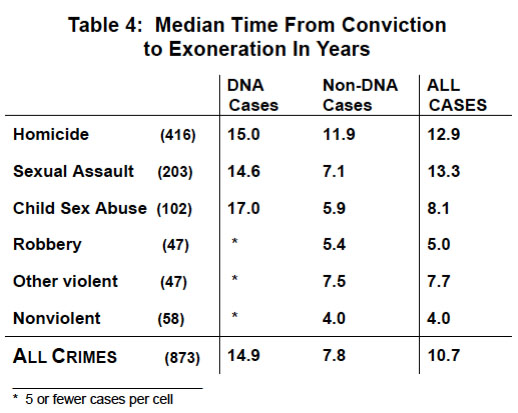
The report is lengthy (108 pages), and is a RICH source of wrongful conviction data.  And since I am a “data junkie”, I thought I’d post what I think are probably the two most telling of the tables in the report, so you don’t have to go looking for them – Table 4 and Table 13.

And please keep this in mind.  The report and it’s data are only for recognized exonerations, and only the ones the authors could find.  The US justice system makes an “exoneration” an incredibly difficult thing to achieve.  The report does not, and cannot, include all of the wrongfully convicted people who are still in prison or who have served a sentence and been released.

Breaking News: Groundbreaking Registry Unveiled Today Details 2,000 Wrongful Convictions in U.S. Since 1989…

New Report Reveals Many More Exonerations and False Convictions than Previously Found, but Represents Only “the Tip of the Iceberg”

More than 2,000 people who were falsely convicted of serious crimes have been exonerated in America in the past 23 years.

Nearly 900 of these exonerations are profiled, with searchable data and summaries of the cases on the National Registry of Exonerations, a new joint project of the University of Michigan Law School and the Center on Wrongful Convictions at Northwestern University.  The Registry, available atexonerationregistry.org, will be updated on an ongoing basis. It is by far the largest collection of such cases ever assembled – and the most varied.

More than 1,000 additional cases are “group exonerations” that occurred in response to 13 separate police corruption scandals, most of which involved massive planting of drugs and guns on innocent defendants. The group exonerations are described in a Report from the National Registry, Exonerations in the United States, 1989 – 2012, but are not included in the Registry itself.

As the Report documents in detail, there are many more false convictions and exonerations that have not been found

“The National Registry of Exonerations gives an unprecedented view of the scope of the problem of wrongful convictions in the United States,” said Rob Warden, Executive Director of the Center on Wrongful Convictions. “It’s a widespread problem.”

“It used to be that almost all the exonerations we knew about were murder and rape cases. We’re finally beginning to see beyond that,” said Michigan Law professor Samuel Gross, editor of the Registry and an author of the Report. “This is a sea change.”

The Report includes the following cases, most of which do not appear in any previous compilation:

·      58 exonerations for drug, tax, white collar and other non-violent crimes.

·      39 exonerations in Federal cases.

·      102 exonerations for child sex abuse convictions.

·      129 exonerations of defendants who were convicted of crimes that never happened.

·      135 exonerations of defendants who confessed to crimes they didn’t commit.

·      71 exonerations of innocent defendants who pled guilty.

Plus more than 1,000 group exoneration cases – including over 200 drivers who were framed for drunk driving by police officers, who usually stole money from their wallets in the process.

According to Gross, the cases in the Registry show that false convictions are not one type of problem but several that requiredifferent types of solutions.

·      For murder, the biggest problem is perjury, usually by a witness who claims to have witnessed the crime or participated in it. Murder exoneration also include many false confessions.

·      In rape cases, false convictions are almost always based on eyewitness mistakes – more often than not, mistakes by white victims who misidentify black defendants.

·      False convictions for robbery are also almost always caused by eyewitness misidentifications, but there are few exonerations because DNA evidence is hardly ever useful in robbery cases.

·      Child sex abuse exonerations are almost all about fabricated crimes that never occurred. (See Table 13.)

The ten states with the most exonerations are Illinois, New York, Texas, California, Michigan, Louisiana, Florida, Ohio, Massachusetts, and Pennsylvania (not counting the 39 exonerations in Federal cases).  The states with most exonerations are not necessarily those where most false convictions have occurred. (See Table 7.)

“It’s clear that the exonerations we found are the tip of an iceberg,” said Gross. “Most people who are falsely convicted are not exonerated; they serve their time or die in prison. And when they are exonerated, a lot of times it happens quietly, out of public view.”

For example, most people in the United States live in counties in which there have been no exonerations – including counties like San Bernardino in California and Bexar in Texas that have populations in the millions. “Obviously there are false convictions in those counties – and no doubt exonerations in some cases,” said Gross, “we just don’t know about them.”

According to Warden, “this is a good start – a milestone – but there’s a long way to go before we have a complete picture of wrongful convictions in the United States.”

“We’ve begun to find exonerations that don’t fit the mold we’re used to – some that were initiated by prosecutors or police, and some that were deliberately concealed – but we know there are many more that we haven’t found, at least not so far,” said Gross.

“If you’ve been exonerated and aren’t in this Registry, or if you know someone who has been exonerated and isn’t included, we want to know about it,” said Gross.

“The more we learn about false convictions, the better we’ll be at preventing them – or if that fails, at finding and correcting them as best we can after the fact,” said Gross.

Registry here…

Washington Post article here….

Chicago Sun-Times here

From USA Today:

Perjury, faulty eyewitness identification and prosecutorial misconduct are the leading reasons for wrongful convictions, according to the first national registry of exonerations compiled by university researchers.

The database, assembled in a collaboration by theUniversity of Michigan and  Continue reading

Updates on the Sam Hallam Exoneration this Week in the UK

Gerry Conlon, man wrongly convicted of the IRA Guildford pub bombings warns Hallam:

‘Coming out is like a second punishment.”

Miscarrriage of justice victim Sam Hallam celebrated his freedom with a pint, a plate of pie and mash, and an episode of his favourite sitcom Only Fools and Horses.

Friday’s Quick Clicks…