Author Archives: Mark Godsey

Losing sight of justice…

tunnel-vision1There have been a couple recent examples in the news of the kind of unfortunate attitude those in the Innocence Movement see all to frequently from judges and prosecutors who have lost touch with the notion of putting justice over winning.  In Ohio, a judge berated a jury after they acquitted a man.  You can imagine what kind of message that sends to jurors in that county who are called for jury duty next month or next year.  Unbelievably unprofessional conduct by a judge.  And in Chicago, a former prosecutor talks about how she quit after being demoted because she did not want to press forward with what she believed was an untenable prosecution.  Kudos to her for having the courage to speak publicly.

Tuesday’s Quick Clicks…

click
  • Arizona prosecutor opposes ethical rule requiring prosecutors to disclose evidence of a wrongful conviction
  • Dallas DA Craig Watkins, champion of the wrongfully convicted, draws challenger for 2014 election
  • Oklahoma Innocence Project files brief to free to men featured in John Grisham’s book The Innocent Man and in the book The Dreams of Ada
  • Colorado exoneree Robert Dewey may receive $1.2 million in compensation

New Scholarship Spotlight: The Daubert Counterrevolution

Professor David Bernstein has posted the above-titled article on SSRN.  Download here.  The Abstract states:

This Article reviews the history of the evolution of the rules for the admissibility of expert testimony since the 1980s, the revolutionary nature of what ultimately emerged, and the consistent efforts by counter-revolutionary judges to stop or roll back the changes, even when the changes were codified into Federal Rule of Evidence 702.

Part I reviews the law of expert testimony through the Supreme Court’s Daubert decision. Critics had charged for decades that the adversarial system was a failure with regard to expert testimony.

Parties to litigation, they argued, often presented expert testimony of dubious validity because it supported their positions, while lay juries were incapable of discerning which side had the better case. However, it took the rise of toxic tort litigation based on questionable causation theories and the attendant threat to multi-billion dollar industries to provoke a meaningful response from the courts, a sudden and dramatic shift toward stricter admissibility standards.

Part II describes the Daubert trilogy and the emergence of amended Rule 702. A pattern emerged of the Supreme Court attempting to strengthen the rules governing expert testimony, some lower courts resisting, and the Court responding by issuing a new opinion clarifying the courts’ new “gatekeeping” responsibilities. Eventually, an amendment to Federal Rule of Evidence 702 codified the Daubert trilogy, and did so with language that removed ambiguities and loopholes exploited by judges who had been inclined to try to evade the Court’s rulings.

Nevertheless, as Part III describes, some federal judges have continued to apply significantly more lenient standards for expert testimony than Rule 702 allows. They do so by ignoring the language of Rule 702, and instead relying on precedents from a bygone era. The First Circuit’s Milward opinion, described in detail in Part III, demonstrates many errors and fallacies common to judges who have chosen to resist the Daubert revolution.

The underlying issue theme tying the history of, and present controversy over, the admissibility of evidence in toxic tort litigation is a dispute over the underlying rationale for having special rules for the admissibility of expert testimony. Judges that favor more liberal rules for admissibility believe that the rules are meant to address only the problem “junk science” – scientific testimony that not only falls outside the scientific mainstream, but does so in the face of well-accepted contrary evidence.

More restrictive judges, by contrast, are addressing the broader problem of “adversarial bias” that results from our legal system allowing the parties to choose their own experts. In short, parties to litigation have a natural inclination to choose experts whose views match their theory of the case, even if those experts are outliers or hired guns. Rule 702 tries to limit this problem by insisting that experts show an objectively verifiable basis for their testimony, so that the trier of fact is not in the position of relying on the mere ipse dixit of an expert chosen solely because his views are consistent with the partisan position of a party to litigation.

This Article concludes by discussing some of the factors that have led some federal judges to defy Rule 702. The author contends that the Supreme Court should take an appropriate opportunity to crack down on such judicial rebellion, for two reasons. First, Rule 702 is the law of the land, and federal judges are obligated to enforce it regardless of their personal views on what expert testimony should be admissible. Second, Rule 702 represents a constructive effort to confront the problem of adversarial bias while retaining the basic contours of broader adversarial process.


Judge fires 34-year court veteran for helping man wrongfully convicted of rape

From deseretnews.com:

KANSAS CITY, Mo. — A Kansas City man freed from prison three decades after being wrongfully convicted of rape considers Sharon Snyder his “angel” for giving him a public document that showed him how to properly seek DNA tests. A Jackson County Circuit judge considers the 34-year court employee an insubordinate for offering legal advice and being too chatty about courthouse matters.

Sharon Snyder, a 70-year-old great-grandmother who was fired nine months before she was scheduled to retire, sees herself somewhere in the middle and insists she would provide the same help if she had a chance to do it again.

Robert Nelson, 49, was convicted in 1984 of a Kansas City rape that he insisted he didn’t commit and sentenced to 50 years for forcible rape, five years for forcible sodomy and 15 years for first-degree robbery. The judge ordered the sentence to start after he finished serving time for robbery convictions in two unrelated cases prior to the rape conviction.

Those sentences ended in 2006.

In August 2009, Nelson filed a motion seeking DNA testing that had not been available at his trial 25 years earlier, but Jackson County Circuit Judge David Byrn denied the request. Two years later Nelson asked the judge to reconsider, but again Byrn rejected the motion because it fell short of what was required under the statute Nelson had cited.

After the second motion failed in late October 2011, Snyder gave Nelson’s sister, Sea Dunnell, a copy of a motion filed in a different case in which the judge sustained a DNA request.

Nelson used that motion — a public document Dunnell could have gotten if she had known its significance and where to find it — as a guide for a motion he filed Feb. 22, 2012, again seeking DNA testing. That August, Byrn sustained the motion, found Nelson to be indigent and appointed Laura O’Sullivan, legal director of the Midwest Innocence Project, to represent him.

The Kansas City Police Department’s crime lab concluded last month that DNA tests excluded Nelson as the source of evidence recovered from the 1983 rape scene and he was freed June 12.

“She gave me a lot of hope,” Nelson said of Snyder. “She and my sister gave me strength to go on and keep trying. I call her my angel. She says she’s not, but she truly is.”

Five days after Nelson was released, Court Administrator Jeffrey Eisenbeis took Snyder into Byrn’s office near closing time and told her the prosecutor and defense attorney “had a problem” with her involvement in the case. She was suspended without pay, ordered to stay out of the courthouse unless she had permission to be there and scheduled to meet with a human resources investigator June 20.

“At first I didn’t know if my pension was going to be intact, and all I could do was curl up in a fetal position and cry,” said Snyder, who had been planning to retire in March. She later found out her pension would be just fine.

Byrn fired her June 27, telling her she had violated several court rules by providing assistance to Nelson and talking about aspects of the case, even while under seal, to attorneys not involved in the matter.

The judge’s dismissal letter cites numerous recorded phone conversations between Dunnell and Nelson in which they discussed Snyder’s efforts, including the document she provided that Nelson used in his successful DNA motion.

“The document you chose was, in effect, your recommendation for a Motion for DNA testing that would likely be successful in this Division,” Byrn wrote. “But it was clearly improper and a violation of Canon Seven … which warns against the risk of offering an opinion or suggested course of action.”

Court spokeswoman Valerie Hartman said Byrn and other court officials wouldn’t comment on the story for a number of legal and ethical reasons, in addition to it being a personnel matter. Nelson’s attorney, O’Sullivan, also declined to comment.

“I lent an ear to his sister, and maybe I did wrong,” Snyder said. “But if it was my brother, I would go to every resource I could possibly find.

“I think I might have been the answer to his prayers.”

Scientists Applaud FBI’s Decision To Review Reliability Of Forensic Hair Analysis

From Mintpressnews.com:

The FBI announced last week it would reexamine thousands of once-closed cases in which a person was convicted — and in some cases put to death —  based on hair samples. Known as microscopic hair comparison analysis, this type of testing was often used to link a criminal defendant to a crime, but its reliability has now been called into question.

The FBI said that in more than 2,000 cases from 1985 to 2000, analysts may have exaggerated the significance of hair analyses or reported them inaccurately. All defendants affected by the inaccurate analyses will be notified and offered free DNA testing if errors in are found in the FBI’s lab work or testimony.

According to a report from The Washington Post, more than 120 convictions have been flagged as suspicious in the FBI’s review thus far. Of those cases, 27 defendants received the death penalty as their punishment.

In addition to reviewing individual cases, the FBI is also using the review process to improve lab training, testimony, audit systems and research.

“There is no reason to believe the FBI Laboratory employed ‘flawed’ forensic techniques,” Special Agent Ann Todd, a spokeswoman for the FBI, said. “The purpose of the review is to determine if FBI Laboratory examiner testimony and reports properly reflect the bounds of the underlying science.”

The review includes every case between 1985 and 2000 in which the FBI found a positive association between hair taken from defendants and hair found at a crime scene.

Those who pushed for the review included the national nonprofit Innocence Project, the National Association for Criminal Defense Lawyers and its partners, which included pro bono attorneys.

Since DNA testing can cost several thousand dollars, hair analysis is often used to link a defendant to a crime scene. However, the practice was deemed “highly unreliable” in 2009 by a National Academy of Sciences report that concluded hair sample analyses cannot be linked to one person, but only categories of people.

Despite the poor reliability, Todd says microscopic hair analysis is “a valid forensic technique and one that is still conducted at the lab” along with DNA testing.

Peter Neufeld, co-director of the Innocence Project, applauded the FBI’s admission that there may be an issue with the validity of some of the findings in the cases.

“The government’s willingness to admit error and accept its duty to correct those errors in an extraordinarily large number of cases is truly unprecedented,” he said in a press release.

The review “signals a new era in this country that values science and recognizes that truth and justice should triumph over procedural obstacles,” Neufeld said. “Unfortunately hair analysis is only one of many flawed forensic practices that are still used that pose the threat of infecting criminal trials across the nation.”

“It is possible to conduct hair microscopy and find similarities among various samples. But it appears that in many cases the FBI analysts were overstating the significance of these similarities, often leaving juries with the false impression that a hair recovered from the crime scene must have come from the defendant and could not have come from anyone else,” he added. “The government is now acknowledging that this was wrong and that the science does not support such conclusions,”

Until all of the cases can be analyzed and verified for accuracy, officials from the Justice Department have waived the deadlines and procedural hurdles for those inmates who are currently on death row.

Steven D. Benjamin, a Virginia attorney and the president of the National Association for Criminal Defense Lawyers, said the Justice Department’s decision to delay the execution of those defendants whose innocence is once again up for debate is a critical step in “giving wrongly convicted people a fair chance at a fair review.”

“We hope that the actions taken by the FBI and DOJ will serve as a model for state law enforcement and crime laboratories throughout the country to respect ethical obligations to reverse wrongful convictions when learning about improper evidence,” said Norman Reimer, executive director of the association.

Though groups like the Innocence Project don’t often find themselves endorsing the FBI’s efforts, the organization’s leaders have all publicly applauded the FBI for the review. They say it is an important first step in “bringing together the law enforcement and defense communities in pursuit of the shared objective of ensuring that only the guilty are convicted and that only scientifically valid forensic science is used in our criminal justice system.”

Wednesday’s Quick Clicks…

click
  • Exoneree Brian Banks launches blog on Atlanta Falcons training camp
  • DOJ waives procedural bars in FBI hair analysis case reviews with Innocence Project
  • The Oklahoma Innocence Project is working to overturn the conviction of a man imprisoned for the 1984 kidnapping and murder of convenience store clerk in Ada.  The Innocence Project at Oklahoma City University’s School of Law announced Wednesday its plan to file an application for post-conviction relief in the case of 48-year-old Karl Fontenot, one of two men initially sentenced to die for the 1984 killing of Donna Haraway. It is the first case the project has sought to overturn since it was created in 2011.  After two separate trials, Fontenot is currently serving life without parole.
  • Forensics on trial

New Scholarship Spotlight: What is a Miscarriage of Justice? The Irish Answer to an International Problem

Vicky Conway and Jennifer Schweppe have posted the above-titled article on SSRN. Download here.  The abstract states:

We inherently link miscarriages of justice with innocence. Yet the language of the term is not so restrictive, and implies that a broader definition can be contemplated, one encompassing all cases in which justice has not been done or carried. This article will begin by considering why the definition and application of the term is so problematic, followed by a conceptual and theoretical discussion of the term ‘miscarriage of justice’. It will then look at why the change in Irish law occurred in 1993 with the passing of the Criminal Procedure Act, with a short overview of the new law. The focus will then turn to a substantive discussion of the case law on the issue, charting the evolution of the definition and difficulties that faced the judiciary. The article will conclude with a discussion supporting the approach of the Irish judiciary, arguing that it presents an important challenge to legal systems internationally.

Tuesday’s Quick Clicks…

click
  • Wisconsin exoneree Joseph Frey sadly now homeless
  • Taxpayers will pay nearly $500,000 for legal fees in the Michael Morton case
  • The Innocence Project (Cardozo), the National Association for Criminal Defense Lawyers (NACDL) and its partners announced a groundbreaking and historic agreement with the FBI and the Department of Justice (DOJ) to review more than 2,000 criminal cases in which the FBI conducted microscopic hair analysis of crime scene evidence.
  • Andrew Johnson exonerated by DNA in Wyoming

New Scholarship Spotlight: Gideon’s Amici: Why Do Prosecutors So Rarely Defend the Rights of the Accused?

Fordham law professor Bruce Green has posted the above-titled article on SSRN.  Download article here.  The abstract states:

In Gideon v. Wainwright, twenty-three state attorneys general, led by Walter F. Mondale and Edward McCormack, joined an amicus brief on the side of the criminal accused, urging the Supreme Court to recognize indigent defendants’ Sixth Amendment right to appointed counsel in felony cases. This was a unique occurrence. Although amicus filings by public entities have increased significantly since then, including in criminal cases, government lawyers rarely submit amicus briefs in the Supreme Court supporting criminal defendants’ procedural rights, and never en masse as in Gideon. The states’ public support for Gideon’s position points up the special nature of the right to a defense lawyer — a right that is fundamental to a fair trial and to avoiding wrongfulconvictions and which most states had already recognized as a matter of state law by the time Gideon was argued. Although Gideon was special, there have been recent Supreme Court criminal cases in which progressive government lawyers might similarly have supported recognition of the procedural right in issue. This Essay identifies philosophical, practical, and political reasons that might explain government lawyers’ unwillingness to take the defense side on questions before the Court, but argues that these rationales are not entirely convincing. The Essay concludes that, consistent with their duty to seek justice, government lawyers should play a stronger role in promoting criminal procedural fairness by occasionally serving as Supreme Court amici on the defense side.

Friday’s Quick Clicks…

click

U.S. reviewing 27 death penalty convictions for FBI forensic testimony errors

From the WashingtoPost:

An unprecedented federal review of old criminal cases has uncovered as many as 27 death penalty convictions in which FBI forensic experts may have mistakenly linked defendants to crimes with exaggerated scientific testimony, U.S. officials said.

The review led to an 11th-hour stay of execution in Mississippi in May.

How accurate is forensic analysis?

Learn more about the reliability of each type of forensic analysis.

DNA

Fingerprint

Handwriting

Polygraph

Firearm evidence

Hair and
fiber

Pattern and impression

Bullet lead composition

Independent scientists critique suspect forensic work

Select a name below to see case reviews

It is not known how many of the cases involve errors, how many led to wrongful convictions or how many mistakes may now jeopardize valid convictions. Those questions will be explored as the review continues.

The discovery of the more than two dozen capital cases promises that the examination could become a factor in the debate over the death penalty. Some opponents have long held that the execution of a person confirmed to be innocent would crystallize doubts about capital punishment. But if DNA or other testing confirms all convictions, it would strengthen proponents’ arguments that the system works.

FBI officials discussed the review’s scope as they prepare to disclose its first results later this summer. The death row cases are among the first 120 convictions identified as potentially problematic among more than 21,700 FBI Laboratory files being examined. The review was announced last July by the FBI and the Justice Department, in consultation with the Innocence Project and the National Association of Criminal Defense Lawyers (NACDL).

The unusual collaboration came after The Washington Post reported last year that authorities had known for years that flawed forensic work by FBI hair examiners may have led to convictions of potentially innocent people, but officials had not aggressively investigated problems or notified defendants.

At issue is a once-widespread practice by which some FBI experts exaggerated the significance of “matches” drawn from microscopic analysis of hair found at crime scenes.

Since at least the 1970s, written FBI Laboratory reports typically stated that a hair association could not be used as positive identification. However, on the witness stand, several agents for years went beyond the science and testified that their hair analysis was a near-certain match.

The new review listed examples of scientifically invalid testimony, including claiming to associate a hair with a single person “to the exclusion of all others,” or to state or suggest a probability for such a match from past casework.

Whatever the findings of the review, the initiative is pushing state and local labs to take similar measures.

For instance, the Texas Forensic Science Commission on Friday directed all labs under its jurisdiction to take the first step to scrutinize hair cases, in a state that has executed more defendants than any other since 1982.

Separately, FBI officials said their intention is to review and disclose problems in capital cases even after a defendant has been executed.

“We didn’t do this to be a model for anyone — other than when there’s a problem, you have to face it, and you have to figure how to fix it, move forward and make sure it doesn’t happen again,” FBI general counsel Andrew Weissmann said. “That tone and approach is set from the very top of this building,” he said, referring to FBI Director Robert S. Mueller III.

David Christian “Chris” Hassell, director of the FBI Laboratory, said the review will be used to improve lab training, testimony, audit systems and research, as it has done when previousbreakdowns were uncovered. The lab overhauled scientific practices when whistleblowers revealed problems in 1996 and again after an FBI fingerprint misidentification in a high-profile 2003 terrorism case, he said.

“One of the things good scientists do is question their assumptions. No matter what the field, what the discipline, those questions should be up for debate,” Hassell said. “That’s as true in forensics as anything else.”

How accurate is forensic analysis?

Learn more about the reliability of each type of forensic analysis.

DNA

Fingerprint

Handwriting

Polygraph

Firearm evidence

Hair and
fiber

Pattern and impression

Bullet lead composition

Independent scientists critique suspect forensic work

Select a name below to see case reviews

Advocates for defendants and the wrongly convicted called the undertaking a watershed moment in police and prosecutorial agencies’ willingness to re-open old cases because of scientific errors uncovered by DNA testing.

Peter J. Neufeld, co-founder of the Innocence Project, which supports inmates who seek exoneration through DNA testing, applauded the FBI, calling the review historic and a “major step forward to improve the criminal justice system and the rigor of forensic science in the United States.”

Norman L. Reimer, executive director of the NACDL, also praised the effort, predicting that it would have “an enormous impact on the states” and calling on the defense bar to represent indigent convicts.

“That’s going to be a very big job as this unfolds,” said Reimer, whose group has spent 1,500 hours identifying cases for the second round of review.

Under terms finalized with the groups last month, the Justice Department will notify prosecutors and convicted defendants or defense attorneys if an internal review panel or the two external groups find that FBI examiners “exceeded the limits of science” when they claimed to link crime scene hair to defendants in reports or testimony.

If so, the department will assist the class of prisoners in unprecedented ways, including waiving statutes of limitations and other federal rules that since 1996 have restricted post-conviction appeals. The FBI also will test DNA evidence if sought by a judge or prosecutor.

The review will prioritize capital cases, then cases in which defendants are imprisoned.

Unlike DNA analysis, there is no accepted research on how often hair from different people may appear the same.

The federal inquiry came after the Public Defender Service helped exonerate three D.C. men through DNA testing that showed that three FBI hair examiners contributed to their wrongful convictions for rape or murder in the early 1980s.

The response has been notable for the department and the FBI, which in the past has been accused of overprotecting its agents. Twice since 1996, authorities conducted case reviews largely in secret after the scientific integrity of the FBI Lab was faulted.

Weissmann said that although earlier reviews lawfully gave prosecutors discretion to decide when to turn over potentially exculpatory material to the defense, greater transparency will “lessen skepticism” about the government’s motives. It also will be cheaper, faster and more effective because private parties can help track down decades-old cases.

Scientific errors “are not owned by one side,” he said. “This gives the same information to both sides, and they can litigate it.”

The review terms could have wide repercussions. The FBI is examining more than 21,000 federal and state cases referred to the FBI Lab’s hair unit from 1982 through 1999 — by which time DNA testing of hair was routine — and the bureau has asked for help in finding cases before lab files were computerized in 1985.

Of 15,000 files reviewed to date, the FBI said a hair association was declared in about 2,100 cases. Investigators have contacted police and prosecutors in more than 1,200 of those cases to find out whether hair evidence was used in a conviction, in which case trial transcripts will be sought. However, 400 of those cases have been closed because prosecutors did not respond.

On May 7, Mississippi’s Supreme Court stayed the execution of Willie Jerome Manning for a 1992 double homicide hours before he was set to die by lethal injection.

FBI cases may represent only the tip of the problem.

While the FBI employed 27 hair examiners during the period under review, FBI officials confirmed for the first time this week that records indicate that about 500 people attended one-week hair comparison classes given by FBI examiners between 1979 and 2009. Nearly all of them came from state and local labs.

State and local prosecutors handle more than 95 percent of violent crimes.

In April, the accreditation arm of the American Society of Crime Laboratory Continue reading

What China’s Wrongful Convictions Mean for Legal Reform

From the WallStreetJournal:

Two prominent judges have recently issued sharp critiques of China’s judicial system, leading to optimism in some quarters that long-awaited legal reforms could finally be on their way.

Shen Deyong, appointed earlier this year to his post as executive vice-president of the Supreme People’s Court, in May took the country’s legal system to task for its high numbers of wrongful convictions, blaming pressures placed on judges. Earlier this month, the head of the Guangdong Provincial High Court went even further, criticizing the continued use of a Soviet-style system in which the courts are undifferentiated from administrative agencies.

Advocates of legal reform are right to feel encouraged. The high positions of both judges and the directness of their comments suggest that higher authorities approved their views. But, as is often the case, there are caveats.

The discovery of wrongful convictions is nothing new in China, but publicity around them has grown in recent months posing a challenge to the reputation of China’s courts.

In November, media widely reported the case of man in Guangdong province who was awarded 825,000 yuan ($131,000) in compensation after serving 11 years in prison for a fraud he didn’t commit.

In April, a farmer in Henan was released after spending 12 years in prison for the rape and murder of a 13 year-old girl when the province’s high court overturned his conviction for lack of evidence.

Two cases in eastern China’s Zhejiang province have also attracted widespread attention:  In April, the provincial high court overturned a death sentence and a 15-year prison term for two men convicted of the murder of a woman in Hangzhou after determining their confessions were coerced. And in early July, the high court reversed the 1997 conviction of five men accused of robbing and killing two taxi drivers, also after finding the men had been tortured into confessing.

The number of these cases and the flagrancy of the injustice they reveal suggest powerful reasons for reform.

In an article published in the People’s Court Daily in May, Judge Shen described such glaring miscarriages of justice as “an unprecedented challenge” to China’s courts, adding that “if a true criminal is released, heaven will not collapse, but if an unlucky citizen is wrongfully convicted, heaven will fall.”  Wrongful convictions, he wrote, “are often the result of given orders, an abandonment of principles or sloppy dereliction of duty.”  In Judge Shen’s words, Chinese judges “face intervention and pressure from all sides,” preventing them from acting independently.

The Global Times, an English-language paper under the control of the Communist Party mouthpiece People’s Daily, reported on Judge Shen’s article in a manner reflecting approval, noting that he emphasized the need to counter the persistent influence of the presumption of a suspect’s guilt.  A partner in a Chinese law firm was quoted as saying that the recent reversals of convictions mentioned above are “a signal from the central authorities to actively push for judicial justice by correcting faults, and these efforts have to be strengthened in the whole system.”

The article further quoted Beijing Law School Professor Jiang Ming’an, a well-known advocate of law reform, saying “it was rare to see so many corrections of wrongful convictions.”

It should be noted that Judge Shen’s call is not just about the courts. He is attentive to the need to mobilize other agencies in what is commonly referred to as the “political-legal system”– police, the procuracy (prosecutors) and courts.  He was reported to have urged, in a seminar in Guangzhou, that courts must work with police and procuracies “to safeguard judicial justice through cooperation as well as systems of checks and balances.”

He also stressed in his article that Communist Party leadership is necessary to carry out reform.

Judge Shen is more than a single voice for law reform. Zhou Qiang, appointed early this year as president of the Supreme People’s Court, has also made calls for lawyers and legal scholars to join together in the effort to reform China’s legal system.

In his own critique earlier this month, Judge Zheng E, president of the Guangdong Province Higher People’s Court, took aim at the judicial system’s basic structure.

Judge Zheng accurately described the system as heavily influenced by an “outdated Soviet-style model that treats the courts as just another government agency” in which judges’ decisions are reviewed by court superiors and the courts are financed by local governments, which can interfere with the outcomes of specific case.  He referred to pilot projects in two cities in Guangdong “where judges are allowed to rule [sic] their own cases without seeking guidance from superiors.”

Such statements from senior judges so soon after they assumed their posts suggest change may indeed by coming. Yet there are reasons to be cautious.

Teng Biao, a lecturer at the China University of Politics and Law in Beijing, characterized Judge Shen’s article as “a good statement,” but warned that it was “likely to be just personal views.” Even if the courts want to change, he said, “they remain restrained by public security organs and the [Communist Party’s] Politics and Law Committee.”

Chinese and foreigners alike must wait for further developments before it will be possible to ascertain whether progress is likely, and how soon it will appear.

However important law reform may be, the current emphasis of the leadership on economic reform will dominate policy for the foreseeable future.  Looking ahead, systemic reforms will require not only inter-agency consultation and debate, but changes in the mentality of judges and officials.

For now, Judge Shen’s words have begun to resonate with proponents of law reform, and give them a glimmer of hope for progress.


Tuesday’s Quick Clicks….

click

New Scholarship Spotlight: Innocent Defendants: Divergent Case Outcomes and What They Teach Us

A group of scholars, including Richard Leo, have posted the above-titled article on SSRN.  Download here.  The abstract states:

Why are some innocent defendants convicted and spend years in prison before exoneration (“erroneous convictions”), while others are released before trial or are acquitted on the basis of their factual innocence (“near misses”)? What factors could have predicted these dramatically divergent outcomes? The authors seek to answer these questions using advanced statistical and comparative social science methodologies. This chapter reports the results from a large scale empirical research project that compares case outcomes following the indictment of 460 factually innocent defendants for a violent felony. Two hundred of these cases ended in a near miss, and the remaining 260 defendants were erroneously convicted. The authors conclude that a number of variables, including the age and criminal history of the defendant, the punitiveness of the state, Brady violations, forensic error, a weak defense and weak prosecution case, a family defense witness, a non-intentional misidentification, and lying by a non-eyewitness, can predict case outcome. Moreover, these individual factors are connected and exacerbated by tunnel vision, which prevents the system from self-correcting once an error is made and leads to general system failure. The authors conclude by suggesting reforms that will allow the legal community to improve its ability to justly adjudicate cases of innocent defendants in the future.

Prosecutors in Zimmerman Trial Circle Their Wagons and Send a Message……

From source:

State Attorney Angela Corey fired her office’s information technology director Friday after he testified last month about being concerned prosecutors did not turn over information to George Zimmerman’s defense team in the shooting death of Trayvon Martin.

On the same day attorneys finished their closing arguments in that nationally watched trial, a state attorney investigator went to Ben Kruidbos’ home about 7:30 a.m. to hand-deliver a letter stating Kruidbos “can never again be trusted to step foot in this office.”

The letter contended Kruibos did a poor job overseeing the information technology department, violated public records law for retaining documents, and noted he was questioned in March when the office was trying to determine who had leaked personnel information obtained through a computer breach.

In an interview Friday, Kruidbos denied the allegations in the letter, which was written by Cheryl Peek, the managing director of the State Attorney’s Office.

He said he had acted in good faith about “genuine concerns.” He said he had been proud to work at the State Attorney’s Office and feared the letter would cripple his chances at finding another job to support his family, including a 4-month-old son.

“I don’t have any regrets,” he said, “but I am terrified about the future and what that will end up being.”

His attorney Wesley White — who resigned from the State Attorney’s Office in December and is a critic of Corey — said the firing was aimed at sending a message to office employees “that if they feel like there is wrongdoing,” they should not disclose it or seek legal guidance from a private attorney.

“If they do speak to an attorney, then they are dead,” he said. “The State Attorney’s Office will do whatever is necessary to not only terminate them, but destroy their reputations in the process.”

Jackelyn Barnard, spokeswoman for Corey and the State Attorney’s Office, did not return phone calls or emails for comment.

Kruidbos, 42, had been on paid administrative leave since May 28 from his $80,892 job.

In January, he used computer software technology to extract photographs and text messages from the source file in Martin’s cellphone. Kruidbos was able to recover more information than the Florida Department of Law Enforcement obtained previously.

GETTING LEGAL ADVICE

Kruidbos said he became concerned that lead prosecutor Bernie de la Rionda might not have turned over Kruidbos’ report to defense attorneys. Kruidbos asked White in April for legal advice and described some contents of his report such as a photo of an African-American hand holding a gun, a photo of a plant resembling marijuana and a text message referring to a gun transaction.

White then contacted one of Zimmerman’s attorneys and learned the defense had not received the report generated by Kruidbos. The defense did receive the source file from the cellphone and used its own experts to extract data.

Last month, Zimmerman’s attorneys subpoenaed both White and Kruidbos during a pretrial hearing on their motion seeking sanctions against prosecutors. Circuit Judge Debra Nelson deferred a ruling until after the trial.

Before Kruidbos’ name surfaced in the Martin trial proceedings, he received a pay raise for “meritorious performance,” according to a document dated May 16 in his personnel file.

But the dismissal letter written by Peek contends he did his job poorly as information technology director and said he should have asked someone in the office about his concerns regarding the Martin case.

“Your egregious lack of regard for the sensitive nature of the information handled by this office is completely abhorrent,” Peek wrote. “You have proven to be completely untrustworthy. Because of your deliberate, wilful and unscrupulous actions, you can never again be trusted to step foot in this office.”

The letter said Kruidbos “apparently questioned the ethics” of de la Rionda, who has been an assistant state attorney since 1983. “His record as an honorable and respected attorney is unblemished and beyond reproach,” Peek wrote.

Kruidbos said the question of de la Rionda’s ethics “is not really my place to decide.”

He said he asked White for legal advice because he was concerned he could face “legal exposure” if the cellphone report wasn’t turned over to the defense before the trial started.

He said he did not feel comfortable posing that question to anyone within the office because the State Attorney’s Office had just conducted an in-house probe of whether someone was leaking personnel information.

OFFICE ‘PARANOIA’

“It felt like everyone was on heightened sensitivity,” Kruidbos said. “It felt like the paranoia in the office had gotten worse.”

In March, the office investigated a security breach involving someone hacking computers to obtain disciplinary matters and personal health information about employees, according to Peek’s letter. That investigation followed news reports in February that Corey approved using about $342,000 in taxpayer dollars to upgrade pensions for herself and de la Rionda. Kruidbos said the investigation might have stemmed from the stories about the pensions.

Kruidbos said office administrators told him that he and Richard Komando, who was executive director of the office, were suspected of improperly obtaining the information. Komando resigned April 4. Kruidbos said he does not believe Komando was involved because “it makes no sense. He worked very hard to get to where he was. He had nothing to gain from that.”

Kruidbos had his job duties changed on April 3, removing eight employees from his supervision and curtailing his access to the computer system. But the investigation did not find he was involved in the computer breach or leaking any information. He has denied any involvement and testified last month to that effect.

As for why he did not approach Corey about his concerns in the Martin case, Kruidbos said Corey has a close relationship with de la Rionda and “any attempt by me to go to them and say I think something wrong has happened would not have been taken seriously, and then ultimately held against me.”

“I consulted an attorney, which is my right,” he said. “I had concerns about what I had seen at work, and this was just how it ended up playing out.”

Corey and others learned Kruidbos had hired White as his attorney when White, subpoenaed by the defense, identified Kruidbos by name at a May 28 hearing. Corey put Kruidbos on paid leave that same day.

Peek’s letter contends that on May 24, Kruidbos wiped clean the information on a computer assigned to him, thereby violating public records law. Kruidbos said he does not know what computer is referred to by the letter.

He said the computer network stores information on a number of backup systems in addition to personal computers.

White has a contentious relationship with Corey, but Kruidbos said that wasn’t a factor in him hiring White, whom he described as a “good lawyer who does the right thing.”

White said he and Kruidbos are reviewing their legal options in response to the dismissal.

White said he wants an outside review by a state attorney from another circuit.


Breaking News: Utah Supreme Court Affirms Debra Brown Exoneration…

Story here…Prior coverage here, here and here..Prior statement of Utah AG here

Breaking: Utah Supreme Court to Release Debra Brown Decision Today…

09-04-debra-brownFrom newssource:

SALT LAKE CITY – The Utah Supreme Court will release its decision Friday on whether a Cache County woman should remain exonerated for murder.

Debra Brown was released from prison in May 2011 after a judge found her factually innocent in the 1993 murder of her boss.

The Utah Attorney General’s Office says the judge was wrong and they want her convicted of the crime again. Brown’s attorneys say she had an alibi and didn’t kill him.

The Supreme Court’s decision could mean Brown remains free or she could go back to prison.


Friday’s Quick Clicks…

click
  • In Ohio, an appellate court upholds new trial for Dewey Jones, after DNA testing fails to show Jones’ DNA on any of the items handled by murderer
  • Series of wrongful convictions has caused some in China to consider cause of false confessions
  • New England Innocence Project looking for Executive Director
  • Senator Patrick Leahy honored by Mid-Atlantic Innocence Project
  • Kirk Bloodsworth—My case shows we need to abolish the death penalty
  • Exoneree Barry George loses compensation bid
  • Attorneys for a West Virginia inmate who has served more than a decade for a rape his lawyers claim DNA proves he didn’t commit are headed back to court to try to clear his name.  Harrison County Circuit Court Judge Thomas Bedell is considering whether to overturn Joseph Buffey’s conviction for the 2001 rape and robbery of an 83-year-old Clarksburg woman. Buffey pleaded guilty to the crime, but later said his confession was coerced.  A three-day hearing begins Wednesday. Bedell could rule this week or could take additional time.  A DNA test conducted on biological evidence left at the scene excluded Buffey as a contributor in 2011. Buffey’s attorneys fought for more than a year to have the DNA run through the national criminal database.  In November, authorities did so and it hit on another man, Adam Bowers, who is serving time for another assault and previously was convicted of breaking and entering.  Prosecutors charged Bowers with the crime, but they are fighting efforts to free Buffey.
  • Amanda Knox retrial to begin on September 30th

George Souliotes Freed

Photo by Donald Satterlee, Satterlee Photographs

Photo by Donald Satterlee, Satterlee Photographs

By Linda Starr, Northern California Innocence Project…

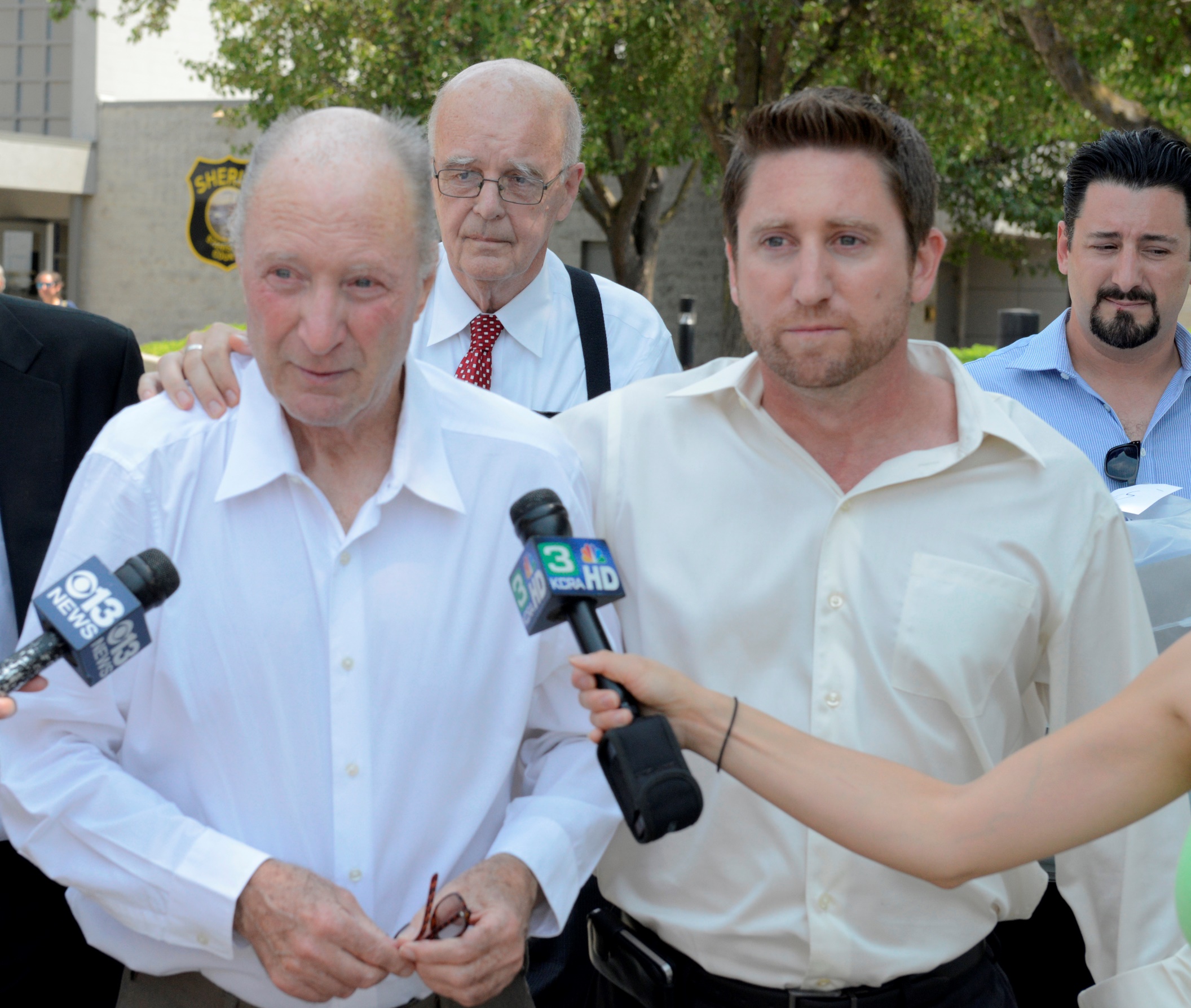
On July 3rd, Northern California Innocence Project client George Souliotes walked out of a Stanislaus County jail a free man, after his attorneys from NCIP, Morrison & Foerster, LLP and Orrick, Herrington & Sutcliffe, LLP successfully negotiated an agreement to secure his immediate freedom following 16 years of wrongful incarceration. Souliotes was wrongfully convicted of arson and triple murder in 2000. The state sought the death penalty but the jury instead voted for three life terms without parole. NCIP has worked on this case for more than 10 years – over which time dozens of our students have had the opportunity to work on the case.

The tortuous path of this case is worth reviewing as a classic demonstration of all that can go wrong with a criminal prosecution.  Mr. Souliotes’s first trial for murder and arson for the deaths of a mother and her two children in a fire in his rental home, resulted in a hung jury.  He was convicted in a second trial and his conviction was affirmed on direct appeal.  After losing the case on state habeas through the state courts, NCIP and our pro bono partner filed a federal habeas petition.  The district court dismissed the petition finding that some of the claims had been filed 5 days beyond the AEDPA statute of limitations.

The 9th Circuit then upheld that finding when our panel was forced to follow a different 9th Circuit panel that in Lee v. Lampert, 653 F.3rd1125 (9th Cir 2010) had only weeks earlier held that Schlup did not apply to an AEDPA statute of limitations violation.  Then, with the Innocence Network appearing as amici, the 9th Circuit granted en banc review of Lee and reversed, holding that a Schlup finding of actual innocence would permit a court to overlook an AEDPA statute of limitations violation. (Lee v. Lambert, 653 F.3rd 929 (9th Cir 2011)(en banc)).  Based on that new Lee decision, the 9th circuit reversed that part of the holding in our case as well and sent the matter to the district court for a Schlup actual innocence hearing.

We then had a Schlup hearing in federal district court, at which experts including Jennifer Dysart, Jim Lentini, Steve Carman, Thomas Streed, and others testified and after which the federal magistrate found and the district court agreed, that we had established that Mr. Souliotes was actually innocent and that his conviction was based on faulty fire science as well as a totally unreliable eyewitness identification.  The U.S. Supreme Court then granted cert in McQuiggin v. Perkins, putting the whole case again at risk for dismissal.

The magistrate and federal district court judge refused to stay the proceedings pending Perkins, considered the merits of the habeas petition and reversed the conviction based on ineffective assistance of counsel and ordered Mr. Souliotes released within 30 days unless the State took concrete and substantial steps to retry him before July 10, 2013.  The State announced that it would retry him and retrial had been set to begin on July 8.

When the state indicated its intent to retry Mr. Souliotes, renowned trial attorney Jim Brosnahan and his firm of Morrison and Foerster, including partners George Harris and Raj Chatterjee, as well as associates Chris Mangana and Andrew Bernick, and paralegal Tom Beyer, looked down the barrel of the gun and agreed to take this triple homicide to trial within 6 weeks!  Working with NCIP as well as with the Orrick team, Mr. Brosnahan led the retrial efforts that reached a turning point when a Stanislaus County Superior Court judge excluded both the outdated and faulty fire science and the testimony of the “eyewitness” as highly unreliable.

Under the terms of the agreement announced last Tuesday, Souliotes pled no contest to three counts of involuntary manslaughter for failure to maintain a working smoke alarm as required by the California Health and Safety Code. And the plea could be entered only after we thoroughly explored the potential immigration consequences with the superb immigration lawyer, Zackary Nightingale.

On July 3rd, Mr. Souliotes was released for time served.  The defense team and Mr. Souliotes maintain his absolute innocence.  But Mr. Souliotes, 72 years old and with health issues, along with his legal team and his family, decided that it was in his best interests to resolve the case before a third trial, so that he may return home to his family and friends immediately and without restrictions.

This case had an extraordinary contribution of pro bono assistance.  The herculean efforts of law firm of Orrick, Herrington and Sutcliffe, and in particular associate Jimmy McBirney, as well as associate Shannon Leung, and former associates Megan Crane, Randy Luskey, and Anne Hawkins resurrected this case from a draconian AEDPA death.  Their work in the federal court was nothing short of miraculous.

Cooley Godward, led by Lori Mason, filed amici on behalf of the Network, in Mr. Souliotes’s proceedings as well as in the Lee v. Lampert en banc proceedings, contributing to that critical reversal.   Lori and Cooley then also filed an important amicus brief in the U.S. Supreme Court on behalf of the Network in Perkins.

Throughout, the team received the terrific assistance of investigators Sheila Klopper and Grant Fine.

NCIP has investigated and litigated dozens of cases over the 12 years of our existence – this is our 17th victory since our creation.

But no case has so consumed our office for so many years.  No case has raised so many procedural hurdles and substantive issues as this case, including AEDPA pitfalls, faulty forensic science (of several kinds), newly discovered evidence, ineffective assistance of counsel, mistaken eyewitness identification, actual innocence, Vienna Convention issues, jury misconduct, and a witness whose own charges “went away” when she cooperated here.  The case required massive coordination of legal teams and management of the unpredictable press, with enormous pro bono assistance from the public relations firm of Sard Verbinnen, especially Lindsay Andrews, Jenny Gore and Reze Wong.

Discretion does not permit me to name the many prominent and influential people from the highest levels of politics, business and law who came to our aid over the years to try and negotiate with the state attorney general’s office to get them to see that justice required that they drop their procedural opposition to the case and let it proceed on the merits.

This win truly exemplifies the importance of the work that we all do.   It demonstrates how even with a miscarriage of justice so obvious to so many, it can be impossible to have a wrongful conviction overturned – particularly where deadlines matter more than innocence.  It demonstrates the extraordinary contributions of our pro bono partners who share our commitment to justice – this case has received more pro bono assistance than all of our other cases combined.

But I am mostly just blown away by Mr. Souliotes.  He knew that my father had recently passed away.  And when I called him after his release, after another of his many thank yous, his first thought was to ask about my ailing mother and how she was able to handle things.  He really makes it so easy to think about doing it all again.

Justice Scalia: Ensuring Innocent People Get Out Of Prison Is A ‘Faustian Bargain’

scalia-e1364082903791From thinkprogress.org:

A man who may be locked up for a murder he did not commit should not be allowed to challenge his conviction, according to Justice Antonin Scalia and his three most conservative colleagues. And three members of the Supreme Court seem to believe that most people jailed due to unconstitutional convictions should have no recourse to the federal courts. At least, that’s what emerges from a four justice dissenting opinion written by Scalia in a case dealing with the rights of state prisoners who may be “actually innocent” of the crime they were convicted of committing.

McQuiggin v. Perkins is a fairly unusual case. After being sentenced to life in prison for murder, Floyd Perkins spent years gathering three affidavits from witnesses corroborating his claim that another man committed the crime. Yet he sat on this new evidence for nearly six years before presenting it to a federal court. Justice Scalia’s dissent claims that a one year statute of limitations prevents Perkins from presenting six year-old evidence that he may be innocent. Justice Ruth Bader Ginsburg’s majority opinion holds that “actual innocence” may overcome this one year time limit, although she also requires prisoners in Perkins’ shoes to overcome a very high bar before their claims of innocence may succeed in federal court.

Beyond the narrow issue presented by this case, however, the final paragraphs of Scalia’s opinion — three paragraphs that conservative Justice Samuel Alito pointedly chooses not to endorse — suggest a massive contraction of prisoners’ rights. Earlier in his opinion, Scalia claims that state prisoners’ right to challenge their conviction in federal court was “radically expanded in the early or mid-20th century to include review of the merits of conviction and not merely jurisdiction of the convicting court.” This is likely a reference to a controversial theory, championed by a young future Chief Justice William Rehnquist and later promoted by a conservative law professor named Paul Bator, that federal courts traditionally could not overrule state convictions so long as the defendant enjoyed minimal safeguards such as “counsel to argue all his points to the trial court, [access to] the state appellate courts” and the ability to seek Supreme Court review.

Scalia’s final paragraphs claim that the practice of allowing broad challenges to unconstitutional state convictions, including cases where a state prisoner may in fact be innocent, was a “Faustian bargain that traded the simple elegance of the common-law writ of habeas corpus for federal-court power to probe the substantive merits of state-court convictions.” As Scalia warns, permitting state prisoners to challenge their conviction in federal court leads to “floods of stale, frivolous and repetitious petitions [which] inundate the docket of the lower courts and swell our own.”

Justice Scalia is correct that judges have to do more work if potential innocents are allowed to seek vindication. Unlike prisoners locked up for crimes they did not commit, however, those judges will also get to go home every day.