Author Archives: Mark Godsey

Remember the Name Tyrone Noling…

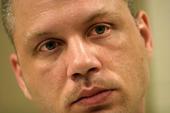
Tyrone Noling

Tyrone Noling

Good luck to Ohio Innocence Project attorney Carrie Wood, who is arguing a death row case in the Ohio Supreme Court Tuesday morning, on behalf of Tyrone Noling.  The State of Ohio has thus far denied Tyrone the right to DNA testing to prove his innocence, despite the fact that another person, with an M.O. for committing similar murders, subsequently confessed to committing this crime.  It was also discovered (but not revealed to the defense before trial) that this person who later confessed had been a police suspect before trial.  The State did serology testing (a primitive test before DNA testing existed) and this alternate suspect COULD NOT BE EXCLUDED as the source of biological material collected from the crime scene.  But this was not turned over to defense and was only discovered years later through a public records request.

Also, all 3 cooperating witnesses against Tyrone have subsequently said Tyrone is innocent and they were pressured to testify falsely against him.  All of this, and the State of Ohio will still not simply grant Tyrone a simple DNA test to see if the alternative suspect can be conclusively linked to the crime scene.

The Atlantic.com called Carrie’s argument Tuesday one of the 10 most significant legal events of 2013 in the U.S.

I mooted Carrie today and she was amazing. Tyrone couldn’t have a better attorney representing him in this important case. Prayers, thoughts and fingers crossed for Tyrone and Carrie.

The Ohio Public Defenders’ Office is representing Tyrone on all non-DNA issues, as they have for years.

You can watch the oral argument at about 10am EST here.

New Scholarship Spotlight: The Evidence of Things Not Seen: Non-Matches as Evidence of Innocence

liebman_j_68x91A group of authors, including James Liebman of Columbia Law School, has posted the above-titled article on SSRN.com.  Download here.  The abstract states:

Exonerations famously reveal that eyewitness identifications, confessions, and other “direct” evidence can be false, though police and jurors greatly value them. Exonerations also reveal that “circumstantial” non-matches between culprit and defendant can be telling evidence of innocence (e.g., an aspect of an eyewitness’s description of the perpetrator that does not match the suspect she identifies in a lineup, or a loose button found at the crime scene that does not match the suspect’s clothes). Although non-matching clues often are easily explained away, making them seem uninteresting, they frequently turn out to match the real culprit when exonerations reveal that the wrong person was convicted. This Article uses “non-exclusionary non-matches” and what would seem to be their polar opposite, inculpatory DNA, to show that: (1) all evidence of identity derives its power from the aggregation of individually uninteresting matches or non-matches, but (2) our minds and criminal procedures conspire to hide this fact when they contemplate “direct” and some “circumstantial” evidence (e.g., fingerprints), making those forms of evidence seem stronger than they are, while, conversely, (3) our minds and procedures magnify the circumstantial character of non-exclusionary non-matches, making them seem weaker than they are. We propose ways to use circumstantial matches and non-matches more effectively to avoid miscarriages of justice.

Friday’s Quick Clicks…

Thursday’s Quick Clicks…

  • Exoneree Christopher Scott named Texan of the Year
  • The governor of North Carolina has signed full pardons of innocence for 10 political prisoners wrongfully convicted of arson and conspiracy more than 40 years ago.  Gov. Beverly Purdue pardoned the Wilmington 10 on Monday. The nine black men and one white woman, only six of whom are still living, were wrongfully convicted of fire-bombing a grocery store after police shot a black teenager.  “I have decided to grant these pardons because the more facts I have learned about the Wilmington 10, the more appalled I have become about the manner in which their convictions were obtained,” Gov. Purdue said.

International Expansion of the Innocence Movement in 2012

The purpose of this post is to briefly summarize organized innocence activity around the world during 2012 (If I have left items out, please let me know so I can supplement this post).  The calendar year 2012 undoubtedly saw the largest expansion of organized innocence work in history.  Well-attended innocence conferences were held in 5 different continents.  Organizations designed to free the innocent operated in every inhabited continent, and new projects launched in various Latin American countries, France, the Netherlands, the Philippines, Israel, and Taiwan, among others.  Here is a brief summary:

  • The Innocence Network, which currently consists of more than 60 member projects in the U.S., UK, Canada, the Netherlands, and Australia, issued its 2012 report, which lists the members and summarizes the 22 exonerations  its members obtained in the calendar year.  Major conferences on the subject were held in Australia, the UK and the U.S.
  • A network of organizations fighting for the innocent was launched in Latin America, Red Inocente (website here).  Red Inocente held its first annual conference in July, which was attended by more than 70 representatives from various Latin American countries.  Presentations were made about innocence efforts underway in Argentina, Bolivia, Chile, Mexico, Nicaragua, Paraguay, Peru, and Puerto Rico.  Details of conference here.  The second annual conference will be held in 2013 in Buenos Aires.  Red Inocente has already seen its first exoneration, which occurred this year in Argentina.
  • In Europe, the UK has had a rich history of innocence work for decades, most recently spearheaded by the Innocence Network UK, and many other university-based groups not part of INUK.  This past year has seen innocence organizations launch in the Netherlands and in Lyon, France.  The Innocence Law Clinic in Warsaw, Poland, successfully continued its operations, which have been ongoing since 1999, and the Supreme Court of Poland held a lecture on the international expansion of the Innocence Movement, sponsored by the Helsinki Foundation.  Also in Poland, a conference was held in Krakow on on the topic of wrongful convictions, attended by judges and prosecutors from across the country.  In the Czech Republic, lectures on wrongful convictions were held at 2 major law schools, summarized in this news clip.  Interest in starting an innocent project is budding in Italy, with representatives from a major law school there planning to attend the 2013 Innocence Conference and to shadow the Ohio Innocence Project this summer.
  • In Africa, the highly-organized Wits Justice Project in South Africa continued its operations with many successes; and a new Innocence Project South Africa launched
  • The Israeli Wrongful Convictions Clinic launched
  • In Asia, projects launched with much acclaim in Taiwan and the Philippines.  China held its first major conference on the topic of wrongful conviction, attended by hundreds of judges, prosecutors, professors and defense attorneys.  Two books on wrongful convictions, False Justice and Illustrated Truth, were translated and published in China.

Launch of Israeli Wrongful Convictions Clinic…

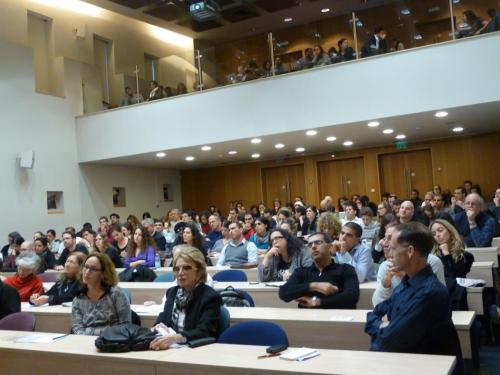
Audience at conference

Audience at conference


On Monday, October 12, 2012 (The International Human Rights Day), a conference took place at the Hebrew University School of Law, which launched the new (and first of its kind in Israel) wrongful convictions clinic, that was recently opened at the Hebrew University School of Law, in collaboration with the Israeli Public Defender’s Office.

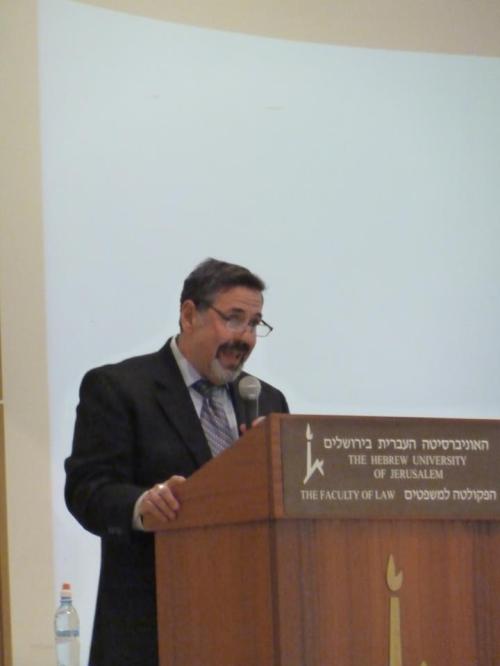
The conference, organized by Dr. Anat Horovitz, Deputy Head of the National Public Defender’s Office, and Dr. Einat Albin, Head of the Center for Clinical Education at the Hebrew University School of Law, began with greetings by Dr. Guy Rotkopf, Director-General of the Israeli Ministry of Justice, Prof. Yuval Shany, Dean of the Hebrew University School of Law, and Dr. Yoav Sapir, Head of the National Public Defender’s Office. The greetings were followed by an exceptional keynote speech delivered by Prof. Larry Marshall of Stanford Law School.  During the second session of the conference, the well-known documentary filmmaker, Ms. Ofra Bikel, talked about her work and part of her film the “Confessions” was viewed by the audience.

Keynote speaker:  Larry Marshall

Keynote speaker: Larry Marshall

At the final session of the conference, a panel which included former Supreme Court Justice E. Goldberg, Prof. M. Kremnitzer (Vice President of the Israel Democracy  Institute), Ms. E. Fink (Head of the Re-Trial Department at the National Public Defender’s Office) and Mr. S. Lemberger (Deputy Israel State Attorney), engaged in a lively discussion regarding procedures for addressing wrongful convictions in Israel, moderated by Dr. Anat Horovitz. The conference was open to the public and attended by  many criminal law professionals (including judges, prosecutors and defense attorneys) as well as a large number of law students.

Sunday’s Quick Clicks…

Dutch Supreme Court Re-Opens Alleged False Confession Case…

Here is an update written by Evelyn Bell of the Knoops Innocence Project in the Netherlands (earlier report on case here):

On 18 December 2012 the Dutch Supreme Court re-opened the case of six wrongfully convicted individuals. This re-opening was based on a request of the prosecution after a new investigation into the case. The defense also submitted a request to re-open the case, in support of the prosecution request. The Supreme Court referred the case to the Court of Appeals for a retrial.

On 4 July 1993 the mother of the owner of the Chinese restaurant Peacock was found dead, and she had been violently stabbed to death. In 1995 six individuals were convicted, based on the false confessions of three of the six accused. The three convicted women had falsely confessed during police interrogations. One of the women already withdrew her confession at trial, but this retraction was ignored by the judges. The three convicted men claimed their innocence at all stages of the proceedings. Nevertheless, they were convicted for second degree murder on the basis of the confessions of the women during the police interrogations and sentenced to ten years imprisonment. Two of the women were convicted as assessors to the murder and sentenced to two years imprisonment and the third was sentenced to fifteen months imprisonment. All of the accused have fully served their sentences.

One of the accused requested, eight years ago, the assistance of the Project “Gerede Twijfel” at the Vrije Universityin Amsterdam. This person sought legal representation of Mr Knoops in 2009 who represented him and two other defendants in this case during the review proceedings.

It was established that the confessions were very likely to be false, while the convictions were almost solely based on these confessions. The confessions were in contradiction of the statements two witnesses who were sitting in a bus shelter across the restaurant on the night of the murder. However, these two exculpatory statements were not disclosed in 1995 to the judges. Two lawyers of the Knoops’ Innocence Project (Mr. G.G.J. Knoops and Mrs. R. Dijkstra) provide legal representation as Counsel during the re-trial proceedings in 2013 for three of the six defendants among which the accused who initiated the review.


Breaking News: Man Exonerated of Murder Charge in France…

From France24.com:

A Parisian court quashed the conviction of a young man imprisoned for seven years for a murder he did not commit Thursday. Marc Machin also made French legal history, as it is only the eighth time a conviction has been overturned since World War II.

Paris’s criminal court made front page news on Thursday after acknowledging a serious miscarriage of justice in the wrongful imprisonment of a young man for murder.

Marc Machin was only 19 years old when he was first accused of the brutal December 1, 2001 murder of Marie-Agnès Bedot. The 45 year-old Bedot had been found stabbed to death near the wealthy and chic town of Neuilly, just outside of Paris. After a nearly two-week long investigation, police charged the young Machin with the crime, despite the fact that the evidence against him was largely circumstantial.

Machin initially denied the charges, but under duress owned up to the crime. By the time Machin attempted to retract his confession, it was too late. The young man was found guilty of murder and sentenced to 18 years in prison.

Machin always maintained his innocence, and attempted to overturn the ruling, but lost his appeal in 2005.

Interest in Machin’s case was revived in March, 2008, however, after a David Sagno, a homeless man, turned himself into the police for a separate murder, which also took place near Neuilly. During his confession, Sagno also owned up to killing Bedot, describing the crime in exact detail. Police reopened their investigation into the case, only to find traces of Sagno’s DNA on the victim’s clothing.

After seven years in prison for a crime he didn’t commit, there was a call for Machin’s case to be re-examined. Now, more than 11 years after Machin first stood accused of the crime, his name has finally been cleared.

Speaking after his acquittal, Machin said, “When you’ve been the victim of a miscarriage of justice, wrongfully and unjustly imprisoned, you cannot celebrate and jump up and down… I need to rebuild my life.”

Machin’s acquittal is only the eighth time since World War II that a criminal conviction has been reversed.


New Scholarship Spotlight: Freeing the Guilty without Protecting the Innocent: Some Skeptical Observations on Proposed ‘Innocence’ Procedures

bio-2Utah professor Paul Cassell has posted the above-titled article on SSRN.  Download here.  The abstract states:

Proceeding from the perspective of “innocentrism” (that is, the idea that exoneration of the “innocent” ought to be privileged over other values in the criminal justice system), I suggest eight proposals for reform: (1) researching the frequency and causes of wrongful conviction; (2) allowing waiver of rights for greater freedom to raise post-conviction innocence claims (Professor Gross’s proposal in this symposium); (3) improving the implementation of existing rules on disclosing exculpatory evidence; (4) increasing resources for defense counsel and prosecutors to focus on issues relating to actual innocence; (5) abolishing the Fourth Amendment exclusionary rule; (6) replacing the Miranda regime with a system of videotaping custodial interrogation; (7) barring prisoners from filing for habeas relief without a colorable claim of actual innocence; and (8) requiring defense attorneys to directly ask their clients if they are actually innocent. These discriminating proposals offer a far greater prospect of providing help to the innocent without blocking conviction of the guilty. A common theme underlying many of them is that they reorient the focus of the criminal justice system away from procedural issues and toward substantive issues of guilt or innocence. Sadly, Bakken’s proposals seem to offer too much procedure and not enough substance, a recipe for helping the guilty. The truly innocent will benefit in a system that values substance over procedure.


Wednesday’s Quick Clicks…

  • clickThe new West Virginia Innocence Project helps an exoneree clear his name from the sex offender registry
  • Irish barrister shadows Duke Innocence Project
  • Story on the documentary West of Memphis
  • Don’t let the Florida Innocence Commission die

Update with the Wits Justice Project in South Africa…

image003-1

I am cutting and pasting below an email from the Wits Justice Project in South Africa.  I had the pleasure of visiting these folks about 2 years ago.  They are a first-class organization.

The Wits Justice Project team – Nooshin, Carolyn, Gift, Grethe, Robyn, Ruth and Tshepang – would like to thank you for your support and encouragement in 2012 and wish you a restful and safe holiday and festive season and a very successful 2013.

We have had a tremendously exciting year and would like to share some of the highlights with you:

a. Journalism

  • WJP won the Webber Wentzel Legal Journalist of the Year award for the second year in a row. Senior journalist, Ruth Hopkins, won first prize and our other senior journalist, Carolyn Raphaely, was first runner-up for her articles on torture. Carolyn won this prestigious award last year, in 2011.

The articles for which Ruth won her award were in two categories. The first looks at the scourge of TB in our prisons and how it has affected both the inmates and their families.

1. “Sisters probe TB scourge in prison” http://mg.co.za/article/2012-04-13-sisters-probe-tb-scourge-in-prisonwhich appeared in the Mail & Guardian and

2. “SA prisons: hotbed for spread of TB inside and outside” http://www.journalism.co.za/index.php/wjpnews/5064-sa-prisons-hotbed-for-tb-inside-and-outside.html which appeared in the Saturday Star.

The second category was the systemic failures which cause unreasonable delays in finalizing cases.

1. “Incarcerated since 2007 – but trial hasn’t progressed” http://www.iol.co.za/the-star/incarcerated-since-2007-but-trial-hasn-t-progressed-1.1255807 which appeared in The Star, show the consequences of court delays,

2. “Who is watching the lawyers?” (with Grethe Koen) http://www.iol.co.za/saturday-star/who-is-watching-the-lawyers-1.1328182 which appeared in the Saturday Star.

b. Advocacy

  • WJP project coordinator, Nooshin, was asked to speak at various conferences on issues affecting remand detainees and other matters affecting the criminal justice system . This included the “Helen Suzman Foundation Quarterly Roundtable on Remand Continue reading

Monday Quick Clicks…

  • clickD.C. judge exonerates Santae Tribble in 1978 murder; cites DNA test that showed hair evidence at trial was flawed
  • Innocence Network exoneration report for 2012
  • Video story about the Ohio Innocence Project’s Roger Dean Gillispie case
  • Murder exoneree Kerry Porter sues the Louisville, KY police department

Peter Neufeld Responds to Alverez’ Response to 60 Minutes…

From ChicagoTribune.com:

Innocence Project co-director Peter Neufeld has emailed me his response to the open letterCook County State’s Attorney Anita Alvarez sent to complain about a report on last Sunday’s broadcast about false confessions in Chicago:

What I am most concerned with is not Ms. Alvarez’s individual comments which can and will be easily refuted. Rather, it is the fact that her letter reveals that she is simply stuck in denial of the magnitude of the catastrophic consequences suffered by nine young African American men who were stone cold innocent but lost the best years of their lives.   

The first step to improving a situation where mistakes and misconduct occurred in the past is to admit that errors were made. The admission of error  is a fundamental first step whether a shuttle crashes, a hospital mishandles a patient or an innocent person languishes in prison for a crime he did not commit.   If you can’t first admit error, there is no hope for meaningful improvement or change. 

The most serious aspect of the manner in which Ms. Alvarez has handled these cases, is her utter unwillingness to admit that the Continue reading

Cook County State’s Attorney Anita Alvarez Responds to 60 Minutes Interview … Kind Of

From the Pennsylvania Innocence Project Blog:

After being universally drubbed for her comments during a recent 60 Minutes segment on false confessions in Chicago, Cook County State’s Attorney Anita Alvarez wrote to the head of CBS to complain of what she viewed as one-sided and unfair coverage on the broadcast. You can read her letter here. Among the points she raised,

  • There were 5 men convicted in the murder of Cataresa Matthews, not 3. Two men pled guilty to the charges in court where they were represented by counsel and testified against the other three.
  • Bob Milan, the trial prosecutor featured in the piece, took the confession in the Dixmoor case and was the best person to see whether “mistreatment and coercion” took place.

While these are interesting points, they just indicate that, for all the progress Ms. Alvarez has made in her office to investigate wrongful convictions, she just doesn’t get it when it comes to false confessions. We know beyond a doubt that people plead guilty to crimes they didn’t commit, and they often testify against other “co-defendants” as part of the deal they receive.

Moreover, the fact that some of the statements were secured with a prosecutor present who saw no “coercion” misses the point. The techniques used to obtain a false confession do not always involve overt coercion; furthermore, police generally have already been talking to suspects long before the prosecutors arrive. Mr. Milan was quite clear in his statement to 60 Minutes: he’s haunted at having played a role in these tragedies.

The Chicago police had a more productive response to the segment. Chicago Police Superintendent Garry McCarthy pointed out that the department has undertaken major reforms since those cases were prosecuted. For instance, he noted the state has required videotaping of all homicide interrogations and confessions for years, to document whether proper procedures were followed.

“You know, there’s been so many other things; upgrading supervision in the department, better training for our detectives, and looking at the methods that we’re doing lineups, for instance,” he said.

McCarthy said all police procedures are under review, even now.

“We’ve got nine separate committees that are working on revamping everything that we do,” McCarthy said.

We learn more daily about how to prevent wrongful convictions. As we do, police departments nationwide are working to improve their investigation techniques; a development we applaud and support.


Friday’s Quick Clicks…

  • clickFlorida exoneree Bill Dillon pardoned for former drug conviction
  • In Ireland, a movement to exonerate Myles Joyce 130 years after he was hanged for a crime many believe he didn’t commit
  • In New Zealand, police accused of causing the wrongful conviction of David Bain fight back

Despite Exonerative DNA Results, Prosecutor Won’t Budge Until Guilty Plea Explained…

From Wboy.com:

They’re just four words. But those four words have become synonymous with the American justice system: “innocent until proven guilty.”

A man in Harrison County (West Virginia) is challenging that, years after he was sent to prison.

Joseph Buffey was accused of the rape and robbery of an elderly woman in Harrison County back in 2001.

“A break-in robbery rape of an elderly woman who was the mother of a police officer here in Clarksburg,” said Barry Scheck, Co-Director of the Innocence Project.

Buffey pleaded guilty to those charges, but later recanted his plea.

“Before DNA test results came back, he was strongly recommended by his lawyers. His lawyers, on the record, said to take a guilty plea. So he did take a guilty plea,” Scheck said.

Buffey was sentenced to 40 years in prison for those charges.

A status conference for Buffey’s challenge was held on Thursday in front of Harrison County Circuit Judge Thomas Bedell.

The Innocence Project said DNA sperm results indicate Buffey is not guilty and argued Buffey should be allowed to recant his plea and be released from prison.

But Assistant Harrison County Prosecuting Attorney David Romano said it will take much more than DNA results to get Buffey out of prison.

Romano said Buffey will need “a compelling reason for why he pleaded guilty.”

Romano added it is extremely difficult for a person to retract sworn statements in a guilty plea and said the burden is now on Buffey and his lawyers. He said for Buffey’s plea to be overturned, Buffey and his lawyers would have to show “innocence without a doubt.”

Romano added in court that Buffey waived his right to challenge “error, if there was any, when he plead guilty.”

Buffey’s team said there’s “scientific evidence” and “irrefutable facts” that now exclude Buffey from those crimes.  It said the state could re-prosecute Buffey if it felt it had enough evidence to do so.

“Then the Innocence Project got involved. We got another set of tests done that we thought definitively excluded him,” Scheck said.

Scheck said DNA sperm results show Buffey’s innocence and another man’s guilt.

“The reason we are here in court is it can now be said in public that, just the other day, there was a hit to a young man,” Scheck said.

The name was brought up in court but it’s against 12 News’ policy to identify suspects until they’ve been formally charged.

The Innocence Project called out the prosecuting attorney’s office for not making those charges, and said the state should be doing more to “prosecute the man who really did this, so the person responsible doesn’t get back on the streets.”

As of Thursday, that man was not charged, but Romano said he is being investigated, and the investigation is ongoing.

Judge Bedell stated in court that he would not make a decision to release Buffey without evidence in front of him.

Another status conference is scheduled for Jan. 16 at 1:15 p.m. in Harrison County Circuit Court. The court also scheduled a status conference for Feb. 15 at 10 a.m.

A hearing for Buffey’s request to be released from prison is set to start on March 27.


Spotlight on Oklahoma Innocence Project

From Kosu.org:

A law clinic operating out of Oklahoma City University is on a mission to balance the scales for the state’s wrongfully convicted. The Oklahoma City Innocence Project is new to the state but they are just one cog in an older nationwide wheel meant to curb the mistakes of the justice system. But what does it take to prove someone innocent and how do they end up in prison?

“It is stressful at times because you realize that a person’s life is in your hands. That is truly daunting.”

How do you have that conviction to keep on being on call?

“Because I know what its like watching someone spend their life in prison for something they didn’t do. And it continues to happen.”

Professor Tiffany Murphy is head of the Oklahoma Innocence Project that just opened in August of last year. She’s on call 24 hours a day through the entire year mostly because her staff is just her and…

“…a staff attorney, a legal assistant, and along with clinical students from the law school.”

Right now that’s three students from OCU and the legal team tackles as many cases as they can handle.

“The project has had over 500 cases come through its doors. At any given time we have about 80 to 100 cases waiting in line to be reviewed and 12 -16 cases being actively worked up.”

500 cases? Can all of these people be innocent? Probably not, but Tiffany doesn’t take clients at just their word. Her team only focuses on a case if innocence can be proved.

“The cases that I’m working on are certainly very valid cases to be reviewed.”

Dan Grothaus is a private investigator Tiffany uses on occasion. He’s worked innocence cases before and has no illusions about a 100% accurate justice system.

“I think every community should make sure, if they’ve got someone locked up in prison for the rest of their life. They really should want to make sure they’ve got Continue reading

New Zealand Compensation Case Gets Interesting…

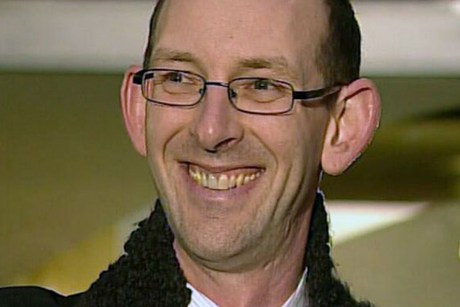
Exoneree David Bain

Exoneree David Bain

Exoneree David Bain’s compensation case in NZ has gotten quite controversial.  A retired Canadian judge was hired to review the case and decide whether Bain should be compensated.  A Canadian judge was selected for neutrality and because the compensation scheme in Canada is similar to that in New Zealand.  But after the judge reviewed the case and recommended in favor of compensation, the Justice Minister Judith Collins has refused to accept the results and gone on a sort of political campaign to avoid paying compensation.  The debate has been very public and has gotten quite heated.  Story here.  Justice Minister’s attack on the ruling detailed here.  Justice Ian Binnie’s response here.

Thursday’s Quick Clicks…

  • clickCalifornia Supreme Court holds that, in post-conviction, recantation of an expert based on new scientific advances carries more weight than recantation of a lay witness.  Summary here, decision here
  • A jury in Iowa is still trying to decide whether two Omaha, Neb., men should be paid millions of dollars for spending 25 years in prison on murder convictions later overturned.Jurors began deliberating Friday afternoon after 21 days in the courtroom. They spent eight hours Monday and six hours Tuesday working on the case.  They must decide whether Terry Harrington and Curtis McGhee should be paid by the city of Council Bluffs and two retired police officers who worked to convict them in 1978.