Author Archives: Mark Godsey

Idaho Innocence Project on Dateline NBC Tonight in U.S….

An Idaho murder case from 1996 is coming under new scrutiny with the help of the Idaho Innocence Project. On Friday, Aug. 24, NBC-Dateline will air “The Confession. A mother fights to free the man convicted in her daughter’s murder.”

The Emmy award winning program will showcase an all new one-hour special about Angie Dodge’s murder in her Idaho Falls apartment and the confession of Chris Tapp, who currently is serving a sentence of 25 years to life for the crime. The show airs at 9 p.m. on KTVB Channel 7.

The Idaho Innocence Project believes that Tapp is innocent. Biology and criminal justice professor Greg Hampikian is working on DNA aspects of the case, which is being handled by Rick Visser, IIP assistant director and staff attorney. Several Boise State students also have assisted in research and investigation.

Innocence Project Reaches Out to Chemists…

From Nature.com:

A group that has used DNA evidence to free nearly 300 wrongly convicted people from prison reached out to scientists this week, asking chemists to engage with forensic science. Peter Neufeld, co-founder of the Innocence Project, an organization based in New York that investigates potential wrongful convictions, asked researchers at the American Chemical Society (ACS) meeting in Philadelphia, Pennsylvania, to do more to improve the troubled field of forensic science.

Complaints about the unreliability of some scientific evidence used in courts worldwide are long-standing, and a 2009 report by the US National Research Council called for major reforms to the US forensic-science system, including better standardization of protocols and more research into the reliability of methods used. The US Congress is now considering a bill that would provide money for forensics research and require the US National Institute of Standards and Technology to establish standards in the area (see ‘Proposed bill calls for better forensic science‘).

But despite such concerns, little has changed on the ground, says Justin McShane, an attorney at the McShane Firm in Harrisburg, Pennsylvania, who works with the Pennsylvania Innocence Project and serves as co-chair of the ACS Division of Chemistry and the Law. “It’s still a Wild Wild West out there in forensic science.”

Neufeld says that misuse of forensic science is a major factor in nearly half the cases investigated by the Innocence Project. He is calling on chemists to lobby Congress individually and through the ACS in support of the bill. But he also wants more scientists to engage with forensic science research. “What we want to do is make forensic science more about science and less about law enforcement,” he says, so it becomes an impartial assessor of evidence rather than a branch of law enforcement.

This call was echoed by Frederick Whitehurst, a chemist and former investigator for the US Federal Bureau of Investigation. “What we seem to know in the world of science is that there are some real problems in the world of forensic science, and we’d rather work on something cleaner,” he told an ACS session on chemistry and the law. “We don’t seem to want to work with dirty crime sciences.”

Whitehurst says that crime-laboratory technicians are often under pressure to produce evidence that agrees with police or prosecutor theories. Scientists can “run into a sledgehammer” when their evidence doesn’t confirm prosecutors’ hypotheses, says Whitehurst, potentially putting their careers at risk.

Greg Hampikian, a geneticist at Boise State University in Idaho and director of the Idaho Innocence Project, told the meeting that he regularly has nightmares about the ease with which innocent people can be convicted because of flaws in forensics systems.

Hampikian has worked on such high-profile cases as that of Meredith Kercher, a British student who was murdered in Italy in 2007. Amanda Knox and Raffaele Sollecito were convicted of the murder, partly on the basis of DNA evidence, but were freed in 2011, in part because Hampikian showed that DNA can easily be transferred via gloves from an item a person has touched to another item — such as a knife — that they have not touched. As new techniques allow ever smaller amounts of DNA to be detected, such contamination will be an increasing problem, Hampikian says.

But DNA analysis can also prove innocence: several attendees at the ACS meeting had been exonerated through investigations by the Innocence Project.

Steven Barnes was convicted of rape and second-degree murder in 1989 and spent nearly 20 years in prison before DNA testing showed that sperm cells from the crime scene did not match his. Ray Krone was sentenced to death on the basis of a bite-mark analysis in a 1991 murder case. He was proven innocent by DNA testing after serving ten years in prison. “I had never been in trouble in my life. They put me on death row. This could happen to you,” said Krone. “I’m calling on the ACS to get more involved in forensic science.”

ACS president Bassam Shakhashiri, a chemist at the University of Wisconsin–Madison, has been a strong supporter of the Innocence Project, and he appeared with many of the speakers for the Innocence Project at a press conference on Monday. He told Nature that before the society could lobby Congress in favour of the bill, the board would need to approve a policy statement on the matter, but that he planned to speak to several of the governance committees that oversee the topics involved.

“The topics discussed by the Innocence Project are vitally important to all of us,” he says.


Friday’s Quick Clicks…

  • Brooke Shields, Stockard Channing and Brian Dennehy set for The Exonerated’s Off-Broadway return (New York Times article here)
  • Wrongful convictions in India
  • Connecticut Supreme Court rules that eyewitness identification expert witnesses are proper and admissible
  • Michigan Innocence Clinic wins new trial in child molestation case based on recanting witnesses

Thursday’s Quick Clicks…

  • A Minnesota judge has denied a defense request to conduct DNA testing on a knife found at the scene of a 1992 murder in rural Big Lake.  Kent Jones is serving a life sentence for the murder of Linda Jensen, who was found assaulted and stabbed in her home. The Innocence Project represented Jones and asked for the DNA testing.  But the St. Cloud Times reports (http://on.sctimes.com/NFLTsl) that Anoka County District Court Judge Alan Pendleton denied that request Tuesday, citing concern about all of the people who handledthe knife since 1992
  • An Indiana woman convicted of setting a 1995 fire that killed her 3-year-old son was released Wednesday for the first time after 16 years in prison.  A Decatur County judge set bail for Kristine Bunch at $5,000 cash Wednesday while she awaits a new trial on murder and arson charges stemming from a mobile home fire that some experts now say appears to have been accidental.
  • DNA results lead to new trial in Vermont in the case of John Grega

California Man Still Locked Up 2 Years After Being Found Innocent…

California Innocence Project client Daniel Larsen was found innocent by a federal judge 2 years ago, but remains locked up while the state AG appeals and tries to get the decision overturned.  Full story here and here…sign petition to get him released here

Successful Wrongful Convictions Conference in China Held August 6-8, 2012…

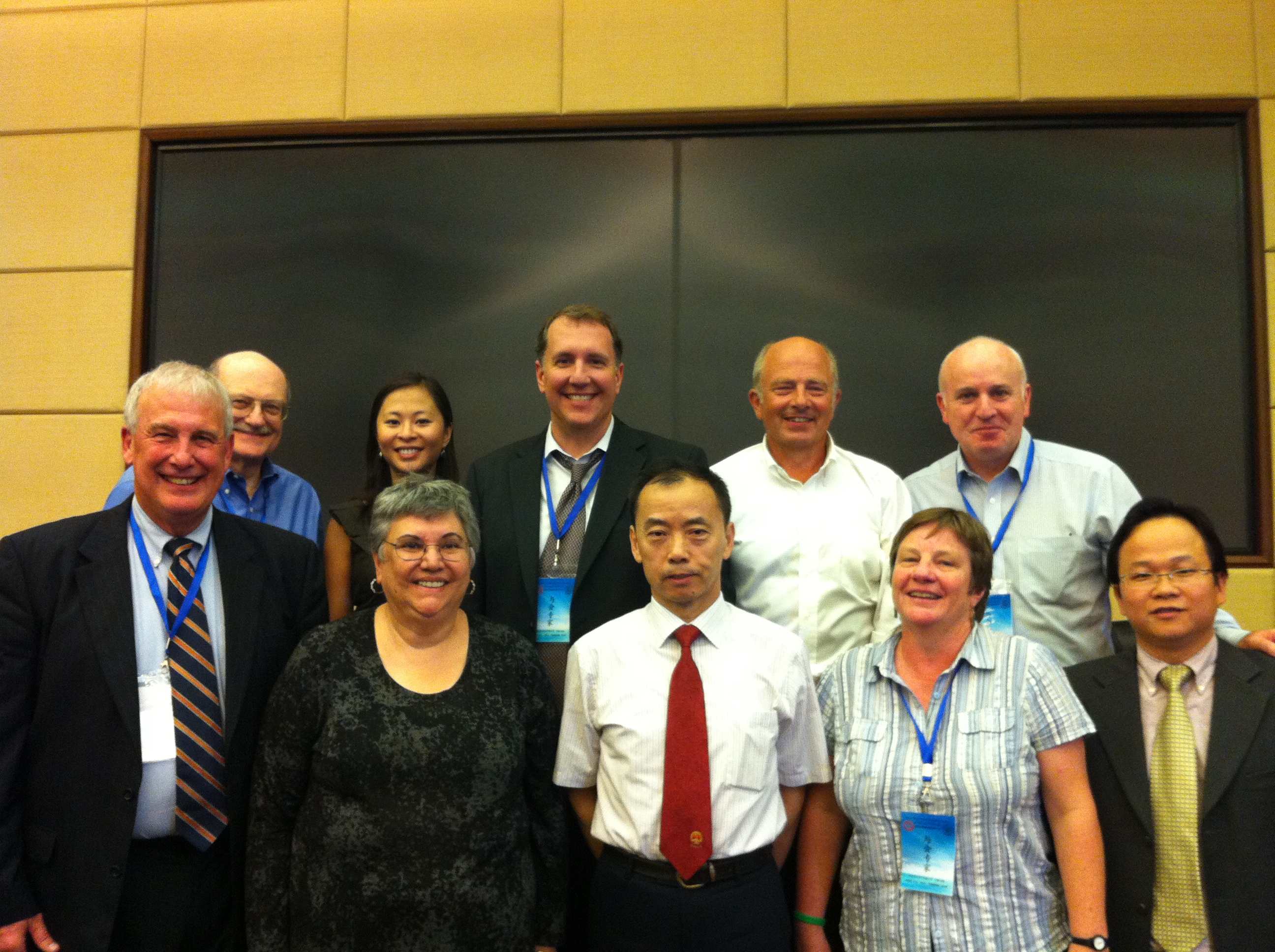
The “foreign” delegates with conference host Professor Jiahong HE (front row, center).  More than 150 Chinese scholars, judges, prosecutors and defense attorneys attended the intense 3-day event.

China has had many high-profile and well-publicized wrongful convictions and exonerations in the past decade, and this was the first conference in China to focus on the problem of wrongful conviction.  The conference was held August 6-8, 2012 in Changchun, China, which is in the north near North Korea and Russia.  The conference was packed with interesting speakers (program with speakers and topics here), and I can attest (as can anyone else who was present) that the more than 150 Chinese scholars, judges (including Supreme Court Justices), defense lawyers and high-level prosecutors were extremely concerned about the problem and keen on getting the Chinese system to start working on reforms to minimize it.  China recently passed reforms requiring videotaped interrogation in many cases, and is working diligently to update the criminal procedure rules and to get other innocence reforms in place.

The thing that many of us from the “West” commented to each other throughout the conference was how open the judges and prosecutors were to the problem, and how they seemed to be on the same page with the scholars interested in reform.  You rarely see that kind of cooperation in the U.S. or, as Innocence Network UK founder Michael Naughton noted, in the UK.  [Note:  Naughton is on the far right of the back row in the above picture]

Some of the causes of wrongful conviction that the Chinese speakers frequently noted were false confessions due to intense interrogation methods, political interference in the cases from the local communist party officials who sometimes take an interest high-profile cases and want them to come out a certain way, tunnel vision of police and prosecutors, and the evaluation and promotion process for judges and prosecutors that rewards high conviction rates.  Restructuring the system that so the judiciary is totally independent (from both other branches of government and the Communist Party) seemed to be most frequently cited as the next reform to tackle.  Discussion was open, frank, and filled with a spirit that reform is the air in China, and that anything is possible (eventually).

In addition to being an outstanding conference substantively, a nice perk was that conference attendees had the option of going to the Changbai Volcano on the border of North Korea.  It was remarkably beautiful; I took this photo with my Iphone

One interesting point that was discussed was the Chinese legal system’s distrust of confessions (due in part to the history of torture to obtain them), and the growth of the Mutual Proof Rule, which requires a judge to determine that the objective facts of the case match the suspect’s confession before considering the confession as probative evidence of guilt.  Cases were discussed in which the Mutual Proof Rule resulted in confessions being disregarded because the details varied too far from the undisputed facts.

Another interesting point that was discussed was how the judiciary in the Hunan Province, after a troubling exoneration a few years ago, declared May 9th each year to be set aside for the local judicial system to reflect on wrongful convictions and discuss reforms.  Each year on May 9th the province judicial council issues a report on wrongful convictions and what progress the province has been made to remedy the problem in the past year.

My favorite moment of the conference was when an American professor congratulated the Chinese reformers on how far they have come in recent years, but noted that only 30% of defendants in China are entitled to counsel during trial.  One of the Chinese scholars retorted:  “America put the right to counsel in the Bill of Rights in the 1790s and didn’t make it a universal reality until the 1960s.  It took you almost 200 years.  We have only had serious reform in China for 1o or 20 years, so we’re on track to beat America by more than 150 years.  And we’re gonna do it!!”

If this conference is any indication of the Chinese resolve for reform, then this statement may very well end up being true.

Me with Norwegian Professor Ulf Stridbeck, who was instrumental in founding the Norwegian CCRC, which some believe is the most effective governmental body designed to fight wrongful convictions anywhere in the world…

Tuesday’s Quick Clicks…

Decision from Nicaraguan Court on Jason Puracal Could Come in Next 10 Days….

From Komonews.com:

MANAGUA, Nicaragua (AP) – A Washington state man convicted of money laundering in Nicaragua has argued at a hearing appealing his 22-year sentence that police and prosecutors created lies to link him to organized crime.

The lawyer for 35-year-old Jason Puracal of Tacoma says three appellate judges are looking at evidence such as business records that show Puracal has no ties to the companies listed in the formal accusation.

The panel is expected to make a decision in five to 10 days, attorney Fabbrith Gomez told The Associated Press after Monday’s hearing.

Puracal’s family says he was wrongfully convicted two years ago and thrown into one of the most dangerous Central American prisons. Now family members are going to new lengths to try to get him freed.

“He was the kind of brother who would be very protective – but would also challenge you,” Jason’s sister, Janis Puracal, said earlier this month.

Puracal is a University of Washington graduate who served in the Peace Corps in Nicaragua in 2002. He was convicted in 2011 of laundering money through his Re/Max International real estate franchise in San Juan del Sur on Nicaragua’s west coast.


Monday’s Quick Clicks…

Decision on Whether to Retry Michael Hash Due Today…

UPDATE:  Charges DROPPED….

Previous coverage of case here

From the Richmond Times-Dispatch:

Michael Wayne Hash, whose 2001 capital murder conviction was overturned by a federal judge in February, likely will learn today whether he will be freed or retried.

Raymond F. Morrogh, the Fairfax commonwealth’s attorney appointed special prosecutor in the case, is set to appear in Culpeper Circuit Court this morning to report on his investigation into the 1996 slaying of Thelma B. Scroggins.

Hash was sentenced to life for the slaying of the 74-year-old Lignum woman shot to death during a robbery in her home. Two others were charged. Jason Kloby was acquitted, and Eric Weakly pleaded guilty after testifying against the other two.

In February, U.S. District Judge James C. Turk overturned Hash’s conviction, calling it a miscarriage of justice involving police and prosecutorial misconduct and gave authorities six months to decide whether to retry him.

In his 65-page opinion, Turk said Hash had made a showing of actual innocence.

The six-month period does not expire until Aug. 28, but Morrogh is expected to announce his decision today. At an earlier hearing, Morrogh told the court he had requested new DNA testing on crime scene evidence and that witnesses were being interviewed.

Longtime Culpeper Commonwealth’s Attorney Gary Close, who prosecuted Hash and the others, resigned in March, saying the controversy was a distraction to law enforcement.

Hash was 15 and living in the Lignum area of Culpeper County when Scroggins was slain. Convicted when he was 19, he was released from confinement in March and is living with his parents in Crozet and reporting regularly to authorities.

Hash’s lawyers declined to comment. Circuit Judge Jay T. Swett told lawyers involved in March that he did not want it tried in the newspapers.

Weakley, who served almost seven years in prison, is now free and has repudiated his confession and testimony implicating Hash.

26 Arson Cases Stand Out in Texas….

From pbs.org:

How many Texans are in prison for arson fires that, in fact, were accidents?

The Innocence Project of Texas, in conjunction with the state fire marshal’s office, recently completed first steps of a review of 1,000 fires in which someone was held criminally responsible. Of those, 26 stood out because of one important factor: flawed forensic science may have been used to make an arson determination.

The review comes almost a year after the Texas Forensic Science Commission (TFSC) concluded its investigation of the Cameron Todd Willingham case. Willingham, who was convicted of starting the fire that killed his two daughters in 1991, was executed 13 years later. His final appeal included new evidence provided by renowned fire scientist Gerald Hurst, who offered a strongly worded critique of the original arson findings.

“On first reading, one might well wonder how anyone could make so many critical errors in interpreting the evidence,” Hurst wrote. His opinion, which debunked Continue reading

New Scholarship Spotlight: Beyond Finality: How Making Criminal Judgments Less Final Can Further the ‘Interests of Finality’

Andrew Chongseh Kim has posted the above-titled article on SSRN.  Download here.  The abstract states:

Courts and scholars often assume that granting convicted defendants more liberal rights to challenge their convictions and sentences would necessarily harm society’s various interests in “finality,” the most prominent of which are resource conservation, efficient behavior by defense counsel, and deterrence. The extent to which convicted defendants should be allowed to challenge their judgments depends, according to the common analysis, on how much society is willing sacrifice those interests to validate defendants’ rights. This article argues that although expanding defendants’ rights on post-conviction review inherently makes criminal judgments less “final,” it does not necessarily harm the interests “finality” presumes to protect. Rather, when the financial costs of wrongfulincarceration, resource constraints on defense counsel, and the effects of legitimacy on compliance are considered, it becomes clear that granting more liberal review can often conserve state resources, will rarely affect the behavior of defense counsel at trial, and can help reduce crime.

First, the assumption that defendants’ post-conviction rights impose significant burdens on states ignores the costs of wrongful incarceration. Although recent studies on innocence have demonstrated that successful post-conviction review can produce large incarceration savings, they offer little insight into how significant those savings are compared to the administrative costs of providing the many appeals by defendants who failed to obtain relief on appeal. This article demonstrates, using the limited data available, that for direct appeals, the wrongful incarceration savings are generally quite substantial compared with the administrative costs of providing those appeals. Indeed, it is quite possible that some states realize net cost savings by providing direct appeals. The article then identifies specific restrictions on defendants’ rights, such as restrictions on relief from plain errors in sentencing that impose net costs on states. This article argues the existence of such restrictions that harm defendants at net financial cost to states is partly the result of an agency problem in criminal appellate decision making.

Second, although limiting defendants’ opportunities to seek relief from errors after conviction may increase incentives on defense counsel to prevent errors at trial, these increased incentives are unlikely to affect the actual behavior of counsel. With respect to strategic behavior or “sandbagging,” this article argues that because harmless error rules prohibit relief from errors that did not, in retrospect, affect the outcome of a trial, defense counsel will rarely have incentives ex ante to intentionally sandbag errors. In addition, because most inadvertent mistakes are caused by resource constraints on public defenders, rather than inattentiveness, increased restrictions on post-conviction rights are unlikely to reduce inadvertent mistakes. Moreover, to the extent that restricting review might actually compel defense counsel to take additional care at trial, because this care must be paid for by the state, it could actually be inefficient.

Finally, this article argues that the traditional finality deterrence argument, which depends heavily on the assumption that prisons effectively rehabilitate offenders, has been severely undermined by social science literature. Liberalizing post-conviction review, however, could increase incentives on people to obey the law by reducing wrongful convictions and the punishment given to defendants wrongfully convicted. Although the effects of reduced wrongful conviction are unlikely to affect the incentives of most people, for whom the risk of wrongful conviction is already negligible, they may be significant for at risk populations for whom the risk of profiling and wrongful suspicions are more salient. In addition, studies have demonstrated that the willingness of people to obey the law is influenced heavily on how “fair” or “legitimate” the legal system is perceived to be. Because many restrictions on post-conviction relief may be perceived as procedurally “unfair” by defendants, lifting these restrictions may actually encourage criminals and their associates to comply with the law.


Thursday’s Quick Clicks…

Wednesday’s Quick Clicks…

Jason Puracal Granted Hearing in Nicaragua…

From the NewYorkTimes.com:

A U.S. citizen serving a 22-year prison sentence in Nicaragua for drug trafficking and money laundering who a United Nations group has said was wrongly convicted has been granted an appeals hearing, his supporters announced on Wednesday.

Jason Puracal, 35, was detained by Nicaraguan authorities in November 2010 and later found guilty by a trial judge along with 10 Nicaraguan co-defendants despite their testimony that they had never met or worked with Puracal, his legal team said. It added that the prosecution’s own witnesses said he was innocent.

Puracal has become a cause célèbre for human rights activists in the United States and around the world, with U.S. lawmakers appealing to Nicaraguan President Daniel Ortega and a former high-ranking U.S. Drug Enforcement Administration official launching a massive petition drive on Puracal’s behalf.

“The 11-month wait for Jason’s hearing is over. The one-year anniversary of his conviction will be August 29, and we really hope to have him home by then. We’re optimistic, and we just ask that people continue to stay engaged,” said Eric Volz, founder of an international crisis resource group called the David House Agency that has been helping push for Puracal’s release.

Puracal’s appeal will come before a three-judge panel on August 16 in a hearing that is expected to last five days, supporters said. A decision could come anywhere from five days to months after the hearing concludes.

Neither prosecutors nor the Nicaraguan government immediately responded to requests for comment.

Supporters have been pushing for the appeal to be heard for nearly a year, and heightened those efforts in the past week after finding out that Puracal, who has been insolitary confinement, was put on suicide watch by Nicaraguan authorities.

Puracal’s sisters Janis and Jaime flew to Nicaragua this week and started knocking on the doors of government officials and visited the appeals court in person, supporters said.

“Within four hours, Jason’s attorney got a phone call being notified of the date that was being set for the hearing. That’s the main reason we believe this is finally moving,” Volz told Reuters.

Volz was himself convicted of murder in the same Nicaraguan courtroom in 2006, eventually serving 14 months of a 30-year sentence in the same La Modelo prison in Tipitapa, just east of the capital Managua. A Nicaraguan appeals court overturned his conviction last year.

The United Nations Working Group on Arbitrary Detention said in May that Puracal was arbitrarily imprisoned and recommended that he be immediately freed.

A U.S. citizen born in Washington state, Puracal became a resident of Nicaragua after serving there as a Peace Corps volunteer in 2002, and he has married a Nicaraguan woman.

Before his arrest, he was working at a real estate office in the Nicaraguan city of San Juan del Sur, a surfing destination on the Pacific Coast.

Puracal’s supporters said he came under suspicion due to his job as a real estate agent, which gave him control over large sums of money held in escrow for property transactions and drew the attention of Nicaraguan law enforcement authorities.


Innocence Project’s New Strategic Litigation Unit Takes on Bite Mark Evidence…

From press release:

THE INNOCENCE PROJECT (IP) is a national litigation and public policy organization based in New York dedicated to exonerating wrongfully convicted individuals through DNA and reforming the criminal justice system to prevent future injustice.  As the DNA exonerations have revealed, the misapplication of forensic science has been a leading cause of wrongful convictions.  The newly created Strategic Litigation unit is aimed at, among other things, eliminating junk science from courtrooms nationwide, beginning with bite mark comparison evidence.  To that end, IP seeks to partner with an attorney(s) on criminal cases involving bite mark comparison.  Attorneys with cases meeting the following criteria should contact IP directly.

  • Bite mark testimony is proffered by the government as evidence identifying the defendant to exclusion of all other potential sources
  • Pre-trial, trial, appellate or post-conviction cases:  The primary interest is assisting with pre-trial Frye/Daubert motions and hearings, but IP will consider bite mark cases in all stages of litigation
  • Other disciplines, in particular other pattern or impression evidence:  Although the initial focus is on bite marks, other novel, unvalidated disciplines will be considered.
  • NOTE:  Strategic Litigation will consider cases with or without biological evidence, i.e., non-DNA cases.

Monday’s Quick Clicks…

Breaking News: Exonerative DNA Test Results Announced in High-Profile “Bite Mark” Murder Case in Ohio

Former Police Captain Douglas Prade

Douglas Prade, a former police captain from Akron, Ohio, was convicted of killing his ex-wife in 1998 based primarily on “bite mark” evidence (i.e., an expert testified at trial that the bite mark impression left on his ex-wife’s skin matched Douglas’ teeth).  Doug’s ex-wife, Margo Prade, was a prominent doctor in Akron at the time she was murdered in her van in the parking lot of her office.  The case received significant national media attention at the time of trial, including from Dateline NBC and other  national programs.

The law firm of Jones Day and the Ohio Innocence Project have teamed up for several years now on the case, seeking DNA testing of the bite mark (the bite occurred through the lab coat Margo was wearing when she was killed; DNA testing was sought of the bite mark area of the lab coat).  DNA testing at the time of trial in 1998 was not sensitive enough to obtain meaningful results.  At the time of trial, experts testified that the killer would have “slobbered” all over the part of the lab coat where the intense bite occurred, and the state’s own expert testified at trial that future testing  of the bite mark area of the lab coat would be the best place to find the killer’s DNA (presumably assuming DNA testing continued to become more advanced and sensitive).

The OIP and Jones Day announced today that DNA testing of the bite mark area of the lab coat found male DNA, and Captain Prade was excluded as the source of that DNA.   Prade was also excluded from all other DNA found at the crime scene, including the male DNA found under the victim’s fingernails.  Despite the prosecution’s claims that the lab coat might have been contaminated, months of DNA testing on various parts of the lab coat, pursued by the prosecution, failed to show any male DNA profiles anywhere on the coat except in the bite mark area where the killer bit so hard that he left a deep, lasting impression.

The litigation in this case has been under seal until today.  Prade’s opening brief is here; the Innocence Network’s amicus brief is here; the State’s response is here, and Prade’s reply brief is here.

Upon his conviction in 1998, Prade immediately stood, addressed the court, and stated: ”I didn’t do this…  I am an innocent convicted person. God, myself, Margo and the person who killed Margo all know I’m innocent.”  Prade also stated that Continue reading

Tuesday’s Quick Clicks…

  • In Australia, David Harold Eastman one step closer to overturning his conviction based on fresh evidence of possible innocence
  • Michigan Supreme Court limits expert testimony regarding false confessions
  • Video:  Patrick Joseph Hill, one of “The Birmingham Six” in the UK, gives a visceral account of the anger and ongoing trauma faced by him and other victims of wrongful conviction.
  • Zackary Stewart, imprisoned for four years for a murder he didn’t commit, filed a civil suit against three law enforcement officers who investigated the case and the Stone County Sheriff’s Department in Missouri.  In the complaint filed Friday, Stewart alleges Stone County investigators violated his constitutional rights, had inadequate training, and abuse of police and arrest power on the citizens of Missouri.  The lawsuit in U.S. District Court cites seven points, including malicious prosecution, false arrest, and wrongful incarceration.  Video here
  • Thomas and Raymond Highers, brothers, granted new trial in Michigan based on new evidence of innocence
  • Video of exoneree Brian Banks on the Tonight Show in the U.S.
  • An article summarizing the American press on the death of the Lockerbie Bomber, who many outside of the U.S. believe was wrongfully convicted

Judge Breaks Rules to Help Amanda Knox…

From news source:

King County (Washington State) Superior Court Judge Michael Heavey, who became a staunch defender of American Amanda Knox from the bench, said in a speech Thursday in Yakima that he was willing to break a few rules in order to see justice served.

Standing in front of a large crowd at the Yakima Convention Center, he told Downtown Rotary members how he was compelled to support wrongfully convicted murder suspect Knox from his Superior Court office, and that despite allegations of misconduct for doing so, he did the right thing.

“I always felt and still feel this way, is that I did the right thing — imperfect at times — but still the right thing,” he said.

Knox, now 26, made national headlines when she and her boyfriend, Raffaele Sollecito, were accused of cutting the throat of her roommate, Meredith Kercher, in Italy where she was a student. After serving four years — she was sentenced to 26 years,  while he was sentenced to 25 years — their convictions were overturned on Oct. 3, 2011.

Heavey was admonished by the state Commission on Judicial Conduct for using his office to advocate for Knox, firing off letters on her behalf to political leaders and the Italian embassy. After his support was echoed by U.S. Sen. Maria Cantwell, D-Wash., and Donald Trump, the Italian embassy began looking into Continue reading