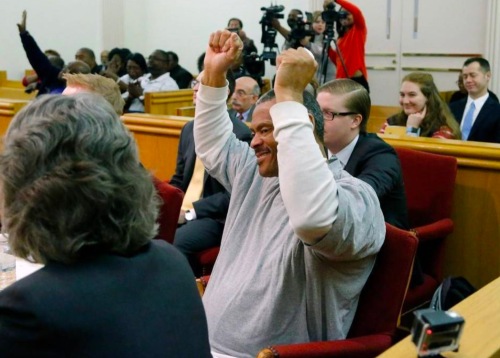
Howard Dudley Freed in North Carolina After 23 Years

DudleyPhoto: Chris Seward - cseward@newsobserver.com

 

After 23 years in prison for a crime he didn’t commit, convicted by false accusation and perjury, Howard Dudley has been released from prison in North Carolina.

Dudley: “The only thing I had to fight with was the truth.”

Judge: “This cries out as an injustice to Mr. Dudley.” “The Brady violations are ‘egregious, even outrageous.'”

Major congratulations and thanks to the Duke Law Wrongful Convictions Clinic for persevering through the discovery and litigation processes on this case for the last three years.

Please see The News & Observer story here. I strongly recommend viewing the several videos that are embedded in the article.

Restrictive discovery laws still foster injustice

Regressive discovery laws in New York and elsewhere render innocent defendants guilty in the court of opinion even when the charges are dropped, says Debora Silberman, a public defender who represented one of the five teenagers falsely accused in a highly publicized Brownsville, N.Y., rape case. If the discrepancies in the accusations had been disclosed earlier, she says here, the defendants’ reputations would not have been left in a shambles.


Retrial Granted in a Case Involving Illegal Undercover Investigation

From the Japan Times (Kyodo) :

Japan court grants retrial to convicted Russian following ‘unfair’ undercover probe

Kyodo

The Sapporo District Court decided Thursday to grant a retrial to a Russian man who was sentenced to two years in prison for possessing a handgun in 1997, acknowledging he was convicted because of an “illegal undercover investigation” by local police.

Presiding Judge Koji Saeki granted the retrial to the former sailor, saying, “A collaborator in police investigations initiated a deal to exchange a handgun with a valuable secondhand car,” thereby prompting the Russian man to bring in the gun.

“It was an illegal investigation that induced” the crime, Saeki said. “The state that should be preventing crimes have created a crime involving a handgun, thereby threatening the life and safety of its citizens.”

The Russian man, 46, was arrested for violation of the firearms control law and sentenced by the same court in August 1998. His sentence was finalized after no appeal was made, and he served out the prison term. He now lives in Russia. Continue reading

Courtney Bisbee Evidentiary Hearing Vacated

Courtney Bisbee was a single mother and school nurse, living and working in Scottsdale, AZ in 2004 when, through a combination of false accusations, police misconduct, prosecutorial railroading, very expensive but incompetent defense, and a judge who “owed one” to the prosecution, she was convicted in a bench trial, and sent to prison for “improperly touching” a teenager. An incident that never happened. You can read our first post about Courtney’s case here. Courtney has been in prison ever since.

I have personally been following this case for almost three years. This past December, we jubilantly posted that Courtney Bisbee had been granted an evidentiary hearing. Please see that report here. AT LAST, we saw a chance for the real truth to come out. However, as you would expect, the prosecution has been fighting against this with great vigor, and it appears, that for the time being, they have succeeded. Those readers who have been following this story should know that Courtney’s evidentiary hearing has been vacated.

No hearing was held, but on February 3, 2016, Senior Federal District Court Judge Roslyn O. Silver granted the prosecution’s objections, and vacated Courtney’s evidentiary hearing. You can see US Senior District Judge Roslyn O. Silver’s ruling here.

Let me take some editorial license here and state that this ruling is NOT about justice and truth and doing what’s right. This is about justice system officials desperately trying to prevent disclosure of their misdeeds. And it’s also about a justice system that has elevated “procedure” to the point of being an end unto itself, regardless of actual guilt or innocence.

The legal point at issue here was the subject of a 2011 U.S. Supreme Court decision in the case of Cullen vs. Pinholster, commonly referred to as just ‘Pinholster.’ Prior to this decision, federal habeas courts had the ability to conduct an evidentiary hearing and do fact finding to get to the truth. The decision in Pinholster limits the habeas court to considering only evidence that was presented at trial. This has been a part of the systematic gutting by the Supreme Court over the past decade of Constitutionally guaranteed habeas corpus protection. (If interested, you can download an interesting paper on the subject here.)

It must be noted that in her ruling, Judge Silver did not address the merits of the case. Consequently, there is still hope that Courtney may yet have her evidentiary hearing, and that the truth will come out. It’s just going to take longer.

Courtney has a petition on Change.org. Here is a link to that page: https://www.change.org/p/help-free-an-innocent-mom-courtney-bisbee-maricopa-county-az/u/15702845


Wrongfully accused? Jerome Morgan is still fighting for his freedom

Mike Perlstein, Eyewitness Investigates

NEW ORLEANS — Jerome Morgan is a busy man. On most days, he can be found going from posting signs at his advertising job, to cutting hair at a barbershop, to tutoring students at McDonogh 35.

But on some days, Morgan is pulled away from his jam-packed work schedule and dragged into court, where District Attorney Leon Cannizzaro maintains he is a killer.

The DA’s office has charged Morgan with second-degree murder in a fatal shooting of a 16-year-old boy at a birthday party in 1993.

For Morgan, 37, the case is like a recurring nightmare.

Recurring nightmare

AFTER 20 YEARS IN JAIL, FINALLY FREED
Cannizzaro is prosecuting Morgan even though his previous conviction in the case disintegrated in 2014 after the two key witnesses in the case recanted, saying they were coerced by police into falsely fingering Morgan.

Jailed at age 17, Morgan spent more than 20 years behind bars before he was freed.

From the beginning, he maintained his innocence. Along with the witness recantations, Morgan’s defense team discovered a critical piece of evidence that had been withheld by prosecutors, leading District Court Judge Darryl Derbigny to throw out the conviction.

The fatal shooting of 16-year-old Clarence Landry took place inside a ballroom at a Howard Johnson’s hotel on Old Gentilly Road on May 22, 1993. According to police and court records, the killer fled, chased by another party-goer, Kevin Johnson.

“The jury did not hear the evidence that makes it almost impossible for Mr. Morgan to have been the gunman who fled the scene.” MORGAN’S ATTORNEYS WROTE
Johnson returned after the gunman escaped by jumping over a wall, and he quickly found himself in the ballroom with other teenaged guests, locked inside by a security guard. Also confined to the room was Morgan, who was helping another teenager who was wounded.

Police responded within six minutes and took the names of everyone locked down.

But documents that reveal the timeline showing the arrival of police was not turned over to Morgan’s defense attorney at the time of his trial.

“The jury did not hear the evidence that makes it almost impossible for Mr. Morgan to have been the gunman who fled the scene,” Morgan’s attorneys wrote in his successful appeal.

At trial, prosecutors argued that enough time had passed for the killer to flee the scene, then somehow return to the locked ballroom.

But bolstered by evidence that room was locked down immediately, Morgan’s attorneys summarized the implausibility.

In their brief, the attorneys at the Innocence Project New Orleans wrote, “The jury heard that 30 to 45 minutes passed between the shooting and arrival of police…The evidence shows police arrived six minutes after the shooting.”

Continue Reading the full story here.

Monday’s Quick Clicks…

Oscar winner ‘Spotlight’celebrates hysteria and injustice, writer argues

There is a dark side to the feel-good story about Spotlight being named the best movie of year at the Oscars last night, JoAnn Wypijewski says. The Boston Globe’s investigative series of articles exposing priest pedophilia celebrated in Spotlight, she argues, fueled a moral panic that imprisoned the innocent as well as the guilty.

“By their nature, moral panics are hysterical. They jettison reason for emotion, transform accusation into proof, spur more accusation and create a climate that demands not deliberation or evidence or resistance to prejudice but mindless faith,” Wypijewski says here.

What Hollywood celebrated last night, she adds, was “the bunk of recovered memory; the Globe reporters’ failure to challenge any charlatan who embraces it; and the lure of money.”

Thursday’s Quick Clicks…

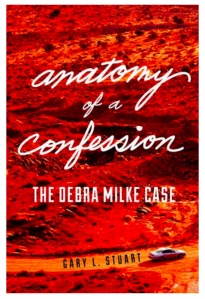
Anatomy of a Confession - The Debra Milke Case

Gary Stuart, author and Professor of Law at Arizona State University, has just published a book about the Debra Milke case. See our previous post here: http://wrongfulconvictionsblog.org/2015/04/10/interview-with-debra-milkes-attorney/

anatomy of confession

“Anatomy of a Confession is the story of the 1990 murder trial of Debra Milke. Two men—Debra’s boyfriend at the time and a friend of his—murdered Debra’s four year-old son in the Arizona desert. One of them implicated the boy’s mother. Even before Debra was questioned, the police hung a guilty tag on her. Debra Milke spent twenty-three years on death row for the murder of her four year-old son based solely on a confession she never gave. This is also the story of Detective Armando Saldate, his history of extracting forced confessions, and the role the Phoenix Police Department played in the cover-up and misconduct in its handling of the Milke investigation. Anatomy of a Confession is a vivid and shocking reminder of what America’s vaunted presumption of innocence is all about.”

It’s available on Amazon here.

Monday’s Quick Clicks…

Friday’s Quick Clicks…

Tuesday’s Quick Clicks…

Exoneration doesn’t always mean freedom or compensation

Not every exoneration has a happy ending. Many end up like Danny Brown’s. Fifteen years after he was exonerated by DNA, prosecutors in Toledo, Ohio, still cling to the dubious eyewitness identification of a then-6-year-old boy to insist that Brown remains a suspect in the rape and murder of the boy’s mother.

In all that time, prosecutors have successfully prevented Brown from collecting compensation for the 20 years he spent in prison even though they have uncovered no evidence linking Brown to the man whose semen was found on the victim.

As The Blade reports here, Brown is now homeless and in declining health. Jobs are hard to come by even when he’s in good health because he remains a suspect in a horrible murder and suffers from the anxiety that comes with it.

Sex, Lies, and Wrongful Conviction: Kathleen Kane’s Other Scandal

Want to get angry? Just read this article by Lorenzo Johnson, who was found innocent and released from prison after 16 years, and then put back in. He’s still there.

Lorenzo Johnson Article

Former Prosecutor Apologizes for Sending an Innocent Man to Death Row

Former Louisiana Prosecutor Marty Stroud recently made a heartfelt video apologizing to the innocent man he helped send to Death Row, Glenn Ford. Ford was exonerated last year after spending nearly 30 years in prison. Just months after being freed, Ford died of lung cancer.

To watch the video, follow this link: https://youtu.be/rmxASoca1P8

Thursday’s Quick Clicks…

New Study on Sleep Deprivation and False Confessions

A new study, published in Proceedings of the National Academy of Sciences of the United States of America, supports the link between sleep deprivation and false confessions. Lawrence Sherman, Director of the Institute of Criminology at the University of Cambridge, has called it a “milestone.” New Science magazine reports, “…legal experts are predicting it will be cited in future court cases.”

From the Study: “Here we demonstrate that sleep deprivation increases the likelihood that a person will falsely confess to wrongdoing that never occurred. Furthermore, our data suggest that it may be possible to identify certain individuals who are especially likely to falsely confess while sleep deprived. The present research is a crucial step toward Continue reading

Texas Disbars Former Prosecutor

Please see the following article by Jonathan Turley.

Texas State Bar Votes To Disbar Former Prosecutor For Role In Conviction Of Innocent Man

gavel2The Board of Disciplinary Appeals (appointed by the Texas Supreme Court) has upheld a state licensing board’s decision to disbar former prosecutor Charles Sebesta for his role in convicting an innocent man. Anthony Graves spent 18 years on death row for setting a fire that killed six people. Sebesta’s conduct was shocking but remains a relatively rare example of prosecutors being held accountable in such cases of prosecutorial abuse.

Sebesta had convicted Robert Carter for the murders and tried to get Carter to say Graves was an accomplice. However, just a day before the trial, Carter told Sebesta he acted alone and Graves was not involved. Sebesta withheld the information from the defense and presented false testimony implicating Graves. Sebesta also blocked an alibi witness by telling the court that the witness was a suspect in the murders and could be indicted. The witness then refused to testify.

After his conviction was reversed, a special prosecutor found in 2010 that there was no credible evidence that Graves was involved in the murders.

Sebesta now insists that he has been treated unfairly.

=======================================================

Treated unfairly?! Mr. Sebesta is lucky he himself is not now behind bars.

Monday Quick Clicks…

Thursday’s Quick Clicks…