Category Archives: Asia

Indian man freed by Delhi High Court after 14 years in prison

Bhupender Singh walked free on Friday after the Delhi High Court acquitted him of the 1999 murder of the wife of his former employer. Singh had been convicted in 2006, after fingerprints were found in his employers house. The fingerprint evidence was highly contentious, and never dealt with satisfactorily, but the High Court has now decided that Singh can go free, because there was not sufficient evidence for the conviction.

Read more here… HC acquits man of murder 14 yrs after he was jailed

China tries to curb miscarriages of justice as anger over torture, other abuses, grows

From Foxnews.com:

Chen Keyun’s legal nightmare began in 2001 when he was accused of detonating a bomb outside a Communist Party office in his southern coastal city of Fuqing.

Chen denied committing the crime but was held for 12 years, during which he was tortured into confession and twice sentenced to death. He finally was released and exonerated this year, a case that exemplifies the miscarriage of justice that China’s Supreme People’s Court now says it wants to curtail.

Last week, it released its first set of detailed recommendations for preventing wrongful convictions: Judges should presume defendants are innocent until proven guilty, reject evidence obtained through torture, starvation or sleep deprivation and refrain from colluding with police and prosecutors.

The moves reflect Chinese leaders’ recognition that an increasingly prosperous public is demanding a more predictable and fair justice system, though party officials are unlikely to fully loosen their grasp over the courts.

“It is of significance and if adopted seriously, it will effectively help prevent the occurrence of wrongful convictions,” said Prof. Tong Zhiwei, a legal expert at the East China Politics and Law University in Shanghai. “The question is whether the regulation will be fully implemented at local levels.”

The recommendations are seen more as an effort to build a more professional judiciary, one in which judges observe legal process and make rulings that are based on sound evidence — rather than grant courts full independence.

“If courts can be more independent, then these problems can be easily solved,” said Li Fangping, a prominent defense attorney in Beijing. “This guidance can only increase their independence a little bit. On technical issues, it will be of help, but as long as there are cases where there will be intervention, it won’t be of much use.”

In China, the party controls the courts, police and prosecutors. Some judges are not trained in law, and they rarely acquit defendants for fear of embarrassing their partners in law enforcement. Experts and defense lawyers say police commonly fabricate evidence or use torture to obtain confessions.

Chen Keyun was a manager of a state-owned labor recruiter in Fuqing when a bomb exploded in 2001 outside the city branch of the party agency that investigates cadres for corruption. The explosion killed an agency driver.

Attacks on offices that represent party or government power in China are treated with great urgency, with authorities moving swiftly to solve the case and punish perpetrators to send a message of zero tolerance.

Police turned to Chen as a suspect because he previously had been investigated by the anti-graft office and punished. Five others, including Chen’s driver Wu Changlong, Chen’s wife, Wu’s former brother-in-law and two migrant workers, also were arrested for involvement in the attack.

Police detained Chen, then 48, and in the two months that followed, he said, deprived him of sleep, beat him, starved him, and dangled him for hours by strapping his wrists to iron rods on a high window.

“They treated me like less than a dog,” Chen, now 60, said in a phone interview. “I was an old Communist Party cadre who had been about to retire, I had never thought that something like this could happen to me.”

Chen said he protested his innocence until he could no longer endure the torment.

His interrogators eventually forced him to sign a confession, though he later tried to retract it, telling other investigators he had been tortured. Chen’s lawyer took pictures months later showing deep welts on his wrists. Others accused in the case also said they were tortured.

The Fuzhou City Intermediate Court sentenced Chen and Wu to death with a two-year reprieve in 2004, and three of the others to various terms of imprisonment. The defendants appealed in 2005 and several domestic newspapers reported that they might have been wrongfully convicted. The Fujian provincial high court turned the case back to the city court and ordered a retrial.

In 2006, the Fuzhou court tried the case again and upheld the suspended death sentences for Chen and Wu. They appealed again, and in 2011 the provincial court tried the case yet again. In May, the court acquitted all five defendants.

The court offered compensation of about 4.2 million yuan ($690,000) to the five of them in September but they are demanding more, as well as an acknowledgement that they were tortured.

Chen’s is one of a few high-profile cases of wrongful convictions overturned in recent months. In March, a court in eastern Zhejiang province retried and acquitted two men who were convicted in 2004 of raping and murdering a woman, after DNA evidence from another case ruled out their involvement in the crime.

The Supreme People’s Court’s latest directive is seen as building on earlier comments by its president, Zhou Qiang, on the importance of preventing wrongful convictions. Rights activists say it is a welcome move, but may not be enough to curb abuses.

“The guidelines fail to address the structural problems that create wrongful convictions — police power that goes unsupervised, the lack of judicial independence, the absence of effective remedies when things go wrong, and weak defense rights,” said Maya Wang, a Human Rights Watch researcher in Hong Kong. “Thus it will be unlikely to achieve much impact on the ground.”


 

Chinese Supreme Court Cracks Down on False Confessions and Wrongful Convictions

From voanews.com:

China’s top court has ruled out forced confessions and vowed to reduce miscarriage of justice, in a move that highlights increasing policy emphasis on legal reform.

The directive, issued by China’s Supreme People’s Court on Thursday, is intended to strengthen the rule of law in a system that many analysts agree still lacks basic elements of judicial independence.

The court says that all levels of the judiciary are required to perform their duties strictly according to the law, base their judgments on facts, and protect human rights. It lists 27 provisions, including the protection of defendants’ right of attorney, the need for trials to be open and based on legally obtained evidence, and the elimination of confessions obtained through torture.

Encouraging sign

Nicholas Bequelin of Human Rights Watch says the ruling is an encouraging sign that the government is responding to pressure from society demanding better rights protection during criminal trials.

“It gives a foothold to lawyers and legal reformers in China, it helps them put pressure on the police, on the courts, on the judicial system whenever they don’t act accordingly,” he says.

In recent years, China has introduced procedural mechanisms to guarantee defendants fair trials, including an amendment last year requiring police to allow lawyers to meet with their client within 48 hours after a request is filed.  Thursday’s court ruling is a step in that same direction – analysts say – in a system plagued by endemic problems of obtaining confessions through torture, wrongful convictions and persecution of lawyers.

Police remain powerful

But rights advocates say that despite court reforms, the powerful police in China still make the justice system unfair.  In a recent case, a Chinese official under investigation for corruption was tortured to death and drowned in a bathtub as police investigators were trying to break him into confession.

Bequelin of Human Rights Watch says that given that courts in China are often subservient to police departments, there are limits to what the courts – such as with Thursday’s provisions – can achieve.  “It is all well for the courts to say ‘oh, we are going to make sure we reduce wrongful convictions and torture,’ but the fact is they have very little leverage to do that because it is basically the police that are driving the criminal system in China,” he says.

Call for review of past cases

Li Zhuang, a criminal lawyer based in Beijing, says that to prove they are serious in implementing the documents, courts should start reviewing past cases where lawyers have presented proof of coerced testimony.

Li Zhuang was one of the lawyers targeted in a campaign against mafia in Chongqing, then the stronghold of now ousted politician Bo Xilai.  Li was charged with perjury after attempting to defend a local entrepreneur whose confession had been obtained through torture.

Li confessed wrongdoing and was sentenced to 18 months in jail.  “Contesting evidence has been provided that sufficiently overthrows that judgment, but it has been more than two years and there has been no review,” Li says. “We have to wait and see whether these provisions will be implemented on the ground. That is the next step.”  Li says there is little incentive for court officials to review cases because in many instances they have based career promotions on wrongful convictions.

In Chongqing, some of the city’s wealthiest entrepreneurs were put to jail based on confessions obtained through illegal means, and their assets were seized by the city government.  “Many assets seized during the campaign have been spent,” Li says. They used them to plant trees and organize red songs revivals. How can you give back money that has already been spent?”

Evolution of judicial reforms

The Supreme Court’s ruling comes days after China wrapped up an important party meeting and announced key reforms in a number of fields, including its legal system.  After much public pressure, party leaders pledged to scrap the system of re-education through labor – a notorious practice of administrative detention that gives the police rights to bypass courts and detain suspects without trial for up to three years.

Such amendments have been welcomed by legal scholars and professionals in China, but some believe that individual measures will be meaningless if they do not ensure independence of the legal system – which in China is still to a great extent under the yoke of the party and the public security apparatus.

Note to Yong Vui Kong post: death penalty reprieve for Chum Tat Suan (Singapore)

Prior to Yong Vui Kong (blog post here), there was another drug trafficking case where the Singapore High Court exercised its discretion under legislative amendments for drug trafficking during the sentencing hearing. The decision explains the manner by which this discretion is exercised and highlights the judge’s concerns. This was in the case of Chum Tat Suan (24 October 2013).

One of the conditions that an accused convicted of drug trafficking has to meet to benefit from this judicial discretion is that he/she must be found to be a mere drug “courier”. Recognising, among others, that this issue was “a matter of life and death” for the accused, the judge decided to give the “benefit of doubt” to the accused of being a mere “courier”, though no new evidence about this was introduced at that stage and evidence earlier adduced during trial on this point was found to be “not unequivocal”.

Ps: Thanks to CHEN Siyuan and Jack LEE from the Singapore Management University for highlighting important facts about the Chum Tat Suan case

New Evidence Found in 1966 Hakamada Case

My previous post on Hakamada Case here. This is a case from 1966. Hakamada claims his innocence from Tokyo Detention Center, where he is held on death row. He has been held in confinement for over 45 years.

From the Mainichi:

New evidence emerges in 1966 murder case: lawyers

SHIZUOKA, Japan (Kyodo) — New evidence has emerged in a 1966 murder case that suggests the man who has been convicted and is on death row for the crime may have been wrongfully accused, his defense lawyers said Sunday.

The new evidence in favor of Iwao Hakamada, 77, may provide stronger grounds in their appeal for a retrial, the result of which will be decided by the Shizuoka District Court next spring at the earliest.

The lawyers said the new evidence came to light in the witness statements of two colleagues of Hakamada who were staying at the same company dormitory at the time of the crime in June 1966. Continue reading

Japan’s Hanging Method Criticized by U.S. Occupation Officials More than 60 Years Ago

 An important document concerning the capital punishment in Japan was found recently. The document showed that the U.S. occupation officials raised concerns about the execution by hanging. The method is still used today. Read here about how the executions are carried out in Japan.

 From The Asahi Shimbun:

U.S. occupation officials criticized Japan’s hanging method

By GEN OKAMOTO/ Staff Writer

U.S. occupation officials in 1949 raised concerns about how Japan executed prisoners, saying the condemned were not dying quickly enough under the hanging method that is still used today, a document showed.

The concerns were expressed in an internal document from the General Headquarters of the Supreme Commander for the Allied Powers (GHQ) that was found in the National Diet Library by Kenji Nagata, an associate professor of law at Kansai University.

“The document shows that issues were being raised about the hanging method used in Japan from more than 60 years ago,” Nagata said.

The internal document was written by an official in the Civil Intelligence Section (G2) of GHQ and dated Sept. 2, 1949. The subject of the memo is “Executions, Japanese Prisons.”

In the document, an official in the Nagoya area is quoted as calling for a change in capital punishment “so as to effect rapid and more humane death of the subject.”

The statement indicates the official wanted Japan to employ hanging methods then in use in the United States that severed the neck vertebrae to instantly kill the prisoner.

The official in charge of prisons in G2 says in the document that the matter would be brought up with the director of the correction and rehabilitation bureau of what is now the Justice Ministry.

The document was originally kept in the U.S. National Archives and Records Administration. A copy has been kept at the National Diet Library’s Modern Japanese Political History Materials Room.

Another GHQ internal document showed that 79 people were executed during the occupation period, and the average time before the individual was confirmed dead was about 14 minutes.

Japan’s hanging method has come under fire because those executed do not die quick deaths. Critics say the method violates Article 36 of the Constitution, which states “cruel punishments are absolutely forbidden.”

In a criminal trial held in 2011 at the Osaka District Court, a former prosecutor testified, “At one execution that I witnessed while working as a prosecutor, it took about 13 minutes before the individual died.”

Japan has used hanging for capital punishment since 1873.


Singapore courts review death penalty convictions under amended legislation: Yong Vui Kong

I previously blogged on the 2012 legislative amendments to Singapore’s Penal Code and Misuse of Drugs Act, which give Singapore judges some discretion over imposing the death penalty in cases of murder and drug trafficking – offences that previously carried the mandatory death penalty. Singapore Courts have been reviewing cases and deciding which convicted persons may have their death sentences replaced under these amendments.

Among the cases reviewed so far is the high profile case of Yong Vui Kong. Since his 2008 conviction, locally-based activists in Singapore have ceaselessly campaigned for the reconsideration of Yong’s case based on his circumstances. On 14 November 2013, the Singapore High Court reduced Yong’s death sentence to life imprisonment and 15 strokes of the cane.

As mentioned in my earlier post, these 2012 legislative amendments, by circumscribing the application of the death penalty, will positively impact investigations into possible wrongful convictions. The only independent organisation specialising in such investigations in Singapore is the Singapore Innocence Project, which was established by students from the National University of Singapore and formally launched in May 2013. Though an imprisonment based on a wrongful conviction can seldom be truly compensated, at least, in cases of imprisonment, those found to be wrongfully convicted will be alive to experience relief and vindication.

Convictions quashed on application of Singapore Attorney General’s Chambers

An interesting case was heard by the Singapore High Court in October, 2013. The Singapore Attorney General’s Chambers (AGC) made an application to the High Court to review and set aside the conviction of Thomas Tay, who had been sentenced six years ago under the Securities and Futures Act. The High Court quashed Tay’s convictions and returned him the $240 000 fine he had paid.

The AGC had applied for a review of Tay’s case based on the acquittals of other individuals linked to Tay’s case.

This is an interesting case of criminal revision being initiated by the Singapore AGC, instead of by the Court or the accused. Based on Singapore’s written laws (as opposed to common law), a criminal case that has exhausted the appeals process can presently only be revisited based on S. 400 (1) of Singapore’s Criminal Procedure Code. This provision allows the High Court to study the record of criminal proceedings brought before any Subordinate Court to satisfy itself of “the correctness, legality or propriety of any judgment, sentence or order recorded or passed and as to the regularity of those proceedings.” Note that under S. 400 (1), this ability to review cases is limited to the High Court and only applies to cases previously heard before Subordinate Courts. S. 400 (1) therefore does not cover many serious offences which carry severe penalties and fall within the High Court’s original jurisdiction. It was fortunate that Tay’s case fell within the narrow limits of S. 400.

Though it is encouraging that the AGC took the initiative to apply for a review in the Tay case, and though the Singapore Court of Appeal has recognised the possibility that it may review cases to prevent wrongful convictions, the Tay case shows that there is need for legislature to be passed in Singapore that clearly recognises the ability Singapore Courts to review criminal cases to prevent wrongful convictions or serious injustices, regardless of the court before which the case was first heard and regardless of the lapsing of appeal timelines.

Friday’s Quick Clicks…

click

Exoneree on a Lecture Tour in Japan

From Fernando Bermudez:

 I Cannot Take Off My Straw Sandals

                                                                                       By Fernando Bermudez

 Strong Hugs. Wiped tears. Repeated reassurances. Through the eyes of my children, my emotional return from Japan reflected more accomplishment than exhaustion after lecturing in 9 Japanese cities from Tokyo to Okayama throughout October 2013. In sharing my 18-year wrongful incarceration story in New York until exonerated in 2009 (due to mistaken eyewitness identifications and police and prosecutorial misconduct), my lectures at Japanese bar associations and universities urged Japan to abolish its death penalty and reduce relying on confessions to secure Japan’s 99% conviction rate, which have caused several wrongful convictions and exonerations in Japan due to false confessions.

DSCN0117

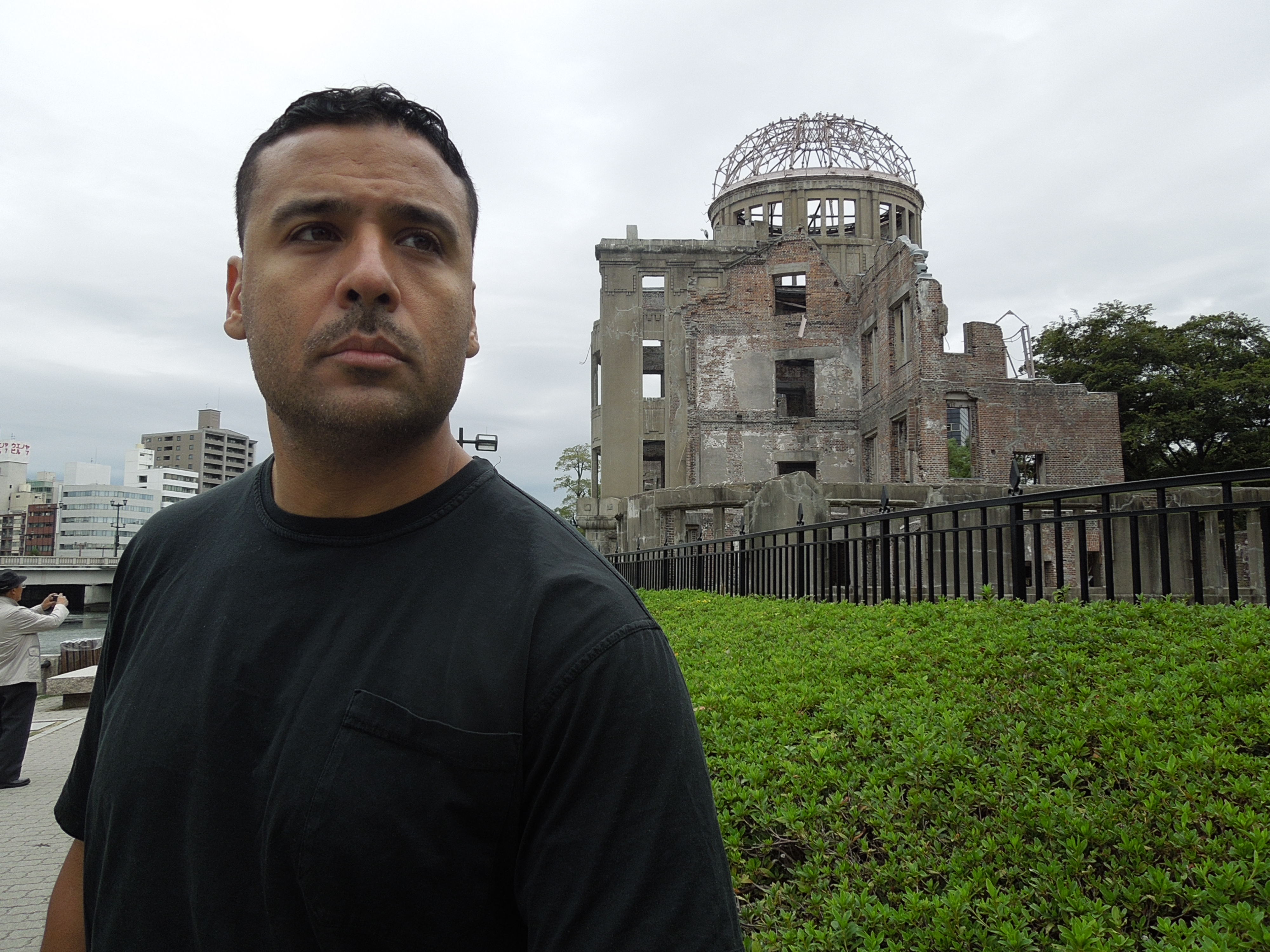
Fernando Bermudez in Hiroshima

Continue reading

Death of inmate’s adoptive son ends ‘Teigin’ retrial bid

My previous post on Teigin Case here.

From the Japan Times:

Death of inmate’s adoptive son ends ‘Teigin’ retrial bid

by Keiji Hirano, Oct 16, 2013

The curtain has effectively come down on the most mysterious mass-murder case in postwar Japan, with numerous questions left unanswered.

Takehiko Hirasawa, 54, who sought a posthumous retrial for his adoptive father, Sadamichi Hirasawa, was recently found dead in a home in Suginami Ward, Tokyo.

Sadamichi Hirasawa was sentenced to hang for poisoning 12 people to death at a branch of Teikoku Ginko (Imperial Bank) in Tokyo on Jan. 26, 1948, in what became known as the “Teigin Incident.” He passed away in a prison hospital on May 10, 1987, at the age of 95, after maintaining his innocence for nearly 40 years. Continue reading

Supreme Court Rejects to Reopen Nabari Case…

Previous posts on Nabari Case here, here and here. This is a murder case from 1961. The defendant, Masaru Okunishi is critically ill, awaiting his execution on a prison hospital bed.

From Mainichi.jp:

Top court rejects petition to reopen 1961 murder case

TOKYO (Kyodo) — The Supreme Court said Thursday it has turned down a petition by a death row inmate for a retrial over a 1961 murder case in which five women died after drinking poisoned wine in Nabari, central Japan.

In the seventh plea for a retrial, the defense team for Masaru Okunishi, 87, presented an expert opinion that the poison used in the crime was not tetraethyl pyrophosphate as determined in the final ruling.

However, the top court’s No. 1 petty bench unanimously rejected the petition, saying the pesticide could have been used as the poison as Okinishi had initially confessed.

In response, the defense team said it plans to file another plea for a retrial with the Nagoya High Court in the near future.

The case involves the poisoning of 17 people on March 28, 1961, at a local community meeting in Nabari, Mie Prefecture. Five, including Okunishi’s wife, died and 12 fell sick.

The Tsu District Court acquitted Okunishi in 1964 for lack of evidence, but the Nagoya High Court handed him a death sentence in 1969, finalized by the Supreme Court in 1972.

Accepting his petition for a retrial, the high court decided in 2005 to reopen the case and suspend the execution, but another panel of the high court nullified the decision the next year, accepting the appeal of prosecutors.

His petition was again rejected by the high court last year after having the case sent back by the top court, leading Okunishi to file a special appeal to the Supreme Court.

Okunishi has experienced deteriorating health and is in a serious condition at a medical prison in Hachioji in the western suburbs of Tokyo, where he has been held since May.

October 17, 2013(Mainichi Japan)

Blog editors discuss wrongful convictions in China

Wrongful Convictions Blog editor Mark Godsey, left, and contributing editor Nancy Petro, second from right, are shown visting the Great Wall of China on Saturday. They are joined by Mark’s wife, defense attorney Michelle Berry Godsey, and Nancy’s husband, former Ohio attorney general Jim Petro. All four were invited to China to discuss wrongful convictions throughout the world.

China

Thursday’s Quick Clicks…

click
  • Cambodia’s Supreme Court ordered the release of two men Wednesday who were wrongly convicted and jailed for the 2004 murder of a prominent opposition activist.  The court’s decision to drop all charges came amid renewed calls to free the men, whom leading international rights groups have called “scapegoats” in the murder of Chea Vichea and one of many examples of the country’s corrupt judicial system.  Rest of article here
  • Alaska Innocence Project files motions to free the Fairbanks Four
  • Judge Ken Anderson, former prosecutor who prosecuted Michael Morton, resigns
  • Tyra Patterson:  Interesting alleged false confession case in Ohio

Law Review Issue on Wrongful Convictions Around the Globe Now in Print…

Cover

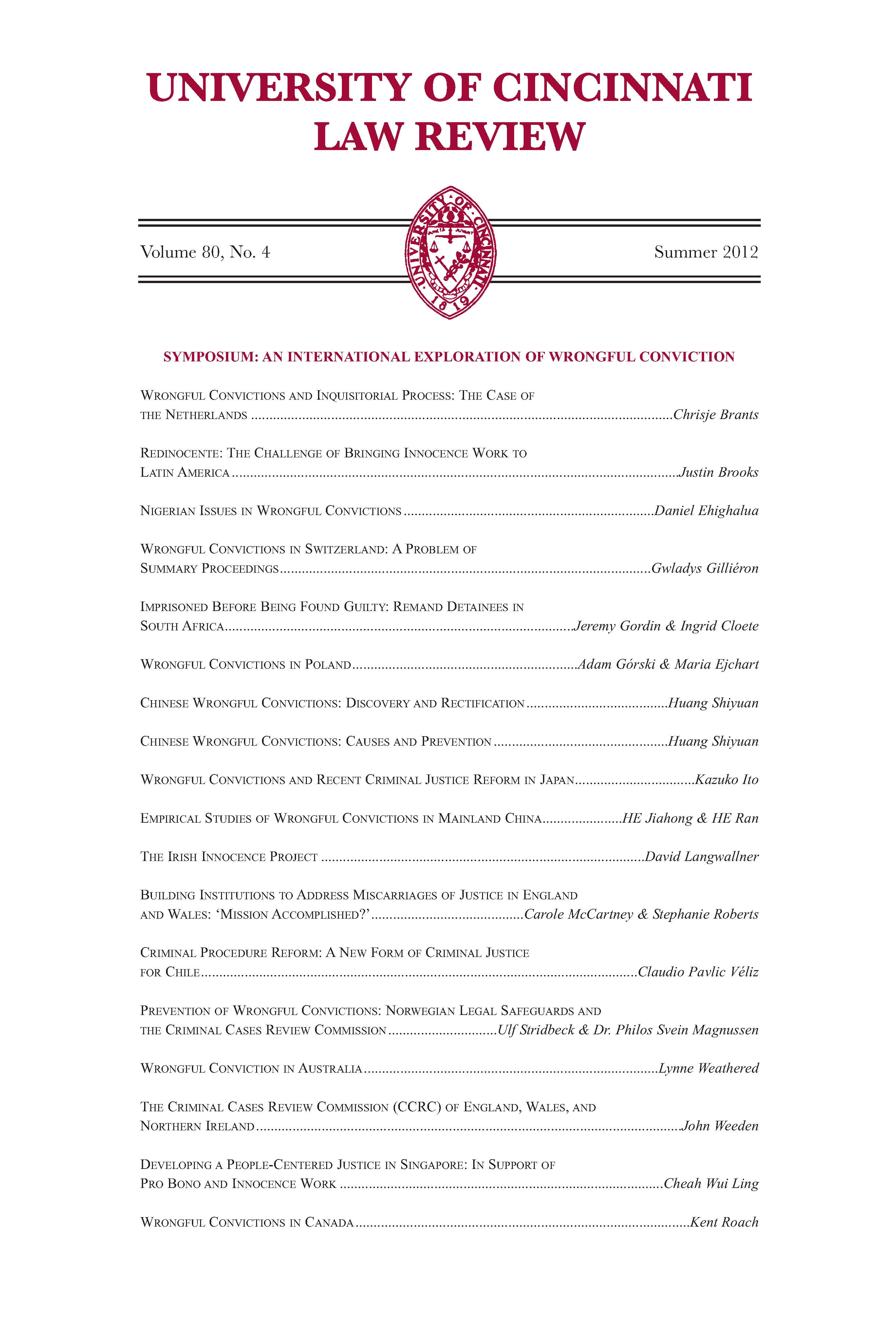
At long last, the University of Cincinnati Law Review symposium issue stemming from the 2011 International Innocence Conference in Cincinnati is finally in print.  The edition contains articles discussing and summarizing the causes and extent of wrongful conviction in countries across the globe.  You can find the entire volume here.  Congrats to all involved on completing this important work.

73 Year-Old Inmate Executed on Sep. 12, 2013 in Japan

From the Japan Times:
Death-row inmate, 73, sixth executed under Abe Cabinet
by Tomohiro Osaki Staff Writer
Sep 12, 2013

Tokuhisa Kumagai, 73, was put to death after Justice Minister Sadakazu Tanigaki signed the order for the execution, the sixth under the Cabinet of Prime Minister Shinzo Abe, who took office last December.

About a month after the slaying, Kumagai attempted another robbery during which he shot an employee at Shibuya Station in Tokyo. The station worker narrowly escaped death, but was partially paralyzed.

For this incident, Kumagai was convicted of attempted murder and attempted robbery.

He was also convicted of attempted arson and robbery for earlier incidents.

During a hastily arranged news conference after the hanging, Tanigaki denounced Kumagai’s crimes as “extremely flagrant,” saying the murder and other transgressions were motivated by selfishness and caused immeasurable pain to the families of the victims.

“As a matter of fact, his acts were scrutinized by the courts numerous times, and I myself repeatedly gave them serious considerations before signing the final order,” Tanigaki said. Continue reading

Singapore courts review death penalty convictions under amended legislation: implications for investigations into possible wrongful convictions

Singapore courts have recently reviewed two death penalty convictions in July and August 2013, replacing these with a combination of life imprisonment and judicial caning (see below for more details on sentences). These reviews were undertaken pursuant to 2012 legislative amendments which give Singapore judges some discretion over imposing the death penalty in cases of murder and drug trafficking, offences that previously carried the mandatory death penalty. The two reviewed death penalty convictions had been handed down prior to the 2012 legislative amendments. Altogether, 34 death penalty convictions are expected to be reviewed by Singapore courts.

Public debate in Singapore has focused on how these legislative and judicial developments permit a more circumscribed use of the death penalty and the tailoring of sentences to each individual case. These developments will also positively impact investigations into possible wrongful convictions. Such investigations usually take many years, and the Singapore Innocence Project was just formally launched in May 2013. Singapore prides itself on its efficient legal system, and it is commonly believed that those sentenced to the death penalty are not on the “death row” for long – though detailed official statistics on this is not publicly available.

Avoiding the death sentence will allow cases of wrongful conviction to be remedied while the wrongfully convicted person is still alive.

Note: In both reviewed cases, the convicted persons had their death sentences reduced to sentences of life imprisonment with 24 strokes of the cane. Judicial caning is a permitted form of legal punishment under Singapore’s Criminal Procedure Code, and a convicted person may be sentenced to a maximum of 24 strokes of the cane.

Friday’s Quick Clicks…

click
  • In Vermont, an aggravated murder charge against John Grega, a Long Island, N.Y., man charged with killing his wife in 1995, has been dismissed, because of difficulties with additional DNA testing. The dismissal of the second murder charge against Grega comes a year after his 1996 conviction was dismissed, and a new trial ordered, because of new DNA evidence. Windham County State’s Attorney Tracy Shriver announced late Wednesday that murder charges against Grega would be dismissed without prejudice because of difficulties finding a lab to do necessary DNA matching of evidence taken from Christine Grega’s body.
    Shriver, in a joint statement with Vermont Assistant Attorney General Cindy Maguire, said they “remain committed to continuing this investigation to seek justice for Christine Grega and her family.”  In 2012, new DNA testing had revealed the presence of an unknown man’s DNA in her body, the discovery of which resulted in a judge ordering a new trial.
  • A U.S. judge ordered a new trial Wednesday for a Philadelphia man sentenced to death in 1992 for killing a high school student for her gold earrings.  U.S. District Judge Anita Brody found that James Dennis’ conviction was based on dubious eyewitness testimony, bad police work and a poor defense by his lawyer, The Philadelphia Inquirer reported. She said he must be freed if he is not retried within six months.
  • In India, Supreme Court limits right of intermediate courts to overturn acquittals

Miscarriages of Justice in China Prompt New Guidelines

Unknown-1

China has recently been uncovering a raft of miscarriages of justice. The latest case sees a man released after spending 17 years in prison for the murder of his wife. This latest case, and the many that have recently hit the headlines have led to new guidelines from the ruling Communist Party, regarding prosecution policy and procedures. The guidelines reaffirm the presumption of innocence, and makes police and prosecutors ‘responsible’ for erroneous convictions – removing the previous ‘conviction target’ system of appraising performance simply through numbers of convictions. Read more here:

Chinese man innocent after 17yrs in jail

Lifelong Responsibility

In China, String of Wrongful Convictions Leads to Judicial Reforms…

From Eastday.com:

BEIJING, Aug. 12 — China has started a new round of judicial reform to tackle problems impeding judicial justice, China’s chief justice wrote in an article published on Monday.

The reform is aimed at making breakthroughs in improving the judicial system, especially enhancing the independence of judges and prosecutors and curbing interference from other sources of power and the influence of profits, wrote Zhou Qiang, president of the Supreme People’s Court (SPC), in a byline article published by the People’s Daily, the mouthpiece of the Communist Party of China (CPC) Central Committee.

Judicial departments are urged to adopt measures to curb outside intervention and improve their work styles, Zhou wrote.

Although the country’s legislation has progressed well, greater efforts are needed in the implementation of laws, the article stated, adding that the full and effective implementation of laws is the most important factor in promoting the rule of law in China.

Judicial departments should bear their duties of upholding justice and protecting the authority of the law in every court case, Zhou wrote.

In addition, the chief justice called on officials to “be always in awe of the Constitution and laws.”

Officials, especially those in charge, should set an example by abiding by laws and maintaining the principle that the red line of the law should not be crossed, Zhou wrote.

Judicial departments should also firmly believe in the ideal of the law and socialist legal system while consciously resisting the infiltration of Western concepts, he wrote in the article.

Chinese courts have been under public scrutiny since a string of cases involving the miscarriage of justice and scandals involving judges were exposed.

On July 2, a Zhejiang court overturned sentences for five men who were wrongfully convicted of robbing and killing two taxi drivers 18 years ago.

Last week, four senior judges from Shanghai’s higher court were removed from their positions for allegedly hiring prostitutes at a nightclub.

The SPC on Wednesday said the four court officials have tarnished the image of the nation’s judges and scarred judicial credibility.

It has ordered courts across the country to fight corruption and eliminate black sheep to stop similar events from occurring in the future.