Category Archives: Forensic controls

ABC critical report on forensic evidence in Australian courts.

Leading forensic science and legal expert Prof Gary Edmond has featured in a highly critical report on forensic evidence being presented in Australian courts. Much of it is backed by very little ‘science’. Using voice identification evidence to illustrate some of the pitfalls, the report warns that much forensic evidence can be “dangerously misleading”. Read the full report here…
Courts’ use of forensic evidence called into question

Blood Spatter – Some “Legal Stuff”

Jodie English is a criminal defense lawyer practicing in Indianapolis, IN who deals only with major felonies.  She has drafted three “model” or “template” motions dealing with blood spatter or blood pattern analysis (BPA) evidence – one each to ‘limit’, to ‘discover’, and to ‘exclude’.  I attach them here with her permission.

Motion to Limit BPA

Motion to Discover BPA

Motion to Exclude BPA

You might want to reference my previous post on the subject:

https://wrongfulconvictionsblog.org/2012/04/30/blood-spatter-evidence/

Crime-lab scientist claims she was fired for blowing whistle on errors

A fired whistleblowing forensic scientist in Texas claims in a lawsuit that her problems at the Austin Police Department’s crime lab started when she sent a corrected blood-alcohol-level test to the lawyer representing a man charged with intoxication assault.

The suit filed in Travis County District Court last Friday by Debra Stephens says that state law required her to report the corrected amount, but department officials told her that was a violation of lab policy.

Stephens, who worked for the lab for nine years until she was fired in 2011, later filed a complaint against the lab with the Texas Forensic Science Commission for allegedly cutting corners during drug-evidence testing.

Stephens claims that police and city officials subsequently spread false information about her that damaged her reputation, according to an article in the Austin American-Statesman. More details about Stephens’ allegations of mishandled evidence is covered here.

Stephens’ claim of retaliation for exposing lab errors mirror those made in 2009 by Chris Nulf, a former forensic analyst with the Dallas County Crime Lab. Nulf filed an ethics complaint in April against Williamson County District Attorney John Bradley, claiming that Bradley and others on the Forensic Science Commission failed to properly investigate his complaints of negligence and misconduct at the Dallas lab.

Another lab scandal surfaces in Texas

Texas, which loves to be No. 1 in everything, seems to be making a concerted effort to outdo other states in the number of wrongful convictions. Now it seems determined to be top dog in crime-lab scandals as well.

The Texas Department of Public Safety has just warned district attorneys about errors in drug evidence analysis at its Houston regional lab. Officials said evidence that wasn’t properly tested could have resulted in faulty convictions since 2006 in Houston’s Harris County and several other counties that the lab serves.

In an email to prosecutors in the affected counties, the Department of Public Safety said the errors appeared to all be linked to one forensic scientist who has been suspended.

The Houston Police Department Crime Lab had to be shut down several years ago after lax testing, some of which contributed to wrongful convictions, was discovered there. Problems also have surfaced in a San Antonio crime lab.

But Texas still has lots of competition for lab scandals, as writer Matt Clarke documents here.

Blood Spatter — Evidence?

Well … you knew that sooner or later we’d get around to “blood spatter”.  This is also sometimes called “blood pattern analysis” (BPA).  As the name implies, BPA is the analysis of patterns made by blood that has been expelled from the body by a violent act – stabbing, shooting, beating.  These patterns can be used to help reconstruct the violent event, and can provide information about type of injury sustained, movement of a victim, angle of a shooting, location of attack, etc.  Unfortunately, BPA is one of the forensic disciplines least based upon real science.  It has evolved from a collection of anecdotal and empirical observations that have resulted in potentially flawed inductive inferences about the fluid dynamic behavior of blood outside the body.

Now, like all forensics, BPA is not useless.  There is certainly legitimate information that can be garnered from an analysis of blood patterns at a crime scene.  But, again, as with all forensics, it must be used within the bounds of what is scientifically supportable.

Continue reading

Bromwich urges reforms to avoid more lab scandals

Former U.S. Department of Justice Inspector General Michael Bromwich, whose investigation first documented flawed forensic testing in the FBI crime lab in the 1990s, weighs in here on The Washington Post’s revelation last week that many defendants were never notified of his findings.

Bromwich, who went on to expose even worse problems at the Houston Police Department Crime Lab, laments that innocent defendants had their lives ruined when they were denied crucial information with which they could challenged their wrongful convictions.

“Unfortunately, this story is not unique in our criminal justice system,” Bromwich says. He recommends several specific reforms to address what he calls “systemic failures” in the practice of forensic science in the United States.

Sunday’s Quick Clicks…

  • John Grisham is keynote speaker at Midwest Innocence Project’s fundraiser this Wednesday the 25th
  • Article on the problems with forensic sciences
  • The full video version of the PBS Frontline show, The Real CSI on the problems with forensics in the courtroom

Washington Post on Junk Science and What Obama and Congress Are Trying to Do About it

Full story here.  Excerpt:

In Hollywood, the moment the good guys trace a hair, a bullet fragment or a fingerprint, it’s game over. The bad guy is locked up.

But the glamorized portrait is not so simple in real life.

Far from infallible, expert comparisons of hair, handwriting, marks made by firearms on bullets, and patterns such as bite marks and shoe and tire prints are in some ways unscientific and subject to human bias, a National Academy of Sciences panel chartered by Congress found. Other techniques, such as in bullet-lead analysis and arson investigation, survived for decades despite poorly regulated practices and a lack of scientific method.

Even fingerprint identification is partly a subjective exercise that lacks research into the role of unconscious bias or even its error rate, the panel’s 328-page report said.

“The forensic science system, encompassing both research and practice, has Continue reading

A Forensic Resources Blog

Sarah Rackley is Forensic Resource Counsel for North Carolina Indigent Defense Services, and she maintains a forensic resources blog.  While it is, expectedly, a little NC-specific, there’s much good information there.

Here is a link:

http://ncforensics.wordpress.com/

“The Real CSI”

I hope you were able to watch “The Real CSI” on PBS last night.  The program shined a bright light on the shortcomings and failures of the forensic disciplines.(Excuse me, but I refuse to call them “sciences”.)  The focus was mainly on “fingerprints”, “bite marks”, and “odor analysis”, but mention was also made of “blood spatter”, “hair & fiber”, and “ballistics”.  There was also a piece about the shoddy state of forensic expert “certification”.  Please see the earlier post by Mark Godsey:    https://wrongfulconvictionsblog.org/2012/04/18/must-read-story-about-lack-of-control-in-forensic-accreditation/

If you were not able to watch, you can view the program online here:

http://www.pbs.org/wgbh/pages/frontline/real-csi/

In the closing of the program, Federal Judge Harry T. Edwards, who was one of the principal authors of the NAS report, got it exactly right when he said, “It’s not pro-defense.  It’s not pro-prosecution.  It’s pro-justice.”

The question I have to keep asking the forensic “experts”, and the one that will stop them in their tracks, is – “Show me the data from which I can compute a probability of occurrence.”  The only forensic discipline that can do this today is DNA.

Must Read Story About Lack of Control in Forensic Accreditation

From ProPublica.com.  Full article here.

Excerpt:

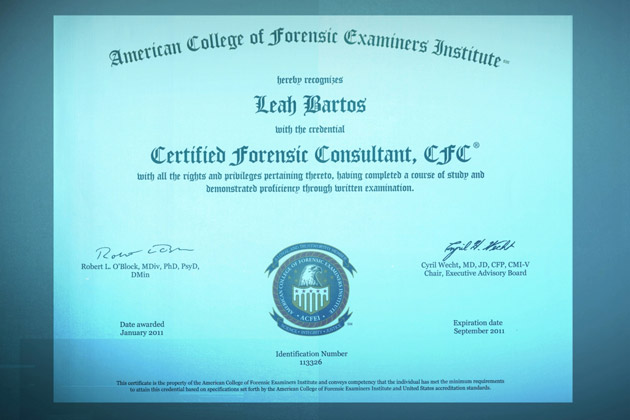
This is how I — a journalism graduate student with no background in forensics — became certified as a “Forensic Consultant” by one of the field’s largest professional groups.

One afternoon early last year, I punched in my credit card information, paid $495 to the American College of Forensic Examiners International Inc. and registered for an online course.

After about 90 minutes of video instruction, I took an exam on the institute’s web site, answering 100multiple choice questions, aided by several ACFEI study packets.

As soon as I finished the test, a screen popped up saying that I had passed, earning me an impressive-sounding credential that could help establish my qualifications to be an expert witness in criminal and civil trials.

For another $50, ACFEI mailed me a white lab coat after sending my certificate.

For the last two years, ProPublica and PBS “Frontline,” in concert with other news organizations, have looked in-depth atdeath investigation in America, finding a pervasive lack of national standards that begins in the autopsy room and ends in court.

Expert witnesses routinely sway trial verdicts with testimony about fingerprints, ballistics, hair and fiber analysis and more, but there are no national standards to measure their competency or ensure that what they say is valid. A landmark 2009 report by the National Academy of Sciences called this lack of standards one of the most pressing problems facing the criminal justice system.

Over the last two decades, ACFEI has emerged as one of the largest forensic credentialing organizations in the country.

Go to full article here.

Wednesday’s Quick Clicks…

  • Wake Forest Prof Carol Turowski on the problems in post-conviction innocence cases of the prosecutors squeezing guilty pleas to lesser charges from innocent inmates; the inmates often take the deal even though innocent rather than remain incarcerated while the post-conviction innocence cases works its way through the courts
  • New book by Chicago attorney Ted Grippo on the wrongful convictions and executions of Nicola Sacco and Bartolomeo Vanzetti
  • The unchecked charging power of the prosecutor
  • Jason Puracal’s family fights to free him from Nicaraguan prison
  • Montana Innocence Project wins evidentiary hearing in attempt to obtain new trial in rape case
  • Woman in Texas attempts to overturn her murder conviction that was based on the notoriously unreliable evidence from a dog-scent lineup

Hundreds of convicted defendants weren’t told of FBI’s forensic flaws

In 2003, I was asked to investigate the 1988 murder conviction of a former Mansfield, Ohio, police officer who insisted he was innocent. While reviewing the case, I learned that the only physical evidence linking the officer to the crime was provided by FBI hair and fiber expert Michael P. Malone, who testified that two fibers found on the victim matched the carpet fiber in the squad car the officer drove the night the victim disappeared.

Malone’s crucial testimony concerned me. I had read the excellent book Tainting Evidence: Inside The Scandals At The FBI Crime Lab , which detailed numerous examples of how Malone had given false and misleading testimony in criminal trials. Records I obtained through the Freedom of Information Act revealed that the Mansfield case was one of them.

The records showed that the prosecutor’s office supposedly was notified of this, but word never reached the former officer in prison until he heard it from me. It turns out that this failure to notify the defendant that the testimony used against him had been determined to be false or misleading wasn’t unusual.

According to a report in The Washington Post today, the U.S. Justice Department has known for years that flawed forensic analysis by Malone and others might have led to convictions of potentially innocent people nationwide but didn’t notify the defendants or their attorneys.

“As a result, hundreds of defendants nationwide remain in prison or on parole for crimes that might merit exoneration, a retrial or a retesting of evidence using DNA because FBI hair and fiber experts may have misidentified them as suspects,” The Post says.

Forensic DNA Technology has Stagnated in Africa

Forensic DNA technology has grown in leaps and bounds elsewhere in the world, except Africa. Whilst there is no doubting the utility of this technology to solving complex criminal investigation, African countries are still very reluctant to embrace it. There is only one forensic laboratory in Nigeria. It is located in Lagos and managed by the Nigerian Police Force. Given the serious credibility deficit by most government agencies, it is not unusual for serious applicants and accused persons to seek experts and expertise from outside Nigeria, in analysing forensic evidence. In Nigeria, post election appeals have tended to be heavily reliant on forensic evidence to determine or prove electoral fraud. And in almost all cases, the experts are imported from abroad. For more examples of how DNA could be used in Africa readhttp://www.forensicmag.com/article/dna-4-africa?page=0,0

Tuesday’s Quick Clicks…

  • During post-conviction evidentiary hearing in Missouri in the case of Ryan Ferguson, witness recants and says prosecutor talked him into falsely implicating Ferguson
  • Decision on whether Michael Hash will be retried in Virginia awaits outcome of DNA testing initiated by the special prosecutor (more here)
  • Exoneree in the UK awarded 841,000 pounds in compensation for his ordeal (more here)
  • State of New York called out for failing to move on innocence reform
  • The Innocence Project of Florida will host its inaugural awards gala next week where it will honor Holland & Knight 
  • New Book: Falsely Accused:  former police officer explains the problems in the system that lead to wrongful convictions
  • Texas opens inquiry into Austin crime lab
  • Mid-Atlantic Innocence Project’s annual awards lunch will be honoring the lawyers and artists who helped the West Memphis Three gain their freedom and the Hunton & Williams legal team who helped secure the release of MAIP Client Michael Hash
  • Misdeeds by Texas judges are not released to the public

The Real CSI: PBS to Air Show on Junk Science Tomorrow Night in U.S.

From a press release:

FRONTLINE AND PROPUBLICA EXAMINE FORENSIC SCIENCE IN THE COURTROOM

FRONTLINE Presents

“THE REAL CSI” 

Tuesday, April 17, 2012, at 10 P.M. ET on PBS

www.pbs.org/frontline/real-csi 

www.facebook.com/frontlinepbs

Evidence collected at crime scenes—everything from fingerprints to bite marks—is routinely called upon in the courtroom to prosecute the most difficult crimes and put the guilty behind bars. And though glamorized on commercial television, in the real world, it’s not so cut-and-dried. A joint investigation by FRONTLINE, ProPublica and the Investigative Reporting Program at UC Berkeley examines the reliability of the science behind forensics in “The Real CSI,” airing Tuesday, April 17, 2012, at 10 P.M. ET on PBS (check local listings).

FRONTLINE correspondent Lowell Bergman finds serious flaws in some of the best known tools of forensic science and wide Continue reading

Time of Death – A Critical Factor in Many Convictions – But It’s VERY Imprecise

Determination of “time of death” is a critical factor in any case involving the death of a victim.  If a suspect cannot account for his/her whereabouts at “time of death”, he/she has a problem.  If a suspect has a concrete, verifiable explanation for being somewhere other than at the scene at “time of death”, they cease to be a suspect.

But did you know that estimations of “time of death” are very imprecise, and subject to a wide range of physiological and environmental influences?  If the “post mortem interval” (PMI) is less than ‘about’ 24 hours, the primary estimator is usually body core temperature.  However, this will depend on ambient temperatures and humidities experienced by the body during the PMI, convection, sun exposure, the amount and type of clothing worn by the victim, and even how “fat” or “skinny” the victim is.  Another indicator is “stomach contents”, but rates of digestion can very dramatically based upon a number of physiological factors.  The onset and resolution of rigor mortis can vary by hours, as can the rates of post mortem lividity (settling of the blood).

Continue reading

Breaking News: California Gov. Commutes Sentence in Shaken Baby Syndrome Case Championed by California Innocence Project…

Read full article here.   Washington Post article here.  Excerpt from news source:

SACRAMENTO, Calif. – Gov. Jerry Brown on Friday commuted the sentence of a 52-year-old woman convicted of shaking her baby grandson to death, saying that significant doubts surround her conviction.

Shirley Ree Smith was convicted in December 1997 of shaking her 7-week old grandson, Etzel Dean Glass III, to death. She was sentenced to 15 years to life in prison, but has been free since 2006, when the 9th U.S. Circuit Court of Appeals set aside her sentence.

Brown said he was commuting Smith’s second-degree murder sentence to time served “in light of the unusual circumstances in this particular case, the length of time Ms. Smith has served in prison, and the evidence before me that Ms. Smith has been law-abiding since her release from prison.”

Senate Commerce Committee Holds Hearing on “The Science and Standards of Forensics”

Sarah Chu

This entry was written and submitted by Sarah Chu, Forensic Policy Advocate at the Innocence Project:

On March 28, 2012, the Senate Commerce Committee held a hearing on “The Science and Standards of Forensics.”  This Committee of Congress has jurisdiction over the science agencies of Congress – the National Science Foundation (NSF), the National Institute for Standards and Technology (NIST), and the National Academy of Sciences (NAS).  Our hope is that these science agencies will have a new or more significant role in the future of forensic science.  An articulation of their roles will further demonstrate to the American public that forensic science should be grounded as a scientific endeavor.  Dr. Eric Lander (Innocence Project Board Member, President and Founding Director of the Broad Institute of Harvard & MIT, and Co-Chair of the President’s Council of Advisors on Science and Technology), Dr. Patrick Gallagher (Director of NIST), and Dr. Subra Suresh (Director of NSF) were the invited panelists.

In his opening statement, Senator Rockefeller stated, “I don’t often get the chance to say that a Commerce Committee hearing is about truth and justice.  But that’s exactly what this hearing is about today.  It’s about using more science in our criminal justice system.  And it’s about creating standards that judges, prosecutors, defense lawyers, and juries all can trust.”  He called attention to the need to create a culture of science because “Too often, their conclusions are subjective and lack scientific validation and standards.  Without properly analyzed evidence, it’s harder for law enforcement to apprehend and prosecute criminals.  And it’s more likely that our system will wrongfully convict innocent Continue reading

A New Zealand Study of How Panties Tear to Help Identify False Claims…

From a press report:

Forensic scientists are studying women’s knickers and how they tear to help police determine whether a sexual-assault complaint is authentic.

The Otago University study on how several types of common underwear fabric tear under force has been published in the latestForensic Science International journal.

Researchers said the results could be important in cases of false sexual assault accusations where underwear had been torn using scissors or a knife.

The paper said identifying a false sexual-assault Continue reading