Category Archives: Freedom’s Heroes

The National Registry of Exonerations Quickly Reaches 1,000 Milestone

When the University of Michigan Law and Northwestern Law School announced their joint project—the National Registry of Exonerations (here)—earlier this year on May 21, the initial tally of exonerations in the United States since 1989 was 891. Today, five months later, the number of exonerated in the registry is 1,000. No one knows how high the number will go. The only certainty is that this milestone will soon be surpassed. Continue reading


RIP Exoneree James Woodward…

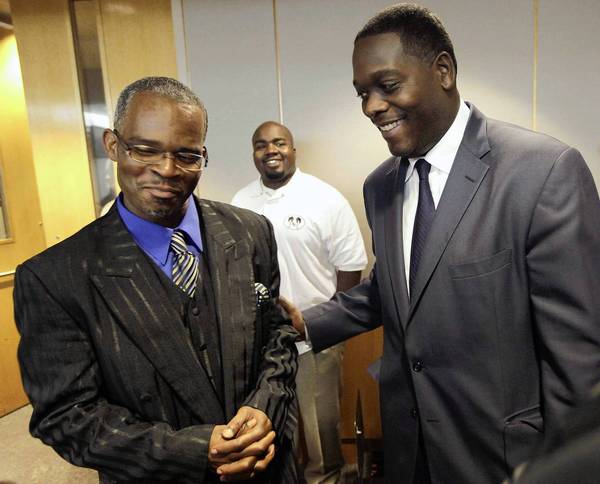
From CBSDFW.COM : DALLAS – James Woodard’s name resonates with any exoneree in North Texas. He was one, and spent the last several years helping others.

Woodard, 60, was the 17th Dallas County Inmate freed by DNA testing.

He was serving a life sentence for the murder of Beverly Jones.

After serving 27 years behind bars for the murder conviction he walked out of court a free man in April of 2008.

“It’s a good day! April 29th, 2008, I never forget it,” he said walking out of a Dallas courtroom that day.

Woodard was back in jail in late August after being arrested.

After responding to a traffic accident, Carrollton police arrested him for several outstanding warrants.
Investigators say after searching him they found cocaine.

Over the past weekend Woodard, who suffered from seizures, was rushed from the Dallas County Jail to Parkland Hospital, where he died.

Those close to him want to know what happened. “It’s a loss that we can’t get Continue reading

The Passing of a Forgotten (Wrongfully Convicted) Man

George Whitmore Jr. “never saw himself as a race activist. In the 1960’s and 1970’s, from prison and on the streets, he watched the civil rights movement and the Black Power Movement at a wary distance. He did not judge people by the their skin color. He knew he had been the victim of a grave injustice, but he did not assume that the detectives who framed him, or his slow torture at the hands of a rigged system, were motivated by racial prejudice.” Thus writes, T.J. English in his New York Times piece (here), “Who Will Mourn George Whitmore?”

According to English—who befriended Whitmore and has written The Savage City: Race, Murder, and a Generation on the Edge about Whitmore and his times—in April, 1964, Whitmore, at 19 years old, was picked up by New York City detectives and interrogated for 22-hours before signing a confession to Continue reading

Understanding the Unthinkable: False Confession

According to Rob Warden, of 70 wrongful convictions in Cook County, Illinois, between 1986 and 2011, a false confession was involved in more than half, including both those who falsely confessed to a crime they did not commit and those implicated by another person’s false confession. Warden should know. Co-founder and executive director of the Center on Wrongful Convictions at Northwestern Law, he’s an award-winning legal affairs journalist, whose efforts to expose official misconduct—physical abuse in interrogations in Illinois—resulted in a more complete understanding of the phenomenon of false confession.

Warden’s 11-minute TEDx video (here) is a primer on why false confessions occur and how the criminal justice system can reduce them.

Warden notes that physical torture does not account for the majority of false confessions today. Most are the result of psychological pressures that could prompt many reading this article to confess to a crime not committed. Continue reading

Sixth Circuit Finds Evidence of Actual Innocence in Ohio Murder Case

Ohio inmate Al Cleveland, convicted of murder in 1996, has been a client of Jennifer Bergeron of the Ohio Innocence Project for many years. His case has also been investigated at various points in time by the Center on Wrongful Convictions at Northwestern University and private investigator Martin Yant.

Today, the 6th Circuit Court of Appeals ruled that the evidence compiled over the years is sufficient to meet the “actual innocence” Shlup exception, and overturned the lower court’s decision and remanded the case for further proceedings. The fantastic opinion is here. All the details of the case are contained in the opinion. News report here and in WSJ here

This the type of victory that reflects determination and persistence. Bergeron worked against great odds for years to get to this point. It is a sweet victory for Al, and a sweet victory for Jennifer.

Below is a painting that Al created in prison, entitled Flood of Lies, which reflects his feelings about his plight. About the painting, Al wrote:

I don’t have many words to describe this piece, but it represents the end of the artistic confines to which I have been bound for years, and marks the beginning of an inward journey of truth-telling in art and the expression of such by all means despite the look. No beauty right now, just a soul under pressure and an able hand in need, coming to grips with a few dreams it must let go. Upon further thought, this represents the feeling of many of us wrongfully incarcerated, serving Life sentences.

Flood of Lies

Monday’s Quick Clicks…

Sign of Progress: Newspaper Urges Criminal Justice Reforms

“Another day, another wrongful conviction uncovered,” begins The Buffalo News editorial chastising the New York Senate for failing to follow the Assembly in passing a bill earlier this year that would have required best practices in criminal justice procedures. It comes in the wake of evidence of another wrongful conviction—as reported by The New York Times here and here and this blog Continue reading

Alabama says “No” to DNA Testing as Execution Day Approaches

Oprah’s “Our America” episode “Innocent Behind Bars” features Ohio Innocence Project Director Mark Godsey, editor of this blog and international expert on the topic, in this video clip published yesterday. Godsey is speaking here about the execution of Thomas Arthur, scheduled soon in Alabama. Arthur was convicted of the 1982 murder of Troy Wicker. On death row for more than 20 years, he’s always claimed innocence. Godsey freely admits that he doesn’t know if Arthur is guilty or not. He’s not alone in that stance, which is why he’s Continue reading

Wednesday’s Quick Clicks…

Re Wrongful Conviction: Katie Monroe Seeks Policy, Cultural Change

“What we would like to see is change in the culture in the way government officials respond to wrongful convictions,” says Katie Monroe. “We’d like it to grow to a place where government officials realize that correcting mistakes is good for all of us and not just the person in prison.” Monroe, longtime leader of the Rocky Mountain Innocence Project (RMIP), is leaving her RMIP post, as reported here, to become the Innocence Project’s first person in Washington, D.C. dedicated to working with prosecutor and police groups to shape policy that can reduce wrongful conviction.

She takes helpful experience to the challenge. The RMIC authored with the Utah Attorney General’s office Utah’s 2008 non-DNA factual innocence statute, which Continue reading

Federal Grant will Target Wrongful Conviction Cases with No DNA

The vast majority of criminal cases—some estimate up to 90 percent—do not have DNA evidence to help settle claims of wrongful conviction. Yet, there is no reason to believe that wrongful conviction is less frequent in non-DNA cases. Criminal defense attorney Glenn Garber was introduced to a wrongful conviction and helped win an exoneration. He became concerned about innocence claims in cases without DNA evidence and decided to dedicate himself to assisting in these challenging cases. In 2009 he founded the Exoneration Initiative, a free legal assistance program dedicated to exonerating the wrongfully convicted, the actually innocent. It’s good news that this Continue reading

Study: Why Mentally Disabled at Higher Risk of Giving False Confessions

It has long been known that people with mental disabilities are more vulnerable to giving a false confession. As reported in the Durango Herald (Colorado) here, a 2008 study revealed “53 cases of serious felonies to which people with intellectual disabilities confessed and were later legally exonerated.” DNA and other proof of innocence sometimes came after years of imprisonment.

One example: a man with an IQ of 56 confessed to the murders of six women and served 22 years before DNA excluded him as the perpetrator.

The article explains, “People with intellectual Continue reading

Former Supreme Court Justice’s Work for Wrongfully Convicted Sheds Light on Justice

Among the many misconceptions about the criminal justice system revealed through DNA exonerations is the myth that conviction errors will get corrected on appeal. The Innocence Project now lists 292 DNA-proven wrongful convictions. Many of these unfortunate people had exhausted a lengthy appeals process before DNA finally proved their innocence. Former New Jersey Supreme Court Justice Virginia Long, who has committed to working for the wrongfully convicted, recently provided insights into why the courts do not Continue reading

Freedom Comes, At the Nick of Time for Patrick Okoroafor

I blogged recently about the plight of Patrick Okoroafor, in detention awaiting the executioner. That was on the 20th of April, 2012. Thanks in large part to the advocacy by Amnesty International, young Patrick Okoroafor has regained his freedom and been spared the hangman’s noose. He has since rejoined his family and remain thankful to the tens of thousands of people who campaigned tirelessly for his release. It is the right thing to do. It is worth reiterating my bewilderment, at the prospect of having a young man’s life snuffed out just like that, given the circumstances leading to his arraignment; his trial as a minor and the subsequent injustice, suffering and humiliation he endured whilst awaiting execution. And now clemency!. Read further here

The legal details surrounding Patrick’s release are still foggy. It would appear that the Governor of Imo State, Owelle Rochas Okorocha exercised his prerogative power of mercy, as I canvassed in my earlier blog; as one way of bringing this unfortunate travesty of justice to a close. In a sense therefore, he is truly the hero, given that most Governors would prefer to remain obstinate about exercising such powers. This, of course, is not taking anything away from Amnesty International who internationalised this case. Will it be asking too much, for Patrick and his legal team to be demanding for compensation? That again, is the right thing to do.

Wednesday’s Quick Clicks…

Profile of Heroic Dallas DA Craig Watkins…

From the Los Angeles Times:

DALLAS — On the way to witness his first execution in the town known as the “Execution Capital of the World,” the Dallas County district attorney stopped at the prison cemetery to find his great-grandfather’s grave.

Captain Joe Byrd Cemetery in Huntsville is the final resting place of inmates whose families could not afford burial anywhere else. Tall pines guard the grassy expanse nicknamed “Peckerwood Hill,” where many gravestones bear prison identification numbers, not names.

Dist. Atty. Craig Watkins scanned row upon row of gray crosses and headstones, making quick progress in his usual cowboy boots until he found the boxy stone belonging toRichard Johnson, dated Aug. 10, 1932.

Watkins knelt beside the grave in his suit.

Engraved next to Johnson’s prisoner number — 101 — was a telltale X. His great-grandfather had been executed.

His dual missions that day in February — paying respects, witnessing the execution — embodied how Watkins, Texas’ first African American district Continue reading

Tuesday’s Quick Clicks…

  • A blogger writes about the impact that recent the Innocence Project of Florida annual gala had on him
  • Yesterday at Robert Dewey DNA exoneration in Colorado, it is revealed that the prosecutors have identified and issued a warrant for a new suspect; prosecutor apologizes to Dewey; more on the good prosecutor here
  • Story on the double DNA exoneration yesterday in Dallas
  • A blogger wonders whether those who still believe Amanda Knox “done it” are biased because of anti-American sentiment
  • A glowing review of exoneree Gloria Killian’s new book about her ordeal
  • The Croation 6: New evidence supports innocence of six men in Croatia
  • Murder convict in the UK, Luke Mitchell, who has long declared his innocence causes a stir by passing polygraph administered by one the leading technicians in the UK

Innovative Colorado DNA Initiatives Pay Off

On October 1, 2009, Colorado Attorney General John W. Suthers, announced that the state had received a $1.2 million federal grant to start a program that would seek to identify wrongful convictions through DNA testing. Today, April 30, 2012, Robert Dewey, 51, is expected to be the first person to be exonerated through the testing. He has served more than 16 years for a crime he said he never committed. A Colorado imprisoned felon is a new suspect in the case. Read about this case, reported earlier on this blog by Mark Godsey with news link here, and also here.

This exoneration is just one of the beneficial results of the Colorado Justice Review Project. Working with the Denver District Attorney’s Office, the University of Denver College of Law, the Colorado Bureau of Investigation and the Colorado Public Defender’s Office, the federally funded project has enabled review of more than 5,000 past rapes, Continue reading

Monday’s Quick Clicks…

  • Nice profile of Talbot “Sandy” D’Alemberte, the founding Chairman of the Innocence Project of Florida
  • A blogger’s recap of the Wrongful Convictions conference in New York last week
  • Discussion of the distinction between the developments of the Innocence Movement in the U.S. and the UK
  • New website, mccleskyvkemp.com, provides information about the ongoing crisis of race in criminal justice and offers information about specific activities that individuals and organizations can take to repeal the death penalty and ameliorate the racial disparities in the criminal justice system; more here
  • This blog has reported extensively about the prosecutorial misconduct in the Senator Ted Stevens case; but is he nonetheless guilty?

Sunday’s Quick Clicks…