Category Archives: Inquisitional and adversarial systems of justice

Breaking News: Another Exonerating DNA Testing Result Revealed in Mainali Case

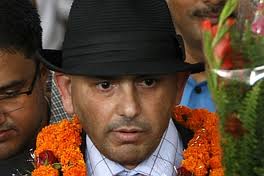
From Asahi Shimbun Digital News.Mr. Govinda Prasad Mainali (middle).

Previous posts on the Mainali Case here, here and here.

This is a 1997 robbery-murder case where Govinda Prasad Mainali, a Nepali national, was convicted and sentenced to life in Tokyo, Japan. Mainali was granted a retrial in June this year. The prosecution did not appeal the decision of the Tokyo High Court which rejected the prosecution’s objection against the decision to grant a retrial. Mainali has already gone back to his home country, Nepal.

It was revealed yesterday that an additional testing by the prosecution brought another exonerating result. A third person’s DNA profile has already been found on and inside the victim’s body during previous testings (hairs left near the victim’s body and semen). This time, the same person’s DNA was found on victim’s fingernail clippings. Scrapings from victim’s right thumb fingernail and left middle fingernail were concluded to have matched that person, and scrapings from other fingernails also might have come from him. The redundant DNA results from many different items found at the crime scene suggest that the DNA came from the actual perpetrator.

It is reported that the prosecutions will argue that Mainali is innocent of the crime during the retrial. The retrial will start on October 29th.

Read the news in Japanese here.


Monday’s Quick Clicks…

Supreme Court Denies Release in Higashi-Sumiyoshi Case

Previous posts on Higashi-Sumiyoshi Case here (part 1) and here (part 2).

This is an arson case where a couple (Tatsuhiro Boku and Keiko Aoki) was convicted in 1999 of setting their house on fire and killing an 11 year old girl (Aoki‘s daughter) in Higashi-Sumiyoshi Ward, Osaka Prefecture.

Boku and Aoki each filed a petition for retrial to the Osaka District Court in 2009, and were granted a retrial in March 2012.  The presiding Judge stated in the decision that the petitioners’ confessions were unreliable and unreasonable from a “scientific viewpoint”, taking into consideration the result of the new experiment.

The prosecutors instantly appealed the ruling, and the retrial petition is currently being reviewed by the Osaka High Court.

Osaka District Court had also ordered Boku and Aoki’s immediate release. The prosecution also appealed this ruling. Osaka High Court agreed with the prosecution and reversed the District Court’s decision. The petitioners then filed a special appeal to the Supreme Court, but it denied the appeal on September 18th. The Supreme Court merely stated that the conditions of special appeal did not meet in the case. It did not even go into the actual facts of the case…

Even in the rare instances where a retrial is granted, the appeal process may take years. After the lengthy appeals process, the actual retrial process may take even longer…

A statement by the supporters can be found here (in Japanese).

Texas Prosecutors: Misconduct Allegations are Overblown…

From Mercurynews.com:

DALLAS—Despite the recent attention paid to wrongful convictions and the behavior of prosecutors, the state group of district attorneys says most claims of prosecutor misconduct are overblown.

The Texas District & County Attorneys Association released a report this week that acknowledges a handful of cases in which prosecutors may have mishandled their duties, but questions other allegations of misconduct. The report, issued Monday, responds in part to a study earlier this year by the Northern California Innocence Project, which reported 91 cases over four years of alleged prosecutorial error or misconduct.

The TDCAA’s report accuses the regional Innocence Project group of pointing to Continue reading

Utah AG: The Innocence Movement and 12 Angry Men…

12 Angry Men, Roberto Roman and Factual Innocence in the Debra Brown Appeal
By Utah Attorney General Mark Shurtleff

From Utahpulse.com:

In 1957, Henry Fonda starred as Juror Number 8 in the courtroom film classic 12 Angry Men. I loved the drama of the jury room and the movie became a personal favorite. Five years ago, the Chicago-Kent Law School conducted a symposium in honor of the fiftieth anniversary of the film’s release. Panels of learned judges, trial lawyers and academic scholars discussed the transformative power of jury deliberations and the relevance of the film in today’s criminal justice system. Their presentations were published here. A common criticism of the film was that it is very rare that a single “Juror Number 8” can change the minds of all others and lead them from a unified “guilty” to ”not-guilty” verdict or vice-versa. A second more profound effect on our jury system is that the popular drama enhances the myth that factual innocence of the guilty is a common result of jury trials.

In his article, “Good Film, Bad Jury” Boalt Hall Law Professor Charles Weisselberg argued that while it made for great theatre, it “should not be our ideal of an American jury” and in fact “presents a veritable buffet of juror misconduct.” UCLA Law School Professor Michael Asimow, points out that “the movie serves as an argument against the jury system because it is so unlikely to be replicated in any real jury room,” and questions whether factual innocence is preserved when holdout jurors are “convinced the defendant should be acquitted but because of the social pressure to give in to the emerging consensus.”

The power of persuasion in jury deliberations was evident last month when an eight member jury found Roberto Roman “not-guilty” in the murder of Millard County Deputy Josie Fox. As some of those jurors spoke to reporters, it became clear that 55 years after Fonda battled his fellow jurors; a similar scene had been played out in a Utah County jury room. A juror who revealed he was a law student and was for a finding of not-guilty began questioning and picking apart the evidence. He later told the Salt Lake Tribune that he and another juror who was a college theatre professor were” fairly instrumental” in the not-guilty verdict. Other jurors admitted that they may have made a mistake, including one juror who said that very possibly “a murderer walked.” After eight hours of deliberation, the single hold-out, Jury Forewoman Nicole Kay, asked the judge if they should continue or come back the next day. She later told reporters that “there was intense pressure for me to conform and I wish I would have stayed strong and said we weren’t ready.” She wasn’t alone. Juror Cooper said that in announcing the verdict “I felt sick to my stomach, “and I had far less confidence in the process than I had going in.” (All juror quotes are taken from a story by Aaron Falk in an August 25th Salt Lake Tribune article, “Román trial: Doubt takes hold.”)

The acquittal of a confessed cop-killer sent shock waves around the country. People were outraged and blamed the system. Ironically, a Utah judge was praised last year when he overturned a 1995 jury that had found Debra Brown guilty beyond a reasonable doubt of aggravated murder when he used a lesser burden to find her “factually innocent.” This time outrage was directed at me when I concluded that the judge had misapplied the required statutory test, and I appealed to the Utah Supreme Court which heard oral arguments last week. Debra Brown was the first person found “factually innocent” under a new Utah law that my office and I helped draft and pass in 2008 based on a recognition that although infrequent, mistakes can be made within our current system. Factual innocence trials are limited to cases where “newly discovered material evidence” proves the convict did not commit the crime. The Rocky Mountain Innocence Center claims the Brown case as its first victory in support of its belief that false convictions are prevalent.

In his Chicago-Kent symposium treatise, “The Myth of Factual Innocence,” Colorado District Judge Morris Hoffman stated that in his experience on the bench, “innocence projects are in some ways the modern post-conviction equivalent of 12 Angry Men. Because there are just too few [Perry Masons and] Henry Fondas in modern jury pools—or so the innocence project orthodoxy goes—vast seas of wrongfully-convicted defendants must today rely on law students and their clinical faculty advisors to do what Fonda-less juries have chronically failed, and continue to fail, to do.” Judge Hoffman uses facts and statistics to rebut the myth perpetuated by claims like that on the RMIC website that there is a “3 to 6% error rate in our criminal justice system nationwide.” He calculates an overall error rate of the system at around 0.0016%.

I share Judge Hoffman’s concern that if not challenged; myths and Hollywood depictions of factual innocence will result in a loss of confidence in our criminal justice system and the undervaluing of public defenders and jurors. I lobbied for a factual innocence law, and putting emotion aside, I took the Brown innocence finding to the Supreme Court which will determine whether that finding was correctly based on that law.

Two Executions in Japan……

A very disappointing news from Japan…

There has still been no wide and open debate on the issue of death penalty in Japan, but executions are being carried out…

Statements from various organizations ensued. Read the statements by Japan Federation of Bar AssociationsCenter for Prisoner’s Rights, and Amnesty Japan (in Japanese).

Read about the death penalty issues in Japan here and here.

*************************

Here is an article on Friday’s executions by Japan Times staff writer Mizuho Aoki:

Two death-row inmates were hanged Friday, in Tokyo and Osaka, in the second round of executions this year after three men went to the gallows in March.

Friday’s hangings were the first ordered by Justice Minister Makoto Taki, who assumed the post June 4. Prisoners on death row now number 130.

Junya Hattori, 40, and Kyozo Matsumura, 31, were hanged because “there was no uncertainty surrounding their convictions,” said Taki, who supports the death sentence.

Hattori, who was hanged at the Tokyo Detention House, raped a 19-year-old university student in the city of Mishima, Shizuoka Prefecture, in his car and burned her to death in January 2002.

Matsumura was executed in the Osaka Detention House for the robbery-murders of a 57-year-old aunt in the city of Nagaokakyo, Kyoto Prefecture, and a 72-year-old uncle in Sagamihara, Kanagawa Prefecture, within eight days in January 2007.

“I signed documents authorizing the executions after carefully considering each case,” Taki told journalists Friday afternoon.

“As I said when I assumed the post, unless there is any uncertainty concerning a conviction, a justice minister should respect the trial process and the decision of the court,” he said. Continue reading

Breaking News: Mainali Case will Go to Retrial

Tokyo High Prosecutor’s Office stated on August 2nd (JST) that it will not appeal the Tokyo High Court’s decision affirming the ruling to grant a retrial for Govinda Prasad Mainali.  The Prosecutor’s Office commented that it could not find a compelling reason to file a Special Appeal to the Supreme Court (since the grounds for Special Appeal are limited). However, they will not change their argument that Mainali is guilty of the 1997 murder in the retrial process.

Division 4 of Tokyo High Court granted Mainali a retrial in June this year, but the Prosecutor’s Office immediately filed an objection. Objection was denied by Division 5 of High Court on July 31st. Read more in my previous post here.

Division 4 of the Tokyo High Court, which also granted a retrial for Mainali, will handle the retrial process. In all the cases where a retrial took place in the past, “not guilty” decisions followed.

Read a detailed report in English from the Daily Yomiuri Online Staff writers Katsuro Oda and Chihiro Iwasaki here.

Excerpt:

The Tokyo High Court’s rejection of objections by prosecutors regarding the granting of a retrial to a Nepalese man convicted of murder has made it nearly certain a retrial will be held and that the defendant, who was released from custody in June, will be found not guilty. Continue reading

Breaking News: Tokyo High Court Denies Prosecution’s Objection in Mainali Case

Mr. Govinda Prasad Mainali.

Division 5 of the Tokyo High Court denied the objection filed by Tokyo High Public Prosecutor’s Office in Mainali Case, a 1997 murder case, on July 31st (JST). Previous posts about the Mainali Case here, here and here.

Division 4 of the Tokyo High Court granted the petition for retrial for Govinda Mainali, as well as his release from custody last month. The Prosecutor’s Office immediately filed an objection, but the objection was denied today by Division 5 of the same court. The Prosecutor’s Office has until August 6th to file a Special Appeal to the Supreme Court. If the Prosecutor’s Office does not appeal or loses appeal at the Supreme Court, Division 4 of the Tokyo High Court will hold a retrial for Mainali. It has been reported that it is unlikely that the Prosecutor’s Office will appeal.

Mainali was convicted for a murder in 2000.  In March 2005, Mainali filed for a retrial to the Tokyo High Court. Later, a new DNA testing was conducted. The new test focused on the semen found on and inside the body of the victim. Fifteen samples from the crime scene were tested, but none of the DNA type matched Mainali’s. The unknown profile from the semen did match that of the two pubic hairs found in the crime scene.

The decision which granted Mainali a retrial in June stated that it was likely that the third person whose DNA was on the victim had a sexual intercourse with the victim and later killed her. In the Objection, the prosecution stated that this new evidence only suggests that the victim had sexual intercourse with this unknown third person on the evening of the incident, but the court today denied this claim as unreasonable. The prosecutors also sought a new DNA testing of a substance on victim’s hand, but the court denied the request.

Media report about today’s decision in Japanese can be found here and here.

Saturday’s Quick Clicks…

  • More on New Jersey’s new eyewitness identification instructions for jurors
  • Retired detective in New York still trying to solve murder case that sent innocent man Steven Barnes to prison
  • Ken Bates, the Australian senior prosecutor in the wrongful conviction of Andrew Mallard for murder, has conceded he failed to comply with his duty to disclose that the victim’s injuries did not match a wrench alleged to have been used in the crime.  Bates has been fined $10,000 in the State Administrative Tribunal following an allegation brought by the Legal Profession Complaints Committee that he engaged in unsatisfactory professional conduct as a prosecutor on behalf of the crown during the 1995 trial of Mr Mallard.
  • New book on the Amanda Knox case
  • In Ireland, prosecutors have lost a bid to stop Mr Justice Adrian Hardiman from being part of an appeal court that will decide whether a man’s conviction 40 years ago for the manslaughter of a young woman was a miscarriage of justice.  The three-judge Court of Criminal Appeal dismissed the “special and unusual” application by the DPP for Mr Justice Hardiman to recuse himself from further hearing the case of Martin Conmey. His conviction for the manslaughter of Una Lynskey (19) was overturned two years ago and he wants a declaration of a miscarriage of justice.
  • Vermont may be close to first DNA exoneration

Tarrant County Texas Once Again…

I blogged here yesterday about how Tarrant County in Texas claims it has fewer wrongful convictions than Dallas County because they do things better (rather than another factor, such as Dallas County saving an unusually high percentage of DNA from old cases).  Now Tarrant County is called out again:

A Fort Worth Star-Telegram editorial published this weekend concludes that Tarrant County has not exonerated nearly as many innocent prisoners as Dallas County simply because it did not wrongfully incarcerate them in the first place. This black-and-white view is too simple for what’s become a thorny issue across the state.

Tarrant County Assistant Criminal District Attorney Steven Conder handles post-conviction and DNA testing requests and was the main source in the Star-Telegram column.

He contends that Tarrant County’s long-standing open file policies are the primary reason there’s been only one exoneration. Traditionally, Tarrant County has had “a lot more disclosure” than Dallas, permitting defense attorneys to access prosecutors’ files in advance of trial, leading to fewer wrongful Continue reading

Blume and Helm on Innocent Defendants Who Plead Guilty

John H. Blume of Cornell University and Rebecca K. Helm have posted the article “The Unexonerated: Factually Innocent Defendants Who Plead Guilty”, Cornell Legal Studies Research Paper (July, 2012) on SSRN. Here is the abstract:

Several recent high profile cases, including the case of the West Memphis Three, have revealed (again), that factually innocent defendants do plead guilty. And, more disturbingly in many of the cases, the defendant’s innocence is known, or at least highly suspected at the time the plea is entered. Innocent defendants plead guilty most often, but not always, in two sets of cases: first, low level offenses where a quick guilty plea provides the key to the cellblock door; and second, cases where defendants have been wrongfully convicted, prevail on appeal, and are then offered a plea bargain which will assure their immediate or imminent release. There are three primary contributing factors leading a criminal justice system where significant numbers of innocent defendants plead guilty to crimes they did not commit. The first is the perceived need that all defendants must plead. The second is the current draconian sentencing regime for criminal offenses. And, the final contributing factor is that plea bargaining is, for the most part, an unregulated industry. This article discusses cases in which innocent defendants plead guilty to obtain their release, thus joining the “unexonerated” and then propose several options the criminal justice system should embrace to avoid, or at least ameliorate the plight of innocent defendants who plead guilty.

Audio and Visual Recording of Interrogations by Public Prosecutors, Part II

The Supreme Public Prosecutor’s Office (SPPO) issued a report on audio and visual recording of interrogations last week (on July 4th, JST).

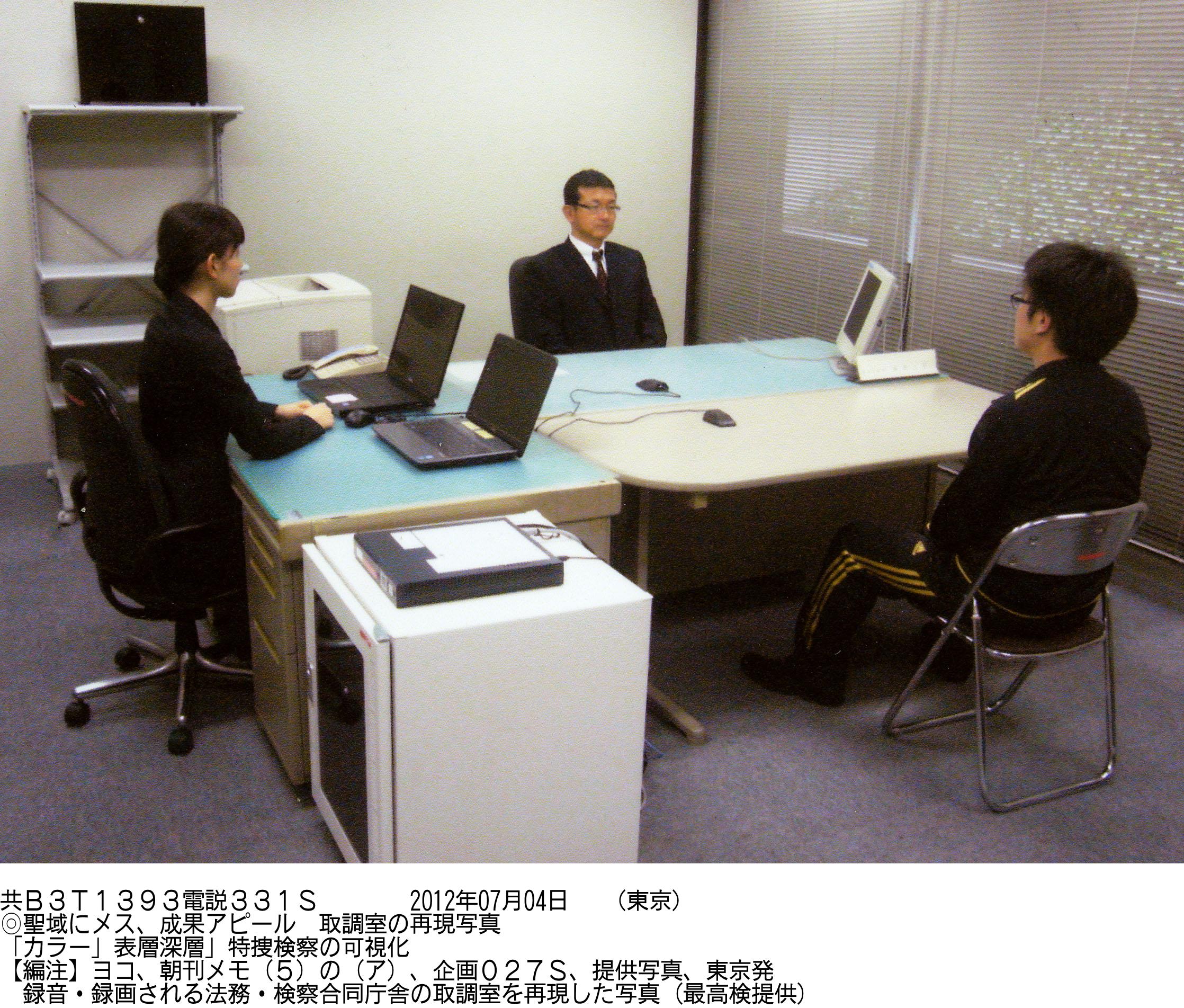
Demonstration of how the recording would take place during interrogation by prosecutor.

As I posted earlier, the SPPO started recording some interrogations on an experimental basis in 2006. Last week’s report  focused on the experimental recording in three Special Investigation Units and ten Special Crime Devision Public Prosecutor’s Office, which took place in 91 cases from March 2011 through April 2012 (note that these offices or branches in the Public Prosecutor’s Office usually involve only white collar crimes). The report revealed what the prosecutors in Japan have to say about the recording of interrogations.

Below are the points worth noting:

1)  Interrogations in 91 cases out of 98 were either partially or entirely recorded. The entire interrogation process was recorded in 39 cases.  30 of the cases concerned tax violations.

2) In seven cases, the suspects refused the recording from the beginning of interrogations. In 12 cases, the suspects refused the recording halfway through. The reasons for their refusal include: they were ashamed of being arrested and incarcerated, and they did not want to provide discussions in front of the camera.

3) Recording took place in other prosecutor’s offices in 946 cases out of 1,005 cases, where the charge was a serious offense and the case was to be disposed of by a Lay Judge trial, such as murder. In cases involving persons with intellectual disabilities, 540 cases were recorded (this was all of the cases in this category except where the accused refused). Continue reading

James Taylor:A Life in Ruin!

One of the troubling after effect of a wrongful conviction, remain how victims come to terms with their present situation; how they go past it, put it aside and move ahead. Some never do. Others just resign themselves to fate and the vicissitudes of life. The system is so skewed and unfair to leave a man stranded for apparently no fault of his.

The vexed question of post wrongful conviction compensation, whether and when to pay, indeed, if there is a right to restitution remain a moot point – both with adversarial and inquisitorial jurisdictions. It sounds strange that the system would continue to stigmatise a man for an offense he did not commit or has not been found culpable by a court of competent jurisdiction.

Despite the ‘giant’ stride that has been made in the United Kingdom, and the long line of cases of miscarriages of justice – from the days of the Birmingham Six,  to the establishment of the Criminal Cases Review Commission – it seems cases still seep through the system undetected and uncompensated when they come to light.

James Taylor deserve to get his life back. He must explore all in his power and within the law to see to that, if the pronouncements of Judge Peter Clarke QC is to make any sense. Judge Peter Clarke QC is reported to have said that ‘We find the consequences to Mr. Taylor little less than horrifying’

You can read Taylor’s odyssey here and make up your own mind http://www.bbc.co.uk/news/uk-england-kent-18787249

Another False Confession Case — Fukawa Case

Takao Sugiyama and Shoji Sakurai

As I posted here, false confessions account for many, if not the majority of, wrongful convictions in Japan. Yet another case illustrates this: the Fukawa Case, in which two people were finally exonerated in 2011 for a 1967 robbery-murder.

The crime occured in August of 1967, in the town of Fukawa, Ibaraki Prefecture, about 40 miles outside of Tokyo. A carpenter was found dead in his home.  His legs were tied with a towel and a shirt, a pair of underpants were stuffed in his mouth, and he was strangled. There were signs of struggle in the house, but it was unclear if anything was taken from the house, except for a white purse the victim supposedly used daily. 43 fingerprints were found but none of them connected to perpetrator(s). There was no physical evidence at the scene.

However, there were several eyewitness statements that two men (one tall man and another shorter man) were near the victim’s house on the evening that the victim was supposedly murdered. This statement lead the police to think there were two perpetrators.

Based on this information, the police investigated more than 180 men in the area, until they found the two men, Shoji Sakurai and Takao Sugiyama,who did not have an alibi on the date of the crime. In October of the same year, both of them were arrested on separate charges, and were interrogated.

Sakurai and Sugiyama were held in police jails (“Daiyo-Kangoku“), and interrogated for hours and days. After 5 days of interrogations, Sakurai confessed to the crime. Based on Sakurai’s confession, the police also forced Sugiyama to confess. They retracted their confession during the interrogation by the prosecutors, but the prosecutors sent them back to police jails, and after continuous interrogations that ensued, they finally gave in and confessed again.

The two contested their guilt at trial. The prosecutors had no direct evidence of their guilt. All they had were: their confessions made during interrogations by police and prosecutors (with the  testimony of interrogators and the partial tape recordings of the interrogations which recorded only the part after they confessed to the crime), and testimonies of eyewitnesses who saw two men on the day of the crime.

There was no physical evidence, including the white purse which was never found. Their confessions during investigation changed repeatedly, Sakurai and Sugiyama’s confessions contradicted each other’s in important parts, they did not match the circumstances of the crime scene, and there was no information revealed in the confessions which unknown to investigators.

Nevertheless the trial court declared that their confessions made during investigation were reliable and sentenced them to life in 1970. The High Court as well as the Supreme Court denied the appeal. Their sentences were finalized in 1978. Continue reading

Kirstin Lobato: Is this Another American Miscarriage of Justice?

The law on DNA testing in the US appears to be in a flux. Or at least, there are variants of the law that does not exactly add up, as you move from state to state. The curious question you would want to ask, would be, why should a ‘simple’ request for DNA testing be turned down or even denied? What if that goes to the substratum of the case; one that is capable of tilting the case one way or the other.  If justice is actually the ends of prosecution, why would there be obstacles and booby traps, or any legitimate means of achieving it be prevented, stultified or even stalled, a day longer than necessary.

It’s questions like these that really underscores the need for a broad based advocacy strategy for law reform that cuts across state boundaries, indeed, as an international norm, if the rights to innocence, fair trial provisions and to disclosure of evidence, would make any sense in reality. In a sense, this also interrogates the relevance and the nature of the legal system, around on-going debate as to whether the inquisitorial or adversarial system of justice best serves the interest of accused persons.

The Kirstin Lobato case is another case, in a long time of cases where DNA testing is being challenged by the DA. It will be interesting to see what the outcome would be. Petitions are currently awash on numerous sites urging the DA to do the right thing ‘not to file any opposition to Lobato’s appeal to the Nevada Supreme Court, and request that he allows the Innocence Project to conduct DNA testing and re-testing of crime scene evidence’ Read Ground Report of this case here, including efforts to get Lobato exonerated http://www.groundreport.com/US/100-000-Call-For-DA-To-Allow-DNA-Testing-In-Kirsti/2946798

False Confessions as Major Cause of Wrongful Convictions in Japan

A Police Jail in Tokyo.

One of the major causes of wrongful conviction in Japan is definitely false confessions.

Why? Obviously, since a confession is still the “King of evidence” in Japan.  And since the law permits long period of detention (23 days!) before the formal charge (indictment) of a suspect, and since during this pre-charge detention period, there are lengthy interrogations by the police and prosecutors.

When and How Long can a Suspect be Detained?

In Japan, a suspect can be detained when there is a “reasonable cause” that he/she committed the crime, and there is a risk of flight or he/she might tamper with the evidence in the case.  When a judge issues an arrest warrant and once the suspect is arrested (“Taiho“), the police has 48 hours to transfer the suspect and the case to prosecutors.

When prosecutors receive the suspect and if they think he/she should be detained further, they must ask a judge within 24 hours of receiving the case to issue a warrant for up to 10 days of additional detention (“Koryu“). This is when the suspect appears before a judge for the first time.  Additional 10-day extension of Koryu is possible after the initial 10days. Judges almost always issue the arrest/ detention warrant. Less than 1 % of the warrant claim is denied. For violent crimes, it’s almost 0%.

To sum up, police and prosecutors can detain a suspect for up to 72 hours before the suspect has to appear before a judge, and then for additional 20 days  before the formal charge (23 days in total!).

Interrogation During Detention

During this 23-day period, police and prosecutors usually interrogate the suspect for a long period of time. Conducting the interrogation is critical, even for prosecutors. Continue reading

Yet Another Police Misconduct Revealed in Mainali’s Case

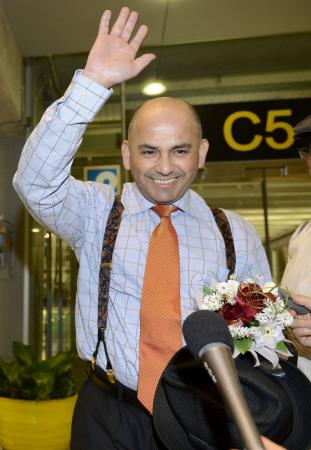
Mr. Mainali, on his way back home.

Previous posts on Govinda Mainali’s exoneration in Japan here, here, and here.

While Mainali went back to his home contry (Nepal) after the Tokyo High Court granted his new trial, yet another misconduct by the police in his case was revealed.

From the Japan Times.

Roommate says police forced him to sign false statement indicating Mainali’s guilt

DHULABARI, Nepal — A Nepalese man who shared a Tokyo flat with compatriot Govinda Prasad Mainali, 45, said Monday he was coerced while in detention in Japan to sign a false statement indicating his roommate had murdered a Tokyo woman in 1997 in order to rob her…….

Khadka said he and Mainali were among five Nepalese migrant workers who lived in a building in Tokyo’s Shibuya Ward adjacent to the vacant apartment where the woman was murdered. Police found her body 11 days after her death.

“Japanese police wanted to establish that Mainali was desperately in need of money at the time of the murder. They made me sign a statement that said Mainali returned to me a few days after the murder a sum of ¥100,000 that he had borrowed from me in February that year,” Khadka told Kyodo News at his residence in Dhulabari, about 300 km southeast of Kathmandu. Continue reading

Tuesday’s Quick Clicks…

  • Innocence Project co-founder Barry Scheck takes the stage with Miss America to advocate for prison reform in the U.S.
  • North Carolina’s president of NAACP will speak at rally for the Wilmington 10
  • Mark Alan Norwood of Texas, who is charged for the same murder that wrongfully sent Michael Morton to prison, has his trial moved to a new county
  • California exoneree Brian Banks files for his state statutory compensation of $100 per day of wrongful conviction
  • Supporters of Kirstin Blaise Labato are seeking signatures petitioning the District Attorney to take a different stance than his predecessors and allow DNA testing on evidence, which may shed new light on the case. Jason Kreag, an attorney with the Innocence Project, frames the issue in a letter to District Attorney Steven Wolfson. “My question is simple: what do you have to lose by consenting to testing? If the results confirm Ms. Labato’s involvement in the murder, then that would effectively end the case, and Ms. Labato’s conviction would stand. . . But if the testing identified someone other than Ms. Labato as the murderer, then that result could not only serve as compelling evidence of Ms. Labato’s innocence but also bring the true perpetrator to justice.” 

Did Japan Execute the Wrong Man? – Iizuka Case

Photo taken near Iizuka CIty

Michitoshi Kuma was executed at the Fukuoka Detention Center in October 2008. He had always maintained innocence to the crime of which he was found guilty. Kuma’s family filed for a retrial in October 2009.

Kuma was found guilty of abducting, killing and dumping the bodies of two 7-year-old girls in 1992 in Iizuka, Fukuoka Prefecture. He was arrested in 1994, but maintained his innocence.

Since there was no direct evidence linking Kuma to the crime, they relied on circumstantial evidence, including a testimony by an eyewitness that he saw the dark-blue vehicle which belonged to Kuma near the place where the victims’ bodies were found, and a fiber analysis which revealed that some pieces of fiber on the victims’ clothing was the same fiber from the seat from Kuma’s vehicle.

Another evidence against him was the result of a DNA testing conducted by the Police crime laboratory. Blood on the ground from where victims’ bodies were found were tested for a DNA profile, and they said that the DNA type matched Kuma’s.

The Fukuoka District Court sentenced him to death in 1999. The High Court as well as the Supreme Court affirmed the conviction and his sentence was became finalized in 2006. He was hanged in 2008 at the age of 70.

Then, in 2009, the country was stirred by a finding in another high profile case, the Ashikaga Case (read about this case here). Continue reading

Mainali Case Reveals Flaws of Japanese Criminal Justice System

Mainali’s wife and his two daughters.

Here is an article by Minoru Matsutani of the Japan Times on the Mainali Case and the flaws of the Japanese criminal justice system that it highlights (read about the Mainali Case here and here).

It points out some of the problematic features of the Japanese system including: (1) prosecutors withholding evidence which would have cleared the defendant (no Brady rule in Japan), (2) not enough disclosure of the prosecution’s evidence, (3) no law to limit the appeal by the prosecution to a not guilty decision by the court, etc. In addition, there were apparently even more hardships for Mainali, who is a Nepalese.

Mainali is expected to leave Japan for his home country this week.

Excerpt:

Mainali case exposes flaws, bias in judicial system –Prosecutors withheld evidence, detained Nepalese after acquittal

Facing retrial, exoneration and freedom after spending 15 years in prison for the 1997 murder of a Tokyo woman — a crime for which he was initially acquitted — Govinda Prasad Mainali could be a case study in the flaws in the nation’s judicial system.

Like other foreigners in violation of their visa status, the Nepalese was placed in immigration detention after his acquittal, pending deportation. But prosecutors had other plans: They made sure he stayed in immigration custody as they retried his case on appeal, bent on a conviction.

To this end, they withheld evidence that would strongly establish reasonable doubt of guilt. In short, they presented, as a spokesman for the state said, what was needed “to prove their case.”

……Mainali lawyer Shozaburo Ishida faulted prosecutors for withholding vital evidence that could have upheld Mainali’s acquittal. Continue reading