Category Archives: Junk science

Thursday’s Quick Clicks…

click

The Latest in the Medical Debate Over SBS/AHT (Shaken Baby Syndrome/Abusive Head Trauma)

Well, it seems we’ve got a situation of “dueling journal articles.”

Dr. Sandeep Narang has been one of the more cogent medical authors in support of the conventional SBS/triad theories, and has recently published a paper to that effect: A DAUBERT ANALYSIS OF ABUSIVE HEAD TRAUMA/SHAKEN BABY SYNDROME.

Prof. Keith Findley, Prof. David Moran, Dr. Patrick Barnes, and Dr. Waney Squier have published a recent paper “in response.” And by the way, this paper is the best overall summary of the SBS/AHT situation and directions that I have read to date. SHAKEN BABY SYNDROME, ABUSIVE HEAD TRAUMA, AND ACTUAL INNOCENCE: GETTING IT RIGHT.

And in addition, Dr. Norman Guthkelch, who is the progenitor of the original SBS hypothesis has also published a recent paper in response as well. PROBLEMS OF INFANT RETINO-DURAL HEMORRHAGE WITH MINIMAL EXTERNAL INJURY.

They may not be great “bedtime reading,” particularly Narang’s paper since it is quite long, but here they are if you’d care to read them:

Narang

Barnes PD. SBS and AHT. Getting it right. Hous J Health Law Poly 2012

Guthkelch AN. Preface to Narang. Hous J Health Law Poly 2012

Witnessed Baby Shakings - Shaken Baby Syndrome

This article addresses Shaken Baby Syndrome, SBS (now officially renamed Abusive Head Trauma - AHT), and the so-called “triad” of symptoms that the bulk of the medical establishment and the justice system say are pathognomonic (exclusively indicative of) of SBS. The “triad” consists of retinal hemorrhage, subdural hematoma, and diffuse edema of the brain, and according to largely prevailing medical wisdom, violent shaking or abusive head trauma is the only thing that can cause these symptoms in an infant or child - not diseases or genetic conditions or short falls.

Documented, witnessed baby shakings are a rare event. Charges of SBS are almost universally brought against care givers in situations in which there are no witnesses, and the determination of SBS rests solely upon a medical opinion. Prof. Deborah Tuerkheimer of DePaul University has said that a “post mortem determination of SBS is essentially a medical diagnosis of murder.”

Continue reading

Dismissed Case Raises Questions On Shaken Baby Diagnosis

This is an excellent article, with a link below, but here is a significant quote from the article: (emphasis is mine)

Patrick Barnes, a pediatric neuroradiologist and one of the experts hired by Aspelin’s defense, explained how doctors now recognize “a variety of accidental and natural causes” that are sometimes overlooked in cases that are first diagnosed as shaken baby syndrome.

Barnes had testified for the prosecution in one of the most famous shaken baby syndrome cases — at the 1997 trial of English au pair Louise Woodward in Massachusetts. Since then he has come to believe that the syndrome is overdiagnosed and misdiagnosed.

You can read the article here.

Execution Imminent in Taiwan

Cheng Hsing-tse was arrested on 5 January 2002 and accused of killing a police officer during a gunfight. He was sentenced to death for murder by the Taichung District Court on 18 November 2002. The case bounced back and forth between the High Court and the Supreme Court for appeals and retrials; however Cheng Hsing-tse’s death sentence was finalized on 25 May 2006. His lawyers have since applied for extraordinary appeals but the requests have been rejected each time by the Prosecutor General.

The recently founded Taiwan Innocence Project has taken on the case. They believe that a confession that was made was obtained through torture, and have filed perjury charges against two police officers for lying about that in testimony. The defendant has recanted the confession. The crime scene investigation was completely botched by the police - the guns were not left in place and were collected, and the bodies were moved. There was also a bogus ballistics analysis done, which has been confirmed as such by a US firearms expert. However, despite their efforts, the Minister of Justice could sign an execution order at any moment.

Here is the call by Amnesty International for petitions to be submitted to the Taiwanese government: asa380062012en

Thursday’s Quick Clicks…

  • clickCalifornia Supreme Court holds that, in post-conviction, recantation of an expert based on new scientific advances carries more weight than recantation of a lay witness. Summary here, decision here
  • A jury in Iowa is still trying to decide whether two Omaha, Neb., men should be paid millions of dollars for spending 25 years in prison on murder convictions later overturned.Jurors began deliberating Friday afternoon after 21 days in the courtroom. They spent eight hours Monday and six hours Tuesday working on the case. They must decide whether Terry Harrington and Curtis McGhee should be paid by the city of Council Bluffs and two retired police officers who worked to convict them in 1978.

Friday’s Quick Clicks…

  • clickCalifornia Supreme Court upholds murder conviction despite flawed forensics in the form of bite mark evidence
  • The wrongful conviction of Leo Frank in Georgia in 1913 and antisemitism
  • Texas exoneree James C. Williams would like an apology from the rape victim who incorrectly identified him

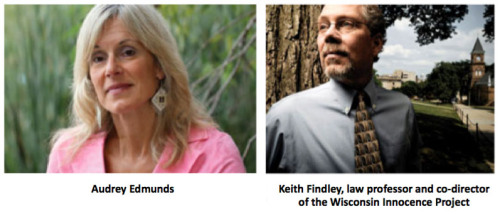
Katie Couric to Interview Audrey Edmunds and Keith Findley - Shaken Baby Syndrome

Audrey & Keith

Even casual followers of the SBS saga are familiar with the Audrey Edmunds case. Audrey was convicted and imprisoned for the shaking death of an infant in her care. She spent 11 years in a maximum security prison until Keith Findley and the Wisconsin Innocence Project succeeded in having her conviction overturned, and she was exonerated.

The American Bar Association Journal from Dec., 2011 has an article that provides a good summary of the case. See that article here. The article will also give you some idea of how entrenched SBS theory is in the US medical community and justice system. For example, to this day, the prosecutor in the case is still convinced that Audrey murdered that infant.

On Dec. 10, 2012, Audrey and Keith are scheduled to appear on the daytime talk show “Katie” with Katie Couric. 3:00 PM Eastern time on ABC. This should be one to put on your calendar. The appearance was originally scheduled for Dec. 6, but pending any further schedule change, it is now set for Dec. 10.

Wensday’s Quick Clicks…

Friday Quick Clicks…

California Supreme Court Facing Flawed Forensics…

From the LATimes.com:

Police suspected that William Richards had killed his wife, Pamela, the night her body was found.

There was no sign of an intruder, and police said the crime scene appeared staged. But Richards denied killing Pamela, and authorities had trouble obtaining a conviction.

After two juries hung, a third heard new evidence: A forensic odontologist testified that a “bite mark” on Pamela’s hand was consistent with Richards’ unusual dentition, a pattern the prosecution expert said was found in only about 2% of the population. That jury convicted, and a judge sentenced Richards to 25 years to life.

Ten years after the conviction, the prosecution odontologist recanted his testimony. Relying on new computer technology that made it possible to view the “bite mark” more clearly, the odontologist ruled out Richards as its source.

The California Supreme Court is now weighing his case, wrangling over what to do when forensic evidence is later discredited. A broad ruling could affect scores of criminal convictions. A narrow one would offer little hope to those convicted at least in part by so-called junk science.

“A lot of forensic science is not well validated to begin with, and that especially includes bite mark evidence,” said Hastings Law School professor David L. Faigman, an expert on scientific evidence. He said the court could rule for Richards but limit the kinds of cases that would be affected. If discredited science alone became grounds for a retrial, he said, “then you are potentially opening up the floodgates.”

The case against Richards, 63, was largely circumstantial. Richards said he discovered his wife’s body after returning home from work shortly before midnight Aug. 10, 1993. But the sandy, sagebrush-pocked land around their remote, high desert home in San Bernardino County contained no unknown tire tracks or footprints. Nothing had been stolen.

Although Pamela was found naked from the waist down, blood splatter on her Continue reading

SBS - Shaken Baby Syndrome. Politics and “Religion” vs. New Science

Sue Luttner is the editor of a blog called OnSBS. (OnSBS.com) After reading a recent Quick Click on the Wrongful Convictions Blog, she was inspired to author a post on her blog. The Quick Click in question is one about the San Antonio Four - four young women who were wrongfully convicted and incarcerated for what was described as “Satanic cult child abuse”; even though the theory of Satanic cult child abuse had been debunked years prior to that. You can read the Quick Click article here. [Sidebar: You may remember the McMartin Preschool case from the 80's, which was driven, at least in part, by a wave of "Satanic cult ritualistic abuse" paranoia that had taken the country. This was the longest and most expensive criminal trial in US history, and eventually, all charges against all defendants were dismissed; although, one of the defendants had already spent 5 years in prison. This was truly a black mark on the US justice system.]

In the post, Sue draws an insightful parallel between the debunking of the old Satanic cult theories and those of the entrenched medical dogma of SBS and the “triad” (a combination of three symptoms said to be uniquely indicative of SBS). See Sue’s OnSBS post here. She very appropriately titles the post Old Theories Die Hard.

I’d like to leverage off the message of that title within the context of SBS. I once heard pathologist and anti-triad crusader Dr. John Plunkett say, “It takes 10 years to get a new idea into medicine, but it takes 100 years to get a bad idea out of medicine.” I believe he was speaking from experience. There has been much recent, new, and still emerging research that clearly calls into question the 100% validity of the triad. There’s lots of other stuff that can cause a child to present with retinal hemorrhage, subdural hematoma, or diffuse edema. And the old theories that triad symptoms can’t be caused by short falls, and that there’s no such thing as “lucid invertal” have been proven absolutely untrue. However, the vast majority of the medical community seems to turn a blind eye to it. How can that be?

Continue reading

Thursday’s Quick Clicks…

Shaken Baby Syndrome Accusations: A Modern Day Witch Hunt?

Sue Luttner posted this earlier on her blog “On SBS” here.

Hangbin and Yi Ling have been incarcerated in Rikers Island since 2008 for the abusive death of their baby daughter Annie. It was discovered only a few months ago that Annie had a genetic marker for osteogesis imperfecta (brittle bone disease), and the family histories suggest the possibility of other genetic problems as well. The NY Chinese community has rallied around them, and formed a support group. That group recently published a statement which summarizes the SBS situation quite well. Here is the text of their statement:

Friday’s Quick Clicks…

Exoneree Deskovic wins round in suit against polygraphist

In February, I posted an article here about how the polygraph is often used to induce false confessions. One of the most outrageous examples of that was the case of Jeffrey Deskovic. Deskovic spent almost 16 years in prison before he was released in 2006 after testing matched DNA found on the victim identified the real killer, who pleaded guilty to the crime in 2007.

As reported here, Deskovic has already donated about $1.5 million from the money he was awarded in two court cases he filed after his release to start the Jeffrey Deskovic Foundation for Justice to promote awareness of wrongful convictions and related issues.

Now Deskovic is focusing attention on the misuse of polygraphs in criminal investigations, starting with his own case. As reported here, a federal judge has refused to dismiss Deskovic’s claim that the investigator who administered the lie-detector test that prompted his false confession violated his rights.

According to Deskovic, the investigator told him that he had failed the polygraph test and then said, “You just told me within yourself, through the polygraph results, that you committed (the murder). All we want you to do is verbalize it.” After more intimidation and manipulation, Deskovic acceded to the investigator’s request.

Sadly, investigators still use the polygraphs in this fashion to get confessions. I am currently investigating a case in which a high-school dropout with a low IQ confessed to a crime after being told the polygraph proved he was guilty. No matter how many false confessions involving the polygraph are exposed, police continue to use it as a tool to obtain confessions from young or easily manipulated individuals.

In Arizona, Drayton Witt’s SBS Murder Charges Dismissed - “With Prejudice”

Drayton Witt stands with his wife Maria Witt. Drayton’s 2002 second degree murder conviction was vacated recently after the Arizona Justice Project helped secure his release.

Thanks to the tireless work of the Arizona Justice Project, Drayton Witt has had 2nd degree murder charges against him for the shaking death of his 4 month old son dismissed, with prejudice. “With prejudice” means that the state can never again bring charges against him related to the death of his son.

Read the story here.

This is another case of the pediatric medical community blindly relying on the “triad” to diagnose death by shaking. Someday …. someday …. they will creep out of the Stone Age, and acknowledge the reality that the “triad” is NOT pathognomonic (uniquely indicative) of shaking, or as they call it today - abusive head trauma.

For more on the “triad”, see previous post here.

Canadian Supreme Court Reopens Manslaughter Case Based on New Medical Understandings…

From thestar.com:

The Supreme Court of Canada has ordered the Ontario Court of Appeal to re-examine the case of a man convicted 41 years ago of killing his common-law partner.

Three pathologists have taken a fresh look at the manslaughter conviction of John (Jack) Salmon, concluding Maxine Ditchfield, 28, did not die from a blow to the head during brutal beatings, as the jury heard, but by a stroke.

The three pathologists say it’s likely the stroke was caused by a series of falls at her Woodstock home and in the kitchen of a nearby farmhouse after a night of heavy drinking.

Toronto lawyer James Lockyer applied to the Supreme Court to direct the appeal court consider the new evidence and decide whether Salmon’s conviction was a miscarriage of justice.

The Court ruled in his client’s favour Thursday, giving no reasons.

Salmon testified, at his 1971 trial in Woodstock, that he never assaulted the mother of three, as alleged, but noticed in the days before her death she slept a great deal and kept stumbling and falling.

A jury found him guilty nonetheless, and he was sentenced to 10 years in prison. His appeal to the Ontario Court of Appeal was dismissed in 1972. He was granted parole two years later.

Now a 72-year-old married grandfather living in Orillia, Salmon has always maintained his innocence and told the Star last year that he had loved Ditchfield. He could not be reached for comment Friday.

Lockyer called the case “a nice find.” Salmon originally approached the criminal lawyer in 2000 just for a pardon. “He said, ‘I didn’t do it, but they convicted me.’”

This prompted Lockyer to review his case. “I thought the pathology was really suspect.”

At trial, the prosecution relied on the opinion of Dr. Michael Dietritch, a now-deceased pathologist who gave the cause of death as “circulatory and respiratory failure secondary to brain damage caused by blunt trauma to the head.”

In addition, Ditchfield’s 8-year-old son Michael testified he twice saw Salmon hitting his mother, making her fall to the ground, something no one else reported. Lockyer argued his testimony is open to question.

In a document filed last July, the Crown agreed the new evidence, on its face, calls into question the validity of the medical evidence tendered at trial. The Crown joined Salmon in asking that the case be reviewed by the appeal court.

A date has not yet been set for the hearing.


Thursday’s Quick Clicks…

  • A review of the film West of Memphis, on the West Memphis 3
  • A Montana man seeking a new trial for a 2002 rape conviction faced his male accuser in court here Wednesday for the first time in 10 years – and heard the accuser take back an earlier recantation he made to officials with the Montana Innocence Project. The alleged victim – now a 24-year-old prison inmate – said he falsely told Innocence Project officials in 2009 and 2010 that the jailhouse rape never occurred because he wanted them to quit bothering him about it.
  • Ohio Supreme Court will hear arguments in case in which Ohio Innocence Project has been denied DNA testing for a man on death row
  • Exoneree Arthur Whitfield pleads guilty to domestic violence offense
  • New documentary film about an alleged wrongful conviction called Incident at Devils Lake
  • The Arson Project releases two new reports about cognitive bias in arson investigations here and here

Family Files for Posthumous Pardon of Cameron Todd Willingham…

From the Houston Chronicle:

Related story here….

Despite repeated rebuffs by the state of Texas, relatives of Cameron Todd Willingham on Wednesday again will try to get officials to admit that the Corsicana man was wrongly executed eight years ago for the 1991 deaths of his three young children in a Christmas-season fire.

Eugenia Willingham, the convicted killer’s stepmother, and two of his cousins are scheduled to join lawyers from the New York-based Innocence Project in Austin to announce they will ask the Texas Board of Pardons and Paroles to recommend a posthumous pardon.

Also to be present is Ernest Willis, a West Texas man who spent 17 years on death row for the 1986 suspected arson murders of two Iraan women. In December 2004, 10 months after Willingham’s execution, Willis was freed when a Pecos County district attorney concluded the fire in his case likely had been accidental.

A draft of Willingham’s pardons petition asserts that “since his trial, scientific advances have shattered every assumption underlying the testimony of the two fire investigators who declared to the jury and the court that Willingham had set the fire that killed his children. In fact, today, no credible arson expert would make such a declaration.”

Willingham’s relatives could not immediately be reached for comment, but in a statement released Tuesday, the killer’s stepmother said “it was Todd’s last wish that we help clear his name.” His cousin, Patricia Willingham, added, “It’s time for the state of Texas to own up to its mistake and give Todd the justice he deserves.”

Only once, in 2008, has the pardons board recommended that Gov. Rick Perry grant a posthumous pardon. That case involved Timothy Cole, a Texas Tech University student who died in prison 14 years after being convicted of rape. His case – the victim later admitted she had misidentified Cole as her attacker – was a catalyst for a state law providing compensation for exonerated prisoners.

The Innocence Project began championing Willingham’s cause in 2008 when it asked the Texas Forensic Science Commission to review the quality of arson investigations leading to the former auto mechanic’s conviction.

Three reviews of the investigations, one commissioned by the Innocence Project and another by the forensic science commission, found that Corsicana and state arson investigators had misread evidence at the fire scene. Willingham went to his death at the Texas death house protesting his innocence.

The forensic science commission puzzled through conflicting claims in the case until July 2011 when Texas Attorney General Greg Abbott shut down the inquiry by finding commissioners were acting outside their jurisdiction.

Although the review led to far-reaching recommendations to improve education for firefighters, commissioners stopped short of finding that investigators in the Willingham case had done sloppy work.

In a separate attempt to have Willingham declared wrongfully executed, the Innocence Project in 2010 petitioned Austin district courts for a court of inquiry. A proceeding in state District Judge Charles Baird‘s court ended abruptly when an appeals court ruled the judge acted improperly in accepting the case.

Baird’s term ended weeks after that ruling, and no effort was made to revive the court of inquiry in another venue.