Breaking News: Man Released from Prison by Osaka District Public Prosecutors Office

It was reported today in Japan that a man who was sentenced to 12 years in prison had been released. He was accused and convicted of rape and indecent assault, but filed a motion for a retrial.

The Osaka District Public Prosecutors Office has decided that he was actually innocent and already submitted a statement to the Osaka District Court.

It is said that the testimony of the victim which was the main evidence of his guilt was found to be false.

More news will follow…

How the Courts Trap People Who Have Been Convicted by Bad Forensics

Radley Balko, investigative reporter for the Washington Post, has just published an article dealing with the justice system’s refusal/inability to deal appropriately with false, fake, unscientific, and discredited forensic evidence post conviction.

The focus is on a case that involves the infamous Dr. Steven Hayne, a now thoroughly discredited expert witness, who was sole medical examiner for the state of Mississippi for 20 years.  I urge you to read the entire article, but I’ve extracted a few particularly telling quotes:

•  “The courts and the people who operate in them seem to feel that the integrity of the system demands the preservation of verdicts.”

Addressing the fact that the body of scientific knowledge grows as a process, rather than an event; coupled with the legal time restrictions for introduction of new evidence  ————

•  “From the perspective of the wrongly convicted, you can see the trap here. File too soon, and the court may conclude that you haven’t presented enough evidence that the forensic theory upon which you were convicted has been discredited. If you then try to file more petitions as more evidence comes out to bolster your argument, you risk the court concluding that this is an  issue you’ve already raised, you lost, and you’re therefore barred from raising it again.”

•  “Koon was convicted due to testimony from an expert the court now admits isn’t credible. For the same court to nevertheless uphold his conviction because he missed a deadline is to keep him in prison on a technicality. It’s a cynical outcome that suggests the criminal justice system values process more than justice.”

Read the story by Radley Balko of the Washington Post here.


Monday’s Quick Clicks

New York Taxpayers to Pay $9 Million in Wrongful Conviction Settlement

New York City, its Housing Authority, and the State of New York have agreed to pay $9 million to Danny Colon, 50, and Anthony Ortiz, 44. Both men spent 16 years in prison before their convictions in a 1989 double murder — a drive-by shooting — were overturned in 2009.

The New York Court of Appeals reversed an earlier Appellate court decision and ordered a new trial for the men after finding that the Manhattan prosecutor had knowingly utilized false testimony from a key witness, a felon and drug dealer. The prosecutor denied in her final argument to the jury that the witness had been compensated for his testimony, but he subsequently received a Continue reading

Tuesday’s Quick Clicks…

  • RIP exoneree Darby Tillis
  • Chicago Tribune review of Parade, a musical about a wrongful conviction
  • How the criminal justice system fails the deaf community
  • A Catholic monsignor has been exonerated by the Vatican for alleged child abuse, after being suspended from the church for more than a decade.   [Editors note:  While I don’t know anything about this case, and whether this monsignor is innocent or guilty, knowing what I know about the criminal justice system and how we humans are prone to the witch hunt mentality (like we saw with the “Day Care Hysteria Cases“), I wouldn’t be surprised if some of the abuse cases against Catholic priests coming in the past 15-20 years are bogus.]

Monday’s Quick Clicks…

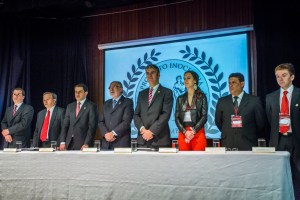
Red Inocente Conference 2014

The Red Inocente conference in Bogota, Colombia this past weekend was an incredible success.  We had over 800 participants attend, including Angelino Garzon, the former ex-president of Colombia.  Staff attended from international innocence projects in Argentina, Chile, Costa Rica, Mexico, and Peru.  The conference was hosted by the Colombia Innocence Project at the Universidad Manuela Beltrán, which boasts 8 exonerations in the past 5 years.

EricOpening Table

Red Inocente is a legal education program that offers assistance to legal professionals in Latin America to create projects dedicated to the release of those wrongly convicted.  We also create and develop legislative reforms to reduce the number of wrongful convictions.  Red Inocente was based on more than a decade of success by the both the California Innocence Project and Proyecto ACCESO.

Martha ColombiaJustin from Above

28 to be released as FBI agent is investigated for tampering with evidence

Federal prosecutors will dismiss indictments against 28 defendants in Washington, D.C., drug cases as the FBI investigates an agent accused of tampering with evidence, including narcotics and guns, The Washington Post reports.

The Post says 14 of the defendants had already pleaded guilty and were serving sentences. Prosecutors said they can withdraw their guilty pleas and the charges will be dropped. You can read the story here.

Thursday’s Quick Clicks…

Recovery therapy still being used to foster false accusations

“The belief that hidden memories can be ‘recovered’ in therapy should have been exorcised years ago, when a rash of false memories dominated the airwaves, tore families apart and put people on the stand for crimes they didn’t commit,” Pacific Standard magazine reports in a story you can find here.

Sadly, pseudoscientific recovery therapy is still being used, and, Pacific Standard says, “people are still paying the price.”

Tuesday’s Quick Clicks…

Open Records Policies Shine Light on Misconduct, Injustice

Dallas County (TX) District Judge Mark Stoltz issued findings of fact and conclusions of law last week before recommending that the murder convictions of Dennis Lee Allen and Stanley Orson Mozee be overturned. The two men were subsequently released after each had served 15 years in prison. The judge’s findings will now go before the Texas Court of Criminal Appeals for review. ABC News WFAA 8 reported (here) that the two are expected to be exonerated.

Allen and Mozee were convicted of the 1999 murder of Reverend Jesse Borns Jr., who was found stabbed outside his workplace, a retail store. No physical evidence linked the men to the crime. The conviction was won on the unrecorded confession of Mozee — who immediately recanted and claimed he was coerced into signing the police-written statement — and the testimony of two jailhouse informants. The informants denied under oath at trial that they were promised compensation for their testimony. Continue reading

Monday’s Quick Clicks…

  • South China Morning Post:  Reduction in number of crimes eligible for death penalty move in right direction
  • Recent exoneree Michelle Murphy discusses life outside of prison
  • Innocence Project (Cardozo) says DNA clears Minnesota man of murder; prosecutors disagree
  • The Mississippi Supreme Court has ruled the state’s program that provides compensation to inmates wrongfully convicted of crimes covers not only time behind bars but also house arrest.

National Academy of Sciences Releases Landmark Report on Memory and Eyewitness Identification, Urges Reform of Police Identification Procedures

The Innocence Project has posted a notice on its website, with a link to a press release, about the recently released report by the Nation Academy of Sciences on memory and eyewitness identification.

From the report:  “the legal standard that most courts use regarding the admissibility of eyewitness testimony was established before most of the scientific research was conducted.”

The report endorses the following procedures for police lineups:

  • Blind Administration — Research shows that the risk of misidentification is sharply reduced if the police officer administering a photo or live lineup is not aware of who the suspect is. This prevents the witness from picking up intentional or unintentional clues from the officer conducting the lineup.
  • Confidence Statements — Immediately following a lineup, the eyewitness should be asked to describe in his or her own words how confident he or she is in the identification. As the report notes, the level of confidence a witness expresses at the time of trial is not a reliable predictor of accuracy. Having the witness describe their level of confidence at the time an identification is made will provide juries with a useful tool for judging the accuracy of the identification.
  • Instructions — The person viewing the lineup should be told that the perpetrator may not be in the lineup and that the investigation will continue regardless of whether the witness identifies a suspect.
  • Videotape the procedure — The report recommends that police electronically record the identification procedure to preserve a permanent record of the procedure.

Most recent data from the National Registry of Exonerations shows that for the 1,467 wrongful convictions currently in the registry, 35% had mistaken eyewitness identification as a contributing factor.

See the Innocence Project posting here.

Hundreds ‘convicted in error’ in Houston drug cases

The scandal-plagued Houston criminal-justice system has yet another scandal. The Houston Press reports that prosecutors have sent out hundreds of notices to people convicted of drug offenses that they were wrongly convicted.

The problem came about when evidence tested by the Houston Police Department crime lab came up negative for a controlled substance after the defendants had already taken plea deals. In some cases, the district attorney’s office knew about the negative results before the defendant pled guilty, but most test results were received after a conviction.

The district attorney’s office apparently knew about the problem for years, but only recently sent out the notices.

You can read more here.

Friday’s Quick Clicks…

Justice for Sale at the Highest Level?

Lobbyists Pursue State Attorneys General

From an October 28, 2014 NY Times story:

“Attorneys general are now the object of aggressive pursuit by lobbyists and lawyers who use campaign contributions, personal appeals at lavish corporate-sponsored conferences and other means to push them to drop investigations, change policies, negotiate favorable settlements or pressure federal regulators.”

See the NY Times article here.

This is yet another reason why ‘prosecutor’ should not be an elected political position.  It exposes the position to a host of pernicious incentives.

Blacks must wait longer to be exonerated, study shows

From The Huffington Post:

By Michael McLaughlin

It took 18 years for DNA evidence to surface that cleared Derrick Williams of a rape and attempted kidnapping in Florida. Prosecutors had relied on the testimony of the victim, who identified Williams as her attacker in 1992. But he walked free at age 48 in 2011 because his DNA didn’t match that left on a gray T-shirt by the actual perpetrator.

The truth might have surfaced sooner if Williams were white or Latino instead of African-American.

There’s no way to know for sure, of course, but data about wrongful convictions show that blacks who are exonerated after a bogus conviction have served 12.68 years on average before the good news, according to Pamela Perez, professor of biostatistics at Loma Linda University. It takes just 9.4 years for whites and 7.87 for Latinos.

“Black Americans are exonerated at a substantially slower rate than any other race,” said a new report from Perez, shown exclusively to The Huffington Post.

There’s enough of a pattern that the differences between racial groups cannot be called random, Perez said. But there isn’t enough information to explain what caused the differences.

“All we can do is infer,” Perez told HuffPost. “You can’t prove a darn thing.”

She discovered the different timespans by examining 1,450 exonerations listed on theNational Registry of Exonerations through Oct. 20, 2014. Perez conducted the research for Safer-America.com, a consumer research group.

The findings are based on what is probably only a fraction of all exonerations. There are likely cases that didn’t make it onto the national registry, and there are almost certainly more wrongly convicted people still waiting to clear their names.

The registry didn’t collaborate with Perez, but one of its researchers reviewed Perez’s work at HuffPost’s request and approved of her methodology.

“I’m not surprised by the numbers,” said Sam Gross, the exoneration registry’s editor and a University of Michigan law professor. “The main thing we can say is that it’s very hard to know what it means.”

Perez, Gross and others cautioned against jumping to conclusions about the findings. Without further research, they said, no one knows if the results were caused by a biased criminal justice system or other factors.

The Innocence Project looked at a smaller set of 212 cases in which DNA proof freed their clients. (The national registry includes exonerations due to other contributing factors like false confessions and perjury.) The project found a similar racial disparity, with black inmates serving 14.3 years before being exonerated compared to 12.2 years for all other racial groups.

“These two numbers are statistically different, suggesting that the difference between them isn’t due to chance,” Innocence Project research analyst Vanessa Meterko told HuffPost. “It’s notable, but it’s hard to say what the difference is.”

Jennifer Thompson Promotes the Justice for All Act

Jennifer Thompson has been featured on the WCB before.  She authored, along with Ronald Cotton, the book Picking Cotton.  Ms. Thompson incorrectly identified Ronald Cotton as the man who raped her, and Cotton spent 11 years in prison before DNA proved he was not guilty.  After his release, Ronald and Jennifer became friends, and co-authored the book, which chronicles the events of the rape and the wrongful conviction.

Ms. Thompson has recently written an op-ed for The Hill in support of reauthorization of the Justice for All Act to ensure that post-conviction DNA testing remains accessible.

See the original posting on The Hill here.  The text of her piece appears below:

October 26, 2014
Harm multiplies when the innocent are wrongly convicted
By Jennifer Thompson

In June of 1995, I found myself on a journey I never wanted, never asked for and never would have wished on another human being. I learned that the man whom I had identified in court as my rapist – the man whose face, breath and evilness I had dreamt about for 11 years – was innocent. The man whom I believed had destroyed me that night, who had stolen everything from me, and whom I hated with an all-consuming rage had lost 4000 days, eleven Christmases, eleven birthdays, and relationships with loved ones. And on June 30th of 1995, Ronald Cotton, the man I had hated and prayed for to die, walked out of prison a free and innocent man.

My rage and hatred had been misplaced. I was wrong. I had sent an innocent man to prison. A third of his life was over, and the shame, guilt and fear began to suffocate me. I had let down everyone — the police department, the district attorney’s office, the community, the other women who became victims of Bobby Poole, and especially Ronald Cotton and his family.

Several years after Ronald was freed, I received a phone call from Bobby Poole’s last victim. I remember hearing her story about what happened to her and realizing that we all had left him on the streets to commit further crimes – rapes — that we possibly could have prevented if Ronald had not been locked up for something he had never done. The knowledge that Mr. Poole had been left at liberty to hurt other women paralyzed me and sent me into a backward spiral that took years to recover from. This journey has taught me that the impact of wrongful convictions goes so much further than a victim and the wrongfully convicted. The pool of victims from 1984 was huge – me, Ron, the police department, our families, and the other women who became victims of Bobby Poole all suffered.

This case crystalized for me why it is so important to have laws in place that protect the innocent. Those laws would be important enough if they only protected the innocent, but they do so much more. They also protect the potential victims of real perpetrators, the families and children of the wrongfully convicted person, and – ultimately – the victim who learns the truth.

The Justice for All Act, which is up for reauthorization by Congress, allows men like Ronald to obtain post-conviction DNA testing that can lead to their freedom and to the conviction of the guilty. Without access to such testing, innocent men will remain in prison, real perpetrators will remain free, and new victims will have to experience the same horrors and indignities that I did. I urge Congress to pass the Justice For All Act now so that we can live in a world where the truly guilty are behind bars and the innocent are free.

Thompson is the co-author with Ronald Cotton of the book Picking Cotton, a memoir they wrote together after DNA testing proved that Cotton had been wrongly convicted of raping Thompson as a college student.

Tuesday’s Quick Clicks…