Author Archives: Kana Sasakura

Blume and Helm on Innocent Defendants Who Plead Guilty

John H. Blume of Cornell University and Rebecca K. Helm have posted the article “The Unexonerated: Factually Innocent Defendants Who Plead Guilty”, Cornell Legal Studies Research Paper (July, 2012) on SSRN. Here is the abstract:

Several recent high profile cases, including the case of the West Memphis Three, have revealed (again), that factually innocent defendants do plead guilty. And, more disturbingly in many of the cases, the defendant’s innocence is known, or at least highly suspected at the time the plea is entered. Innocent defendants plead guilty most often, but not always, in two sets of cases: first, low level offenses where a quick guilty plea provides the key to the cellblock door; and second, cases where defendants have been wrongfully convicted, prevail on appeal, and are then offered a plea bargain which will assure their immediate or imminent release. There are three primary contributing factors leading a criminal justice system where significant numbers of innocent defendants plead guilty to crimes they did not commit. The first is the perceived need that all defendants must plead. The second is the current draconian sentencing regime for criminal offenses. And, the final contributing factor is that plea bargaining is, for the most part, an unregulated industry. This article discusses cases in which innocent defendants plead guilty to obtain their release, thus joining the “unexonerated” and then propose several options the criminal justice system should embrace to avoid, or at least ameliorate the plight of innocent defendants who plead guilty.
Audio and Visual Recording of Interrogations by Public Prosecutors, Part II

The Supreme Public Prosecutor’s Office (SPPO) issued a report on audio and visual recording of interrogations last week (on July 4th, JST).

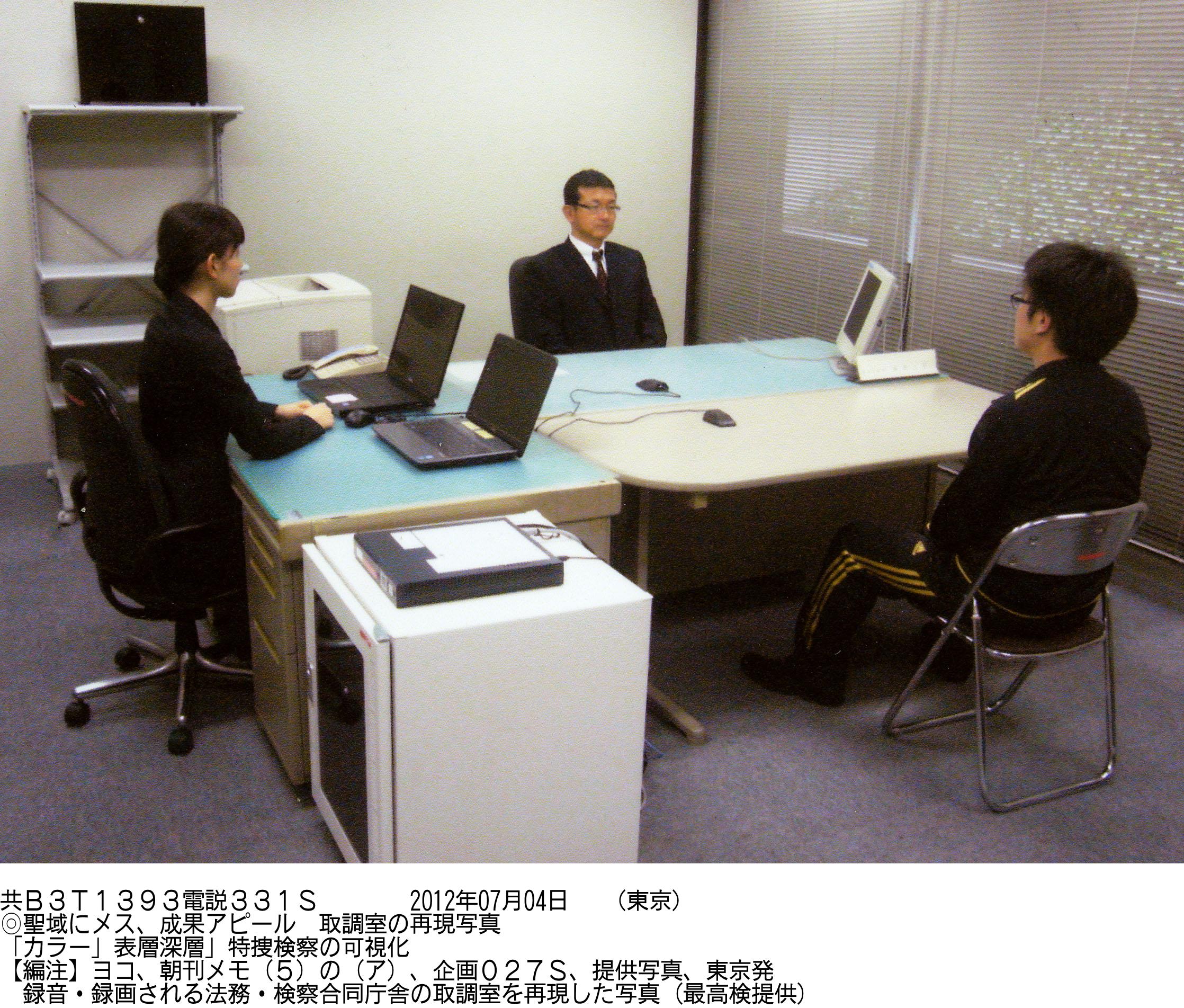
Demonstration of how the recording would take place during interrogation by prosecutor.

As I posted earlier, the SPPO started recording some interrogations on an experimental basis in 2006. Last week’s report  focused on the experimental recording in three Special Investigation Units and ten Special Crime Devision Public Prosecutor’s Office, which took place in 91 cases from March 2011 through April 2012 (note that these offices or branches in the Public Prosecutor’s Office usually involve only white collar crimes). The report revealed what the prosecutors in Japan have to say about the recording of interrogations.

Below are the points worth noting:

1)  Interrogations in 91 cases out of 98 were either partially or entirely recorded. The entire interrogation process was recorded in 39 cases.  30 of the cases concerned tax violations.

2) In seven cases, the suspects refused the recording from the beginning of interrogations. In 12 cases, the suspects refused the recording halfway through. The reasons for their refusal include: they were ashamed of being arrested and incarcerated, and they did not want to provide discussions in front of the camera.

3) Recording took place in other prosecutor’s offices in 946 cases out of 1,005 cases, where the charge was a serious offense and the case was to be disposed of by a Lay Judge trial, such as murder. In cases involving persons with intellectual disabilities, 540 cases were recorded (this was all of the cases in this category except where the accused refused). Continue reading

Another False Confession Case — Fukawa Case

Takao Sugiyama and Shoji Sakurai

As I posted here, false confessions account for many, if not the majority of, wrongful convictions in Japan. Yet another case illustrates this: the Fukawa Case, in which two people were finally exonerated in 2011 for a 1967 robbery-murder.

The crime occured in August of 1967, in the town of Fukawa, Ibaraki Prefecture, about 40 miles outside of Tokyo. A carpenter was found dead in his home.  His legs were tied with a towel and a shirt, a pair of underpants were stuffed in his mouth, and he was strangled. There were signs of struggle in the house, but it was unclear if anything was taken from the house, except for a white purse the victim supposedly used daily. 43 fingerprints were found but none of them connected to perpetrator(s). There was no physical evidence at the scene.

However, there were several eyewitness statements that two men (one tall man and another shorter man) were near the victim’s house on the evening that the victim was supposedly murdered. This statement lead the police to think there were two perpetrators.

Based on this information, the police investigated more than 180 men in the area, until they found the two men, Shoji Sakurai and Takao Sugiyama,who did not have an alibi on the date of the crime. In October of the same year, both of them were arrested on separate charges, and were interrogated.

Sakurai and Sugiyama were held in police jails (“Daiyo-Kangoku“), and interrogated for hours and days. After 5 days of interrogations, Sakurai confessed to the crime. Based on Sakurai’s confession, the police also forced Sugiyama to confess. They retracted their confession during the interrogation by the prosecutors, but the prosecutors sent them back to police jails, and after continuous interrogations that ensued, they finally gave in and confessed again.

The two contested their guilt at trial. The prosecutors had no direct evidence of their guilt. All they had were: their confessions made during interrogations by police and prosecutors (with the  testimony of interrogators and the partial tape recordings of the interrogations which recorded only the part after they confessed to the crime), and testimonies of eyewitnesses who saw two men on the day of the crime.

There was no physical evidence, including the white purse which was never found. Their confessions during investigation changed repeatedly, Sakurai and Sugiyama’s confessions contradicted each other’s in important parts, they did not match the circumstances of the crime scene, and there was no information revealed in the confessions which unknown to investigators.

Nevertheless the trial court declared that their confessions made during investigation were reliable and sentenced them to life in 1970. The High Court as well as the Supreme Court denied the appeal. Their sentences were finalized in 1978. Continue reading

DNA for the Defense Bar

Courtesy of Fernanda Torres of the Innocence Project Northwest.

The National Institute of Justice issued a report titled “DNA for the Defense Bar“.

Summary: DNA for the Defense Bar is the newest addition to a series of NIJ guides that aims to improve the use of forensic DNA in the criminal justice system. Designed specifically for criminal defense lawyers, it:

  • Offers a primer on the science of DNA, from collection at a crime scene to laboratory analysis and findings.
  • Provides general discussions on working with a criminal defense client and preparing a defense, including the testimony of a DNA expert witness and cross-examining prosecution DNA witnesses.
  • Offers guidance regarding trial issues (for example, jury selection and opening and closing statements) and includes an in-depth discussion of the statistics with respect to CODIS match probabilities.
  • Include a discussion of post-conviction DNA testing.

This is the fourth publication in a series designed to increase the field’s understanding of the science of DNA and its application in the courtroom (see “Foreword” of this report). Other three are:

■■ Principles of Forensic DNA for Officers of the Court: nij.gov/training/dna-officers-court.htm.

■■ DNA: A Prosecutor’s Practice Notebook: nij.gov/training/dna-prosecutors-notebook.htm.

■■ DNA for Law Enforcement Decision Makers: nij.gov/training/dna-decisionmakers.htm.

False Confessions as Major Cause of Wrongful Convictions in Japan

A Police Jail in Tokyo.

One of the major causes of wrongful conviction in Japan is definitely false confessions.

Why? Obviously, since a confession is still the “King of evidence” in Japan.  And since the law permits long period of detention (23 days!) before the formal charge (indictment) of a suspect, and since during this pre-charge detention period, there are lengthy interrogations by the police and prosecutors.

When and How Long can a Suspect be Detained?

In Japan, a suspect can be detained when there is a “reasonable cause” that he/she committed the crime, and there is a risk of flight or he/she might tamper with the evidence in the case.  When a judge issues an arrest warrant and once the suspect is arrested (“Taiho“), the police has 48 hours to transfer the suspect and the case to prosecutors.

When prosecutors receive the suspect and if they think he/she should be detained further, they must ask a judge within 24 hours of receiving the case to issue a warrant for up to 10 days of additional detention (“Koryu“). This is when the suspect appears before a judge for the first time.  Additional 10-day extension of Koryu is possible after the initial 10days. Judges almost always issue the arrest/ detention warrant. Less than 1 % of the warrant claim is denied. For violent crimes, it’s almost 0%.

To sum up, police and prosecutors can detain a suspect for up to 72 hours before the suspect has to appear before a judge, and then for additional 20 days  before the formal charge (23 days in total!).

Interrogation During Detention

During this 23-day period, police and prosecutors usually interrogate the suspect for a long period of time. Conducting the interrogation is critical, even for prosecutors. Continue reading

Yet Another Police Misconduct Revealed in Mainali’s Case

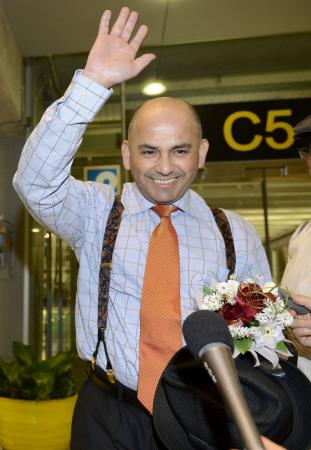
Mr. Mainali, on his way back home.

Previous posts on Govinda Mainali’s exoneration in Japan here, here, and here.

While Mainali went back to his home contry (Nepal) after the Tokyo High Court granted his new trial, yet another misconduct by the police in his case was revealed.

From the Japan Times.

Roommate says police forced him to sign false statement indicating Mainali’s guilt

DHULABARI, Nepal — A Nepalese man who shared a Tokyo flat with compatriot Govinda Prasad Mainali, 45, said Monday he was coerced while in detention in Japan to sign a false statement indicating his roommate had murdered a Tokyo woman in 1997 in order to rob her…….

Khadka said he and Mainali were among five Nepalese migrant workers who lived in a building in Tokyo’s Shibuya Ward adjacent to the vacant apartment where the woman was murdered. Police found her body 11 days after her death.

“Japanese police wanted to establish that Mainali was desperately in need of money at the time of the murder. They made me sign a statement that said Mainali returned to me a few days after the murder a sum of ¥100,000 that he had borrowed from me in February that year,” Khadka told Kyodo News at his residence in Dhulabari, about 300 km southeast of Kathmandu. Continue reading

Did Japan Execute the Wrong Man? – Iizuka Case

Photo taken near Iizuka CIty

Michitoshi Kuma was executed at the Fukuoka Detention Center in October 2008. He had always maintained innocence to the crime of which he was found guilty. Kuma’s family filed for a retrial in October 2009.

Kuma was found guilty of abducting, killing and dumping the bodies of two 7-year-old girls in 1992 in Iizuka, Fukuoka Prefecture. He was arrested in 1994, but maintained his innocence.

Since there was no direct evidence linking Kuma to the crime, they relied on circumstantial evidence, including a testimony by an eyewitness that he saw the dark-blue vehicle which belonged to Kuma near the place where the victims’ bodies were found, and a fiber analysis which revealed that some pieces of fiber on the victims’ clothing was the same fiber from the seat from Kuma’s vehicle.

Another evidence against him was the result of a DNA testing conducted by the Police crime laboratory. Blood on the ground from where victims’ bodies were found were tested for a DNA profile, and they said that the DNA type matched Kuma’s.

The Fukuoka District Court sentenced him to death in 1999. The High Court as well as the Supreme Court affirmed the conviction and his sentence was became finalized in 2006. He was hanged in 2008 at the age of 70.

Then, in 2009, the country was stirred by a finding in another high profile case, the Ashikaga Case (read about this case here). Continue reading

Mainali Case Reveals Flaws of Japanese Criminal Justice System

Mainali’s wife and his two daughters.

Here is an article by Minoru Matsutani of the Japan Times on the Mainali Case and the flaws of the Japanese criminal justice system that it highlights (read about the Mainali Case here and here).

It points out some of the problematic features of the Japanese system including: (1) prosecutors withholding evidence which would have cleared the defendant (no Brady rule in Japan), (2) not enough disclosure of the prosecution’s evidence, (3) no law to limit the appeal by the prosecution to a not guilty decision by the court, etc. In addition, there were apparently even more hardships for Mainali, who is a Nepalese.

Mainali is expected to leave Japan for his home country this week.

Excerpt:

Mainali case exposes flaws, bias in judicial system –Prosecutors withheld evidence, detained Nepalese after acquittal

Facing retrial, exoneration and freedom after spending 15 years in prison for the 1997 murder of a Tokyo woman — a crime for which he was initially acquitted — Govinda Prasad Mainali could be a case study in the flaws in the nation’s judicial system.

Like other foreigners in violation of their visa status, the Nepalese was placed in immigration detention after his acquittal, pending deportation. But prosecutors had other plans: They made sure he stayed in immigration custody as they retried his case on appeal, bent on a conviction.

To this end, they withheld evidence that would strongly establish reasonable doubt of guilt. In short, they presented, as a spokesman for the state said, what was needed “to prove their case.”

……Mainali lawyer Shozaburo Ishida faulted prosecutors for withholding vital evidence that could have upheld Mainali’s acquittal. Continue reading

Recent Developments in Death Penalty Debates in Japan

Since I last posted about the country’s death penalty debates, there have been some developments.

(1) The process of the issuance of death warrants (for the 12 people who were executed since 2009) was revealed for the first time in history. The Ministry of Justice disclosed related documents including the Order of Execution. It became clear that the Minister of Justice (who orders the execution) does not sign the Order him/ herself. Even the official seal of the Minister is done by a staff member. The Minister’s sign appears on another document named “Conclusion of Review of Death Penalty Case (Suitable for Execution)“. How the candidates for the next executions are chosen remained unclear.

The issuance, review, approval and order documents were all on the same date and the actual execution was carried 2 to 4 days thereafter. The process is extremely fast.

(2) New Minister of Justice, Minoru Taki was appointed on June 4th. He is a member of a group of supporters for Iwao Hakamada, a death row inmate. He told the media that now that he is the Minister, he  may withdraw from the membership. In addition, he told the media that he will consider executing death row inmates, since that is his job as the Minister.

(3) Ministry’s top three officials have been discussing (closed from the public) about the method of execution. On June 6th, they decided that they will consider the lethal injection method, currently employed in the United States. They are to conduct a research on why the U.S. decided to employ the lethal injection method in the 1970s.

(4) Meanwhile, the opponents to death penalty are raising their voices. Read an excellent report by the Japan Times on an International Symposium which was held in Tokyo on June 1st here (in English).

Excerpt:

……With international pressure growing against Japan to scrap the system, abolitionists, scholars, lawmakers and law enforcement officers from Japan, Norway and the U.S. recently gathered in Tokyo to spread their message that capital punishment neither prevents crime nor comforts the victimized. Continue reading

Banks Story Highlights Other Innocence Efforts

With the amazing story of Brian Banks‘s exoneration by the California Innocence Project and his numerous tryouts with NFL teams, there are many stories on the media about innocence efforts. It is great that all the sports fans will get to know what the innocence work is all about.

Brian Banks’s tryout with the Seattle Seahawks was a huge news in local media as well. It also highlighted local innocence efforts. Several news featured the work of the Innocence Project Northwest, located at the Univestiy of Washington School of Law.

Here is a story by KIRO FM News.

And here is a brief story by King 5 News.

Excerpt from the King 5 News: Media attention this week on aspiring Seahawks team member Brian Banks is shining light on the Innocence Project, a national effort to free and exhonorate wrongly convicted people from prison…

In Seattle, the Innocence Project Northwest operates out of the University of Washington School of Law, where students, faculty and volunteer legal experts have helped secure freedom for at least 16 people in Washington prisons since 1997. Continue reading

Role of Prosecutors in Postconviction Proceedings

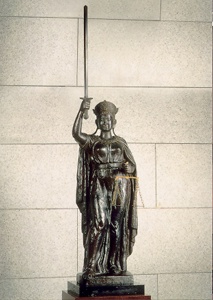
Lady Justice, in the Supreme Court of Japan

As I posted on Thursday, there was a decision by the Tokyo High Court to grant a retrial to Govinda Mainali. The High Court also ordered his release. He was finally released after 15 years of confinement. Since he has a conviction for visa violations, he is placed in immigration custody, and will be sent back home to Nepal, to his family.

However, the Tokyo High Public Prosecutor’s Office immediately filed an objection to the High Court. Even if the Court denies the objection, they can still file an appeal to the Supreme Court. Deputy chief prosecutor of the Tokyo High Public Prosecutor’s Office was quoted as saying that the Court’s decision to grant Mainali a retrial was “absolutely unacceptable”.

Meanwhile, Asahi Shimbun news reported on June 3rd that the Supreme Public Prosecutor’s Office will be holding the first meeting ever with the public prosecutors who deal with postconviction claims of innocence. They are apparently alarmed about the relatively high number of recent court decisions to retry cases. Of the eleven decisions (in death penalty or life sentence cases) to grant a retrial since the end of WWII, five  were handed down after 2009 (decisions in Ashikaga, Fukawa, Fukui, Higashi Sumiyoshi, and Mainali cases. Note that four of these involve false confessions).

The court decisions in these cases were made possible in part by the state-of-the-art DNA testing. As the exonerations all over the world have made it clear, DNA is a strong tool to prove innocence of the wrongfully convicted.

However an exoneration means the police and prosecutors who investigated, prosecuted, and helped to convict an innocent person will be criticized by the public. Thus, it was reported that the prosecutors are worried that these decisions to retry cases “will undermine the public’s trust to the investigation process, and therefore worrisome from the standpoint of public safety”. An executive prosecutor said that they “will do their best to battle these retrial claims by developping prosecution’s scientific knowledge.”

If the prosecutors truly believe what they said in these media reports, it is an evidence that the public prosecutors are worried more about “winning” postconviction cases than finding out the truth. Continue reading

J. Barry on Actual Innocence and the Double Jeopardy Clause

I came across a great article by Professor Jordan Barry of University of San Diego School of Law on prosecution of the exonerated.

Jordan Barry, Prosecuting the Exonerated: Actual Innocence and the Double Jeopardy Clause, 64 Stanford Law Review 535 (March, 2012). It is obtainable on SSRN.

Here is the abstract:

In certain circumstances, a prisoner who challenges her conviction must convince a court that she is actually innocent in order to get relief. Unfortunately, such judicial exonerations often fail to persuade prosecutors, who are generally free to retry prisoners who successfully challenge their convictions. There have been several instances in which prisoners have convinced courts of their innocence and overturned their convictions, only to have prosecutors bring the exact same charges against them a second time. This Article argues that the Double Jeopardy Clause protects these exonerated defendants from the ordeal of a second prosecution. Permitting prosecutors to continue to pursue such individuals contradicts established Supreme Court case law, violates the policies animating the Double Jeopardy Clause, and impairs the operation of the criminal justice system.

Breaking News: Tokyo High Court Grants Retrial for Mainali

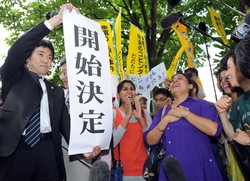
“Retrial Granted!!” — from Mainichi Shimbun News.

The Tokyo High Court granted the petition for retrial for a 1997 murder case today (Friday June 7, 2012, JST). It also granted petitioner Govinda Mainali‘s release from custody.

Of the cases where a death sentence or a life sentence were imposed in Japan since the end of World War II, it is said to be the eleventh case that a court granted a retrial.

The Court ruled that if the new DNA evidence was presented at the original proceeding, Mainali would not have found guilty of the crime. News can be found here and here (in Japanese).

However, the prosecutors may file an objection within three days (and they likely will). Even if the Court rejects the objection, the prosecutors can still file a special appeal to the Supreme Court…

Here is what happened in this case:

The victim was found strangled to death in a vacant apartment in Shibuya, Tokyo on March 19th 1997.  She was also robbed 40,000 yen, and it was said that she was murdered on the night of March 8th, 1997. The case became well known since the victim was said to have lead a double life: a graduate of one of the top colleges in Japan, she worked on weekdays at a then very prestigious company, but worked as a prostitute on weekends.

There was a used condom in the toilet of the empty apartment that the victim’s body was found. DNA testing of the semen in the condom revealed that the sperm came from Govinda Mainali, a Nepali national Continue reading

Illinois Torture Inquiry and Relief Commission Will Go Out of Business…

ImageIllinois Torture Inquiry and Relief Commission was created by a bill which was signed into law three years ago. It is committed to “fairly and impartially investigating a claim by any person who alleges that he or she has been tortured into making a false confesssion, and that the confession was used to obtain a conviction for that crime.”

It will make its first recommendations tomorrow, but then will go out of business…

Story from Chicago Tribune.

Excerpt:

On Tuesday, a state commission set up to investigate claims of police torture will refer its first cases to Cook County’s chief judge, beginning to fulfill its mandate to plumb one of Chicago’s most stubborn scandals by making recommendations for legal relief.
Then it will go out of business.

The Illinois Torture Inquiry and Relief Commission was approved by the Legislature and signed into law by Gov. Pat Quinn in the summer of 2009, a response to the long-standing scandal around former Chicago police Cmdr. Jon Burge and many of his subordinates, who were accused of torturing suspects to get confessions. Continue reading

Attorneys for Okunishi File Special Appeal to Retry Nabari Case

Attorneys for Okunishi on their way to the Nagoya High Court to file a Special Appeal.

Since the Nagoya High Court rejected Okunishi’s retrial last week, there has been much criticism against the decision in the press in Japan. Meanwhile, attorneys for Okunishi filed a special appeal to the Supreme Court today.

There is also a concern about Okunishi’s health. 86-year-old Okunishi has lost appetite, and now has other health issues. He is being treated at a hospital outside the detention center.

At the hospital, his right hand is tied to the bed with a handcuff, his left hand also handcuffed with a rope tying the handcuff to a guard’s hand. Four guards are constantly watching him aroun the bed……  Read about this inhumane treatment here (in Japanese).

Additional story on Nabari Case Continue reading

High Court Rejects Request for Retrial in Nabari Case…

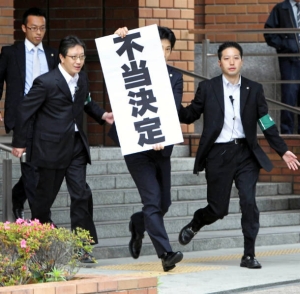
Attorney for Okunishi: “Unjust Decision” — From Chunichi Shimbun

The Nagoya High Court rejected the appeal for a retrial by Masaru Okunishi today. 86-year-old Okunishi has been on death row for 40 years. Previous posts about the Nabari Case here and here.

This is the seventh petition for retrial for Okunishi, filed in 2002. The key new evidence for this petition is a testing result by a chemist. The result concluded that the pesticide in the wine that the victims drank was not “Nikkarin-T”, the chemical with which Okunishi confessed he poisoned the wine.

Division 1 of the Nagoya High Court granted a retrial based on the new evidence in 2005, saying that Okunishi’s confession obtained during 5 days of intense interrogation was unreliable. However, this decision was vacated in 2006 by Division 2 of the same High Court after the prosecution appealed. Okunishi filed a special appeal to the Supreme Court, which referred the case back to the Division 2 of the Nagoya High Court in 2010, saying that “it did not decide on the case based on science”.

Today, Division 2 of the High Court vacated the 2005 decision to grant retrial yet again. Presiding Judge Yasuo Shimoyama stated in the decision Continue reading

New Article by Davis and Leo on False Confession

Deborah Davis and Richard A. Leo, The Problem of Interrogation-Induced False Confession: Sources of Failure in Prevention and Detection, in Stephen Morewitz & Mark Goldstein, eds., The Handbook of Forensic Sociology and Psychology (Springer, 2013 Forthcoming) is now available on SSRN.

Abstract:

Interrogation-induced false confessions are a systemic feature of American criminal justice. In the last few decades, scholars have assembled evidence of instances of false confessions that resulted in wrongful convictions. Despite procedural safeguards and a constitutional prohibition against legally coercive interrogation techniques, American law enforcement continues to elicit false confessions. In particular, American law enforcement interrogation techniques display two problematic features that have the potential to increase the occurrence of false confessions: (1) an assumption of guilt that promotes the misclassification of innocent suspects as likely guilty; and (2) the still-coercive nature of interrogation tactics that include strong incentives promoting confession as the mechanism to achieve the best legal outcomes and that contaminate the content of the confessions they elicit.
In this article, we address two questions: (1) Why do false confessions occur, and what can be done to prevent them?; and (2) Why do false confessions remain undetected once elicited, and what be done to more successfully identify them when they do occur? We particularly emphasize the role of failures of relevant knowledge and understanding among those who elicit and misjudge false confessions.

Fight Continues for 1948 Murder Case — Teigin Case

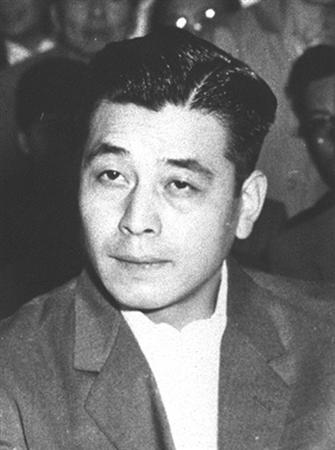
Hirasawa on the first day of his trial.

Many books have been written, documentaries and movies made on the famous Teigin Case.

It was a murder and robbery case in 1948, where a man disguised as a Government health worker entered a Teikoku Bank (“Teigin“) branch and told the employees that there was a sudden outbreak of dysentery and  the US occupation forces ordered to drink medicine. The “medicine” given by the man was in fact poison. The workers obeyed and 12 people were killed. The man fled with cash and checks from the bank.

The investigators believed that the poison used in the murder was a rare poison, obtained by few people, such as those working for a secret Unit 731 of the Japanese army during the WWII, which is said to have conducted experiments on human beings.

However, the police arrested Sadamichi Hirasawa, then a famous painter. Hirasawa was sentenced to death in 1950 by the trial court. He died while on death row in 1987 at the age of 95.

Read about the ongoing efforts to exonerate Hirasawa here.

Excerpt:

TOKYO (Kyodo) — When a death row inmate convicted of a 1948 mass murder died of natural causes 25 years ago, most people believed the “Teigin Incident” had left unanswered questions that would now never be solved.

However, a group of lawyers and experts in pharmacy and psychology are still struggling to unearth the truth behind the most notorious mass-poisoning case in postwar Japan and exonerate Sadamichi Hirasawa, who passed away on May 10, 1987, at a prison hospital in Tokyo at the age of 95.

“We will complete presenting new evidence by the end of next year to reopen the case,” said Nobuyoshi Araki, one of the lawyers involved in the petition for a posthumous retrial of Hirasawa, who was a painter.

The 19th petition was filed with the Tokyo High Court by Hirasawa’s adopted son, Takehiko, on May 10, 1989, the second anniversary of his death. The first had been filed in 1955 and rejected the next year.

One of the focuses in the petition is on the poison used to kill the 12 victims ……While the courts determined the murderer used potassium cyanide, Hiroyoshi Endo, former dean of the pharmacology department at Teikyo University, said, “I can’t specify what the poison was, but as a scientist, I can say it was not potassium cyanide.” Continue reading

High Court to Rule on Whether to Grant a Retrial for Nabari Case on May 25, 2012

86-year-old Masaru Okunishi is still on death row. He has spent more than half of his life in custody, 40 years on death row. Will he get a retrial? The Nagoya High Court will rule later this month, on May 25 on the 51-year-old Nabari Case. (See Mark Godsey’s previous post about this case here)

In March 1961, 5 people were killed and 12 got ill in a rural town in Mie Prefecture. They were at a gathering in the town and drank a bottle of wine, which was poisoned with pesticide. Since Masaru Okunishi was the one who delivered the wine to the gathering and because both his wife and lover were killed in the incident, he soon became a suspect. The police’s theory was that he put the poison in wine and killed his wife and lover, getting rid of the “love triangle” relationship. After 5 days of intense interrogation, he confessed. He was charged for the murders.

The main evidence against him were: 1. his confession, 2. the fact that the wine was in his possession right before the incident, 3. the bite mark that was left on the lid of the wine bottle which the prosecution alleged to have matched his.

The Tsu District Court handed down the decision in December 1964. The court found Okunishi “not guilty” of the crime. The Court said that the confession was unreliable, the witnesses’ testimony on the delivery and possession of the wine was unreliable and the bite mark on the lid could not be determined as his.

The prosecutors appealed and the Nagoya High Court reversed, sentencing Okunishi to death in 1969. Continue reading

Recent Developments in Eyewitness ID Reform

Courtesy of Professor Jacqueline McMurtrie of the Innocence Project Northwest.

Here is a recently published article in the ABA Journal on eyewitness ID.

Excerpt:

Gary Wells, an Iowa State University psychology professor who’s been studying problems with police lineup procedures for 35 years, says the progress made in the past few years “seems like a runaway train” compared with what he witnessed during the first 30.

In the past year:

• Texas became the 10th state to pass a law requiring police departments to adopt written lineup procedures designed to reduce the risk of faulty identifications.

• The New Jersey Supreme Court issued a landmark ruling on the use of eyewitness identification evidence at trial.

• A new field study of police lineup procedures confirms what scientists like Wells have long been saying.

• And the U.S. Supreme Court heard its first case on eyewitness identification evidence in 34 years.

“We still have a long way to go,” Wells says, “but we’re definitely making headway.”

Continue reading