Category Archives: Exonerations

Indian man freed by Delhi High Court after 14 years in prison

Bhupender Singh walked free on Friday after the Delhi High Court acquitted him of the 1999 murder of the wife of his former employer. Singh had been convicted in 2006, after fingerprints were found in his employers house. The fingerprint evidence was highly contentious, and never dealt with satisfactorily, but the High Court has now decided that Singh can go free, because there was not sufficient evidence for the conviction.

Read more here… HC acquits man of murder 14 yrs after he was jailed

CNN Premier of Michael Morton Documentary Rescheduled

News coverage following the passing of Nelson Mandela has prompted the rescheduling of “An Unreal Dream,” the true account of Michael Morton’s wrongful conviction of the murder of his wife, Christine; his 25 years of wrongful incarceration; and his exoneration. The documentary will premier instead this Sunday evening, Dec. 8, at 9:00 p.m. ET/PT on CNN TV. See details here.

As part of its focus on the Morton case, CNN reports on five cases identified as “high-profile exonerations” (here). In addition to the case of Michael Morton, the article highlights the exonerations of Brian Banks, Douglas Prade, Clarence Harrison, and James Bain.

Documentary Demonstrates that Michael Morton’s Case is Not Unique

Michael Morton’s remarkable story of wrongful conviction for the 1986 murder of his wife Christine, his 25 years of incarceration, and his exoneration, will be told to a national audience when the documentary “An Unreal Dream,” written and directed by two-time academy award nominee, Al Reinert, premiers on CNN tomorrow night, Thursday, December 5, at 9:00 p.m. ET and PT. According to CNN (here) the documentary seeks to “demonstrates that Morton’s story is not unique.” Continue reading

Police chiefs lead effort to prevent wrongful convictions by altering investigative practices

By Spencer S. Hsu, Monday, December 2, 6:57 PM
The Washington Post

The nation’s police chiefs will call Tuesday for changes in the way they conduct investigations as a way to prevent wrongful convictions, including modifying eyewitness identification.

In a joint effort with the Justice Department and the Innocence Project, an advocacy group for prisoners seeking exoneration through DNA testing, the International Association of Chiefs of Police (IACP) will urge police departments nationwide to adopt new guidelines for conducting photo lineups, videotaping witness interviews and corroborating information from jailhouse informants, among 30 recommendations.

The group also calls for new tools to identify investigations at high risk of producing a wrongful arrest, as well as formalizing the way flawed cases are reviewed and the way assertions of innocence are investigated.

“At the end of the day, the goal is to reduce the number of persons who are wrongfully convicted,” said Walter A. McNeil, the police chief in Quincy, Fla., and past president of the chiefs association, which convened a national policy summit on wrongful convictions.

“What we are trying to say in this report is, it’s worth it for all of us, particularly law enforcement, to continue to evaluate, slow down, and get the right person,” McNeil said.

Legal experts said the findings, which were funded by the Justice Department’s Office of Justice Programs, mark a milestone in the deepening engagement by police and prosecutors in correcting breakdowns in the criminal justice system. Those errors have been exposed in recent years by advances in DNA profiling.

The findings also reflect a new emphasis by police on preventing mistakes from occurring, as well as a growing willingness to investigate past errors by adopting what the IACP called a “culture of openness” in rethinking how police analyze evidence and tackle problems such as investigative bias.

“We may appear to some to be strange bedfellows, but in fact we all support these reforms because they protect the innocent and enhance the ability of law enforcement to catch the guilty,” said Barry Scheck, co-founder of the Innocence Project.

Criminal prosecutions are handled overwhelmingly at the state and local level, and the IACP said its summit was the first national-level symposium on the subject to be led by law enforcement.

With 17,000 of its 22,000 members in the United States, the IACP brings an influential voice of police professionals to active debates over how police should ask eyewitnesses to identify suspects, for example, and how law enforcement should address past convictions that may have relied on flawed forensic or other evidence.

Despite their strong impact on juries, witness recollections are wrong about one-third of the time, researchers have found. Eyewitness misidentifications played a role in the majority of more than 300 DNA exonerations since 1989.

Many police agencies have moved to reduce potential sources of errors or bias, such as by conducting blind lineups in which the police officer shows a witness photographs but does not know who the suspect is.

In addition, research indicates that showing photographs of possible suspects one at a time, or “sequentially,” rather than in a group, reduces misidentifications. But some police agencies have balked, worrying that in practice it may confuse witnesses or create investigative problems.

The IACP acknowledged both viewpoints, calling for more research even as it urged agencies not to wait to adopt blind and sequential lineups.

Nearly 10 states have implemented such policies, as have police departments serving large cities, including Dallas and Baltimore.

More than 20 states record interrogations statewide, and another 850 law enforcement agencies voluntarily do so.

With several states and the FBI grappling with how to address convictions that may have relied on flawed forensic evidence, the IACP said it and the Justice Department should provide tools to help agencies investigate claims of innocence and resolve wrongful convictions.

“Any time new information comes forward that could indicate the need for redirection, justice system officials across the continuum must welcome and carefully examine that information,” the IACP said in its report.

Monday’s Quick Clicks…

click

Exciting Case Successes Last Week in Netherlands and UK…

Last week, two innocence organizations in Europe got good news on several cases they have been working on for many months/years.

In the Netherlands, the Knoops Innocence Project obtained the exonerations Andy Melaan and Nozai Thomas in the Dutch Antilles.  The Project was able to prove through expert analysis that Thomas was working behind his computer downloading music at the time of the murder, and that Melaan was on the other side of the island (proved via phone records).  The Court also accepted that Thomas’ confession was a false confession.  The two men served eight and five years in prison respectively.   More details here.

In the UK, the Cardiff Innocence Project has had a case referred back to the Court of Appeals by the CCRC.  The defendant is Dwaine George, and his murder conviction was based on faulty GSR testimony.  More details here.   Upon hearing the news, Dwaine said: ‘ I have said from day one that it wasn’t me.  I know there are still huge hurdles ahead, but I want to prove my innocence. I just want a chance to get justice, and I want to thank Cardiff’s innocence project students for the work they have done that will hopefully give me that opportunity.’

Congrats to the Knoops and Cardiff Innocence Projects, and more importantly, to Thomas, Meelan and George….

With Today’s Release of the San Antonio Four, Texas Now On the Cutting Edge of Efforts to Free the Innocent

From the Huffington Post:

Today in Texas, four wrongfully convicted women–known as the “San Antonio Four”–had their convictions overturned and were freed. This came about thanks to the latest in a line of innovations Texas lawmakers and the Innocence Project of Texas have devised to help the wrongfully convicted. Often thought of as a rough-and-tumble, “Hang ‘Em High” state–and still leading the nation in capital punishment–Texas is surprisingly now a trendsetter for innocence reforms.

The four women exonerated today–Elizabeth Ramirez, Kristie Mayhough, Anna Vasquez, and Cassandra Rivera–were caught up in the infamous line of ritualistic child sex abuse hysteria cases of the 1980s and early 1990s. Many of these cases involved allegations against day care workers, and many experts now believe that most of the convicted were innocent victims of the witch-hunt mentality prevalent in that era…………

Read entire article here….

James Bain Exonerated in Florida After 35 Years in Prison

Bain

After spending 35 years in prison for a rape he did not commit, James Bain, after numerous pro se motions, was ultimately assisted by the Innocence Project of Florida, and finally exonerated by DNA evidence.

Read the Business Insider story here.

The CNN story includes an interview with Mr. Bain here.

UK Innocence Project case to be heard at Court of Appeal

Some great news from the UK: The Cardiff Law School Innocence Project (see here...), operating since 2005, has had a case referred back to the Court of Appeal in England and Wales, via the Criminal Cases Review Commission. See the official press release here: Commission refers the murder conviction of Dwaine George to the to the Court of Appeal

This case centres upon gunshot residue evidence, with the students at the project providing the CCRC with a new expert report. The Innocence Project Director, Julie Price, has been writing a blog about the challenges of running an Innocence Project and has written about the news here… Whilst it is indeed time for reflection, and this is not a ‘victory’ in that the appeal still has to be won, it is surely a good day for all of us in the UK who hoped that Innocence Projects in this country could make a difference.

Kash Delano Register Free After Judge Overturns Decades-Old Murder Conviction

Register

After 34 years in prison for a murder he did not commit, Kash Delano Register is a free man.  How could this perversion of justice have happened?

This quote from the HuffPost story pretty much says it all.  “Superior Court Judge Katherine Mader threw out the conviction on Thursday, ruling that prosecutors used false testimony at trial and failed to disclose exculpatory evidence.”

Read the HuffPost story here.

With news of wrongful convictions occurring at a steady pace these days, it really causes one to ponder – how many more are out there?

Idaho Innocence Project puts new cases on hold after losing grant

BOISE, Idaho (KBOI) – The Idaho Innocence Project won’t take on any new cases after its major funding source dried up, according to Director Greg Hampikian.

The Boise-based group uses DNA evidence to help free the wrongfully convicted. Hampikian and his team played a role in the acquittal of Amanda Knox, and they are currently working two cases in Idaho.

“I can’t commit resources we don’t have, so people are writing us, and I’m having to tell them we’re on hold right now,” Hampikian said. “We’re waiting to see where we end up.”

Hampikian said 100 prisoners or so write each year, but the Idaho Innocence Project can’t help them now that its grant proposal was rejected.

The U.S. Department of Justice didn’t award the group a two-year $220,000 grant. Hampikian volunteers, but the Project counted on that money the past four years to pay legal help.

“So who does it affect? It affects the families, and you don’t know if you’re going to be one of these families one day where one of your family members is accused and surprisingly convicted of something they didn’t do,” said Hampikian, who also plays a role in trials around the world.

Knox was accused of killing her roommate in Italy in 2007. Hampikian looked at the DNA evidence and helped her defense team. An Italian jury overturned the 2009 murder conviction. New evidence is expected Wednesday after the Italian Supreme Court demanded a retrial.

“That knife has no reliable evidence that it was used in the murder,” Hampikian said. “It is a kitchen knife that was probably used for cooking the night of the murder and had nothing to do with it.”

Hampikian said he is now scrambling to raise money to continue his work.

“I’d rather work on cases, I’d rather to do what only I can do. Somebody else can probably do this, but I’m the volunteer director, and I’m the only one left. The captain’s left on the ship, I have to call people.”

The Idaho Innocence Project has enough money to finish its two Idaho cases, according to Hampikian, but he’s already turning away others asking for help until he can come up with the money.

Exoneree on a Lecture Tour in Japan

From Fernando Bermudez:

 I Cannot Take Off My Straw Sandals

                                                                                       By Fernando Bermudez

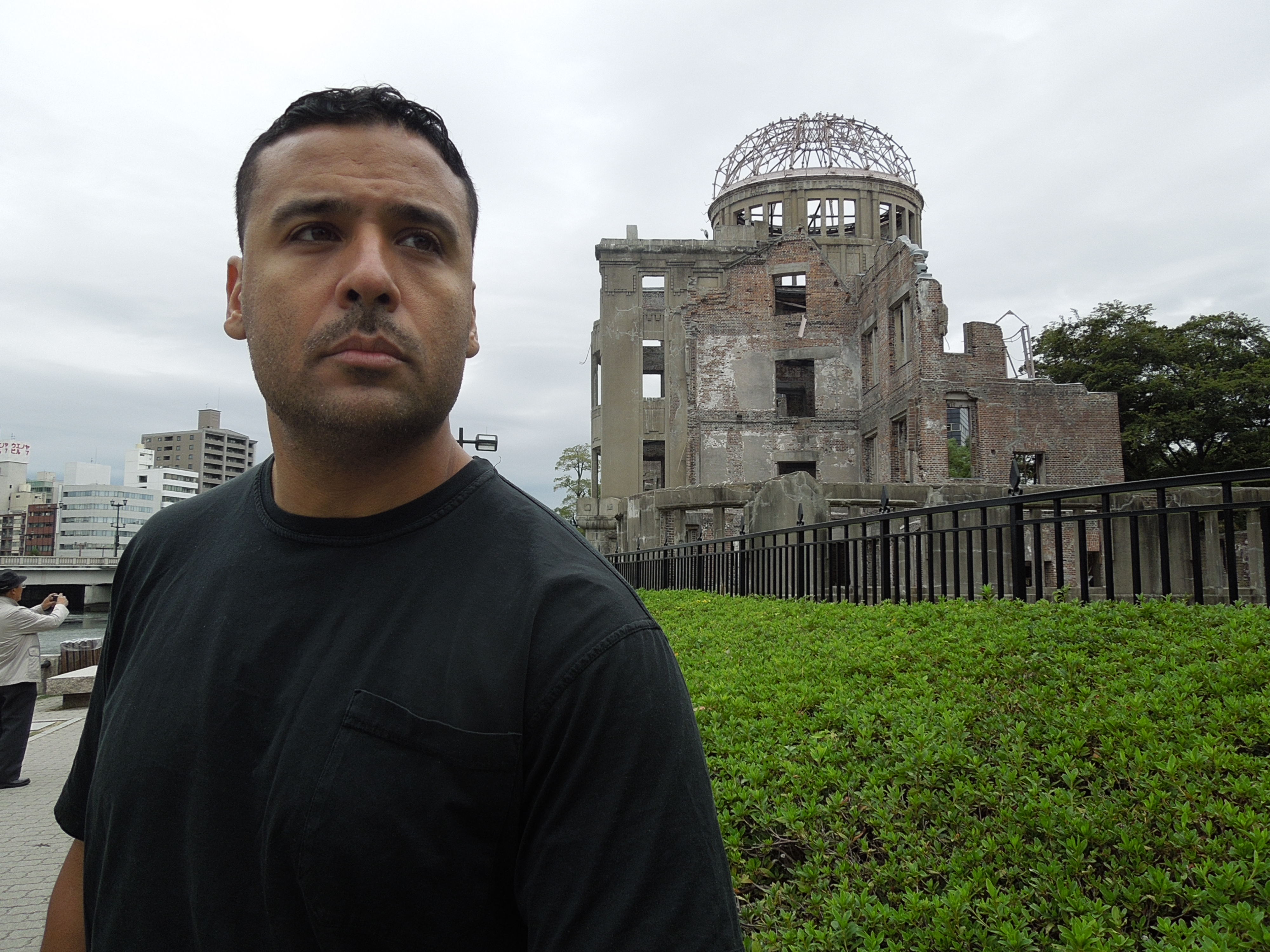
 Strong Hugs. Wiped tears. Repeated reassurances. Through the eyes of my children, my emotional return from Japan reflected more accomplishment than exhaustion after lecturing in 9 Japanese cities from Tokyo to Okayama throughout October 2013. In sharing my 18-year wrongful incarceration story in New York until exonerated in 2009 (due to mistaken eyewitness identifications and police and prosecutorial misconduct), my lectures at Japanese bar associations and universities urged Japan to abolish its death penalty and reduce relying on confessions to secure Japan’s 99% conviction rate, which have caused several wrongful convictions and exonerations in Japan due to false confessions.

DSCN0117

Fernando Bermudez in Hiroshima

Continue reading

Tuesday’s Quick Clicks…

click

Texas Death Row Exoneree Endows Scholarship to Honor His Attorney

Anthony Graves

Anthony Graves spent 18 years in prison – 12 years on death row – for a murder he did not commit.

Thanks to the tireless efforts of his attorney, Nicole Casarez, and her students at Houston’s University of St. Thomas, he was eventually exonerated.  He was awarded $1.4 million by the state of Texas for wrongful incarceration.

Anthony wanted to recognize her efforts with something that would “live on,” and so created an endowed scholarship at the University of Texas Law School in her name.

Read the full story here.

Privy Council in London overturn New Zealand murder conviction

The Privy Council, sitting in London, has heard an appeal from Mark Lundy, a New Zealand resident serving a 20 year life sentence for murdering his wife and daughter. Mark Lundy has already served over 12 years in prison for the murder that he has always maintained he did not commit. The court has overturned the conviction and instructed the authorities in New Zealand to give Mr Lundy a new trial as soon as possible. Mr Lundy turned to the Privy Council after losing all appeal avenues in New Zealand. His appeal turns upon new ‘credible’ expert evidence that casts serious doubt over the original evidence used at trial, of stomach contents analysis, in order to determine the time of death of the victims. Mr Lundy has always had an alibi for when he claims the murders must have taken place, but the stomach content analysis put the deaths at a time when he could have committed the murders. If this evidence is proved flawed, then the whole case is thrown into doubt.

Read more here:

Mark Lundy murder convictions quashed  

New Zealand businessman Mark Lundy wins appeal in UK court over conviction for murdering wife and daughter with tomahawk-like weapon

Update on the National Registry of Exonerations

In Mark Godsey’s ‘Quick Clicks’ yesterday, there was a piece titled “an update from the National Registry of Exonerations,” which currently has logged data on 1,219 exonerations nationwide so far.  I hope you were able to check it out, and were able to navigate through the Registry’s updated website.

To me, the most important value of the Registry is that it’s a rich source of real, hard data on the occurrence of wrongful convictions – something that we have historically not had.  The registry has been able to publish a statistical analysis of 873 exonerations from 1989-2012, and you can see that report here.

I am a self-admitted data junkie, and when I saw the Registry’s new site, was thrilled to see that they have presented data in graphical form that will be continuously updated.  I thought I would highlight two examples for you here.

NatRegExon Charts

And congratulations to both Nancy and Jim Petro on being named to the Registry’s Advisory Board.  I’m sure you’re aware that Nancy is a contributing editor to this blog.

Tuesday’s Quick Clicks…

click

‘False Justice: Eight Myths That Convict the Innocent’ – Why Did They Write It?

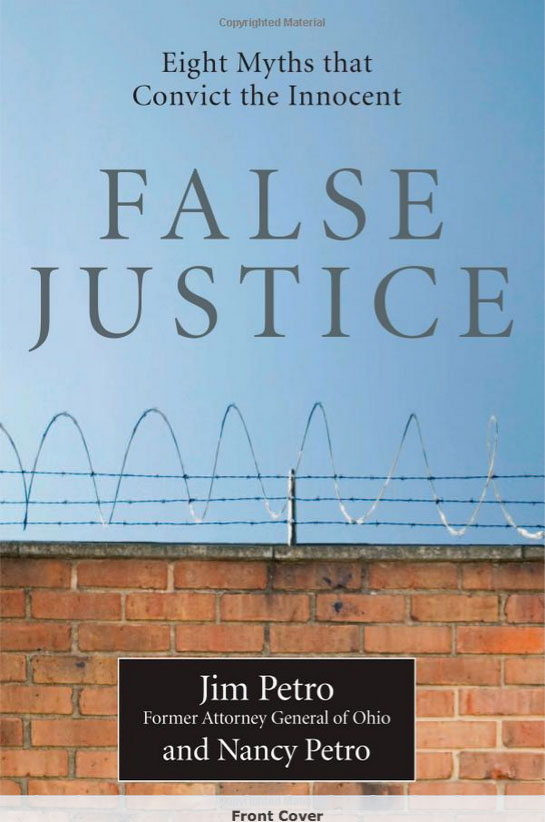
FalseJusticeI hope that you’re all familiar with, and in fact have read, the book by Jim and Nancy Petro, False Justice: Eight Myths That Convict the Innocent.

Jim&Nancy

.

.

.

.

Jim is a former Attorney General of the state of Ohio, and Nancy, among her many other endeavors, is also a contributing editor to this blog.

I recently just happened across this interview with Jim and Nancy at the Columbus Metropolitan Club in 2010.  They talk about what brought them to write the book.

It’s about an hour long, and I found it both fascinating and illuminating.  Definitely worth a watch.

Thursday’s Quick Clicks…

click
  • Exoneree says arrestee names should remain confidential
  • Murder conviction tossed in Georgia
  • An epidemic of prosecutor misconduct
  • Exoneree Fernando Bermudez to kick off ‘Dilemmas of Justice’ lecture series Sept. 24th
  • On Monday, the 9th U.S. Circuit Court of Appeals upheld a lower court ruling that freed a California man who was wrongfully convicted in 1999 of being in possession of a concealed knife under California’s Three Strikes Law.  Daniel Larsen was convicted based largely on eyewitness identification. Two officers testified that they saw Larsen throw a knife under a car located in the parking lot of the Golden Apple Bar in Los Angeles. Because he had prior felony convictions, Larson was sentenced to serve 28 years to life in prison.  Larsen spent nearly 14 years in prison before his conviction was reversed by a U. S. District Court judge in 2010 after the California Innocence Project, which began representing Larson in 2002, found witnesses who testified seeing a different man holding the knife.

Brian Banks Released from Falcons, but his Impact Continues

As reported yesterday by USA Today (here), Brian Banks was one of ten players cut from the roster of the Atlanta Falcons on Friday. Legions of fans—football followers or not—were cheering Banks on in his uphill bid to play with the NFL, an effort delayed ten years by a false accusation, wrongful conviction, prison, and his eventual exoneration when his accuser admitted the sexual assault never happened. USA Today called his determined effort the “summer feel-good story.” Continue reading