Category Archives: Exonerations

Compensation for the Wrongfully Convicted

Studying other legal systems enables us to look back and clearly assess what is wrong with our own system. When I first started working for the Innocence Project Northwest last year, I was shocked to learn that the State of Washington has no law that ensures  compensation to the wrongfully convicted (read the details here). In fact, many of the states in the US still have no compensation law (read the details here).

What about other countries? Here is the situation in Japan.

The Constitution of Japan (which was drafted after the WWII under the US occupation) states in Article 40: ” Any person, in case he is acquitted after he has been arrested or detained, may sue the State for redress as provided by law“.  It ensures one the right to sue the State to get compensation in case he was wrongfully arrested or detained. In response to this Article, the Criminal Compensation Act (1950) specifies the details of the compensation.

Article 4 of the Act provides that the amount of compensation given will be decided by the court. The court shall set the rate of compensation by considering how the person was detained, the length of detention, the person’s loss of property, physical and mental pain he/ she had to suffer, and negligence by the police and prosecutors.  The minimum daily rate is 1,000 yen (12.5 USD) per day he/ she was detained, and the maximum is 12,500 yen (about 155 USD).  See the table below for the amount given to exonerees in past cases.

The wrongfully arrested/ detained can also file a lawsuit against the State under  the State Redress Act (Act No. 125 of 1947).  However, to win the lawsuit, the plaintiff must prove that “a public officer who exercises the public authority of the State or of a
public entity has, in the course of his/her duties, unlawfully inflicted damage
on another person intentionally or negligently” (Art. 1 of the Redress Act. Emphasis added. Translation by Japanese Law Translation).

It is extremly hard to prove the intention or negligence of the public officer since the State has all the evidence about the case, and the lawsuit takes a lot of time and resources. Only about 6% of the lawsuits under the Redress Act end in favor of the plaintiff. This system needs much reform.

So how much compensation will Govinda Mainali (recent exoneree) get for his 15 years of detention? Here’s an article by Daily Yomiuri Online.

From Daily Yomiuri Online.

Excerpt: Chihiro Iwasaki and Kotaro Kodama / Yomiuri Shimbun Staff Writers

Texas Wrongful Conviction Continues to Reveal Tragic Human Costs

Yesterday, a Travis County (TX) grand jury indicted Mark Norwood on capital murder charges in the 1988 death of Debra Baker. Norwood is currently awaiting trial on murder charges in the 1986 death of Christine Morton. The apprehension of the man whose DNA is allegedly linked to both murders was delayed more than two decades by the wrongful conviction of Michael Morton, Christine’s husband, who served 25 years in prison for the crime he always said he did not commit.

The lesson is painfully clear: If Norwood is guilty of both murders, Debra Baker would likely be alive today had Norwood, and not Michael Morton, been Continue reading

Ohio Supreme Court Declines to Hear Prosecutor’s Appeal in Wrongful Conviction Case

Yesterday, Dean Gillispie, 47, the Ohio Innocence Project’s first client, had yet another court victory. The Ohio Supreme Court declined to hear Montgomery County Prosecutor Mathias Heck’s appeal of an earlier court decision that vacated Gillispie’s conviction and sentences.

Gillispie spent 20 years in prison for three 1988 rapes, which he always said he did not commit. His identification by victims in a photo line-up occurred two years after the crimes. No physical evidence connected Gillispie to the crimes.

In December 2011, U.S. District Magistrate Judge Michael R. Merz ordered Gillispie’s release after determining that he did not get a fair trial. Prosecutors Continue reading

Mainali Finally Declared Innocent by Tokyo High Court!

Govinda Prasad Mainali, the Nepalese man convicted of killing a woman in 1997, was finally acquitted today by the Tokyo High Court. It is reported that the prosecutors will not appeal the decision. Mainali has already gone back to his home country.

Read my previous post on this case here.

From The Mainichi:

High court acquits Nepalese man of murder in retrial

A supporter for Govinda Prasad Mainali shows off a banner saying, "Acquitted in a retrial," in front of the Tokyo High Court in Chiyoda Ward on Nov. 7. (Mainichi)

The Tokyo High Court acquitted a Nepalese man, who had been released in June and returned home after serving a prison term for a murder he never committed, in a retrial on Nov. 7.

The court upheld the Tokyo District Court’s initial ruling in April 2000 that found Govinda Prasad Mainali, 46, not guilty. Continue reading

Prosecutors Argue for Mainali’s Innocence

My previous post on Govinda Mainali’s Case here. This is a 1997 case where a Nepalese man was convicted of killing a woman in Tokyo.

 
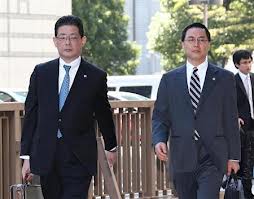
Prosecutors entering Tokyo High Court for the Mainali Retrial Hearing (From Sankei Shimbun News).

The retrial was held on October 29th at the Tokyo High Court.  The prosecutors argued for Mainali’s innocence, saying that Mainali was accused of a crime he did not commit. The court will hand down the ruling next week, on November 7th. The prosecution will not appeal the not-guilty ruling, and the decision will be finalized soon.

Mainali’s case will be the 8th case in Japan after WWII where the defendant was declared innocent after the retrial in a death penalty/ life imprisonment case.

Takayuki Aoki (Tokyo High Prosecutor’s Office) made a comment after the retrial. He said that the investigation and the first trial itself were not problematic. He did state that he is sorry that Mr. Mainali was wrongfully accused and detained for a long time as the perpetrator. However, there was no apology given from the prosecution at the retrial hearing. They still take the position that the their accusation was inevitable, and the circumstances have changed since the new DNA testing results became available.

Typical problems surrounding the Japanese criminal justice system were present during the course of the trial and the retrial of the Mainali case: lengthy detention during investigation, interrogations coerced by the police and prosecutors, prosecutors appealing the decision to grant retrial, and non-disclosure of exculpatory evidence by the prosecution. It is reported that the police and prosecutors will not hold a thorough investigation of what went wrong in this particular case. If we sincerely regret what happened and are determined to never let it happen again, shouldn’t we thoroughly examine the cause of wrongful conviction in each and every case?

Stories on Mainali’s retrial here and here (in English).

The National Registry of Exonerations Quickly Reaches 1,000 Milestone

When the University of Michigan Law and Northwestern Law School announced their joint project—the National Registry of Exonerations (here)—earlier this year on May 21, the initial tally of exonerations in  the United States since 1989 was 891. Today, five months later, the number of exonerated in the registry is 1,000. No one knows how high the number will go. The only certainty is that this milestone will soon be surpassed. Continue reading

After 17 Years, Freedom Is Granted, But an Error Is Unacknowledged

From the New York Times:

There is a memorable line at the end of “Call Northside 777,” a splendid 1948 film based on a true story. It’s about a Chicago reporter who becomes convinced that an innocent man was sent to state prison for the murder of a police officer years earlier. He works relentlessly to right this terrible wrong. When the man is finally freed, the reporter, played by James Stewart, says to him, “It’s a big thing when a sovereign state admits an error.”

Yes, it is. And it is a big thing that the sovereign state of New York inched closer on Wednesday to admitting a whopping error of its own. It may take a while before it gets all the way there, though.

On Wednesday, a woman and a man who had been in prison for a murder that federal investigators are convinced they did not commit walked out of the Bronx criminal courts building, and breathed freedom for the first time in nearly two decades.

Cathy Watkins, 44, and Eric Glisson, 37, were among several people found guilty in the 1995 killing of a livery cabdriver, a Senegalese immigrant named Baithe Diop. They were jailed in 1995, and convicted in 1997. She went to the Bedford Continue reading

California Leads U.S. in Exonerations of Wrongfully Convicted…

From newswise:

A new research group finds that at least 200 wrongful convictions have been thrown out since 1989 in California, costing those convicted more than 1,300 years of freedom and taxpayers $129 million. The California Wrongful Convictions Project, launched by the University of California, Berkeley, School of Law (Berkeley Law) and Hollway Advisory Services, a criminal justice research firm, announced these findings in preliminary data released today.

The project’s long-term objective is to identify wrongful convictions in California and to quantify their economic impact. The project has defined wrongful convictions to include those where all counts are dismissed by the court or by the prosecutor after conviction, as well as those where the conviction was reversed and the individual was completely acquitted on retrial.

In addition to the costs to individuals and their families of life lost behind bars, the direct costs of incarceration and compensation calculated so far total $129 million ($144 million when prison costs are adjusted for inflation). This figure does not yet include the costs of legal representation and court proceedings necessary to overturn the convictions, an amount expected to be substantial given the multiple trials and years of appeals routinely undertaken by wrongfully convicted individuals.

A detailed report to be released in 2013 will include the full costs of legal representation, court proceedings, and appeals, as well as costs related to confirmed misconduct by prosecutors, government investigators or police. It will also track the reasons why convictions are overturned.

“The project’s final analysis will include the time, money and resources wasted on all cases that were overturned and dismissed due to misconduct and legal errors, including those where innocent people are wrongfully charged,” said Rebecca Silbert, a project director and senior associate at Berkeley Law’s Chief Justice Continue reading

Federal Prosecutorial Misconduct – Can There Be Any Difference at the State and Local Level?

USA Today just published a story about Nino Lyons, who was exonerated of drug trafficking charges for which he was convicted in 2001.  It’s a very “telling” article.  Here is the lead-in to the story:

“For more than a week in 2001, the jurors listened to one witness after another, almost all of them prison inmates, describe how Lyons had sold them packages of cocaine. One said that Lyons, who ran clothing shops and nightclubs around Orlando, even tried to hire him to kill two drug suppliers.

But the federal prosecutors handling the case did not let the jury hear all the facts.

Instead, the prosecutors covered up evidence that could have discredited many of Lyons’ accusers. They never revealed that a convict who claimed to have purchased hundreds of pounds of cocaine from Lyons struggled even to identify his photograph. And they hid the fact that prosecutors had promised to let others out of prison early in exchange for their cooperation.”

See full story here.

Quoted in the article is Pace University law professor Bennett Gershman, an expert on misconduct by prosecutors. “It’s systemic now, and … the system is not able to control this type of behavior. There is no accountability.”  (emphasis is mine)

The article focuses on federal prosecutors, but why would this situation be any different at state and local levels?  My expectation is that it’s not.  I’ve heard prosecutors quoted as saying “We will win at all cost.”

There has to be some accountability for these people who are invested with so much power, but it seems there is not.

Exoneration in North Carolina for Willie Grimes…

I failed to report on this case earlier because I was out of the country.  But congratulations to the North Carolina Center on Actual Innocence for their wonderful work on this case…

From the Hickory Record:

It took the three-judge panel less than 30 minutes to decide that Willie Grimes was innocent of a 1987 rape conviction for which he had served more than 24 years.

Judge David Lee read the panel decision, and said the charges of rape and kidnapping were dismissed, as well as having his name removed immediately from the sex offender registry. Then Lee paraphrased the Rev. Martin Luther King’s famous 1963 speech and said, “Free at last! Free at last! Thank God Almighty. Thank Jehovah, Willie Grimes is free at last!”

District Attorney Jay Gaither told the judges, “The State cannot argue any conclusion other than for the innocence in the case of Willie Grimes.” He then Continue reading

Breaking News: Another Exonerating DNA Testing Result Revealed in Mainali Case

From Asahi Shimbun Digital News.Mr. Govinda Prasad Mainali (middle).

Previous posts on the Mainali Case here, here and here.

This is a 1997 robbery-murder case where Govinda Prasad Mainali, a Nepali national, was convicted and sentenced to life in Tokyo, Japan. Mainali was granted a retrial in June this year. The prosecution did not appeal the decision of the Tokyo High Court which rejected the prosecution’s objection against the decision to grant a retrial. Mainali has already gone back to his home country, Nepal.

It was revealed yesterday that an additional testing by the prosecution brought another exonerating result. A third person’s DNA profile has already been found on and inside the victim’s body during previous testings (hairs left near the victim’s body and semen). This time, the same person’s DNA was found on victim’s fingernail clippings. Scrapings from victim’s right thumb fingernail and left middle fingernail were concluded to have matched that person, and scrapings from other fingernails also might have come from him. The redundant DNA results from many different items found at the crime scene suggest that the DNA came from the actual perpetrator.

It is reported that the prosecutions will argue that Mainali is innocent of the crime during the retrial. The retrial will start on October 29th.

Read the news in Japanese here.


False confessions continue to taint justice system

The recent exoneration of Damon Thibodeaux in Louisiana and overturned conviction of Richard Lapointe in Connecticut are two new reminders of the devastating effects of false confessions induced by overzealous interrogators.

Thibodeaux was sentenced to death and spent 15 years in prison for the murder of his half-cousin before his exoneration by DNA testing on September 28. Lapointe, a mentally disabled dishwasher convicted of murder in 1989 was granted a new trial on On October 1. Both men claimed they were manipulated into falsely confessing to the crimes.

You can read about Thibodeaux’s exoneration — the 300th achieved by DNA testing —here and here.

While Thibodeaux is now a free man, Lapointe still faces the possibility of a new trial. The state’s top appeals court only ruled that prosecutors had denied him access to notes by a police detective that tend to support his alibi defense. But longtime innocence advocate Donald S. Connery makes a compelling case of Lapointe’s innocence in this opinion column.

Forensic psychologist Karen Franklin gives an excellent explanation of how a false confession “contaminates everything and everyone in touches — from the prosecutor, the judge, and even the suspect’s own attorney” on her informative blog here.

Michael Clancy Receives $2 million for Wrongful Conviction

Former New York inmate Michael Clancy has been awarded $2 million for his wrongful murder conviction.  He was released in 2008, after spending 11 years in prison.

See the story here.  The page includes a brief informative video about the recently established National Exoneration Registry.

Innocence Project Achieves 300th DNA Exoneration

Louisiana death-row inmate Damon Thibodeaux exonerated with DNA evidence

First, here is some interesting, relevant data to which this case adds:  (the emphasis is mine)

Of 83 exonerations in the past five years, more than 15 percent didn’t involve rape. As many as a quarter of the cases involved a false confession, in which one or more defendants admitted to the crime under interrogation.

Samuel Gross, an author of a report by the recently created National Registry of Exonerations at the University of Michigan, calculated that based on the proven rate of exonerations among death-row prisoners in the past two decades, U.S. courts appear to have an error rate in capital cases of between 2.5 percent and 4 percent.

.
In June, researchers examining biological evidence from hundreds of Virginia rape convictions between 1973 and 1987 determined that new DNA testing appeared to exonerate convicted defendants in 8 percent to 15 percent of cases.
.
See Washington Post story here.
.
And here is a link to a CNN article on the story.
.
Here is a link to the Innocence Project’s web page featuring the story.

A Case of Short Cuts: Innocence Matters Expects Client’s Release Monday

John Edward Smith, 38, is expected to be released after serving 19 years in prison Monday afternoon. Prosecutors are not expected to oppose Smith’s petition for release in the hearing before a California Superior Court judge. Smith has been represented by pro bono attorneys from Innocence Matters (here). Attorney Deirdre O’Connor formed the group after becoming convinced Smith was innocent of the 1993 drive-by shooting in Los Angeles that killed one man and injured another.

Smith was convicted on the testimony of a sole witness, who has recanted. “I never got a good enough look to ever make an ID of the shooter,” Landu Continue reading

Brian Banks, Exonerated of Rape, Signs to Play Pro Football

The Brian Banks case has appeared on this blog before with postings by Nancy Petro here and Kana Sasakura here.

A high school football standout in southern California, he was wrongfully convicted and imprisoned for rape.  With the help of the California Innocence Project, he was exonerated earlier this year.  His dream has always been to play pro football.

He has just signed with the Las Vegas Locomotives, and hopes that this will be his stepping stone to the NFL.  See story here.

After Four Years of Confinement, Wrongfully Convicted Man is Free

In all, 22-year-old Maligie Conteh, who immigrated to the United States from Sierra Leone at age 3, spent more than four years in prison: 17 months after a wrongful conviction of a $150-dollar robbery, and the remainder at an immigration detention facility in Porstmouth, Va., where he awaited deportation to Sierra Leone due to the conviction. Continue reading

Jason Puracal, Finally Freed From Wrongful Imprisonment in Nicaragua, Speaks About His Experience

The case of Jason Puracal initially appeared on this blog in a post by Justin Brooks in March, 2012.  See post  here.

Jason has finally been set free, and has returned home.  He gives a brief interview about his experience here.

Englewood Four are Officially Innocent

On Friday afternoon, Sept. 14, 2012, Judge Paul Biebel, chief judge of the Criminal Division of the Cook County (IL) Circuit Court, granted certificates of innocence to four men—Vincent Thames, Terrill Swift, Harold Richardson, and Michael Saunders—who became known as the Englewood Four after their conviction of the 1994 rape and murder of a South Chicago alleged prostitute.

Ranging in ages from 15 to 18 at the time, the four teens confessed during interrogation by Chicago police. No physical evidence connected them to the Continue reading

U. of Virginia Innocence Project Gets Exoneration….

From the WashingtonPost.com:

A Fairfax County judge on Thursday overturned the robbery conviction of a man who faced deportation, saying prosecutors had failed to disclose evidence that would have cast doubt on the credibility of the victim, who also was the only witness.

Circuit Court Judge Randy L. Bellows said he was confident in his verdict when he found 22-year-old Maligie Conteh guilty in 2010. But he reversed himself after learning that the victim had a conviction for possessing a fake Social Security card.

“It absolutely undermines my confidence in the outcome,” Bellows said.

Conteh, who served more than a year in prison, was facing possible deportation to his homeland of Sierra Leone because of the conviction. He has maintained all along that he was innocent and was using Facebook on a friend’s computer at the time of the crime. He had dreamed of joining the Marine Corps and was hoping to receive an acceptance letter the day he was arrested.

A group that included the staff director of the Senate Finance Committee, the Innocence Project of the University of Virginia and lawyers at the firm of McGuire Woods filed a petition asking the judge to vacate Conteh’s conviction.

They argued that the alleged victim’s crime was critical to the case because it could have undermined the truthfulness of his testimony. They also uncovered records showing that a photo and message had been posted on Conteh’s Facebook account about 10 minutes after the robbery, bolstering his alibi.

Dozens of friends and family members cheered and clapped outside the Continue reading