Category Archives: Exonerations

Wednesday’s Quick Clicks…

“Friendship Nine’s” Convictions Vacated

F9

Pioneers of the civil rights lunch counter sit-in’s in South Carolina, known as the Friendship Nine, have had their convictions vacated and their names cleared.

See the CNN story here.

National Registry of Exonerations: 2014 was Record-breaking with 125 Exonerations in U.S.

For the first time, more than 100 exonerations were recorded in the United States in one year. According to The National Registry of Exonerations Report for 2014, 125 exonerations of innocent criminal defendants mark an increase of 34 over the prior record of 91 in 2012 and 91 again in 2013. The report notes the work of Conviction Integrity Units in the increase.

“The big story for the year is that more prosecutors are working hard to identify and investigate claims of innocence. And many more innocent defendants were exonerated after pleading guilty to crimes they did not commit,” said Michigan Law Professor Samuel Gross, editor of the National Registry of Exonerations and the author of the report.

Both the number of Conviction Integrity Units and the exonerations they produced increased in 2014. There were 49 CIU exonerations in 2014, including Continue reading

Monday’s Quick Clicks…

Update on the National Registry of Exonerations

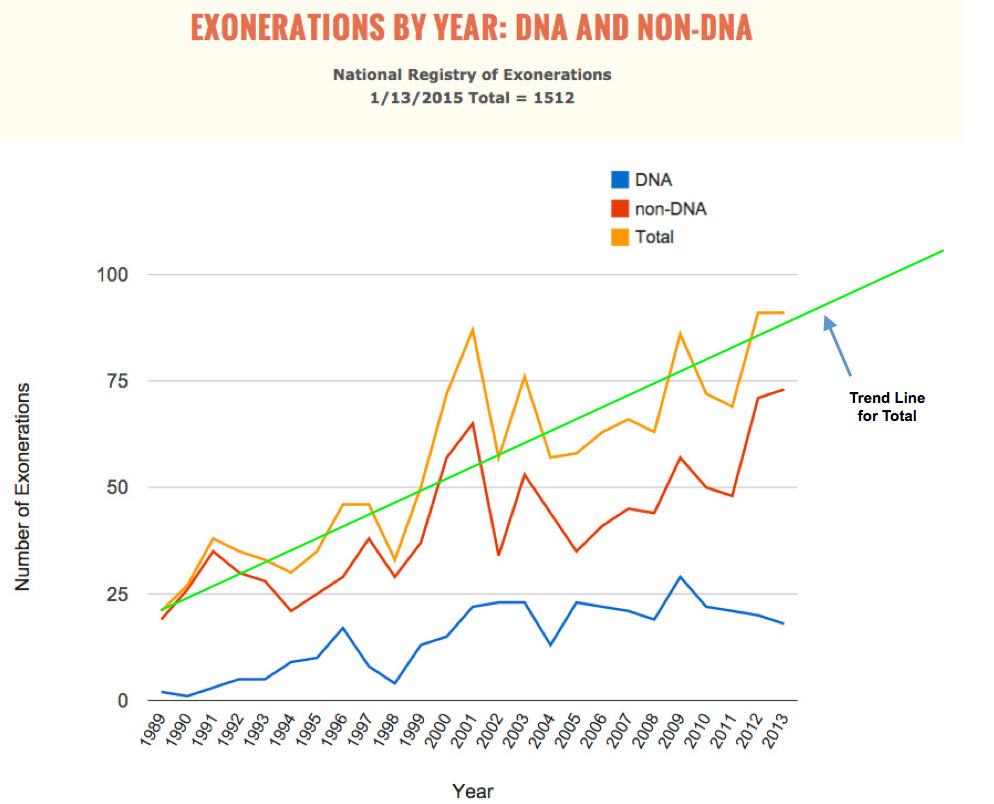
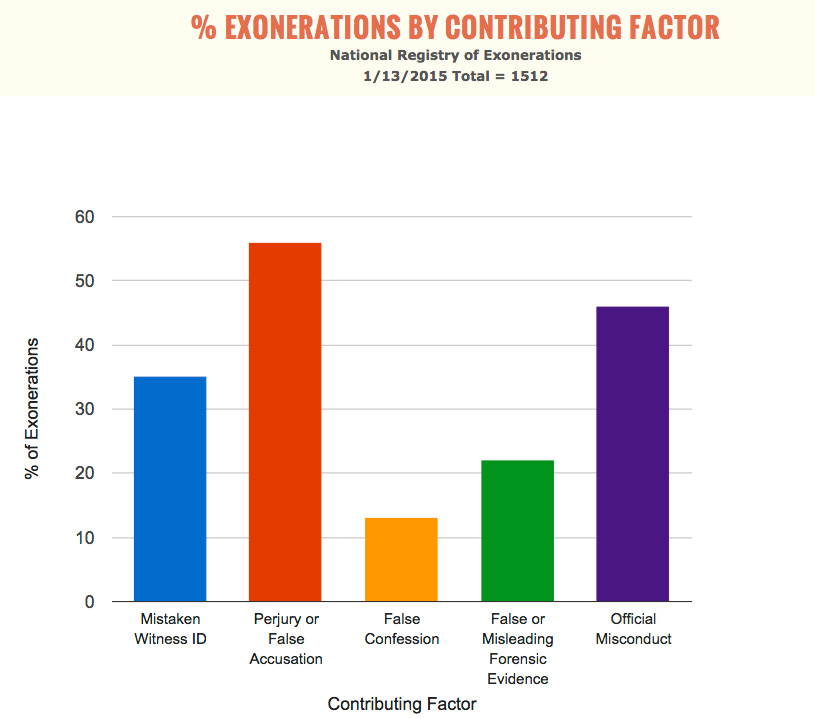
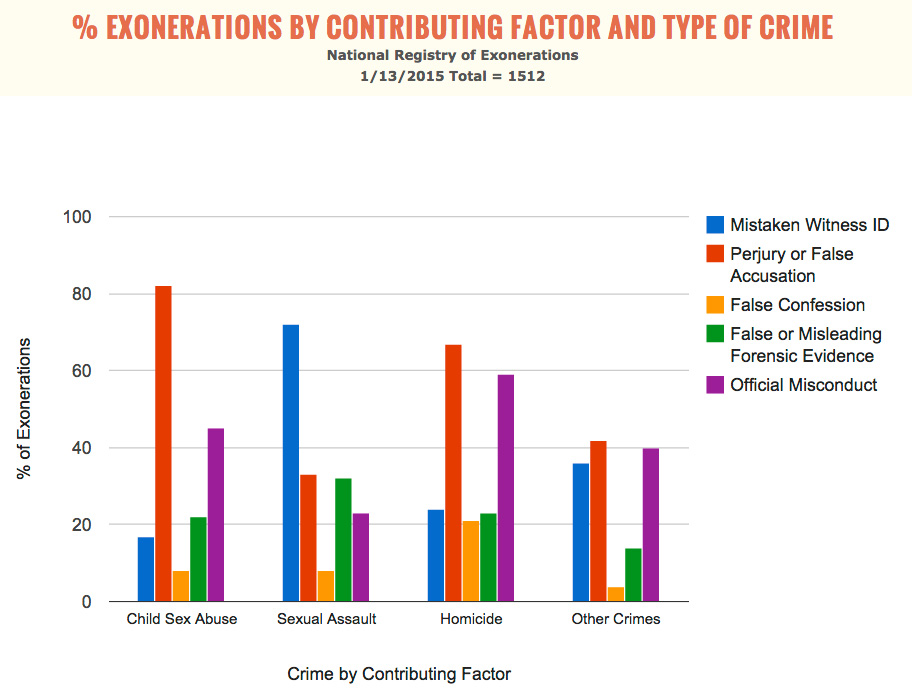
In case you haven’t been able to check in on the National Registry of Exonerations lately, here’s an excerpt from the most recent data.  Note the total is now up to 1,512, and the trend line is definitely UP.

exon dna non

exon cont fact

exon fact crime

I won’t belabor you by pointing out some of the more obvious observations.  Just a few minutes of study will (should) lead you to some very clear conclusions.

It has been reported that the folks at the Registry are hard at work trying to incorporate the exonerations being generated by the newly formed “conviction integrity units” (CIU’s).  For these cases the prosecutors running the CIU’s may not be very motivated to have their exonerations logged into the Registry.

I can’t gush enough about how critical and important this data is.  It is this kind of HARD DATA that will provide the foundation for much needed and long overdue justice system reform.

DA to Appeal Shaken Baby Conviction Reversal

We have previously reported on the Reneé Bailey case here.

Reneé Bailey, a day care provider in Greece, New York, was convicted in 2001 of shaking 2½ year old Brittney Sheets to death.  She was confined in prison until NY State Supreme Court Justice James Piampiano granted an evidentiary hearing in the case to consider the new scientific findings regarding SBS.  She was released without bail in December, 2014, and her conviction was reversed; the first SBS conviction reversal in New York state.  See the Rochester Democrat & Chronicle story here.

Now, in a recent announcement, the Monroe County, NY District Attorney, Sandra Doorley, has declared her intention to appeal the conviction reversal.

See that Rochester Democrat & Chronicle story here.

While this is certainly not good news for Ms. Bailey, who has already served 13 years in prison, there could be a silver lining to this ominous dark cloud. If the conviction reversal is upheld on appeal, this will establish some substantial legal precedent in favor of true science, rather than outdated medical dogma, in the evaluation and disposition of SBS cases.

Stay tuned.

Derrick Hamilton exonerated in New York; Alan Beaman pardoned in Illinois

In two separate cases, men who were convicted and imprisoned for murders they did not commit had a very good week as officials recognized their innocence on Friday, January 9. Both had been released after years in prison but had continued to fight to clear their names and reputations.

Derrick Hamilton spent 21 years in prison for the 1991 murder of Nathanial Cash in Bedford-Stuyvesant, Brooklyn, New York. In prison, he steadfastly proclaimed his innocence knowing that this worked against his opportunities for early parole. He remained in prison even after the sole witness — Cash’s girlfriend whose Continue reading

Wrongly Convicted NY Man Dies 4 Months After $7.5M Compensation

Dan Gristwood was convicted in 1996 of attempted murder for beating his wife with a hammer.  He signed a confession, that he did not write, after 16 hours of interrogation by the NY State Police.

In 2003, the real attacker, Mastho Davis, came forward and confessed. Gristwood was released in 2005, and ultimately awarded $7.5M for his nine years of wrongful incarceration.

Sadly, on January 3, 2015, four months after receiving payment, Dan Gristwood died from lung cancer.  See the ABC News story here.

The syracuse.com story about the case here is definitely worth a read, and reads like a script for the prototypical coerced confession.

In light of all the recent public – and police – furor about police conduct, and how they relate to the community, and how they should be respected, I can do naught but shake my head.  When the police do stuff like this, how can they claim any high ground in this discussion?  Dan Gristwood, after his release, said he thought the problem was a “few bad apples.”  That may very well be so, but guess what? Those “few” bad apples make the whole barrel stink.  And this problem belongs to the police – not the public.

Exoneration in Australia?: Henry Keogh freed after 20 years.

Australia has seen another high-profile wrongful conviction hit the headlines this week with the release on bail of Henry Keogh after serving 19 years in prison for the apparent murder of his fiancee in 1994. Keogh had always maintained his innocence, claiming a litany of errors during the autopsy, resulting in the bizarre conclusion that he had drowned his fiancee in t5984014-3x2-340x227he bath by lifting her legs over her head. The motive was apparently financial, with his fiancee having several life insurance policies. The case has been back and forth to the South Australian courts and Governors over the years until the South Australian Court of Criminal Appeal finally ordered a retrial on Monday, permitted Keogh to be free until such time the DPP decides to bring another prosecution. Keogh, aged 59, was only permitted a further appeal to the courts after a change in South Australian legislation last year, allowing appeals on ‘new and fresh compelling evidence’. Read more on the news here….

Henry Keogh released on bail after 20 years in jail on Anna-Jane Cheney murder conviction

and a journalist who assisted with the case for years, Bob Mole, has a page dedicated to Henry Keogh’s case here….

Networked Knowledge: The Henry Keogh Homepage


Appeals Court Dismisses Debra Milke Murder Charges

We have previously posted about the Debra Milke case here and here.

Milke was originally convicted of murder for having her 4-year-old son killed. The conviction rested upon the testimony of a rogue cop, who claims she confessed to him, although there is no documented record of that confession, and Milke denies it ever happened. This officer had a history of substantial misconduct, and that record was withheld from the defense.

In a ruling just today – citing “egregious prosecutorial misconduct,” the Arizona Court of Appeals on Thursday ordered a Maricopa County Superior Court judge to dismiss murder charges against Debra Milke with prejudice, meaning they cannot be brought again.

See the azcentral story here.

Recent Rash of Exonerations Only the Surface: Many More Remain Wrongfully Imprisoned

By Jefferey Deskovic for The Huffington Post

Fernando Bermudez. Sami Leka. Jose Morales. Reuben Montalvo. Lazaro Burts. Kareen Bellamy. Anthony Ortiz. Frank Sterling. Roy Brown. Dennis Halstead. John Kogut. Eric Glisson. Jonathan Fleming.

Those are the names of 13 men that I personally knew and served time with who were exonerated either during my 16 years in prison or thereafter.

Last year there were 91 exonerations. This year there have been 90 thus far. To date there have been 1482 exonerations overall, only 321 of them being DNA related. Since taking office this past January, Brooklyn DA Thompson’s conviction integrity unit has exonerated 11 people.

Most experts estimate the percentage of wrongfully convicted prisoners to be 2 to 5% of the inmate population — that is 120,000 people. I deem the number to be closer to 15 to 20%.

In either case, what is causing the staggering number of wrongful convictions?

Rogue Law Enforcement. In Brooklyn, disgraced retired detective Scarcella was found to have used the same drug addict as the sole eyewitness in six different murder cases. Various news accounts say as many as 70 homicides he worked on are being reviewed.

Forensic Fraud. In Pennsylvania, forensic scientist, Annie Dhookhan, was sentenced to three to five years in prison and two years of probation after pleading guilty to 27 counts of misleading investigators, filing false reports, and tampering with evidence.

Additionally, forensic scientists are given financial incentives for giving prosecutorial favorable results that lead to conviction in North Carolina, Illinois, Alabama, New Mexico, Kentucky, New Jersey, Virginia, Arizona, California, Missouri, Tennessee, and Wisconsin.

Prosecutorial Misconduct. Lying to judges and juries about the existence of benefits and in some cases coercion to informants was a regular practice over the span of the 23 year tenure of former Brooklyn DA Hynes, as was withholding of evidence of innocence.

Junk science. For 40 years, FBI experts have testified in court about “bullet lead analysis” a procedure in which bullets found at a crime scene are tested for arsenic, tin, silver, and other contaminants or additives, and the findings were compared to analysis of bullets found in the possession of suspects. These experts claimed to be able to link one bullet to others from the same production run. For at least 20 years, FBI officials knew that there were no scientific underpinnings to this junk science — that in fact, there were no studies shown to determine how significant a “match” was.

Disgraced dog scent expert Preston came into courtrooms in Texas and Florida for over 20 years, stating that he had trained dogs which would bark if, after being given items to smell from a crime, the dog recognized the scent from a suspect’s item. Preston claimed that his dogs could smell human traces years or months after a suspect walked over the ground, on heavily trafficked streets, underwater, and even after hurricanes. He is not the only “expert” in this “field.”

In 2013, it was revealed that in 27 death penalty cases, FBI forensic experts may have exaggerated the scientific conclusions that were drawn from a so-called “match” between hair found at a crime scene and hair from a defendant.

Tire tracks, footprints, and bite marks are also junk science.

I served 16 years in prison, from the ages of 17 to 32, wrongfully convicted of a murder and rape in New York, despite the fact that the DNA never matched. I lost all seven of my appeals, including two of which now US Supreme Court Judge Sotomayor denied on procedural grounds for having been four days late despite my substantive innocence argument. Ultimately I was exonerated because further DNA testing identified the actual perpetrator, who killed another victim 3.5 years later.

Using $1.5 million dollars of compensation I received, I started The Jeffrey Deskovic Foundation for Justice to exonerate the wrongfully convicted in DNA and non-DNA cases, educate the public, elected officials, and criminal justice professionals on the causes of wrongful conviction and the reforms need to prevent them, and help the exonerated reintegrate. In two years time, we helped exonerate William Lopez, who had served 23.5 years, and helped 4 wrongfully convicted men reintegrate back into society by providing short-term housing, which enabled them to pursue further education, and in one case open a business.

This holiday season, while celebrating with friends and family, we hope you’ll take a brief moment to remember all those who remain wrongfully imprisoned.

To learn more about The Jeffrey Deskovic Foundation for Justice and how you can help, please visit here.

Great day in UK for Innocence: Cardiff University Justice Project Overturns Wrongful Conviction

The news coming from the UK in recent months, if not years, has rarely been good. Today (9th December 2014) is different, for today, the Criminal Court of Appeal found the conviction of Dwaine George ‘unsafe’ and overturned his  _79607026_ico12-1conviction for murder. George, convicted of shooting dead a teenager in a gang related incident in 2001, served 12 years of his life sentence behind bars, and was released last year.

Professor Julie Price and Dr Dennis Eady, who run Cardiff’s Innocence Project, were joined at the Royal Courts of Justice by 30 Cardiff law students, past and present, to hear the result of the students’ investigative work. Dr Eady said: “It has taken nine years of hard work since the project was launched to get to this point, and based on our students’ efforts the Court of Appeal has decided that Mr George’s conviction is unsafe.We appreciate that today’s decision will be difficult for Daniel Dale’s family, but if the wrong person was jailed then the right outcome has today been achieved.”

Prof Price added: “For Cardiff Law School Innocence Project, and other university projects working on alleged wrongful conviction cases, this is a significant day. It demonstrates that universities are about more than research, and can show public impact from innovative teaching and learning. This result has been achieved by collaborative effort. A huge thanks to our many supporters and students past and present.”

Sir Brian Levenson said in his ruling: “In addition to expressing our gratitude to the Criminal Cases Review Commission, we pay tribute to the work of the Innocence Project and Pro Bono Unit at Cardiff Law School, which took up the appellant’s case and pursued it so diligently.”

With the recent turmoil amongst those working in universities across the UK and their Innocence Projects (mostly called Justice Projects today because they do not satisfy the criteria for the title ‘Innocence Project’) this is a great victory. Many staff work tirelessly for little or no recognition, with students facing ever greater hurdles to have their work and dedication praised. Cardiff University;s staff and students will continue to work tirelessly and have many other cases that are working their way, slowly, through the CCRC. One can only hope that this is the first success of many. But today is a also shot in the arm for all of those working on behalf of the innocent – sorely needed, and richly deserved.

Watch news item and interviews here:

Cardiff Uni students help Dwaine George win murder appeal

Read more here:

UK judge praises students for helping overturn murder conviction

Judge praises Cardiff University law students for helping overturn Dwaine George’s murder conviction

Ex-gang member Dwaine George cleared of 2002 murder on appeal

Weekend Quick Clicks…

Ricky Jackson Prison Release Video

On Wednesday, November 19, Nancy Petro reported on this blog about the exoneration of Ricky Jackson after 39 years in prison.  See that story here.

CNN has posted a great video of his release from prison.  See the 2 minute CNN video here.

Ohio and California: Convictions Overturned after Record-Long Wrongful Incarcerations

It has been a remarkable week for Innocence work, and this is only Wednesday.

Yesterday, November 18, Ricky Jackson’s murder conviction was vacated in Ohio after Jackson had spent 39 years in prison. Cuyahoga County Prosecutor Timothy McGinty acknowledged the case against Jackson had disintegrated when the key witness, who was 12 years old at the time of the crime, recanted. The district attorney does not expect to retry Jackson, 57, who broke into sobs as it became clear that the charges against him were being dropped. He is expected to walk free on Friday. Continue reading

Hundreds ‘convicted in error’ in Houston drug cases

The scandal-plagued Houston criminal-justice system has yet another scandal. The Houston Press reports that prosecutors have sent out hundreds of notices to people convicted of drug offenses that they were wrongly convicted.

The problem came about when evidence tested by the Houston Police Department crime lab came up negative for a controlled substance after the defendants had already taken plea deals. In some cases, the district attorney’s office knew about the negative results before the defendant pled guilty, but most test results were received after a conviction.

The district attorney’s office apparently knew about the problem for years, but only recently sent out the notices.

You can read more here.

Blacks must wait longer to be exonerated, study shows

From The Huffington Post:

By Michael McLaughlin

It took 18 years for DNA evidence to surface that cleared Derrick Williams of a rape and attempted kidnapping in Florida. Prosecutors had relied on the testimony of the victim, who identified Williams as her attacker in 1992. But he walked free at age 48 in 2011 because his DNA didn’t match that left on a gray T-shirt by the actual perpetrator.

The truth might have surfaced sooner if Williams were white or Latino instead of African-American.

There’s no way to know for sure, of course, but data about wrongful convictions show that blacks who are exonerated after a bogus conviction have served 12.68 years on average before the good news, according to Pamela Perez, professor of biostatistics at Loma Linda University. It takes just 9.4 years for whites and 7.87 for Latinos.

“Black Americans are exonerated at a substantially slower rate than any other race,” said a new report from Perez, shown exclusively to The Huffington Post.

There’s enough of a pattern that the differences between racial groups cannot be called random, Perez said. But there isn’t enough information to explain what caused the differences.

“All we can do is infer,” Perez told HuffPost. “You can’t prove a darn thing.”

She discovered the different timespans by examining 1,450 exonerations listed on theNational Registry of Exonerations through Oct. 20, 2014. Perez conducted the research for Safer-America.com, a consumer research group.

The findings are based on what is probably only a fraction of all exonerations. There are likely cases that didn’t make it onto the national registry, and there are almost certainly more wrongly convicted people still waiting to clear their names.

The registry didn’t collaborate with Perez, but one of its researchers reviewed Perez’s work at HuffPost’s request and approved of her methodology.

“I’m not surprised by the numbers,” said Sam Gross, the exoneration registry’s editor and a University of Michigan law professor. “The main thing we can say is that it’s very hard to know what it means.”

Perez, Gross and others cautioned against jumping to conclusions about the findings. Without further research, they said, no one knows if the results were caused by a biased criminal justice system or other factors.

The Innocence Project looked at a smaller set of 212 cases in which DNA proof freed their clients. (The national registry includes exonerations due to other contributing factors like false confessions and perjury.) The project found a similar racial disparity, with black inmates serving 14.3 years before being exonerated compared to 12.2 years for all other racial groups.

“These two numbers are statistically different, suggesting that the difference between them isn’t due to chance,” Innocence Project research analyst Vanessa Meterko told HuffPost. “It’s notable, but it’s hard to say what the difference is.”

David McCallum and the late William Stuckey exonerated of murder

After 29 years in prison, David McCallum was exonerated yesterday  of a murder he did not commit. Kings County (NY) Supreme Court Justice Matthew D’Emic also exonerated William Stuckey who died in prison in 2001. It took an army of advocates over many years — including the late Rubin “Hurricane” Carter, who had also been wrongfully conviction of murder — to finally overturn this miscarriage.

As teenagers McCallum and Stuckey falsely confessed to the murder of  Nathan Blenner, who died of a single gunshot wound to the head. McCallum and Stuckey quickly recanted the confessions. Although the confessions were filled with inconsistencies and inaccuracies, the men were convicted and lost all appeals. Over the years, McCallum refused parole rather than admit guilt to a crime he did not commit. His struggle was recorded in a recently released documentary, “David & me.”

Brooklyn District Attorney Kenneth Thompson, whose Conviction Review Unit investigated the case, recommended this exoneration, and has now cleared convictions in ten cases, said in a Wall Street Journal Report (here), “I think the people of Brooklyn deserve better, and I think we should not have a national reputation as a place where people have been railroaded into confessing to crimes they did not commit.”

Congratulations to Mr. McCallum and to the family of William Stuckey. The nation should be grateful for the persistence and hard work of all who contributed to this reversal including Steven Drizin of the Center on Wrongful Convictions (Chicago), Rubin “Hurricane” Carter and Ken Klonsky, Innocence International (Toronto), Oscar Michelen of the New York law firm of Cuomo, LLC, Professor Laura Cohen of the Rutgers-Newark Law School’s Criminal and Youth Justice Clinic, and King’s County District Attorney Kenneth Thompson  and his Conviction Review Unit team.


Exoneration in California Yesterday

MellenYesterday, Susan Mellen was released from prison after doing 17 years for a murder she did not commit.  She was serving a term of life without the possibility of parole.

Thanks in large part to the work of the organization Innocence Matters, a year-long investigation revealed that she was convicted solely on the basis of testimony from a woman who was proven to be a pathological liar, and that the defense at her trial had not researched that, and it was not presented in her defense.

The judge took only two minutes to vacate her conviction and dismiss her case. He was quoted as saying, “Ms. Mellen is not only not guilty. I believe, based on what I’ve read, that Ms. Mellen is innocent.”  “The justice system failed.”  The prosecution cooperated.

See the DAILY BREEZE story here.

Friday’s Quick Clicks…