Category Archives: False confessions

Audio and Visual Recording of Interrogations by Public Prosecutors, Part II

The Supreme Public Prosecutor’s Office (SPPO) issued a report on audio and visual recording of interrogations last week (on July 4th, JST).
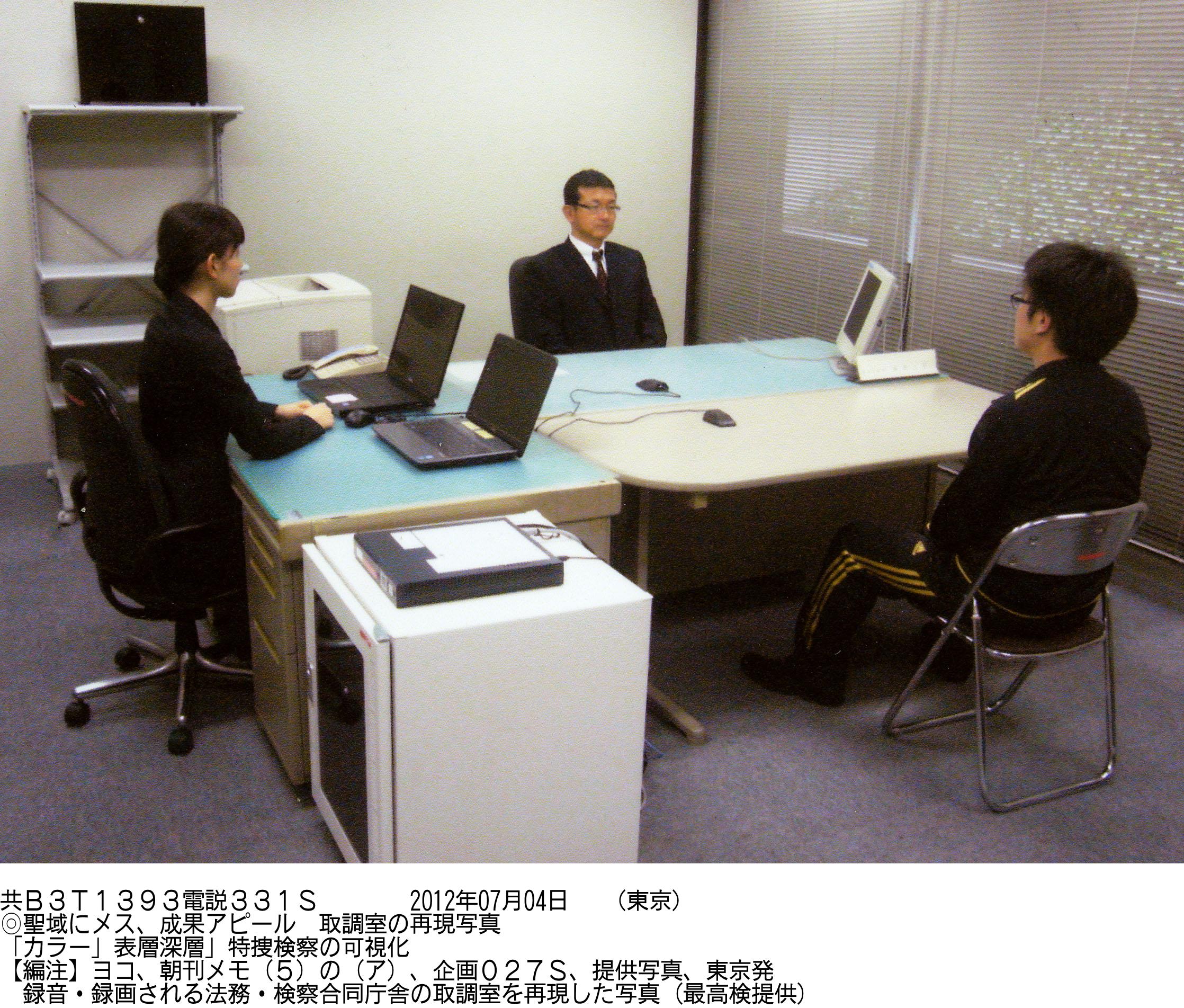
Demonstration of how the recording would take place during interrogation by prosecutor.

As I posted earlier, the SPPO started recording some interrogations on an experimental basis in 2006. Last week’s report  focused on the experimental recording in three Special Investigation Units and ten Special Crime Devision Public Prosecutor’s Office, which took place in 91 cases from March 2011 through April 2012 (note that these offices or branches in the Public Prosecutor’s Office usually involve only white collar crimes). The report revealed what the prosecutors in Japan have to say about the recording of interrogations.

Below are the points worth noting:

1)  Interrogations in 91 cases out of 98 were either partially or entirely recorded. The entire interrogation process was recorded in 39 cases.  30 of the cases concerned tax violations.

2) In seven cases, the suspects refused the recording from the beginning of interrogations. In 12 cases, the suspects refused the recording halfway through. The reasons for their refusal include: they were ashamed of being arrested and incarcerated, and they did not want to provide discussions in front of the camera.

3) Recording took place in other prosecutor’s offices in 946 cases out of 1,005 cases, where the charge was a serious offense and the case was to be disposed of by a Lay Judge trial, such as murder. In cases involving persons with intellectual disabilities, 540 cases were recorded (this was all of the cases in this category except where the accused refused). Continue reading

Are one out of every 10 rape convictions wrong?

Forensic psychologist Karen Franklin presents an interesting anaylysis on false accusations, false convictions and false recantations here.

Another False Confession Case — Fukawa Case

Takao Sugiyama and Shoji Sakurai

As I posted here, false confessions account for many, if not the majority of, wrongful convictions in Japan. Yet another case illustrates this: the Fukawa Case, in which two people were finally exonerated in 2011 for a 1967 robbery-murder.

The crime occured in August of 1967, in the town of Fukawa, Ibaraki Prefecture, about 40 miles outside of Tokyo. A carpenter was found dead in his home.  His legs were tied with a towel and a shirt, a pair of underpants were stuffed in his mouth, and he was strangled. There were signs of struggle in the house, but it was unclear if anything was taken from the house, except for a white purse the victim supposedly used daily. 43 fingerprints were found but none of them connected to perpetrator(s). There was no physical evidence at the scene.

However, there were several eyewitness statements that two men (one tall man and another shorter man) were near the victim’s house on the evening that the victim was supposedly murdered. This statement lead the police to think there were two perpetrators.

Based on this information, the police investigated more than 180 men in the area, until they found the two men, Shoji Sakurai and Takao Sugiyama,who did not have an alibi on the date of the crime. In October of the same year, both of them were arrested on separate charges, and were interrogated.

Sakurai and Sugiyama were held in police jails (“Daiyo-Kangoku“), and interrogated for hours and days. After 5 days of interrogations, Sakurai confessed to the crime. Based on Sakurai’s confession, the police also forced Sugiyama to confess. They retracted their confession during the interrogation by the prosecutors, but the prosecutors sent them back to police jails, and after continuous interrogations that ensued, they finally gave in and confessed again.

The two contested their guilt at trial. The prosecutors had no direct evidence of their guilt. All they had were: their confessions made during interrogations by police and prosecutors (with the  testimony of interrogators and the partial tape recordings of the interrogations which recorded only the part after they confessed to the crime), and testimonies of eyewitnesses who saw two men on the day of the crime.

There was no physical evidence, including the white purse which was never found. Their confessions during investigation changed repeatedly, Sakurai and Sugiyama’s confessions contradicted each other’s in important parts, they did not match the circumstances of the crime scene, and there was no information revealed in the confessions which unknown to investigators.

Nevertheless the trial court declared that their confessions made during investigation were reliable and sentenced them to life in 1970. The High Court as well as the Supreme Court denied the appeal. Their sentences were finalized in 1978. Continue reading

New Scholarship Spotlight: Pretrial Incentives, Post-Conviction Review, and Sorting Criminal Prosecutions by Guilt or Innocence

Michigan professor Samuel Gross has posted the above-titled article on SSRN.  Downloand here.  The abstract states:

A criminal defendant in the United States faces a stark choice: accept the conviction and punishment the prosecutor offers as a plea bargain, or go to trial and risk much worse. In most cases the defendant has an overwhelming incentive to plead guilty; that’s why very few criminal cases go to trial. Unfortunately that incentive is similar for defendants who are in fact guilty and for those who are not. As a result, some innocent defendants plead guilty. We know it happens – some innocent defendants who plead guilty are later proven innocent and exonerated – but we have no idea how often.

In this article I consider an alternative structure. We could offer defendants a different sort of pretrial option: not to plead guilty in return for reduced punishment, but to waive major procedural rights at trial in return for important procedural advantages on post-conviction review if they are convicted. In theory, this pretrial choice should be sufficiently more attractive to innocent defendants than to guilty ones that it will separate the two groups more effectively than our current practice. Along the way, if this option became regular practice, it might also reduce our reliance on plea bargaining, regain some lost ground for criminal trials, and improve the accuracy of fact finding in criminal cases.

Is this plan is practical? Is there a chance that it might be adopted somewhere? I wonder. I offer it as a thought experiment: an attempt to think through an alternative procedural universe in order to better understand the one we live in – which might lead to something useful.

False Confessions as Major Cause of Wrongful Convictions in Japan

A Police Jail in Tokyo.

One of the major causes of wrongful conviction in Japan is definitely false confessions.

Why? Obviously, since a confession is still the “King of evidence” in Japan.  And since the law permits long period of detention (23 days!) before the formal charge (indictment) of a suspect, and since during this pre-charge detention period, there are lengthy interrogations by the police and prosecutors.

When and How Long can a Suspect be Detained?

In Japan, a suspect can be detained when there is a “reasonable cause” that he/she committed the crime, and there is a risk of flight or he/she might tamper with the evidence in the case.  When a judge issues an arrest warrant and once the suspect is arrested (“Taiho“), the police has 48 hours to transfer the suspect and the case to prosecutors.

When prosecutors receive the suspect and if they think he/she should be detained further, they must ask a judge within 24 hours of receiving the case to issue a warrant for up to 10 days of additional detention (“Koryu“). This is when the suspect appears before a judge for the first time.  Additional 10-day extension of Koryu is possible after the initial 10days. Judges almost always issue the arrest/ detention warrant. Less than 1 % of the warrant claim is denied. For violent crimes, it’s almost 0%.

To sum up, police and prosecutors can detain a suspect for up to 72 hours before the suspect has to appear before a judge, and then for additional 20 days  before the formal charge (23 days in total!).

Interrogation During Detention

During this 23-day period, police and prosecutors usually interrogate the suspect for a long period of time. Conducting the interrogation is critical, even for prosecutors. Continue reading

Exoneration in Canada Yesterday in Child Abuse Case…

Brenda Waudby’s wrongful conviction was due to bad science, undisclosed information, and a false confession (guilty plea).  From mykawartha.com:

(PETERBOROUGH) Standing outside the Water Street courthouse with her lawyer, family and friends by her side, Brenda Waudby is content.
On Wednesday (June 27), Justice Michelle Fuerst ruled that Ms Waudby’s 1999 child abuse conviction would be overturned and ordered that her name be removed from the child abuse registry no later than July 11.
“I feel like this has been the final step,” says an emotional Ms Waudby.
“It is a great relief for me that this finally has come to end an end after 15 years.”
Despite being cleared of murdering her daughter Jenna Mellor in 1997, Ms Waudby has lived more than a decade under the shadow of a conviction of child abuse. She has been fighting to remove this black mark from her record since her daughter’s babysitter was convicted of the toddler’s death in 2006. Wednesday, Justice Fuerst agreed that the best and only reasonable explanation of the injuries to Jenna is that they were all inflicted by the babysitter.
“There was no factual basis for the charge of child abuse or to Ms Waudby’s guilty plea to it. Her guilty plea along with ensuing conviction of child abuse was a miscarriage of justice,” Justice Fuerst told the court.
The judge’s decision was heavily supported by series of new disclosures, including 1999 notes by Peterborough police detective Dan Lemay, a transcript of the confession from Jenna’s killer with an undercover officer, and information that came out in the Goudge Inquiry in 2008, including medical evidence from more than one pathologist that pinpointed all of Jenna’s injuries to the time of when she was in the care of her babysitter. It was disgraced pediatric pathologist Dr. Charles Smith that pinpointed Jenna’s fatal injuries, blunt force trauma to Continue reading

Can Dostoyevsky’s Crime and Punishment Help Us Distinguish between True and False Confessions?

Rinat Kitai-Sangero has posted the above-titled article on SSRN.  Download here.  Abstract states:

Dostoyevsky’s Crime and Punishment is also a story about confessions. Raskolnikov, who committed a double murder, and Nikolay, an innocent suspect, each confesses to the same crime. An analysis of Raskolnikov’s and Nikolay’s confession demonstrates the complexity of motives that drive the guilty and the innocent alike to confess and points to the distinction between true and false confessions. Finally this novel supports the conclusion that the accused should be required to provide significant details of the crime as a requirement for relying on his or her confession.

Yet More on False Confessions and the Reid Technique

WCB follower “Greg” has alerted me to a piece from the Canadian Broadcasting Company’s show “The National” regarding false confessions and the Reid Technique.  The video is 17 minutes, and is compelling.  I am posting his comment and a link to the video here:

Greg JOnes | June 25, 2012 at 3:56 pm

The Canadian Broadcasting Corporation’s June 24th Sunday night newscast, “The National”,” had a lengthy story on false confessions, the Reid method, and the substitute “P.E.A.C.E.” model, imported from Britain, now being used in Newfoundland, instead of the Reid method. Links to the piece and other materials can be found on the newscast’s website.

http://www.cbc.ca/thenational/indepthanalysis/truthliesandconfessions/

Advocacy of State’s Conference of District Attorneys: A Disservice to North Carolina, Justice

North Carolina has added a new restriction to its compensation law for those wrongfully convicted: Those who plead guilty are no longer eligible. Denying compensation to those who “contributed” to their conviction by entering a guilty plea has been a common argument from those who seek to minimize the state’s responsibility in miscarriages of justice or deny compensation to those who have had years of their lives stolen through wrongful conviction. But, it’s an argument that should no longer have credibility.  Continue reading

False Confessions and the Reid Technique – Response from John E. Reid & Associates

On June 13, 2012, I posted a piece about false confessions and how they can happen.  https://wrongfulconvictionsblog.org/2012/06/13/false-confessions-how-can-that-happen/   I made some critical comments about the Reid Technique of interview and interrogation, suggesting that it can produce false confessions.  The Reid Technique was developed by, and is taught by, John E. Reid & Associates.  Mr. Joseph Buckley, president of John E. Reid & Associates provided a response, and I include it here, with his permission, and without editorial comment.                                           ====================================================

Hi Mr. Locke,

A colleague recently brought to my attention your blog dated June 13, 2012 on the Wrongful Convictions Blog website.  While false confessions absolutely do occur, there were a few statements in your article about the Reid Technique of Interviewing and Interrogation which are 100% erroneous, namely, the following:

Confessions obtained by the Reid Method fall into two basic categories:

  1. Compliant Confession – the suspect confesses for a reason. Investigators may have promised the suspect that they will be lenient if he confesses. On the other hand, he may have become so fatigued and upset by the interrogation process that he will do anything to end it.
  2. Internalized Confession – the suspect begins to believe that he actually committed the crime. This can happen if the person is particularly susceptible to suggestion. It can also happen if the investigator repeats the same scenario so many times that the suspect begins to feel as though he remembers it.

There has been open criticism of the Reid Method, because of it’s ability to produce  false confessions, particularly if misused by police agencies.  People who are young, developmentally disabled, or mentally ill are particularly subject to falsely confessing as a result of this method.  Regardless, it is widely used within law enforcement.

To the contrary, we teach that interrogators should not make any promises of leniency and they should not try to talk a suspect into believing that they committed the crime – these admonitions are well documented in our book, Criminal Interrogation and Confessions, 5th edition, 2011.

We recently posted on our website a document entitled, “Clarifying Misinformation about the Reid Technique” – I have attached a copy for your review.

Clarifying misinformation about TRT

We are very concerned about false confessions caused by improper police interrogation methods and have served as an expert witness for the Innocence Project (NY) several times (as well as other attorneys), testifying against the police.  It is interesting to note that the Innocence Project used us to interrogate a person in jail whom they believe killed the victim that their client had falsely confessed to killing – we obtained a confession from the actual killer – I have attached a magazine article written about the case below.

http://nymag.com/news/crimelaw/68715/

If in the future you or any of your colleagues have any questions about the Reid Technique, please do not hesitate to contact me.

Joseph P. Buckley
President
John E. Reid and Associates

Tuesday’s Quick Clicks…

  • The Innocence Network UK has long used the Simon Hall cases as an example of a wrongful conviction that the CCRC has done nothing about.  Read an open letter to the CCRC from Simon’s supporters
  • Weeks before an expected shutdown for lack of funding, the Illinois Torture Inquiry and Relief Commission issued three decisions last Wednesday supporting inmates’ claims that Chicago Police detectives coerced their murder confessions
  • Lessons from the Chamberlain case in Australia:  the human cost of wrongful conviction

Sunday’s Quick Clicks…

False Confessions – How Can That Happen??

Recent data from the National Registry of Exonerations shows that 15% of the wrongful convictions in it’s data base involved a false confession.  A reasonable person would have to ask, “How can that happen?”  And how can that happen particularly for brutal crimes like rape and murder?  Well, there are some quirky psychological reasons why some unique individuals might confess to a crime they didn’t commit, but in the more general case, there are reasons why people do this.  The first of these would be what I call gaining a confession “the old fashioned way.”

Continue reading

New Study: Significant Risk of Wrongful Conviction in Plea Bargaining

The nation has been enthralled by the story of Brian Banks. A former blue-chip high school football athlete, Banks served five years in prison after a rape conviction, wore an ankle location bracelet, and was labeled a sex offender for five more years, before his victim admitted the rape never happened. When NFL teams lined up to give him a second chance, the nation reveled in the comeback story but also faced troublesome questions. Why would an innocent person take a plea deal that would send him to prison and  label him a sexual offender? How often does this happen? A new study suggests many are vulnerable to taking a deal even when innocent.

Lucien E. Dervan and Vanessa Edkins report here that over half of the participants in a research study were willing to falsely admit guilt in exchange for Continue reading

Scholarship Spotlight: The Innocent Defendant’s Dilemma: An Innovative Empirical Study of Plea Bargaining’s Innocence Problem

Professor Lucian E. Dervan

Lucian E. Dervan of the Southern Illinois University School of Law, and Vanessa Edkins of the Florida Institute of Technology have posted the above-titled article on SSRN.  Download full article here here.  Abstract states:

In 1989, Ada JoAnn Taylor was accused of murder and presented with stark options. If she pleaded guilty, she would be rewarded with a sentence of ten to forty years in prison. If, however, she proceeded to trial and was convicted, she would likely spend the rest of her life behind bars. Over a thousand miles away in Florida and more than twenty years later, a college student was accused of cheating and presented with her own incentives to admit wrongdoing and save the university the time and expense of proceeding before a disciplinary review board. Both women decided the incentives were enticing and pleaded guilty.

That Taylor and the college student both pleaded guilty is not the only similarity between the cases. Both were also innocent of the offenses for which they had been accused. After serving nineteen years in prison, Taylor was exonerated after DNA testing proved that neither she nor any of the other five defendants who pleaded guilty in her case were involved in the murder. As for the college student, her innocence is assured by the fact that, unbeknownst to her, she was actually part of an innovative new study into plea bargaining and innocence. The study, conducted by the authors, involving dozens of college students, and taking place over several months, not only recreated the innocent defendant’s dilemma experienced by Taylor, but revealed that plea bargaining’s innocence problem is not isolated to an obscure and rare set of cases.

Strikingly, the authors’ study found that over half of the participants were willing to falsely admit guilt in return for a perceived benefit. This finding not only brings finality to the long-standing debate regarding the possible extent of plea bargaining’s innocence problem, but also ignites a fundamental constitutional question regarding an institution the Supreme Court reluctantly approved of in 1970 in return for an assurance it would not be used to induce innocent defendants to falsely admit guilt.

Knoops Innocence Project in the Netherlands Files For Exoneration for Multiple Defendants in Murder Case

By J.D. Schoone of the Knoops Innocence Project in Amsterdam:

According to the Attorney-General of the Supreme Court of the Netherlands, six people might have been wrongfully convicted in a murder case. The case centers on the murder of a Chinese woman in a Chinese restaurant in 1993. The six suspects, most of them teenagers at that time, were convicted in 1994 with sentences of 2 years imprisonment (for the three female suspects) and 10 years imprisonment (for the three male suspects).

Now, with so much information on the causes of wrongful convictions, the case has been re-examined. It became evident that the suspects have been pressured by the police to confess to the crime. They were also shown photos of the crime scene, which resulted in knowledge of the crime scene which was later used against the suspects. Furthermore, exculpatory testimonies of eyewitnesses were not submitted to the defense or to the court. Finally, forensic experts which have reexamined blood traces found at the crime scene have concluded that the DNA corresponds to an Asian male, whereas none of the six suspects are of Asian origin.

The Knoops’ Innocence Project, representing three of the six suspects, will file a supporting revision request with the Supreme Court of the Netherlands, in addition to the lengthy request (160 pages) of the Attorney-General. If revision is granted, then the six suspects will receive a retrial. The Knoops’ Innocence Project hopes that this case shows that wrongful convictions are not only an American phenomenon, but happens worldwide. So far, four wrongful convictions have been overturned in the Netherlands. With these six and other possible wrongful convictions currently being investigated, this number can rise drastically in the following years.

Illinois Torture Inquiry and Relief Commission Will Go Out of Business…

ImageIllinois Torture Inquiry and Relief Commission was created by a bill which was signed into law three years ago. It is committed to “fairly and impartially investigating a claim by any person who alleges that he or she has been tortured into making a false confesssion, and that the confession was used to obtain a conviction for that crime.”

It will make its first recommendations tomorrow, but then will go out of business…

Story from Chicago Tribune.

Excerpt:

On Tuesday, a state commission set up to investigate claims of police torture will refer its first cases to Cook County’s chief judge, beginning to fulfill its mandate to plumb one of Chicago’s most stubborn scandals by making recommendations for legal relief.
Then it will go out of business.

The Illinois Torture Inquiry and Relief Commission was approved by the Legislature and signed into law by Gov. Pat Quinn in the summer of 2009, a response to the long-standing scandal around former Chicago police Cmdr. Jon Burge and many of his subordinates, who were accused of torturing suspects to get confessions. Continue reading

Monday’s Quick Clicks…

  • Florida Governor puts innocence commission to death
  • New trial for George Gould, who was exonerated and then had his conviction reinstated by court of appeals, commences in Connecticut
  • In New York, a big push at the end of the legislative session to pass videotaped recordings and double blind lineup administration
  • News video story on the Alaska Innocence Project

Thursday’s Quick Clicks…

  • Video of Barry Scheck and several exonerees speaking out in favor of legislative reform in New York
  • U.S. Court of Appeals for the Seventh Circuit forces government agencies to turn over files in wrongful conviction lawsuit brought by exoneree Chaunte Ott
  • Petitions pouring in from across the U.S. in support of pardons for the Wilmington Ten
  • Illinois Innocence Project looks into arson case
  • New York Bar Association backs recorded interrogatons requirement and double-blind eyewitness identification methods pushed by the Innocence Project
  • New book about the Craughwell Prisoners–several men who were wrongfully convicted in Ireland more than 100 years ago
  • Man exonerated in Cambodia appeals to Prime Minister to make judicial reforms so that it doesn’t happen to others

Attorneys for Okunishi File Special Appeal to Retry Nabari Case

Attorneys for Okunishi on their way to the Nagoya High Court to file a Special Appeal.

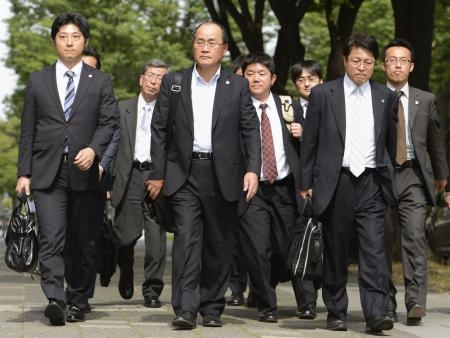
Since the Nagoya High Court rejected Okunishi’s retrial last week, there has been much criticism against the decision in the press in Japan. Meanwhile, attorneys for Okunishi filed a special appeal to the Supreme Court today.

There is also a concern about Okunishi’s health. 86-year-old Okunishi has lost appetite, and now has other health issues. He is being treated at a hospital outside the detention center.

At the hospital, his right hand is tied to the bed with a handcuff, his left hand also handcuffed with a rope tying the handcuff to a guard’s hand. Four guards are constantly watching him aroun the bed……  Read about this inhumane treatment here (in Japanese).

Additional story on Nabari Case Continue reading