Category Archives: Prosecutorial conduct (good and bad)

NY murder convictions vacated; wrongful convictions scandal called “metastasizing”

Brooklyn (NY) Supreme Court Justice Raymond Guzman vacated the murder convictions of Antonio Yarbough, 39, and Sharrif Wilson, 37, Thursday after the two had served 21 years in prison for a 1992 triple murder—that of Mr. Yarbough’s mother, his twelve-year-old sister, and her friend. The two men, who were 15 and 18 at the time of the murders, have long claimed they did not commit them. Brooklyn District Attorney Ken Thompson dismissed the cases against the men.

No physical evidence had connected the two men to the crime. The post-conviction breakthrough came last year when DNA testing of evidence found under the fingernails of Mr. Yarbough’s mother matched DNA from a subsequent rape and murder that occurred in 1999 when Yarbough and Wilson were in prison. Family members cheered as the decision was announced in court. Continue reading

Michigan Man Who Falsely Confessed Charged with Lying to Police

This one is mind boggling.

A mentally ill Lansing, Michigan man, Kosgar Lado, under interrogation by police, momentarily confessed to shooting a man.  Even though he subsequently withdrew that statement later in the interrogation, he was charged with the murder.  After further investigation, the police determined that Lado was not the shooter, and the murder charges were dropped.  But now the prosecutor has charged Lado with felony lying to the police!

Read the LSJ.com story here.

And here’s something else about this story.  The police chief commented to the media that officers went “above and beyond” in confirming that Lado was not the shooter.  B-A-L-O-N-E-Y!  The police have an official duty and an ethical obligation to pursue the facts to determine if their suspects are actually innocent.  I would say they were just doing their job.  The police are normally all too willing to determine if a suspect “might be” guilty, and then turn it over to the prosecutor; and false confessions are one of the major ways they do this.  It’s well known that the mentally ill and the mentally deficient are at high risk of making false confessions.

Thanks to WCB follower Jeremy Praay for forwarding this story.

US Seventh Circuit Rules Prosecutor Can Be Sued For Abusive Investigation and Misconduct

This is a very big deal.

The US Supreme Court had confirmed that prosecutors have absolute immunity from civil suit for their non-criminal actions as prosecutors.  This decision by the Seventh Circuit shines a very different light on the subject.

Read the story by Jonathan Turley here.

The Center for Prosecutor Integrity Announces the 2014 Innocence Summit

The Innocence Movement is gathering momentum, credibility, and clout. The Innocence Summit 2014, to be held in Washington DC, will be the first time that the issue of prosecutorial reform moves front and center to become the focus of national deliberation and debate.

Worthy of note is that among the featured speakers will be Jim and Nancy Petro.  Jim is a former Attorney General of the State of Ohio, and of course, Nancy, in addition to many other innocence related activities, is a contributing editor on this blog.  They are co-authors of the book False Justice – Eight Myths that Convict the Innocent.

Read about the 2014 Innocence Summit here.

Tuesday’s Quick Clicks…

click

Anthony Graves, Exonerated Death Row Inmate, to File Grievance Against Former Texas Prosecutor Charles Sebesta

AGraves

Yet another case of egregious prosecutorial misconduct.

Anthony Graves was wrongfully convicted and sentenced to death for a gruesome multiple homicide that occurred in Somerville, TX in August of 1992.  He was ultimately exonerated and released from prison in 2010.

The prosecutor in the case, Charles Sebesta, under intense public pressure for a conviction of Graves with a death sentence, ignored all evidence pointing to his innocence,  pressed ahead, and, as the special prosecutor appointed to handle Graves’ retrial said, “Sebesta manufactured evidence, misled jurors and elicited false testimony.”  The special prosecutor laid the blame for Graves’ wrongful conviction squarely at the feet of Sebesta.

Anthony Graves and the Houston law firm of Bob Bennett & Associates will file a grievance with the Texas Bar’s Office of the Chief Disciplinary Counsel seeking sanctions against Sebesta for his central role in Graves’ wrongful conviction and imprisonment.

Read the case statement of facts here – Statement-of-Facts.

You can see the full press packet here.

And read the Texas Monthly story here.

Editorial PS:  I think it’s tragic that Mr. Graves has to pursue redress through the Bar Association.  He should have remedy available through the courts.

Monday’s Quick Clicks…

click

Jerome Morgan Wins New Trial in New Orleans

With the help of the New Orleans Innocence Project, Jerome Morgan, who has spent 19 years in prison for a murder termed the “sweet 16 birthday shooting,”
has been granted a new trial.

The prosecution withheld exculpatory evidence in the case, and in Judge Darryl Derbigny’s order he states, “the evidence presented before this court is wrought with deception, manipulation, and coercion by the New Orleans Police Department,” and that “such newly discovered evidence undermines the confidence of the verdict and is fit for a new jury’s judgment.”

Additionally, two prosecution witnesses have recanted, and it was also determined that Jerome had ineffective assistance of counsel.

Read the New Orleans Times-Picayune story here.

Prosecutorial Misconduct Causes Reversal in California…

From the Northern California Innocence Project:

The Northern California Innocence Project (NCIP), acting as amicus, assisted veteran appellate and postconviction attorney Marc Zilversmit in reversing the conviction of Jamal Trulove, wrongfully convicted of murder after a single eyewitness implicated him in a killing San Francisco.  Zilversmit is a long-time supporter of NCIP and it was a pleasure to be able to assist him in attaining justice for Mr. Trulove.

On January 6, following a grant of rehearing on direct appeal, the California Court of Appeal for the First Appellate District reversed the murder conviction of Jamal Trulove on claims of IAC and prejudicial prosecutorial misconduct.

Trulove’s murder conviction relied entirely upon the eyewitness, whose initial description was very vague and who had sat in a police interview room for 2 to 3 hours with a mug shot of Mr. Trulove on the wall in front of her, without ever identifying him.  Her subsequent ID of him was tentative, and only many months later (after seeing him on an episode of a reality TV show) did the witness claim certainty.  Attorney Zilversmit located two witnesses in support of the new trial motion, who testified to Mr. Trulove’s innocence.  Nonetheless, the San Francisco Superior Court denied the motion and affirmed the verdict.  Five additional witnesses then came forward, and Zilversmit filed a habeas petition alongside the direct appeal.  The appeal raised claims of innocence based on eyewitness error, prosecutorial misconduct, and ineffective assistance of counsel.
The trial prosecutor had argued, without any support in the record, that the eyewitness was putting herself in danger by willingly implicating Mr. Trulove and that the jury should be as “courageous” as the witness.  The Court of Appeal initially affirmed the conviction and denied the writ.  Zilversmit then filed a petition for rehearing and reached out to NCIP for amicus support.  NCIP filed an amicus curiae letter brief in support of rehearing and of granting the writ.  The Court granted rehearing, ordered further briefing and reversed Mr. Trulove’s conviction on the grounds that the prosecutor’s argument was prejudicial misconduct and defense counsel’s waiver of the issue by failure to object deprived Mr. Trulove of the effective assistance of counsel.  The Court of Appeal denied the habeas petition as moot without ever evaluating the serious flaws in the eyewitness testimony or the impact of the seven additional defense witnesses on the strength of the case.  The California Attorney General is still deciding whether it will seek review in the California Supreme Court.

“An Offer You Can’t Refuse” – How Prosecutors Force Plea Deals

This just in from the Center for Prosecutor Integrity:

In December, Human Rights Watch released a milestone report titled “An Offer You Can’t Refuse: How US Federal Prosecutors Force Drug Defendants to Plead Guilty.” The report appeared to get lost in the Holiday shuffle, because it didn’t garner much media coverage.  So CPI recently did a Summary of the report. The Summary details the 7 strategies that federal prosecutors use to pressure drug defendants to accept a plea, and also highlights a number of sizzling quotes from the report.  Our Summary concludes, ” The Sixth Amendment of the Constitution guarantees the right to trial by jury. This right should not be diminished or eviscerated by turning it into a trial “penalty.” Disproportionate sentences should not be imposed on the guilty, and the fear of a wrongful conviction should not be a burden to the innocent.”

The CPI summary can be seen here: http://www.prosecutorintegrity.org/reports/hrw-an-offer-you-cant-refuse/

The CPI summary has extracted a number of very telling quotes from the report, and they appear below:

1.      Prosecutors get the innocent to agree to a plea by threatening them with sentences that, in the words of Judge John Gleeson of New York, can be “so excessively severe, they take your breath away.”  In many cases, the prosecutor has complete discretion whether to use these bargaining tools (page 2).

2.      The “threat of a large trial penalty is unavoidably coercive, and contrary to the right to liberty and to a fair trial. In some cases, the sentences imposed on drug defendants who refused to plead are so disproportionately long they qualify as cruel and inhuman”  (page 11).

3.      “Mandatory minimum sentencing laws increased prosecutorial power, transferring sentencing power from judges to prosecutors” (page 31).

4.      “For the government, the guidelines are sacrosanct. Prosecutors insist they must be followed – except they will bend them whenever it suits their purposes.” – Attorney Gerald McMahon, New York (page 34)

5.      The “longer sentences exist on the books largely for bargaining purposes.” – NYU law professor Rachel Barkow (page 81)

6.      “It’s the luck of the draw with prosecutors in each office…some make deals, some won’t, some play fast and loose, charge big, and plead small.” – Anonymous assistant US attorney, Michigan (page 83)

7.      “While some federal prosecutors may reveal their evidence to defense counsel to stress the strength of their case and the wisdom of the plea, others do not. Defense counsel may have to evaluate the risks of ‘trial in the dark’” (page 84).

8.      “There is an inherent conflict of interest when prosecutors are de facto sentencers. They get reputations based on convictions. This is a big difference from federal judges who have no state in a case, who seek only to do justice.” – Judge Thelton Henderson, California (page 91)

9.      “Department of Justice policy has long encouraged prosecutors to charge defendants with the most serious offense (with the longest sentence) consistent with his conduct that is likely to result in a sustainable conviction” (page 92). This differs from the ABA ethical standard that prosecutors should not pursue charges if the punishment is likely to be disproportionate to the offense.

10.   “Prosecutors get kudos based on aggressive prosecutions. It’s not just convictions, but also length of sentence…That’s what earns you pats on the back.” – Former US Attorney (page 97)

11.   “Prosecutors try to be fair and offer good deals. But if you offer the defendant a good deal, and you’ve warned him about the consequences of going to trial, and the defendant doesn’t take the deal, then all bets are off.” – Former federal prosecutor, New York (page 99)

12.   “If you reject the plea, we’ll throw everything at you. We won’t think about what is a ‘just’ sentence.” – Anonymous former US attorney, Utah (page 100)

Let me add, as an editorial comment, that based upon my exposure to cases at the state level, these coercive strategies are not reserved to just federal prosecutors, but are also employed by prosecutors in general.

Registry of Prosecutorial Misconduct

The Center for Prosecutor Integrity has just launched its Registry of Prosecutorial Misconduct.  This is a significant step in documenting the hard data that will ultimately be required to effect some measures of accountability and sanctions for errant and unethical prosecutors.

Here is the press release from the Center for Prosecutor Integrity:

In Wake of NY Times Editorial, CPI Unveils Registry of Prosecutorial Misconduct

 WASHINGTON / January 8, 2014 – Today the non-profit Center for Prosecutor Integrity (CPI) announces the launching of the new Registry of Prosecutorial Misconduct. The unveiling comes three days after a New York Times’ editorial charged ethical violations by prosecutors have become “rampant” across the nation: http://nyti.ms/1hu7K7V

 The Registry is the first publicly available national online database to catalog judicial or legal disciplinary committee findings of prosecutorial misconduct. The Registry of Prosecutorial Misconduct will allow lawmakers, researchers, legal organizations, criminal justice reform groups, and others to identify common types of misconduct, assess trends, and compare jurisdictions.  The database includes over 15 fields such as Crime, State, Prosecutor Name, Trial Year, Misconduct Type, and Sanction Type. The Finding field features the opinion or determination by a disciplinary body or by a trial, appellate, or supreme court.

The Registry database can be viewed here: http://www.prosecutorintegrity.org/registry/database/A graph summarizing the most common types of misconduct committed by federal prosecutors is available here: http://www.prosecutorintegrity.org/registry/graph/numberbymisconducttype/

The database can be accessed by any individual at no charge using Sort, Filter, or Search functions. The Registry defines prosecutorial misconduct as the violation of any pertinent code of professional ethics or law, or other conduct that prejudices, or appears to prejudice the administration of justice.  The database currently features 200 cases of misconduct by federal prosecutors. Additional cases will be added to the database on a state-by-state basis. CPI will identify state-level partners to facilitate data access.

“As a former district attorney, I have become deeply concerned that the American public has begun to question the ethical commitment of prosecutors,” notes CPI chairman Phillip Kuhn. “The Registry of Prosecutorial Misconduct will promote accountability and help advance the integrity of prosecutorial practice.”

Additional information about the Registry can be seen here: http://www.prosecutorintegrity.org/registry/.  Persons may submit cases for consideration for inclusion: registry@prosecutorintegrity.org .

The Center for Prosecutor Integrity is working to preserve the presumption of innocence, assure equal treatment under law, and bring an end to wrongful convictions through the enhancement of prosecutor ethics: http://www.prosecutorintegrity.org/

Rampant Prosecutorial Misconduct…

From the NYTmes:

Editorial Board…

In the justice system, prosecutors have the power to decide what criminal charges to bring, and since 97 percent of cases are resolved without a trial, those decisions are almost always the most important factor in the outcome. That is why it is so important for prosecutors to play fair, not just to win. This obligation is embodied in the Supreme Court’s 1963 holding in Brady v. Maryland, which required prosecutors to provide the defense with any exculpatory evidence that could materially affect a verdict or sentence.

Yet far too often, state and federal prosecutors fail to fulfill that constitutional duty, and far too rarely do courts hold them accountable. Last month, Alex Kozinski, the chief judge of the United States Court of Appeals for the Ninth Circuit, issued the most stinging indictment of this systemic failure in recent memory. “There is an epidemic of Brady violations abroad in the land,” Judge Kozinski wrote in dissent from a ruling against a man who argued that prosecutors had withheld crucial evidence in his case. “Only judges can put a stop to it.”

The defendant, Kenneth Olsen, was convicted of producing ricin, a toxic poison, for use as a weapon. Federal prosecutors knew — but did not tell his lawyers or the court — that an investigation of the government’s forensic scientist, whose lab tests were critical to the case, had revealed multiple instances of sloppy work that had led to wrongful convictions in earlier cases. A state court found the scientist was “incompetent and committed gross misconduct.”

Yet the majority of the federal appeals court panel ruled that the overall evidence of Mr. Olsen’s guilt — including websites he visited and books he bought — was so overwhelming that the failure to disclose the scientist’s firing would not have changed the outcome.

This is the all-too-common response by courts confronted with Brady violations. Judge Kozinski was right to castigate the majority for letting the prosecution refuse to turn over evidence “so long as it’s possible the defendant would’ve been convicted anyway,” as the judge wrote. This creates a “serious moral hazard,” he added, particularly since prosecutors are virtually never punished for misconduct. According to the Center for Prosecutor Integrity, multiple studies over the past 50 years show that courts punished prosecutorial misconduct in less than 2 percent of cases where it occurred. And that rarely amounted to more than a slap on the wrist, such as making the prosecutor pay for the cost of the disciplinary hearing.

Brady violations are, by their nature, hard to detect, but Judge Kozinski had no trouble coming up with more than two dozen examples from federal and state courts just in the last few years, and those are surely the tip of the iceberg. According to the National Registry of Exonerations, 43 percent of wrongful convictions are the result of official misconduct.

The Brady problem is in many ways structural. Prosecutors have the task of deciding when a piece of evidence would be helpful to the defense. But since it is their job to believe in the defendant’s guilt, they have little incentive to turn over, say, a single piece of exculpatory evidence when they are sitting on what they see as a mountain of evidence proving guilt. The lack of professional consequences for failing to disclose exculpatory evidence only makes the breach of duty more likely. As Judge Kozinski wrote, “Some prosecutors don’t care about Brady because courts don’t make them care.”

Courts should heed Judge Kozinski’s call, but it will take more than judges to fix the problem. Prosecutors’ offices should adopt a standard “open file” policy, which would involve turning over all exculpatory evidence as a rule, thus reducing the potential for error.

Fighting prosecutorial misconduct is not only about protecting the innocent. It is, as Judge Kozinski wrote, about preserving “the public’s trust in our justice system,” and the foundation of the rule of law.

Holiday Quick Clicks…

  • clickIn Wisconsin, the governor says he’ll issue no “innocence pardons” because it is too hard to pick and choose who deserves attention and who doesn’t
  • Why is a Texas prosecutor still practicing law after having been found to have committed egregious misconduct to wrongfully convict Anthony Graves?
  • Philly police to implement sweeping interrogation reforms January 1, 2014
  • Virginia man Jonathan Montgomery says exoneration is “best Christmas present ever.
  • Details about the Little Rascals Daycare case in North Carolina, another of the alleged daycare hysteria wrongful conviction cases
  • Nora Wall, wrongfully convicted Irish nun, in talks with Irish government about compensation
  • Connecticut federal judge finds that Scott Lewis was wrongfully convicted as a result of Brady violations
Video

An Epidemic of ‘Brady’ Violations (Prosecutorial Misconduct)

Posted on December 18, 2013 by Phil Locke

An epidemic of Brady violations – those are not my words.  They are the words of Alex Kozinski, Chief Judge of the US 9th Circuit Court of Appeals in a recent decision in the case of US vs. Olsen.

Kozinski

If you don’t know what a ‘Brady’ violation is — it’s when the prosecution fails to turn over exculpatory evidence to the defense.  The US Supreme Court ruled in the case of Brady vs. Maryland (1963) that suppression of evidence by the prosecution violates the defendant’s due process rights.  Note, however, that the ruling does not specify sanctions for prosecutors who fail to comply with Brady disclosure.  It only stipulates that the defendant’s due process rights have been violated, thus making a Brady violation potential grounds for post-conviction relief.

Read the Huff Post story about Judge Kozinski’s opinion here.

This quote from judge Kozinski’s opinion:  “There is an epidemic of Brady violations abroad in the land. Only judges can put a stop to it.”  Kozinski’s statement is interesting, because it is recognizing that there is nothing in the law that punishes (sanctions) prosecutors for this unethical behavior.  They are supposedly subject to sanction from their bar association, but guess what – this just about never happens.

Continue reading

Prosecutorial Misconduct “Double Feature”

Thanks to E. Everett Bartlett of the Center for Prosecutor Integrity for passing this along.

Here is a link to an Anderson Cooper 360 web page that contains two video’s.

The first tells the story of New Orleans exoneree John Thompson, and how the prosecutor withheld critical evidence in his case that eventually freed him from death row.

The second is a “debate” between a criminal defense lawyer and a former federal prosecutor about the issue of prosecutorial immunity.

Misbehaving Prosecutors Almost Always Get Off Scotfree

The Center for Prosecutor Integrity, in December 2013, published a white paper titled An Epidemic of Prosecutor Misconduct.

Appendix B from that paper is a table listing documented cases of prosecutorial misconduct and in how many of those cases sanctions were imposed.

Appendix B

(For the sources footnoted, please refer to the paper.)

Out of 3,625 documented cases of prosecutorial misconduct, sanctions were imposed in only 63 of them – 1.7%.

Isn’t it about time for some prosecutorial accountability and sanctions for misconduct?

Center for Prosecutor Integrity to Establish ‘Registry of Prosecutorial Misconduct’

This (in my opinion) is huge.  By now, you’re probably familiar with the National Registry of Exonerations which has established a mechanism for collecting and documenting data about wrongful convictions across the US.  To date, it has logged data on 1,250 exonerations.  The registry will be a very powerful tool for justice system reform and improvement, because it provides incontrovertible, hard data that can be used to make known and describe the errors that can, and do, happen in this very imperfect system of ours.

Data from the National Registry of Exonerations has already revealed that “official misconduct” (by both police and prosecutors) is a contributing factor in 42% of wrongful convictions.  In a previous WCB post, Prosecutorial Misconduct – What’s to be Done?  A Call to Action, it was pointed out that one of the very first things needed to begin addressing the prosecutorial misconduct cause of wrongful convictions is DATA.  We know that prosecutorial misconduct happens, but our understanding of the problem, and its extent, has been only anecdotal up until now.  This new Registry of Prosecutorial Misconduct is a significant step forward in building a base of data that can be used by legislators, policy makers, and advocates in defining and implementing necessary changes to the laws and rules that govern prosecutorial behavior.

The press release from the Center for Prosecutor Integrity follows:

Continue reading

Friday’s Quick Clicks…

click
  • CCRC’s referral of George case back to court of appeals a boost for the university-based Innocence Projects in the UK
  • Pending bill in Scotland could increase wrongful convictions
  • Exoneree Dwayne Dail gets $7.5 million compensation from state
  • The last of the Scottsboro boys exonerated
  • Derrick Deacon’s first days of freedom
  • Exoneree Christopher Scott uses compensation money to build a business, help others
  • Arizona adopts wrongful conviction provision of ethical rules for prosecutors

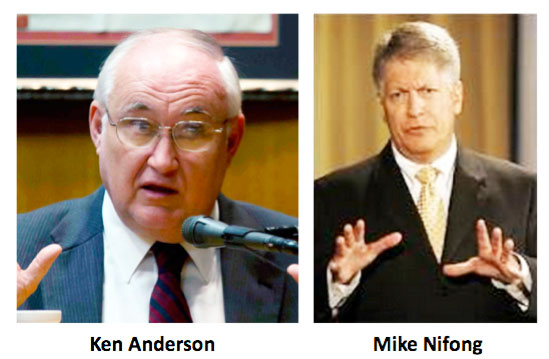
Texas Prosecutor, Ken Anderson, Out of Jail After Only 5 Days.

Former Texas prosecutor, Ken Anderson, sentenced to 10 days jail time for criminal contempt in his prosecution of the Michael Morton case has been released after only 5 days.  See previous WCB post here.

Read the story here.

And the irony is – he was released early for “good behavior.”

Please tell me this is not rubbing salt in the wounds of the wrongfully convicted.

Prosecutor Jail Time – An Emerging Trend? We Can Only Hope.

Prosecutors A&N

We’ve read much recently about former Texas prosecutor Ken Anderson being sentenced to jail time for his conduct in the Michael Morton case.  You can read Mark Godsey’s excellent editorial on the subject here.

The NY Times Editorial Board recently published a commentary on the sanctions against Ken Anderson – read that NY Times editorial here.  One of the points made in the opening paragraph of the editorial is, “the 10-day jail sentence for the prosecutor, Ken Anderson, is insultingly short.”  After all, Michael Morton spent 25 years in prison as a result of the wrongful conviction by Anderson.  I’m sure most would agree that this punishment certainly doesn’t come close to fitting the crime. Continue reading