Category Archives: Prosecutorial conduct (good and bad)

New Report Details Need for Greater Transparency and Accountability for Prosecutors

The Innocence project (NY) has announced the release of a new report calling for greater transparency and accountability for prosecutors.

On the fifth anniversary of the U.S. Supreme Court’s decision in Connick v. Thompson, which granted prosecutors broad immunity for their misconduct, a coalition of innocence organizations today released a new report, Prosecutorial Oversight: A National Dialogue in the Wake of Connick v. Thompson, calling for greater transparency and accountability for prosecutors. Although prosecutors have long argued that there are sufficient systems in place to guard against misconduct, the report reviewed court findings of misconduct over a five year period for five states, documenting 660 findings of misconduct – a likely undercount given the difficulties in identifying this behavior. Of these cases, we know of only one prosecutor who was disciplined for his misconduct, and that took a change of law by the Texas Legislature. The report, which was produced in conjunction with forums featuring a broad array of criminal justice stakeholders in the five states surveyed, provides a list of recommendations that states should pursue to increase prosecutorial transparency and accountability.
This report was a collaborative effort by several organizations that oversaw the design and implementations of the research process. The organizations primarily responsible were the Innocence Project, the Veritas Initiative at Santa Clara University School of Law, Innocence Project New Orleans and Resurrection after Exoneration. A number of additional organizations also provided support in hosting and presenting the prosecutorial oversight forums. These included the Arizona Justice Project, the Pennsylvania Innocence Project and the Actual Innocence Clinic at the University of Texas School of Law.
Illinois Prosecutor Says Man Convicted in Oldest Cold Case is Innocent

We reported on this case two years ago.

In September, 2012, Jack McCullough was convicted of a murder committed in 1957.  The conviction was based largely upon an eyewitness identification made 53 years after the crime by a woman who was 8 years old at the time of the crime. Please see: Defendant in Coldest Case Ever “Solved” Appeals His Conviction.

The wrongful conviction litany just repeats and repeats. In this case it includes a false eyewitness identification, a false deathbed accusation, and (surprise) exculpatory evidence withheld from the defense.

See the CNN story here.

Cook County (Chicago) State’s Attorney Anita Alvarez Ousted in Primary

Anyone who has followed my stuff on this blog even casually knows that, because of their behavior, deeds, and actions, prosecutors are not my favorite group of people. And topping my list of least favorite prosecutors has always been Anita Alvarez, Cook County (Chicago) State’s Attorney. There are lots of reasons for this, many of which are detailed below in Chicago Tribune articles by Eric Zorn. I won’t detail my own opinions about her here so as not to become the defendant in a specious libel suit.

Most recently Alvarez came under fire for her handling of the Laquan McDonald shooting by Chicago police, and this seems to have been “the straw” that broke the voters’ backs. However, it’s really about much more than just her handling of that case. It’s about years and years of the blatant abuse of prosecutorial power.

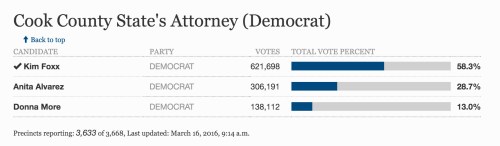
In yesterday’s democratic primary in Cook County, challenger Kim Foxx defeated Alvarez by more than a 2-to-1 vote margin. The people have spoken.

cook vote

See the ThinkProgress story here.

And for more from Eric Zorn at the Chicago Tribune ……..

Continue reading

Anatomy of a Confession – The Debra Milke Case

Gary Stuart, author and Professor of Law at Arizona State University, has just published a book about the Debra Milke case.    See our previous post here:  https://wrongfulconvictionsblog.org/2015/04/10/interview-with-debra-milkes-attorney/

anatomy of confession

“Anatomy of a Confession is the story of the 1990 murder trial of Debra Milke. Two men—Debra’s boyfriend at the time and a friend of his—murdered Debra’s four year-old son in the Arizona desert. One of them implicated the boy’s mother. Even before Debra was questioned, the police hung a guilty tag on her. Debra Milke spent twenty-three years on death row for the murder of her four year-old son based solely on a confession she never gave. This is also the story of Detective Armando Saldate, his history of extracting forced confessions, and the role the Phoenix Police Department played in the cover-up and misconduct in its handling of the Milke investigation. Anatomy of a Confession is a vivid and shocking reminder of what America’s vaunted presumption of innocence is all about.”

It’s available on Amazon here.

Sex, Lies, and Wrongful Conviction: Kathleen Kane’s Other Scandal

Want to get angry? Just read this article by Lorenzo Johnson, who was found innocent and released from prison after 16 years, and then put back in. He’s still there.

Lorenzo Johnson Article

Texas Disbars Former Prosecutor

Please see the following article by Jonathan Turley.

Texas State Bar Votes To Disbar Former Prosecutor For Role In Conviction Of Innocent Man

gavel2The Board of Disciplinary Appeals (appointed by the Texas Supreme Court) has upheld a state licensing board’s decision to disbar former prosecutor Charles Sebesta for his role in convicting an innocent man. Anthony Graves spent 18 years on death row for setting a fire that killed six people. Sebesta’s conduct was shocking but remains a relatively rare example of prosecutors being held accountable in such cases of prosecutorial abuse.

Sebesta had convicted Robert Carter for the murders and tried to get Carter to say Graves was an accomplice. However, just a day before the trial, Carter told Sebesta he acted alone and Graves was not involved. Sebesta withheld the information from the defense and presented false testimony implicating Graves. Sebesta also blocked an alibi witness by telling the court that the witness was a suspect in the murders and could be indicted. The witness then refused to testify.

After his conviction was reversed, a special prosecutor found in 2010 that there was no credible evidence that Graves was involved in the murders.

Sebesta now insists that he has been treated unfairly.

=======================================================

Treated unfairly?! Mr. Sebesta is lucky he himself is not now behind bars.

$16.8 Million Awarded by State of Connecticut to Four Wrongfully Convicted Men

The State of Connecticut has awarded $4.2 million each in compensation to Carlos Ashe, Darcus Henry, Sean Adams, and Johnny Johnson. The four were convicted of murder, assault, and conspiracy resulting from a December 14, 1996, shooting in New Haven, Connecticut. Jason Smith, 23, was killed and brothers Marvin Ogman, 19, and Andre Clark, 22, were injured when allegedly four men utilized semi-automatic weapons in a gang-related retaliation shooting. Including both jail and prison, the four were incarcerated for more than 16 years.

The defendants presented alibi witnesses at trial. The primary evidence presented by the prosecution was inconsistent testimony of the surviving Continue reading

“Conviction Integrity Units” – Foretelling the Future?

We’ve posted previously about our (my) high degree of skepticism regarding the actual integrity of, and motivations for, so-called “conviction integrity units” in prosecutors’ offices. Please see:

A Word About Conviction Integrity Units

Conviction Integrity Units – A Skeptic’s Perspective

In both of these articles we made note of the fact that the New Orleans District Attorney and the Innocence Project – New Orleans had agreed to establish a joint conviction integrity unit. This would be “ground breaking” for a prosecutor to team up with an innocence organization for this, because it would provide absolutely objective oversight of the CIU (which none of them have, because they are totally contained within the prosecutor’s office); and we said this will bear careful watching.

In the second of the above articles, we stated that when the conviction integrity units eventually start to be disbanded (which I believe they will), we will hear one of these reasons, or a combination of the two, as the justification:

1) We’ve fixed everything there was to fix, and we promise to behave ourselves in the future, so the CIU is no longer needed.

2) Budget constraints and the requirements of ongoing prosecutions force us to apply the resource devoted to the CIU to more urgent business.

Please see Mark Godsey’s “Quick Clicks” from Monday, Jan. 11, 2016 here for news that the project between the New Orleans District Attorney’s office and the Innocence Project – New Orleans to form a joint conviction integrity team has been abandoned. And the reason? Budget.

Hmmm. Really?

Final comment. The very existence of “conviction integrity units” begs the question – why? Because they can’t get it right the first time? But given that honest errors leading to a wrongful conviction may occur, leaving it to the prosecutors to correct their own mistakes and misdeeds is not the right way to do it. Having prosecutors oversee prosecutors is like having cops oversee cops, and we know how that works.


Prosecutors Oppose New Trial for Melissa Calusinski in SBS Case

We’ve previously posted about the Melissa Calusinski case in Lake County, IL here. It would seem to clearly be a case of a coerced false confession, combined with bad medical “science.”

Lake County State’s Attorney, Michael Nerheim, has already declined to have his so-called “conviction integrity unit” review the case.

Now, despite the fact that the Lake County Coroner officially changed the cause of death from homicide to undetermined, and despite the fact that newly discovered X-ray evidence shows that the child had experienced previous head trauma, the prosecution is opposing a request for new trial by Calusinski’s attorney.

Why are we not surprised? See the Lake County Daily Herald story here.

Courtney Bisbee Granted Evidentiary Hearing !

Courtney Bisbee was a responsible, law-abiding, hard-working single mother working in the Scottsdale, AZ school system in 2004 when she was sucked into the criminal justice system by false allegations of “improper touching” of a minor.

For background, please see our previous post about this case: A Broken Justice System – Cases in Point – Part 2 – The Case of Courtney Bisbee.

There is recent significant news. Federal District Court Magistrate Judge David Duncan has granted Courtney not just a hearing, but an evidentiary hearing. The two day evidentiary hearing is scheduled for March 14 and 15, 2016.

As we have mentioned before, Courtney filed an absolutely compelling habeas petition with the court 3 1/2 years ago. At the time, former Federal District Chief Judge Roselyn O. Silver, who is now on the 9th Circuit Court of Appeals, reviewed Courtney’s initial petition for Writ of Habeas which was filed April 2012. Silver responded within one business day stating Courtney had 13 viable claims. To date, there has been no further action on Courtney’s habeas petition. Hopefully, the exculpatory evidence cited in Courtney’s habeas petition will be allowed and considered before the court during the hearing.

It comes as no surprise that the prosecution has been fighting ‘tooth & nail’ to keep the hearing from happening. They immediately filed with the court a Motion for Reconsideration to vacate Courtney’s evidentiary hearing, which Judge Duncan rejected. They continue to work furiously to scuttle Courtney’s chance to finally, after more than 10 years, receive justice. For example, the state writes, “Indeed, to proceed with an evidentiary hearing, when any new evidence presented cannot be considered by the federal courts pursuant to Pinholster, would be a waste of state, federal, and judicial resources”. Excuse me? This statement is an insult to the justice system. The state will spend any amount of “resource” when pursuing a conviction. Why now, with actual justice in sight, are they suddenly worried about the dollars and cents?

We can only hope that actual truth and justice will prevail.

Clarence Moses-EL Conviction Vacated After 28 Years.


cmel

If there were ever a classic example of the lengths to which a prosecutor will go to preserve the “sanctity” of what they have to know is a wrongful conviction, this case is one of those examples.

See details of that case here from the Colorado Independent. There’s even an itemized list of the scummy, less-than-ethical things the police and the prosecution did to preserve this wrongful conviction for 28 years.


Friday’s Quick Clicks…

Monday’s Quick Clicks…

Politics and Justice – A Very Bad Combination

I’ve said it before, and I’ll say it again, and again, and again. The justice system has been putrified by politics. I’ve stressed this point numerous times in the past with regard to the pernicious effect politics has on the actions of prosecutors. And of course, it’s not limited to just prosecutors. Elected judges are effected by politics as well. See Judicial Independence – How Do We Get There?

The fact that judges are influenced by politics, particularly big money politics, is supported and amplified by this recent article in The Atlantic: Big Money Propping Up Harsh Sentences.

And by the way, state attorneys general, sheriffs, and coroners are also powerful players in the justice system who are elected political officials.

Thursday’s Quick Clicks…

“Automatic” Justice? Is Technology Eliminating the Presumption of Innocence?

A recent legal research paper from the School of Law at Queen Mary University of London has raised the issue of technology’s impact upon the criminal justice system, and how its effect may be replacing presumption of innocence with presumption of guilt. A truly frightening prospect. You can download the paper here: Automatic justice? Technology, Crime and Social Control.

The nature of evidence in the justice system has steadily been evolving to be ever more founded in technology, be it legitimate and proven technology … or not. And the tendency is for the prosecution (and police) to say, “We have ‘scientific’ evidence of your guilt; therefore, you are guilty.”

And here’s the problem: much of this “technology” has not been verified and statistically validated. It just gets presented in court as “science,” and judges, lawyers, and juries don’t have a clue as to whether or not it’s actually accurate or relevant. How do you know the latest “computer app” is actually true and accurate? You don’t. We’ve seen frequent examples of so-called forensic “science” being proven wrong. Just three of these would be compositional analysis of bullet lead (CABL), microscopic hair comparison, and bite marks. There are currently thousands of cases under re-investigation as a result of scientifically flawed FBI hair comparison work and testimony. There are some infamous cases of fingerprint identifications being wrong; one of these being the case of Brandon Mayfield. Most people, (including lawyers) don’t understand that there is huge margin for error in locating a cell phone through cell towers.

The agents of the justice system – lawyers, judges, police, and especially juries – have been notoriously ignorant regarding the scientific, technological, and mathematical issues of evidence. This is why so much of the justice system depends upon so-called  “experts” to try to understand and explain what all the technology means; but, these experts, often self-styled, may be legitimate — or they may not be. Unfortunately the lawyers, judges, and juries have no way to tell. Defense attorneys will most commonly not technically question (cross examine) prosecution “experts.” This is too bad, because, in my opinion, a technically knowledgable and logically-penetrating defense attorney could just “take apart” many prosecution “experts” – even medical doctors. The typical legal defense strategy is to present “your own” expert, which puts the poor jury in the position of having to decide which of the dueling experts to believe. All this, unfortunately, leaves the justice system, and the defendant, at the mercy of “experts,” and there is no scientific way built into the justice system to sort through which “science” is true and correct, and which is junk – and which experts are truly expert, and which are charlatans.

From the conclusion of the paper: “Our deepest concern is the emergence of a potentially unfettered move towards a technologically driven process of ‘automatic criminal justice.’”

We – all of us – have a problem. The justice system was never conceived or designed to comprehend the explosion of technology. And the lawyers and judges are not trained or prepared to deal with it. It’s a problem.


Why is a Man Serving Life for a Murder that Feds Say Someone Else Committed?

From the Marshall Project:

The case of Lamont McKoy.

Lamont’s case is currently being handled by the Duke Law Wrongful Convictions Clinic at Duke University. I am very familiar with this case, as I have substantial time in on it, and I can tell you there is even more exculpatory evidence than what is cited in the above article.


Wednesday’s Quick Click…

When Prosecutors Can’t be Bothered With Innocence

An insightful article by Radley Balko, writing for the Washington Post.

From the article:

“That they (the two prosecutors cited in the article) have yet to be sanctioned or disciplined by a court or state bar speaks volumes about the legal profession’s ability to police itself. That they continue to be reelected is more evidence that the criminal justice reform movement should get more directly involved in electoral politics.”

Friday’s Quick Clicks…