Category Archives: Reforming/Improving the system

Three cities to start reviewing criminal-justice mistakes

It’s been a common refrain in the innocence movement that when an airliner crashes there is an intense investigation on how it happened to prevent similar crashes, but when a wrongful conviction occurs the criminal-justice system does nothing to prevent a recurrence.

Well, that’s about the change. According to The Crime Report, the major criminal-justice players in Philadelphia, Milwaukee and Baltimore have agreed to develop a system to review cases that went wrong or almost went wrong in an attempt to keep similar mistakes from happening again. Stephen Handelman writes about the project, which will be supported in part by the National Institute of Justice, here.

Police lying: an endemic international problem?

It is starting to feel in the UK like ‘another day, another story of police lies’. In what feels like just a few months we have had media coverage of (to mention just a few) scandals where, for example, police have been caught falsifying reports of an altercation that they ‘witnessed’ when they were not present (see Plebgate scandal...). We have the ongoing revelations over police lies and their coercion of others to lie in the Hillsborough disaster cover-up (see Hillsborough inquiry...). It is suspected that these tactics were honed during the Miner’s Strike when striking miners were ‘fitted up’ (see Miners Strike….). Such tactics clearly have continued for years with many undercover police officers lies leading to convictions  (see undercover policing....) as well as the recent revelation that high profile victim Stephen Lawrence’s family were put under police surveillance during the inquiries into the police failures after Stephen’s murder (to try and discredit the family and their campaign for justice). This all comes on top of the almost run-of-the-mill stories of police ‘collusion’ with one another after fatal police shootings, with the introduction of body-worn cameras to enable the police to be ‘more transparent’ about fatal shootings. In fact, the introduction of police body-worn cameras has been posited as a boon for police as it will cut down on false allegations from the public. However, is it perhaps more likely that police body-worn cameras may serve to make the police more honest? Will they be able to lie with camera footage of the real altercation readily available?

0In Omagh, Northern Ireland, the introduction of CCTV cameras in the town has led to the uncovering of police lies leading to miscarriages of justice – with solicitors claiming that miscarriages may be ‘endemic’: increasingly, CCTC footage is being shown to demonstrate that the police account of events is unreliable – even untrue (see story here…) Of course this has not been a good week either for police south of the border in Ireland, having been found to have been illicitly tape recording phone calls made to police stations (see here…). The other side of the world, in New Zealand, they are calling police lies and false evidence which have led to convictions as ‘failings’ and ‘sloppy police work’ (see here…Police failures led to wrongful conviction).

We have all known for years that there are ‘rotten apples’ and that wrongful convictions have often had police misrepresentations, if not outright corruption and lying, at their heart. However, the question must surely now be asked: is lying among the police an endemic international problem? If so, what can be done about it? These questions are already beginning to be murmured in corners of the UK, I think it is now time to get such questions out in the open. These are challenging times for the police, and if we are not to lose trust in them completely, I believe some hard questions must be asked and answers demanded.


Are prosecutors’ conviction-integrity units the real deal?

Are prosecutors’ conviction-review or conviction-integrity units a sincere effort to right wrongs or an insincere attempt to cover up challenged cases with a heavy layer of whitewash? Hella Winston explores the issue in an excellent article for The Crime Report, which you will find here.

The Center for Prosecutor Integrity Expands Registry to Include State-Level Cases

The Center for Prosecutor Integrity (CPI) announced today the expansion of its efforts to identify and analyze prosecutorial misconduct to include state and local cases. The Registry initially focused on misconduct by federal prosecutors. CPI is now inviting submissions of state-level cases for inclusion in its Registry of Prosecutorial Misconduct, which was established in January 2014.

An online database, national in scope, the Registry identifies leading types of prosecutor misconduct, and enables analysis of trends and comparisons across jurisdictions through searchable sort, filter, and search functions.

Cases can also be downloaded into a spreadsheet to facilitate in-depth analyses: http://www.prosecutorintegrity.org/registry/database/

Cases qualify for inclusion in the Registry based on a determination by a bar disciplinary committee, or by a trial, appellate, or supreme court judge. CPI estimates there have been 16,000 determinations of prosecutorial misconduct nationwide since 1970.

Cases should be submitted by email to Sakeena Farhath, Registry Director: registry@prosecutorintegity.org

For more information, visit the Center for Prosecutor Integrity: http://www.prosecutorintegrity.org


The Child Abuse Pediatrician (CAP) – Just Another Term for Medical “Cop”

CAP Ethics

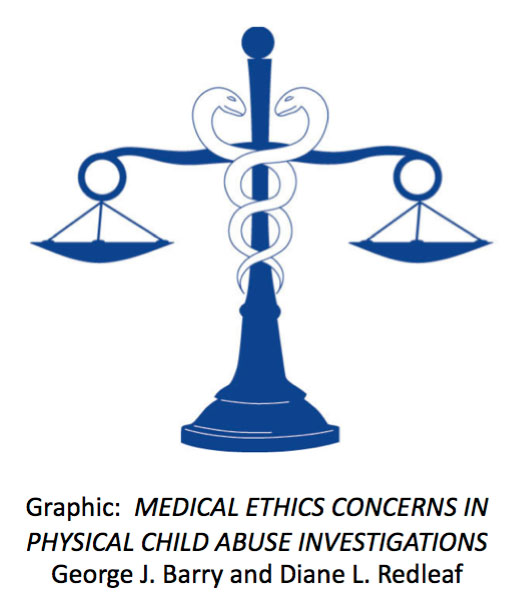
A new paper has recently been published by George Barry and Diane Redleaf of the Family Defense Center in Chicago.  The paper, titled  Medical Ethics Concerns in Physical Child Abuse Investigations, explores and reveals the extent of breeches of medical ethics by child abuse medical investigators (CAP’s).

This paper is a prodigious work, including five detailed case studies.

The title of Section I of Part III conveys the theme of the paper: “Physicians Have an Ethical Obligation Not to Become Law Enforcement Officers.”  And here is an excerpt from the Executive Summary:  “We submit, in this Paper, that this system of child abuse investigation and medical assessment is failing the children and families. We also submit that the failings are due at least in part to practices that are ethically questionable at best, or plainly unethical at worst. The harm of these practices occurs because, while the child may quickly recover from a toddler fracture, nursemaid’s elbow or subdural hematoma that is called in to child protection authorities as suspicious, the trauma families have experienced at the hands of the child protection system does not fade quickly or ever entirely disappear. Moreover, the Center is able to represent only a tiny fraction of the wrongly accused family members in medically complex cases and resources like the Center provides are not available to the vast majority of family members who encounter the child protection and medical care establishment in these cases. Unfortunately, we see little sign that the child protection and medical care establishment are addressing in a meaningful way the harmful impact of erroneous child abuse reports that have resulted from questionable ethical practices that this Paper documents. Indeed, for reasons this Paper documents, we believe that the medical profession has turned a blind eye to the treatment of children and families who are the victims of misplaced child abuse allegations and we are concerned about developments in the handling of medically complex allegations that make these problems worse, not better.”

Don’t get me wrong.  Child abuse is a horrific thing, but equally, if not more, horrific is when when innocent parents and care givers get thrown into prison or separated from their children for a child abuse “crime” they did not commit, and that did not ever happen.  This is a tragedy that occurs all too often when a medical diagnosis is made that does not recognize the new scientific understandings regarding symptoms that have traditionally (and wrongly) been attributed solely to abuse.

And here’s the scary part – the CAP’s, who are basically a medical cop, as part of their training, have been indoctrinated with the American Academy of Pediatrics medical dogma concerning causation of certain symptoms (the triad and long bone fractures) that they insist are pathognomonic (exclusively indicating) of abuse.  This is what the SBS Wars is all about.

“Chid Abuse Pediatrics” was established as a pediatric sub-specialty by the American Board of Medical Specialties in 2006. This definition of the discipline is from the website of the Council of Pediatric Subspecialties (ironically known as CoPS):  “Child Abuse Pediatricians are responsible for the diagnosis and treatment of children and adolescents who are suspected victims of any form of child maltreatment. This includes physical abuse, sexual abuse, factitious illness (medical child abuse), neglect, and psychological/emotional abuse. Child Abuse Pediatricians participate in multidisciplinary collaborative work within the medical, child welfare, law enforcement, and judicial arenas as well as with a variety of community efforts. Child Abuse Pediatricians are often called to provide expert testimony in the court systems. This field offers the opportunity for involvement and leadership roles in community, regional and national advocacy, and in prevention efforts and public policy.”  (emphasis is mine).

I would contend the very existence of the child abuse pediatrician specialty becomes something of a self-fulfilling prophecy.  “I’m here to diagnose child abuse, so that’s what I’m going to do.”

This would be my advice.  If you find yourself in the situation of taking your child to the emergency room, and you find yourself talking with a child abuse pediatrician (and they probably won’t tell you they are one), consider that you are under suspicion, and you are talking to the police.  How you choose to deal with that I must leave to you.

Singapore: A Need to Reconsider the Accused Person’s Constitutional Right to Counsel

The Singapore High Court recently considered the right of an accused to counsel in the case of James Raj s/o Aroliasamy v PP [2014] SGHC 10 (available here). Article 9 (3) of the Singapore Constitution recognises the right of an arrested person to consult counsel, but does not expressly state the point of time at which the person can do so. Singapore Courts have consistently held that an accused does not have an immediate right to consult counsel. Rather the right to counsel is to be exercised within “reasonable time”. Case law has interpreted such “reasonable time” to include the time needed for police investigations, which would otherwise be hampered by permitting the accused access to counsel.

What is interesting about the High Court’s judgement in James Raj s/o Aroliasamy v PP is that the Judge voiced some doubt about how previous case law had narrowly interpreted the right to counsel. The Judge nevertheless stated that he was bound to follow precedent. Even so, the Judge affirmed that the Prosecution bore the burden of showing why permitting access to counsel would jeopardise investigations in a particular case. It was not enough for the Prosecution to point to, inter alia, the complex or cross-border nature of the case. Rather, the Prosecution had to specifically explain why permitting access to counsel would jeopardise investigations in that case.

The High Court’s judgement reflects the increased willingness of Singapore Courts to closely supervise the work of the Prosecution and other criminal justice agencies. However, it is perhaps time for the Court of Appeal to reconsider its interpretation of the constitutional right to counsel in light of the High Court’s assessment of previous case law in James Raj s/o Aroliasamy v PP.

“Flawed Convictions – Shaken Baby Syndrome and the Inertia of Injustice”

flawed conv

Sue Luttner has posted an excellent piece on her blog OnSBS about the new book by Prof. Deborah Tuerkheimer to be released in April – Flawed Convictions – Shaken Baby Syndrome and the Inertia of Injustice.

Please see Sue’s post here.

This book will be a must read for any involved in the SBS debate.

Dog Scent Lineups – “The Worst of Junk Science”

pointerIt was just a year ago that we posted about dog scent lineups.  At the time, we called it “one of the junkiest of the junk sciences.”  This opinion is echoed in a law suit filed just this week by a Texas woman, Megan Winfrey.  Ms. Winfrey spent 6 years in prison before her murder conviction, based on a dog scent lineup, was overturned.  Her suit calls dog scent lineups “the worst of junk science.”

Interestingly, the primary defendant in Winfrey’s suit is former Fort Bend County Sheriff’s Deputy Keith Pickett.  Pickett was identified in our earlier post as being the most infamous and notorious dog handler performing bogus dog scent lineups.  Four other officers, including the San Jacinto County Sheriff, are also named in the suit as being complicit in her wrongful conviction.

You can read the NBC News story about the Winfrey suit here, which contains a link to the actual law suit.

Yet MORE Questions About Shaken Baby Syndrome (SBS)

Much has been written in recent years about the doubts that have arisen over the veracity of traditional “shaken baby syndrome” (SBS) theory.  And not only has that drumbeat continued, but it has also intensified.

The media has been awakening to the injustices visited upon too many innocent infant caregivers by a justice system and a pediatric medical establishment that have brainwashed themselves into blind, unquestioning belief in a 40 year old unsubstantiated theory.

An example of this coverage is a recent SBS case in the San Francisco bay area. Read the CBS Channel 5 San Francisco story here.

Clearly, the US has lagged behind other developed countries in its recognition of the new scientific realities regarding SBS.  Canada has been much more proactive in revisiting old SBS convictions because of new scientific knowledge.  In light of the new scientific understandings, the Ontario government ordered a comprehensive review of all SBS convictions in 2008.  See stories from the Toronto Star here and here.

This EXCELLENT article by Radley Balko for The Washington Post addresses not only the new science but also the barriers our justice system erects that prevent correction of wrongful SBS convictions.

Continue reading

New Data From the National Registry of Exonerations

The release of the new report (for year 2013) by the National Registry of Exonerations was recently posted on the WCB by Nancy Petro.  See her post here, which includes a link to the full text of the new report.

I’d like to reiterate that the most significant value of the Registry is that it provides hard, verifiable data on which reforms to the justice system can be based.  And anyone who studies this data can see that reforms are, indeed, sorely needed.

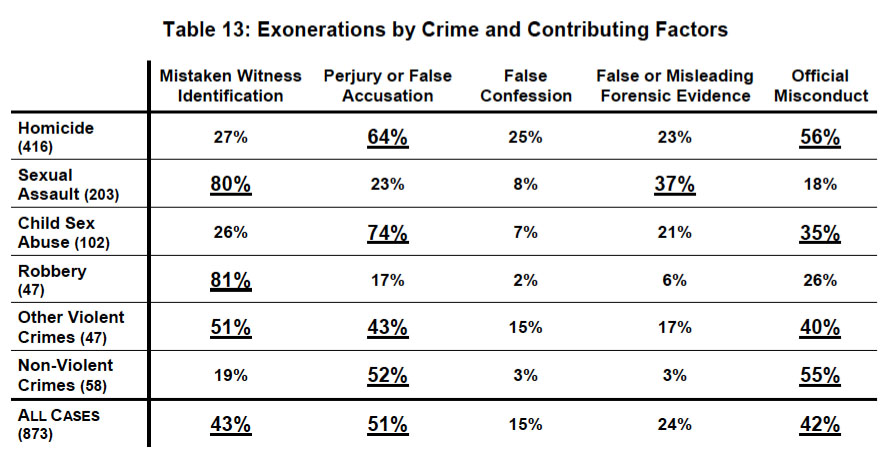
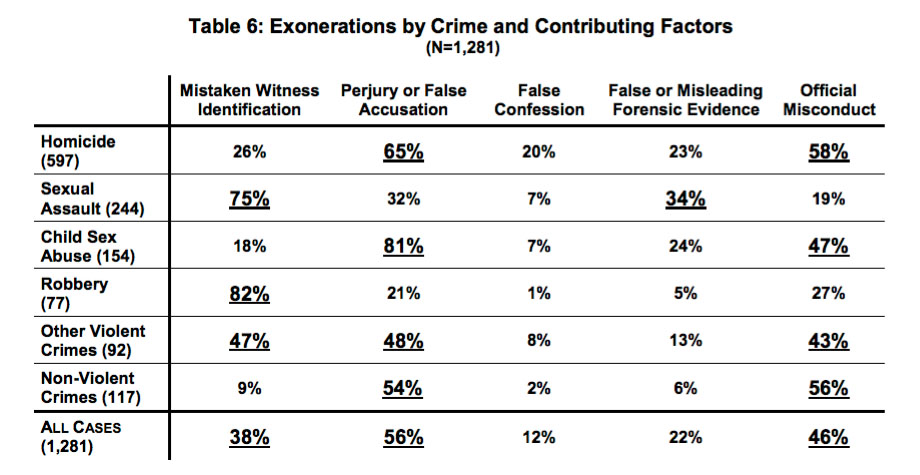
One of the things I find most interesting is the data that sorts out the major contributing factors to wrongful convictions.  This is a very good indicator of both the need for reform in general and the specific areas that are most ripe for reform and improvement.

I encourage you to dig through the full report on your own, but for your convenience, I’m attaching the data on major contributing factors to wrongful convictions for both years 2013 and 2012 below.

From the 2012 NRE report:

Table 13

From the 2013 NRE report:

Table 6 020414

Note that for each class of crime, the numbers add to more than 100%.  This is because any particular wrongful conviction can have more than one contributing factor, which they most often do.

Violence In Brazilian Prisons Revealed in Decapatation Video

Man holding jail barsThe prison conditions in Latin America continue to be a crippling problem for the justice system, highlighted by the recent events in Brazil.  On January 7, 2014, the Brazilian daily newspaper Folha de São Paulo released a gruesome video showing the decapitation of three inmates. The video was taken, presumably, by inmates of Pedrinhas prison (São Luis, Brazil), on December 17, 2014.

This is just one example of the general violence in Brazilian prisons, especially in the state of Maranhão (north Brazil), where, from 2007 to now, approximately one hundred sixty nine inmates have been killed (sixty two in Predrinhas prison during 2013).

Amnesty International has denounced the situation and has described Brazilian prisons as overcrowded dungeons. They claim the government has done little to remedy these conditions.  The U.N. High Commissioner for Human Rights has also urged the Brazilian authorities to conduct an “immediate, impartial and effective” investigation.

The main causes of the problems are delays in the judicial system, lack of sufficient prison spots and the low ratio of police/inmate population. According to the International Prison Study Center, Brazil has the fourth largest inmate population in the world with 548,003 inmates housed in a penitentiary system with a capacity of 318,739.

The international pressure created due to the release of the prison decapitation video has resulted in the Minister of Justice, José Eduardo Cardozo, announcing a package of emergency measures aimed at trying to control chaos in prisons. These measures will be a positive first step in Brazilian prison reform, although without true long-term reform in the justice system prison overcrowding will continue to foster major problems.

Follow me on Twitter:  @JustinoBrooks

Professor Justin Brooks
Director, California Innocence Project
California Western School of Law
225 Cedar Street
San Diego, CA 92101
jpb@cwsl.edu

For more information, please see:  http://mexico.cnn.com/mundo/2014/01/10/brasil-despliega-un-plan-de-emergencia-contra-la-violencia-en-sus-carceles

Image courtesy of bejim / FreeDigitalPhotos.net

Murder Charges Dismissed after Man Spent 20 Years in Prison

Summit County (OH) Judge Mary Margaret Rowland has dismissed aggravated murder, aggravated kidnapping, and aggravated robbery changes against Dewey Jones, 51, of Akron, Ohio, after he spent 20 years in prison following his conviction of the 1993 murder of Neil Rankin, 71. Jones had always claimed innocence.

According to a report from ABC Newsnet 5 (here) Cleveland, Judge Rowland granted Dewey a new trial after DNA testing results in 2012 on a knife and rope Continue reading

US Seventh Circuit Rules Prosecutor Can Be Sued For Abusive Investigation and Misconduct

This is a very big deal.

The US Supreme Court had confirmed that prosecutors have absolute immunity from civil suit for their non-criminal actions as prosecutors.  This decision by the Seventh Circuit shines a very different light on the subject.

Read the story by Jonathan Turley here.

The Center for Prosecutor Integrity Announces the 2014 Innocence Summit

The Innocence Movement is gathering momentum, credibility, and clout. The Innocence Summit 2014, to be held in Washington DC, will be the first time that the issue of prosecutorial reform moves front and center to become the focus of national deliberation and debate.

Worthy of note is that among the featured speakers will be Jim and Nancy Petro.  Jim is a former Attorney General of the State of Ohio, and of course, Nancy, in addition to many other innocence related activities, is a contributing editor on this blog.  They are co-authors of the book False Justice – Eight Myths that Convict the Innocent.

Read about the 2014 Innocence Summit here.

Shaken Baby Syndrome ……. Progress for True Science?

It’s been a while since we’ve posted about SBS.  It’s a complex issue that is just not coverable in a single post.  So in case you’d like a “refresher,” or if you’re new to the topic, there are links to previous WCB posts on SBS at the end of this post.

There is new science emerging all the time in this field – science that largely disputes the classic and entrenched one-size-fits-all “triad” symptom diagnosis, along with the current views of “cause & effect” regarding triad symptoms.  There are, unfortunately, people who do shake or otherwise abuse their babies, and these babies may very well present with one or more of the triad symptoms, so they cannot be dismissed without further understanding.  However, the established medical profession (including the American Academy of Pediatrics) and the justice system (particularly prosecutors) have embraced the “triad can only mean abuse” theory of cause and effect; and they have so far refused – cogently, adamantly, and combatively – to consider giving it up.  They have turned a blind eye to much of the new understandings being created by true science.  What this means is that an alarming number of innocent people continue to get swept up in the “triad dragnet,” and sent to prison.

In my view, the medical establishment has been not just tone deaf and brain dead about accepting new findings in the area; they have put up the deflector shields and aggressively resist it.  The people who hold sway in pediatric medicine seem to have a religiously fanatic attachment to this 40 year old theory.  And the prosecutors are more than happy to go along with the medical establishment, because strict adherence to the triad theory makes for easy convictions – even though they may be wrongful.  There are lots and lots of doctors ready to testify that if triad symptoms are present, it can only be abuse.  Coupled with this is the fact that the prosecution can always afford to put more experts on the stand than the defense; thereby swaying clueless juries, because the side with more experts “must be right,” regardless of the veracity of their testimony.

Let me quote Dr. Waney Squier, a noted UK pathologist, who is one of the prominent SBS truth-seekers (writing for the journal Forensic Science, Medicine, and Pathology, Jan..8, 2014), “The critical issue is why, after more than 40 years, shaken baby syndrome/abusive head trauma (SBS/AHT) remains controversial.  The real controversy is over whether shaking or abuse may reliably be inferred from specific findings, classically, subdural and retinal hemorrhage with encephalopathy (the triad).”  And, “For four decades, the medical profession and the courts have largely accepted the SBS/AHT (triad) hypothesis as fact.  Today, we know that the hypothesis lacks a reliable evidentiary basis …..

The bright spots of true progress on SBS seem to come at an agonizingly and glacially slow pace — but here is one.  Reneé Bailey was convicted 13 years ago of shaking 2½ year old Brittney Sheets to death.  She has been in prison ever since.  Recently, NY State Supreme Court Justice James Piampianon granted an evidentiary hearing in the case to consider the new scientific findings regarding SBS.  This is a huge deal.  It means that at least some segment of the justice system is willing to look past the prevailing medical dogma.  Read the Rochester, NY Democrat and Chronicle story here.

And here is another recent article, this from USA Today, questioning the traditional “science” of SBS.

Science and truth will ultimately prevail, but to paraphrase Nobel physics laureate Max Planck, “Science advances one funeral at a time.”  It’s going to take time to work our way out of this modern day version of the medical dark ages, but it will happen.  As William Shakespeare penned in The Merchant of Venice, “….. at length, truth will out.”  In the meantime, I shudder to think of all the innocent people that will suffer tragic injustice until we get there.

Previous WCB SBS Posts:

The SBS Wars,  Hang Bin Li SBS Case,  Shaken Baby Science Doubts GrowSBS Expert Testimony – This HAS to Get FixedSBS Accusations – A Modern Day Witch Hunt?SBS – Politics and “Religion” vs. New ScienceDismissed Case Raises Questions on SBS DiagnosisWitnessed Baby ShakingsThe Latest in the Medical Debate Over SBSBaby Sitters and SBSMedical “Folklore” Yields Yet Another Wrongful SBS ConvictionSBS – Where Are We? – A Reality CheckSBS: Perspectives on a Controversial DiagnosisAre There Geographic “Hotspots” for SBS?

Anthony Graves, Exonerated Death Row Inmate, to File Grievance Against Former Texas Prosecutor Charles Sebesta

AGraves

Yet another case of egregious prosecutorial misconduct.

Anthony Graves was wrongfully convicted and sentenced to death for a gruesome multiple homicide that occurred in Somerville, TX in August of 1992.  He was ultimately exonerated and released from prison in 2010.

The prosecutor in the case, Charles Sebesta, under intense public pressure for a conviction of Graves with a death sentence, ignored all evidence pointing to his innocence,  pressed ahead, and, as the special prosecutor appointed to handle Graves’ retrial said, “Sebesta manufactured evidence, misled jurors and elicited false testimony.”  The special prosecutor laid the blame for Graves’ wrongful conviction squarely at the feet of Sebesta.

Anthony Graves and the Houston law firm of Bob Bennett & Associates will file a grievance with the Texas Bar’s Office of the Chief Disciplinary Counsel seeking sanctions against Sebesta for his central role in Graves’ wrongful conviction and imprisonment.

Read the case statement of facts here – Statement-of-Facts.

You can see the full press packet here.

And read the Texas Monthly story here.

Editorial PS:  I think it’s tragic that Mr. Graves has to pursue redress through the Bar Association.  He should have remedy available through the courts.

Unreliable Evidence Cost Man 25 Years and Chicago $6.3 Million

According to the Chicago Sun-Times (here), the City of Chicago has agreed to pay $6.3 million to Larry Gillard to settle a federal lawsuit alleging that the Chicago police crime lab distorted evidence, which contributed to his wrongful conviction of a 1981 rape.  Gillard served 25 years in prison before DNA proved his innocence.

Two pieces of unreliable evidence conspired to convict Gillard. A Chicago Police Crime Laboratory analyst testified that Gillard was among 4.4 percent of African Continue reading

Justice and Science — “Houston, We Have a Problem!”

sciencejustice.

It’s abundantly apparent that the nature of ‘evidence’ and ‘expert testimony’ has become increasingly more scientific as the decades have rolled by.  And this is a wonderful thing, because real science is a tool for discerning the real truth and the real facts.  It means that “junk science” forensics will ultimately give way to technologies and disciplines founded upon true science, and this is what the NAS Report was all about.

However, the continuing trend for evidence and testimony to become more scientifically based brings with it some “interesting” consequences of which we need to be aware — the impacts on juries and on judges & attorneys; and whether these people are prepared to cope with all this new scientific information and discipline.

We’ll cover the issues in three sections: Juries, Judges & Attorneys, and Experts.

Continue reading

“An Offer You Can’t Refuse” – How Prosecutors Force Plea Deals

This just in from the Center for Prosecutor Integrity:

In December, Human Rights Watch released a milestone report titled “An Offer You Can’t Refuse: How US Federal Prosecutors Force Drug Defendants to Plead Guilty.” The report appeared to get lost in the Holiday shuffle, because it didn’t garner much media coverage.  So CPI recently did a Summary of the report. The Summary details the 7 strategies that federal prosecutors use to pressure drug defendants to accept a plea, and also highlights a number of sizzling quotes from the report.  Our Summary concludes, ” The Sixth Amendment of the Constitution guarantees the right to trial by jury. This right should not be diminished or eviscerated by turning it into a trial “penalty.” Disproportionate sentences should not be imposed on the guilty, and the fear of a wrongful conviction should not be a burden to the innocent.”

The CPI summary can be seen here: http://www.prosecutorintegrity.org/reports/hrw-an-offer-you-cant-refuse/

The CPI summary has extracted a number of very telling quotes from the report, and they appear below:

1.      Prosecutors get the innocent to agree to a plea by threatening them with sentences that, in the words of Judge John Gleeson of New York, can be “so excessively severe, they take your breath away.”  In many cases, the prosecutor has complete discretion whether to use these bargaining tools (page 2).

2.      The “threat of a large trial penalty is unavoidably coercive, and contrary to the right to liberty and to a fair trial. In some cases, the sentences imposed on drug defendants who refused to plead are so disproportionately long they qualify as cruel and inhuman”  (page 11).

3.      “Mandatory minimum sentencing laws increased prosecutorial power, transferring sentencing power from judges to prosecutors” (page 31).

4.      “For the government, the guidelines are sacrosanct. Prosecutors insist they must be followed – except they will bend them whenever it suits their purposes.” – Attorney Gerald McMahon, New York (page 34)

5.      The “longer sentences exist on the books largely for bargaining purposes.” – NYU law professor Rachel Barkow (page 81)

6.      “It’s the luck of the draw with prosecutors in each office…some make deals, some won’t, some play fast and loose, charge big, and plead small.” – Anonymous assistant US attorney, Michigan (page 83)

7.      “While some federal prosecutors may reveal their evidence to defense counsel to stress the strength of their case and the wisdom of the plea, others do not. Defense counsel may have to evaluate the risks of ‘trial in the dark’” (page 84).

8.      “There is an inherent conflict of interest when prosecutors are de facto sentencers. They get reputations based on convictions. This is a big difference from federal judges who have no state in a case, who seek only to do justice.” – Judge Thelton Henderson, California (page 91)

9.      “Department of Justice policy has long encouraged prosecutors to charge defendants with the most serious offense (with the longest sentence) consistent with his conduct that is likely to result in a sustainable conviction” (page 92). This differs from the ABA ethical standard that prosecutors should not pursue charges if the punishment is likely to be disproportionate to the offense.

10.   “Prosecutors get kudos based on aggressive prosecutions. It’s not just convictions, but also length of sentence…That’s what earns you pats on the back.” – Former US Attorney (page 97)

11.   “Prosecutors try to be fair and offer good deals. But if you offer the defendant a good deal, and you’ve warned him about the consequences of going to trial, and the defendant doesn’t take the deal, then all bets are off.” – Former federal prosecutor, New York (page 99)

12.   “If you reject the plea, we’ll throw everything at you. We won’t think about what is a ‘just’ sentence.” – Anonymous former US attorney, Utah (page 100)

Let me add, as an editorial comment, that based upon my exposure to cases at the state level, these coercive strategies are not reserved to just federal prosecutors, but are also employed by prosecutors in general.

Predicting Wrongful Convictions Statistically…

A group of scholars, including Jon Gould, Julia Carrano, Richard Leo and Katie Hall-Jares have posted an interesting article, Predicting Erroneous Convictions, on SSRN.  The article is forthcoming at the Iowa Law Review.  Download here.  The abstract states:

The last thirty years have seen an enormous increase not only in the exonerations of innocent defendants but also academic scholarship on erroneous convictions. This literature has identified a number of common factors that appear frequently in erroneous conviction cases, including forensic error, prosecutorial misconduct, false confessions, and eyewitness misidentification. However, without a comparison or control group of cases, researchers risk labeling these factors as “causes” of erroneous convictions when they may be merely correlates. This article reports results from the first large scale empirical research project to compare wrongful convictions with other innocence cases in which the defendant escaped conviction (so-called “near misses”). Employing statistical methods and an expert panel, the research helps us to understand how the criminal justice system identifies innocent defendants in order to prevent erroneous convictions. In another first, the research secured the cooperation of practitioners from multiple sides of the criminal justice system, including the national Innocence Project, the Police Foundation, the Association of Prosecuting Attorneys, and the National District Attorneys Association. The results highlight ten factors that distinguish wrongful convictions from near misses, but the larger story is one of system failure in which the protections of the criminal justice system operate in a counterintuitive manner. The article closes with a series of policy reforms to address these failings.