Category Archives: False confessions

‘False Justice: Eight Myths That Convict the Innocent’ – Why Did They Write It?

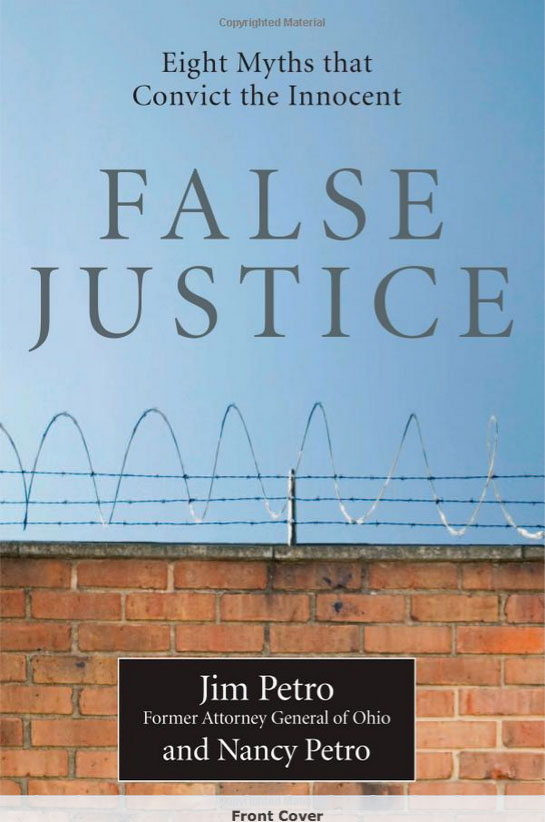
FalseJusticeI hope that you’re all familiar with, and in fact have read, the book by Jim and Nancy Petro, False Justice: Eight Myths That Convict the Innocent.

Jim&Nancy

.

.

.

.

Jim is a former Attorney General of the state of Ohio, and Nancy, among her many other endeavors, is also a contributing editor to this blog.

I recently just happened across this interview with Jim and Nancy at the Columbus Metropolitan Club in 2010.  They talk about what brought them to write the book.

It’s about an hour long, and I found it both fascinating and illuminating.  Definitely worth a watch.

Conviction Error Demands Reexamination of Death Penalty

The following opinion piece with the title “Jim Petro: An intolerable rate of wrongful convictions” was published today in The Akron Beacon Journal (here).

Would you get on an airplane if there were a 2.3 percent chance it would crash? The equivalent of this “worse case” outcome in criminal justice is convicting an innocent person. There’s a special horror in convicting an innocent person of a death penalty crime. Well-documented research has found that our criminal justice system’s error rate in capital cases is at least 2.3 percent. This troubling record was underscored recently when senior U.S. District Judge Anita Brody overturned the conviction of James Dennis, who spent 21 years on death row. As reported by the Associated Press, the judge called the case “a grave miscarriage of justice” and said Dennis was convicted on “scant evidence at best.” Continue reading

Debra Milke Released Pending New Trial

Milke

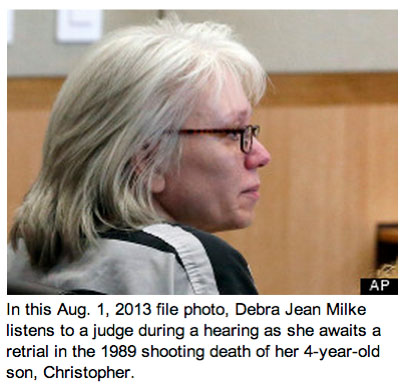
Debra Milke has been in prison since 1990 for arranging the shooting death of her 4-year-old son.  A detective, Armando Saldate, had testified that she had confessed to him.  She has steadfastly maintained her innocence.

Here is an excerpt from the court’s opinion:  “No civilized system of justice should have to depend on such flimsy evidence, quite possibly tainted by dishonesty or overzealousness, to decide whether to take someone’s life or liberty,” Chief Judge Alex Kozinski wrote for the court.

The court noted four cases in which judges threw out confessions or indictments because (detective) Saldate lied under oath and four instances in which cases were tossed out or confessions excluded because Saldate violated the suspect’s constitutional rights.

He was also suspended for accepting sexual favors from a female motorist he stopped and then lying about the encounter, the court said.

The prosecutor had withheld this information from the defense.

Read the full HuffPost story here.

Journalists Never Gave Up on Haunting Case of Innocence

On June 28, 2013, Daniel Taylor, 38, walked out of prison after serving more than 20 years for murders he did not commit. He couldn’t have committed the crimes. Taylor was in jail the night of the murders. He’d been arrested and held there following a fight in a park. But despite his unique and compelling alibi, police and prosecutors used his false confession to convict him and others. Taylor might likely still be in prison if it weren’t for his letter written to Steve Mills, a reporter at the Chicago Tribune. He and his reporting partner on articles about wrongful conviction, Maurice Possley, a Pulitzer Prize winning journalist, were not only intrigued, they became committed to proving Taylor’s innocence. But they never imagined it would take twelve years. Read this remarkable story of determination, hard work, and patience (here) in The Atlantic.

Tuesday’s Quick Clicks…

click
  • Arizona prosecutor opposes ethical rule requiring prosecutors to disclose evidence of a wrongful conviction
  • Dallas DA Craig Watkins, champion of the wrongfully convicted, draws challenger for 2014 election
  • Oklahoma Innocence Project files brief to free to men featured in John Grisham’s book The Innocent Man and in the book The Dreams of Ada
  • Colorado exoneree Robert Dewey may receive $1.2 million in compensation

Sweden’s worst miscarriage of justice?

Sweden, often looked upon as an aspirational model for criminal justice reformers, looks set to finally admit that it has wrongly convicted a mentally ill psychiatric patient of a series of murders after he confessed to the crimes. Bergwall, now 63 years,  ‘confessed’ to dozens of macabre killings (including cannibalising his victims) during the 1990s.  He was convicted – with apparent ease – of at least 8 murders, despite little or no evidence beyond his detailed confessions. Now, the authorities are dropping all charges against him, after he retracted all of his confessions in late 2008. The Swedish Attorney General has admitted:

“That a person has been convicted of eight murders and later been declared innocent, that is unique in Swedish legal history…It has to be considered as a big failure for the justice system.”

The story is receiving international attention, being reported as far afield as China and Auspg-32-sweden-aptralia. Read more here….(Incl. a GQ magazine article)

The Serial Killer Has Second Thoughts: The Confessions of Thomas Quick

Swedish serial killer who raped and ate his victims to be freed – because he made it all up

Swedish ‘serial killer’ cleared of all charges despite confession

A New Twist to False Confessions – The Pharmacological Factor

RxWe’ve reported before on this blog about how police interview & interrogation tactics and techniques can contribute to false confessions.  See previous posts herehere, herehere and here.  One aspect of false confessions that we have not previously covered is the situation in which a subject is interviewed or interrogated while under the influence of medically supervised mind altering drugs.  Recently, two prominent researchers in this area have undertaken a collaboration on this very subject with the intent of educating attorneys about the pharmacological and psychological factors that may affect how a suspect responds to the pressure of interrogation.

Dr. David Benjamin (medlaw@doctorbenjamin.com) is a Clinical Pharmacologist and Forensic Toxicologist, and Adjunct Associate Professor in the Pharmaceutical Sciences Department of Northeastern University School of Pharmacy in Boston, MA.  Dr. Brian Cutler is Professor of Forensic Psychology and Associate Dean of the Faculty of Social Science and Humanities at the University Of Ontario Institute Of Technology, Oshawa, Ontario, Canada (briancutler@mac.com).  Both have extensive experience as educators, consultants, and expert witnesses.

Dr. Benjamin has authored numerous papers, some of which are available on his website,  www.doctorbenjamin.com.  He also conducts a seminar on “Developing Active Listening Skills” which is intended to raise the awareness of testifying expert witnesses to the rhetorical ploys, subterfuge, forms of questions and other attempts to gain concessions used by prosecutors during depositions or during cross examination.  Dr. Cutler has co-authored, with Prof. Timothy Moore, the article titled “Mistaken Eyewitness Identification, False Confession, and Conviction of the Innocent,” and you can read that article here:  Cutler & Moore

As part of their mission to educate attorneys on interrogation and false confessions in general and pharmacological issues in particular, Dr. Benjamin and Dr. Cutler have proposed a workshop on the topic to the National Association of Criminal Defense Lawyers (NACDL) and the American Bar Association (ABA).  The workshop proposal is under review, and the abstract is provided below.  Regardless of the outcome of the review processes, Drs. Benjamin and Cutler aim to pursue educational opportunities for attorneys and are open to presentation, publication, and other methods of reaching out to attorneys about this timely and important topic.

False and Coerced Confessions: Causes and Cures by David M. Benjamin Ph.D. and Brian L. Cutler Ph.D.

Continue reading

Friday’s Quick Clicks…

click
  • In Ohio, an appellate court upholds new trial for Dewey Jones, after DNA testing fails to show Jones’ DNA on any of the items handled by murderer
  • Series of wrongful convictions has caused some in China to consider cause of false confessions
  • New England Innocence Project looking for Executive Director
  • Senator Patrick Leahy honored by Mid-Atlantic Innocence Project
  • Kirk Bloodsworth—My case shows we need to abolish the death penalty
  • Exoneree Barry George loses compensation bid
  • Attorneys for a West Virginia inmate who has served more than a decade for a rape his lawyers claim DNA proves he didn’t commit are headed back to court to try to clear his name.  Harrison County Circuit Court Judge Thomas Bedell is considering whether to overturn Joseph Buffey’s conviction for the 2001 rape and robbery of an 83-year-old Clarksburg woman. Buffey pleaded guilty to the crime, but later said his confession was coerced.  A three-day hearing begins Wednesday. Bedell could rule this week or could take additional time.  A DNA test conducted on biological evidence left at the scene excluded Buffey as a contributor in 2011. Buffey’s attorneys fought for more than a year to have the DNA run through the national criminal database.  In November, authorities did so and it hit on another man, Adam Bowers, who is serving time for another assault and previously was convicted of breaking and entering.  Prosecutors charged Bowers with the crime, but they are fighting efforts to free Buffey.
  • Amanda Knox retrial to begin on September 30th

New Yorkers: Urge Passage of Criminal Justice Reform Now

The Innocence Project is urging New York citizens to voice support of criminal justice reform to their legislators before the current legislative session ends on June 21.  The legislation is designed to reduce wrongful convictions by requiring the full recording of interrogations in serious felonies and by improving police witness eyewitness identification procedures.

The Innocence Project has made it easy to voice support for the legislation with a prepared message (here). Continue reading

Cook County Prosecutors Drop All Charges Against Nicole Harris

The Center on Wrongful Convictions (CWC) at Northwestern Law reports today that Cook County prosecutors have dropped all charges against Nicole Harris, who was wrongfully convicted of the May 2005 strangulation murder of her 4-year-old son, Jaquari Dancy. Harris served seven years of a 30-year sentence before a federal appeals court reversed the conviction. As reported last February on this blog (here) and (here) the court opined that Jaquari’s older brother, Dante—five at the time—should have been permitted to testify. Dante had told police that his brother accidentally strangled himself with a bed sheet while playing and that his brother’s death was an accident. Continue reading

Parolee Charges Authorities for Forcing False Confessions — Sayama Case

From the Japan Times:

Parolee in 1963 Saitama girl’s slaying hits authorities for lying, forcing confessions

by Tomohiro Osaki

Staff Writer, Jun 14, 2013

Investigators will lie, grill for hours on end and withhold exonerating evidence — in effect do anything — to extract a confession from a suspect they have pegged for a crime, a 1994 parolee seeking a retrial to clear his name in the 1963 kidnap-murder of a Saitama Prefecture girl said Thursday in Tokyo.

Speaking at the Foreign Correspondents’ Club of Japan, Kazuo Ishikawa, who appeared with his lawyer, Taketoshi Nakayama, pointed to discrepancies in the kanji used in an apparent ransom demand for ¥200,000 and an earlier document he wrote and also alleged that the state looked to him as a usual suspect because of his roots in Japan’s former outcast class known as the “burakumin.” He continues to claim he is innocent.

Ishikawa was arrested in 1963 for the kidnap-slaying of Yoshie Nakata in the town of Sayama. An autopsy carried out on her corpse at the time concluded she had been raped and strangled.

In a notorious case that would become known as the “Sayama Incident,” Ishikawa was initially sentenced to hang. Continue reading

Friday’s Quick Clicks…

click

Wednesday’s Quick Clicks…

click
  • Risk of wrongful convictions a factor in debate over capital punishment in India
  • Exoneree James Kluppelberg claims in lawsuit that Chicago police tortured him to get confession
  • A crisis of justice and judicial independence in Romania

Judge Calculates New York’s Payment for Wrongful Imprisonment: About $5.5 Million

What financial number would you put on the loss of nine years, nine years of freedom exchanged for nine years in prison? What’s the price of family separation, damaged relationships, stress and anxiety? What’s fair compensation for health ramifications and ongoing required treatment? What about lost wages and impaired future earnings? As mentioned on this blog today (here), Nicholas V. Midey Jr., Judge of the New York Court of Claims, ruled on April 4, 2013, that for Daniel Gristwood, 46, a father of five who spent nine years in prison for a crime he did not commit, the appropriate compensation from New York state is $5,485,394.

Directly from Judge Midey’s 22-page ruling: Continue reading

Amanda Knox case spawns new breed of activists

Seattle Weekly tells how the controversial case of Seattle native Amanda Knox opened the eyes of many people for the first time to how justice can go awry. Some of those who rallied to Knox’s defense have moved on to other interests. But others have expanded their advocacy to other cases, such as those highlighted at http://www.injustice-anywhere.org. You can read the story here.

New Scholarship Spotlight: Why Interrogation Contamination Occurs

Professor Richard Leo has posted the above-titled article on SSRN.  Download here.   The abstract states:

The problem of police interrogation contamination (disclosing or leaking of non-public facts) is pervasive in documented false confessions leading to wrongful conviction. The presence of unique and detailed crime facts in a false confession creates the illusion that the defendant volunteered inside information about the crime that “only the true perpetrator could have known,” thus seemingly corroborating a false confession as verifiably true. This article argues that confession contamination occurs because (1) the guilt-presumptive psychology of American police interrogation is designed to trigger and perpetuate confirmation biases that (2) lead investigators – seemingly inadvertently – to provide detailed case information to suspects as part of their pre- and post-admission accusatory interrogation strategies, but (3) has no internal corrective mechanism to catch or reverse investigators’ misclassification errors or their confirmatory interrogation techniques. American investigators presume not only the guilt of the suspects they interrogate, but also their guilty knowledge of the crime facts. Interrogators almost invariably disclose detailed case information to presumed guilty suspects through the use a variety of information-conveying techniques – accusations, attacks on denials, evidence ploys, feigned omniscience, inducements and scenarios. In the pre-admission stage, investigators convey and disclose detailed case information as part of their interrogation strategies to move the suspect from denial to admission, whereas in the post-admission stage, interrogators do so as part of their strategies to elicit a complete and persuasive narrative of his guilt. Interrogation contamination corrupts the truth-seeking process and increases the risk that a false confession will lead to a wrongful conviction. In order to eliminate it, investigators must dispense with the presumption of guilt that currently underlies interrogations, seek to better understand the multiple sources of their misclassification errors, and create internal corrective mechanisms that help them identify the confirmation biases and tendency toward tunnel vision that lie at the heart of American-style police interrogation.


Monday’s Quick Clicks…

click
  • Article about torture during interrogations in South Africa, exposed by the Wits Justice Project
  • Some lawmakers in the Florida want to speed up executions
  • How the Retrial Act (which allows old cases to be reopened when new evidence of innocence surfaces) has given hope to the innocent in Thailand
  • In California, walking 600 miles for the innocent
  • Connecticut Innocence Project gets new director
  • The Mississippi Supreme Court has thrown out the testimony of the prolific and controversial medical examiner Steven Hayne and ordered a new trial for convicted murderer David Parvin in a unanimous decision. It’s the second time in 20 years that the court has found problems with Hayne’s testimony in a murder case and may foreshadow things to come.
  • Editorial on the need to compensate exonerees in the state of Washington
  • Dallas DA Watkins discusses freeing the wrongfully convicted
  • This month marks the 50th anniversary of one of the most significant Supreme Court decisions this country’s criminal justice system has ever known – Gideon V. Wainwright. The case, along with later decisions, cemented the 6th amendment right to counsel for anyone, regardless if they have the ability to pay.But in a quick scan of the media today of monthly magazines to news dailies on the topic, readers will find one unified reflection expressed — half a century after Gideon, we are far from realizing effective representation for all.  Keep reading here

  • Exoneree and football player Brian Banks talks about signing with the Atlanta Falcons
  • Details on Innocence Project New Orleans’ upcoming 12th annual gala

Conservative columnist says ‘Central Park Five’ film raises serious questions

The documentary by Ken Burns, David McMahon and Sarah Burns about the wrongful convictions of ”The Central Park Five” received high praise today from what some might consider an unlikely source — conservative columnist George F. Will.

As a critic of the overreach of government, though, Will has expressed concern in the past about the abuse of power by police, prosecutors and the courts. And he says what happened to the five innocent young men in the media-fueled hysteria created in the aftermath of a horrific rape and assault of a young woman in 1989 is a cautionary tale of government excess that should give conservatives pause.

”A society’s justice system can improve as a result of lurches into officially administered injustice,” Will writes. ”The dialectic of injustice, then revulsion, then reform often requires the presentation of sympathetic victims to a large audience, which ‘The Central Park Five’ does.”

Will goes on to say that ”this recounting of a multifaceted but, fortunately, not fatal failure of the criminal justice system buttresses the conservative case against the death penalty: Its finality leaves no room for rectifying mistakes, but it is a government program, so . . .”

You can read Will’s eloquent column here.

David Bryant Freed After 4 Decades, Based Upon IAC Claim (Ineffective Assistance of Counsel)

The NY Times article follows:

By: Marc Santora             Published: April 11, 2013

Karen Smith was 8 when she was raped, beaten, stabbed and left for dead in the stairwell of a Bronx apartment house in 1975.  Even in a city that was rife with crime and inured to violence, it was a horrific scene — the body of the little girl was found wearing only socks and underwear, a Nestle’s candy bar by her side and blood spattered four feet high on the wall.

Within a day, the police announced that they had apprehended a suspect, an 18-year-old neighbor named David Bryant who had a previous history of trouble with the law, including two arrests for sexual misconduct.

Mr. Bryant confessed to the murder, was convicted, and the case was largely forgotten.

But on Thursday, nearly 40 years later, a Bronx judge vacated the conviction and ordered Mr. Bryant released after finding that his lawyer at the time had provided a poor defense.

Continue reading

Update on Knoops Innocence Project….the Netherlands…

knoopslogoHere is an update on a new case of interest handled by the Knoops Innocence Project in the Netherlands:

Knoops’ lawyers request re-opening in the case of the “Hilversum showbiz murder”

A Knoops’ lawyers defense team acting on behalf of Martien Meijer-Hunnik requested the Supreme Court to open the case of the “Hilversum showbiz murder.”

Mr. Hunnik was convicted by the Court of Appeal in Amsterdam for manslaughter on Bart van de Laar, a producer from Hilversum, the Netherlands, on November 10, 1981.

The conviction was mainly based on the “confession” of Mr. Hunnik on November 17, 1983. At that time, there was no other direct evidence linking Mr. Hunnik to the crime. Mr. Hunnik withdrew his confession on April 14, 1983, but the judicial authorities did not give credibility to his withdrawal.  A clear motive for the manslaughter was lacking. From 2002 onwards, after he had been detained from 1983 to 1990, Mr. Hunnik tried to obtain his case file, however, to no avail. In 2011 he requested Knoops’ lawyers to investigate his case regarding a revision procedure.

A specialized team of Knoops’ lawyers conducted their own research into the case (2011-2013). Early 2013 the team took notice of “new” material. It turned out that this material was already known to the public prosecution service since 2002 and had resulted in a 2004-police analysis that exculpated Mr. Hunnik.

All these new facts justify the conclusion that Mr. Hunnik was wrongfully convicted in 1984 for the murder on producer Bart van de Laar. The new material shows that Mr. Hunnik is factually innocent to the manslaughter he was convicted for. Also, a not previously known police analysis concludes that it is unlikely that Mr. Hunnik shot Mr. Van de Laar on Tuesday November 10, 1981.

The request to review this case is based on six new facts that are outlined in new pieces of evidence proving that Mr. Hunnik cannot have committed the crime in question. The new material includes a convincing alibi, a new time reconstruction of the events, evidence indicating that his confession was false and a new witness statement.

The defense has urged the Attorney-General of the Dutch Supreme Court to decide speedily on the review request, since the prosecution – as has been shown – was already in the possession of the exculpatory material since 2002.

Mr. Hunnik prays that his conviction will be overturned and that he will be rehabilitated, since he is severely damaged, both mentally and physically, through his conviction by the Court of Appeal in Amsterdam. It had and continues to have a great impact on his personal and family life.

The defense and Mr. Hunnik are – despite the fact that (new) exculpatory material was already known to the judicial authorities since 2002 – very grateful for the efforts made by Mr. Van Straelen, the chief Attorney General of the Court of Appeal in Amsterdam, to reconstruct the course of events and to establish the truth in this case.

Defense counsel: Mr. Geert-Jan Knoops, Ms. Lizette Vosman, Ms. Carry Knoops-Hamburger