Category Archives: Prosecutorial conduct (good and bad)

On July 1st, Virginia to Finally Release Reports on 78 Inmates Excluded by DNA Testing; Project Suggests 6% Wrongful Conviction Rate…

Nancy Petro previously reported on this issue here, when Virginia was refusing to release the names and reports of the inmates where DNA testing had excluded the inmate as the source of the biological material from the crime scene.

From the Richmond Times-Dispatch:

Reports on 78 convicted people whose DNA was excluded in Virginia’s post-conviction testing project — and whose identities have largely been kept secret by the state — will be released under the Freedom of Information Act after July 1.

An amendment in the state budget, passed by the General Assembly last month, directs the release of the reports unless prosecutors deem them critical to a current investigation.

Gail Jaspen, chief deputy director of the Virginia Department of Forensic Science, told the Board of Forensic Science on Wednesday that the amendment appears to have been a response to FOIA requests for the information from the Richmond Times-Dispatch and the Mid-Atlantic Innocence Project.

The forensic science department had previously refused to release the information to The Times-Dispatch and the Innocence Project, citing its discretion under an FOI exemption. But now, in light of the budget amendment, it is preparing to comply with FOIA requests submitted after July 1, Jaspen said.

Any identifying information about victims, their families and their consensual partners will be redacted, she said.

Wednesday’s development comes in the wake of a Williamsburg case first Continue reading
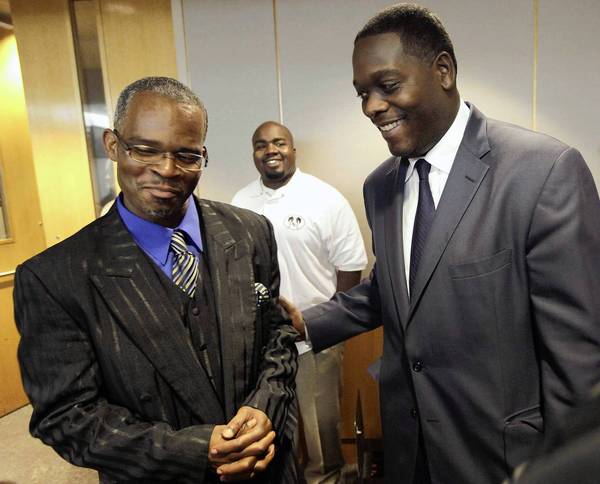
Profile of Heroic Dallas DA Craig Watkins…

From the Los Angeles Times:

DALLAS — On the way to witness his first execution in the town known as the “Execution Capital of the World,” the Dallas County district attorney stopped at the prison cemetery to find his great-grandfather’s grave.

Captain Joe Byrd Cemetery in Huntsville is the final resting place of inmates whose families could not afford burial anywhere else. Tall pines guard the grassy expanse nicknamed “Peckerwood Hill,” where many gravestones bear prison identification numbers, not names.

Dist. Atty. Craig Watkins scanned row upon row of gray crosses and headstones, making quick progress in his usual cowboy boots until he found the boxy stone belonging toRichard Johnson, dated Aug. 10, 1932.

Watkins knelt beside the grave in his suit.

Engraved next to Johnson’s prisoner number — 101 — was a telltale X. His great-grandfather had been executed.

His dual missions that day in February — paying respects, witnessing the execution — embodied how Watkins, Texas’ first African American district Continue reading

The Cost of a Brady Violation: Cuyahoga County Defends $42 Million Lawsuit

Cuyahoga County (OH) Prosecutor Bill Mason has hired Ned Searby, a former federal prosecutor, to defend the county and county officials in a $42 million dollar wrongful imprisonment lawsuit filed by Joe D’Ambrosio, who spent twenty years on death row before his conviction was overturned in 2006. A federal judge ruled that prosecutors had withheld evidence that might have exonerated him.

As establish in Brady v Maryland, prosecutors are obligated to turn over to the defense any evidence that might support the defendant’s innocence. Failure to do so is a Brady violation and can be reversible error, as it was in this case.

The Cleveland Plain Dealer reports here that Searby will charge the county no more than $745,000 for the defense legal fees.

D’Ambrosio, freed two years ago, was not acquitted of the murder, and the Continue reading

Chicago Prosecutors Blind to False Confession…

Press release from the Center on Wrongful Convictions at Northwestern University….

Dear Friends,

This morning’s Chicago Tribune carries an excellent front-page story by Steve Mills detailing how the Cook County State’s Attorney’s Office has been giving short shrift to evidence that CWC client Daniel Taylor is innocent of the 1992 double murder for which he is serving life in prison without parole.

Taylor’s conviction rested on a confession that quite obviously is false; he couldn’t have been involved in the crime because he was in police custody when it occurred. For details, see the Mills story:

http://www.chicagotribune.com/news/local/ct-met-murder-reinvestigation-20120507,0,6204252.story

As hard as it is for some people to believe that false confessions occur, they are in fact amazingly frequent. Since 1986, there have been 104 documented wrongful convictions in Illinois, and, counterintuitive as it may seem, more than half of those involved false confessions. For details, please see:

http://www.law.northwestern.edu/cwc/issues/causesandremedies/falseconfessions/FalseConfessionsStudy.html

Rob Warden, Executive Director

Wrongful Conviction Also Victimizes Victims

Convicted murderer Charles Wilhite has an unusual advocate: the niece of murder victim, Alberto Rodriguez. Marialyn—who requested that the Boston Globe not reveal her last name due to safety concerns—rallied in support of Wilhite on Saturday, May 5, 2012, in Springfield, Massachusetts, because she believes Wilhite was wrongfully convicted of killing her uncle.

As reported here, a key witness in the trial now claims that a Springfield detective and the assistant district attorney pressured his testimony. The witness has recanted his identification of Wilhite as the killer. A decision on whether or not his original testimony will stand is expected today from Hampden Superior Court Judge Peter A. Velis. Continue reading

Major Props for Virginia AG Ken Cuccinelli: Let’s Hope He’s the Next Jim Petro

Ken Cuccinelli

I wrote in this article about how Jim Petro, when he was the AG of Ohio, used his position not only to keep Ohio’s streets safe, but to fight for justice and the wrongfully convicted.  Since Petro left office in 2007, we have seen Craig Watkins, Dallas DA, fill that role in the context of a county prosecutor.  But we haven’t had another state AG step up to fill Petro’s shoes.

We just might be seeing the first contender in Virginia Attorney General Ken Cuccinelli.  Here are two articles (here and here), that explore his stance on justice, the Michael Hash case, and wrongful convictions generally.  They are worth a read.

One Petro-like thing Cuccinelli is promoting is amending Virginia’s post-conviction laws to make it easier for inmates to prove innocence when there is no DNA in their cases (raise your hand if the AG in you state would propose such a law).  Regarding this amendment, he has said:

To have to prove by clear and convincing evidence that no reasonable juror would find beyond a reasonable doubt that someone committed a crime is mind-numbing in the extreme……the process by which it’s handled and the hoops you have to get through, I think, are worthy of reconsideration,” said Cuccinelli, who backed Haynesworth’s bid for exoneration.

Here’s a quote from Cuccinelli about the Michael Hash case:

“I am a big fan of law enforcement … but I also believe we’ve set up systems that achieve justice. You don’t rely on the people in the system. James Madison said, ‘If men were angels we wouldn’t need Continue reading

Barry Scheck on Holding Bad Prosecutors Accountable…

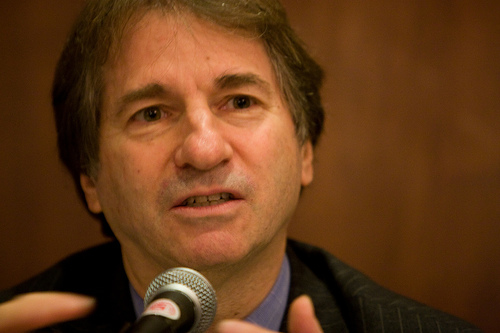
Innocence Project co-founder Barry Scheck

From source:

In February, Texas Supreme Court Chief Justice Wallace Jefferson affirmed the finding of state District Judge Sid Harle that there was probable cause to believe former Williamson County prosecutor Ken Anderson had violated the criminal laws of Texas by disobeying a court order to disclose evidence pointing to the innocence of Michael Morton, who in 1987 was wrongly convicted of murdering his wife. A court of inquiry will now try Anderson on these charges.

The case against Anderson (who is now a state district judge and denies wrongdoing in the Morton case) made national headlines because, as a recent article in the Yale Online Law Review thoroughly documents, our system rarely disciplines, much less brings criminal charges against, prosecutors who have engaged in acts of intentional misconduct. Far too often, prosecutors, who wield enormous power over our lives, aren’t investigated at all, even for intentional misconduct that has led to a wrongful conviction, much less “harmless” intentional misconduct in cases in which the defendant was guilty.

Texas appears to be no exception to the national pattern. The Innocence Project, the Northern California Innocence Project, Innocence Project of New Orleans and Voices of Innocence joined forces to investigate the problem of prosecutorial misconduct in Texas — no small task, given the lack of public data on the issue. In the end, the groups decided to review all of the published trial and appellate Continue reading

Colorado Prosecutor Says Exonerating the Innocent Part of Her Job….

Colorado in Spring…

From source:

Reviewing old convictions for cases where DNA might exonerate an inmate never seemed like defense-attorney work to Julie Selsberg.

On the contrary, the senior assistant attorney general said it squares perfectly with a prosecutor’s responsibilities.

“It’s may be unusual, but not when you really think about it,” Selsberg said. “A prosecutor’s mission is to seek the truth in all matters. That’s the kind of prosecutor I’ve always held myself out to be, and I was happy to see that Colorado aligned with my moral compass on that.”

Selsberg, a transplanted prosecutor from Manhattan, last week helped make Colorado history with the first prosecution-led exoneration of a wrongfully convicted man, Robert “Rider” Dewey.

She heads the Attorney General’s Office’s Justice Review Project, a small grant-funded endeavor that’s stretching into its third year. It’s just her and veteran investigator Larry Adkisson.

Together they reviewed nearly 5,000 cases of murder, sex assault and homicide, looking for a case such as Dewey’s, where new DNA technology could shed light on old convictions.

Without her work and the cooperation of Mesa County prosecutors, Dewey could have spent many more years behind bars.

The Robert Dewey Exoneration and Praise for the Colorado Attorney General’s Office…

Colorado’s wrongful conviction of Robert Dewey holds lessons

By Jason Kreag of the Innocence Project:

NEW YORK  —  During the nearly 18 years he was incarcerated for a rape and murder that DNA evidence finally proved he didn’t commit, Robert Dewey coped by imagining that he was riding a motorcycle. In his own words, “I’d hop on and ride in my mind.”

Eighteen years is a long time to fantasize about being on a bike, but it would have likely been an even longer ride had the Colorado state attorney general’s office and the Mesa County district attorney’s office not been willing to work with the Innocence Project and Dewey’s long-time counsel, Danyel Joffe, to reopen its investigation of the crime.

Dewey became a suspect in the 1994 rape and murder largely because the police found his actions suspicious. Although DNA testing done at the time excluded Dewey as the source of semen at the crime scene, pretrial DNA testing of his shirt seemed to indicate the presence of the victim’s blood on it. Even this evidence was not particularly strong; the analyst testified at trial that the blood on Dewey’s shirt was consistent with approximately 45 percent of the population. That was good enough for the jurors, who convicted Dewey despite any other substantial evidence of guilt.

We now know the system got it wrong. Robert Dewey is innocent. Unlike many of our clients, he was fortunate to have been assigned counsel to help with his post-conviction appeals. In 2007, the Innocence Project teamed up with Joffe and Continue reading

Saturday’s Quick Clicks…

  • Judge in Missouri says murder conviction of Mark Woodworth must be thrown out due to failure of police to make proper pretrial disclosures
  • Chicago exoneree Jarrett Adams graduates with honors from college
  • Article about eyewitness identification studies going on at the U. of Okahoma
  • Murder victim’s daughter, Caitlin Baker, supports new candidate over incumbent DA in Williamson County, Texas, because incumbent was involved in Michael Morton wrongful conviction and with failing to get the true perp who killed Baker’s mother
  • Thoughts on how to improve America’s prosecutorial system
  • John Lentini’s new article on arson investigation science
  • A concise article by Judge Nancy Gertner on the 2009 NAS Report on the problems in the forensic sciences
  • Life and death row and a profile of RAE (Resurrection After Exoneration)

Friday’s Quick Clicks…

  • Robert Dewey’s DNA exoneration early this week would never have happened if not for lucky preservation of the evidence; more on Dewey exoneration here
  • More on the Ohio Innocence Project’s attempts to exonerate Dewey Jones via DNA and other new evidence
  • Protests in Toledo, Ohio interrupt Prosecutor’s lunch; protestors want prosecutor to agree to release DNA for testing in Danny Brown’s case so that Danny, already exonerated, can confirm his innocence to a sufficient level for state compensation
  • Prosecutor in suburban Cincinnati faces criminal charges for intentionally altering an indictment in a case (adding gun specs)
  • Maryland Supreme Court’s decision that collecting DNA profiles from arrestees is unconstitutional may get appealed to SCOTUS
  • Canadian exoneree Romeo Phillion files $14 million lawsuit for wrongful conviction
  • New book focuses on risks of bringing back death penalty in UK
  • Update on the efforts by the Innocence Project to free Booker Diggins in New Orleans

Thursday’s Quick Clicks…

European Court of Human Rights Accepts Use of Anonymous Witnesses to Convict…

Yikes!  From web source:

THE killers of Northampton teenager Letisha Shakespeare have failed in a new bid for freedom after the European Court of Human Rights rejected their appeal against the use of an anonymous witness.

The case of Marcus Ellis and Rodrigo Simms was re-examined after their lawyers submitted their original trial had been unfair. It could have paved the way for a fresh appeal against their 2005 murder convictions, which saw them jailed for life.

Their lawyers claimed they did not receive a fair trial at Leicester Crown Court because a key witness, a convicted robber using the pseudonym Mark Brown, was allowed to give crucial and anonymous evidence against them.

The trial judge’s decision to allow the witness to give evidence from behind a curtain and with his voice electronically distorted “defied 1,000 years of common law in this country” and allowed for “a grave miscarriage of justice”, lawyers argued.

Gang members Nathan Martin, 26, Marcus Ellis, 24, Michael Gregory, 23, and Continue reading

Unbelievable: After Kerry Max Cook’s Long Battle For DNA Testing is Won, He Learns Murder Weapon is Contaminated Because Prosecutor Took it Home as a Twisted Souvenir

You can’t make this up.  From news source:

In a new twist for a case full of them, lawyers of Kerry Max Cook, the Dallas man sentenced to death for a gruesome rape and murder before being exonerated two decades later, are accusing a prosecutor in his case of taking home the murder weapon as a dark, twisted souvenir.

This accusation, part of a motion filed in Smith County, is part of Cook’s ongoing effort to officially clear his name and record after 35 years of being branded by the state as a murderer. Cook, who now lives in Dallas, pleaded “no contest” to a reduced murder charge in 1999 and reclaimed his freedom. As part of the plea agreement that freed him, he never admitted guilt. But legally, he is not recognized as innocent. His attorneys are now working to get a judge to rule on his innocence, and finally bring an end — one way or another — to his 35-year quest to clear his name.

Lately it’s been a mix of setbacks and small victories. A judge recently granted permission for DNA testing of new evidence, but refused a request that Smith County District Judge Christi Kennedy be recused from the case.

But on Monday they filed a motion to reconsider the judge’s denial based on new evidence — including, they claim, the revelation that the case’s original prosecutor, A.D. Clark, III, took home key evidence. That evidence included “the murder weapon — a blood soaked knife — and a sample of Mr. Cook’s hair,” Continue reading

Crime-lab scientist claims she was fired for blowing whistle on errors

A fired whistleblowing forensic scientist in Texas claims in a lawsuit that her problems at the Austin Police Department’s crime lab started when she sent a corrected blood-alcohol-level test to the lawyer representing a man charged with intoxication assault.

The suit filed in Travis County District Court last Friday by Debra Stephens says that state law required her to report the corrected amount, but department officials told her that was a violation of lab policy.

Stephens, who worked for the lab for nine years until she was fired in 2011, later filed a complaint against the lab with the Texas Forensic Science Commission for allegedly cutting corners during drug-evidence testing.

Stephens claims that police and city officials subsequently spread false information about her that damaged her reputation, according to an article in the Austin American-Statesman. More details about Stephens’ allegations of mishandled evidence is covered here.

Stephens’ claim of retaliation for exposing lab errors mirror those made in 2009 by Chris Nulf, a former forensic analyst with the Dallas County Crime Lab. Nulf filed an ethics complaint in April against Williamson County District Attorney John Bradley, claiming that Bradley and others on the Forensic Science Commission failed to properly investigate his complaints of negligence and misconduct at the Dallas lab.

AG of Virginia Joins with U. of Virginia Innocence Clinic in Asking for Exoneration…

Virginia AG Ken Cuccinelli

From the Associated Press:

RICHMOND (AP) — Attorney General Ken Cuccinelli is asking the Virginia Supreme Court to exonerate a James City County man wrongfully convicted of rape in 1978.

The Richmond Times-Dispatch reports that Cuccinelli asked the court on Tuesday to expedite a writ of actual innocence for 56-year-old Bennett S. Barbour.

Barbour’s lawyers with the University of Virginia School of Law’s Innocence Project Clinic requested the writ in March.

Barbour was convicted of raping a College of William and Mary student in Williamsburg. DNA tests conducted in 2010 on material from the case didn’t find Barbor’s DNA. The tests identified the DNA of another man, James Moses Glass Jr.

Glass is scheduled to stand trial Aug. 22.

More here

Public Records Access Laws at the Foundation of Innocence Work, Democracy…

I’ve dealt with public records access laws my entire career.  As a prosecutor, I had to respond to public records request from news media from time to time (or more accurately, as I was taught,I had to come up with some reasonable-sounding explanation as to how the case might still be considered “open” so we wouldn’t have to turn over the records).

And I’ve sent out my fair share of public records request letters over the past decade while doing post-conviction innocence work for the Ohio Innocence Project.

But at no time in my career have I better understood or appreciated the deep importance that public record access laws have on our system than right now.  Two things have brought the importance of these laws to the forefront in the past year or two. Continue reading

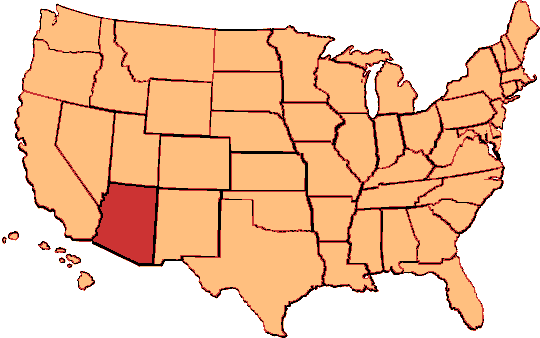
New Study Released Today On Prosecutorial Misconduct in Arizona…

From the crimereport.org:

A coalition of innocence projects, legal experts and wrongly convicted defendants will announce today that a study of prosecutorial misconduct in Arizona from 2004 through 2008 found prosecutors committed error in 20 cases.

The coalition—which includes The Innocence Project of New York, along with Veritas Initiative, a policy and research arm of theNorthern California Innocence Project, as well as Innocence Project New Orleans and Voices of Innocence—is convening in Arizona in the latest stop in a national tour aimed at exposing prosecutorial misconduct and initiating reform.
In 15 of the cases, the finding of error was deemed “harmless” and the convictions were upheld. In five of the cases, the errors were ruled to be “harmful” and the convictions were reversed.
During that same time period, three prosecutors were publicly disciplined by the State Bar of Arizona, but none of the prosecutors in the 20 cases found by Veritas were subject to any discipline.
One of those three prosecutors  disciplined was Kenneth Peasley— once considered the most feared prosecutor in Pima County, Arizona, where he won  conviction after conviction, some of which sent defendants to Death Row.
Keep reading here….

Monday’s Quick Clicks…

  • Nice profile of Talbot “Sandy” D’Alemberte, the founding Chairman of the Innocence Project of Florida
  • A blogger’s recap of the Wrongful Convictions conference in New York last week
  • Discussion of the distinction between the developments of the Innocence Movement in the U.S. and the UK
  • New website, mccleskyvkemp.com, provides information about the ongoing crisis of race in criminal justice and offers information about specific activities that individuals and organizations can take to repeal the death penalty and ameliorate the racial disparities in the criminal justice system; more here
  • This blog has reported extensively about the prosecutorial misconduct in the Senator Ted Stevens case; but is he nonetheless guilty?

Mid-Atlantic Innocence Project Has Important Hearing Today in Brady Case…

From the Washington Post:

The brutal crime gripped the District: a mother of six fatally beaten, robbed and sodomized with a pole as she walked in her Northeast neighborhood on Oct. 1, 1984.Authorities linked the attack to members of a street gang called the Eighth and H Crew. Seventeen of them were arrested, two pleaded guilty in the death of Catherine Fuller, 48, and eight were convicted of first-degree murder in 1985.

On Monday in D.C. Superior Court, a judge will begin hearings to determine whether those convicted should get a new trial — or even be exonerated.
Evidence that wasn’t presented to defense attorneys before the trial “undoubtedly undermines confidence” in its outcome, an attorney wrote in a recent court filing.The men convicted, now in their mid-40s, were Kelvin Smith, Steven L. Webb, Levy Rouse, Clifton Yarborough, Timothy Catlett, Russell Overton and brothers Charles and Christopher Turner.

Webb, who wept and repeatedly claimed innocence during his sentencing in 1986, died in prison. Christopher Turner, who also maintained his innocence, was paroled in 2010 for good behavior after more than 25 years behind bars, according to an attorney familiar with the case.

Prosecutors outlined a horrific scenario during the trial: Fuller, a cleaning woman, left her K Street NE home on a rainy afternoon to fill a prescription. The suspects, then 17 to 21 years old, were smoking marijuana and listening to go-go music at a nearby park.

A group of about 30 confronted Fuller, prosecutors say. She was grabbed from behind and pushed into an alley, where she was beaten and a two-inch-thick metal pole was shoved into her rectum.

Her liver was shattered, a lung was punctured and four of her ribs were broken, according to authorities. Her body was found in a garage in the same alley that evening.

After the trial, defense attorneys examined hundreds of pages of previously unavailable grand jury testimony and discovered that several witnesses identified three other people who were either seen in the alley at the time of the attack or had allegedly confessed to the attack to friends.

Several witnesses told authorities they saw James McMillan, who house-sat on the alley where Fuller was killed. McMillan, now 46, is serving a life sentence in a Virginia prison for another deadly attack on a woman.

That information, defense attorneys argue, was known to detectives and prosecutors but not shared before the trial. Attorneys for Christopher Turner and the six men still in prison, with the assistance of the Mid-Atlantic Innocence Project and nearly a dozen volunteer criminal defense lawyers, began working for a new trial in 2010.

Full article here….