Category Archives: Reforming/Improving the system

Prosecutors Have All the Power

Mara Leveritt is a journalist and author who wrote the book Devil’s Knot, which was subsequently made into an award winning movie.  The book chronicles the case of the West Memphis Three, in which three young men were wrongfully convicted of the gruesome 1993 multiple murder of three eight year old boys.  See previous WCB posts on the West Memphis Three here and here and here.

In 2007, DNA and hair evidence recovered from the crime scene excluded all three of them.  A deal was struck with the prosecutor whereby the three were released from prison in 2011 (after 18+ years), but only after entering an Alford plea.  In an Alford plea, the defendant maintains his/her innocence, but concedes that the prosecution’s evidence would likely be enough to convince a judge or jury of guilt.  (Editorial Note:  In this editor’s opinion, the Alford plea is nothing more than a gimmick built into the justice system system that gives prosecutors an avenue to back out of a case while saving face.  It does nothing to change the facts of the case.  Just my opinion.)

Ms. Leveritt has recently taken on the responsibility of Director of the Center for Prosecutor Integrity‘s Wrongful Convictions Academy, which is brand new, and is just spinning up.  She is an Arkansas native, and has also authored a recent article about prosecutorial misconduct and the attendant lack of accountability and sanctions in Arkansas –  Prosecutors Have All the Power.  In the article she states, “Despite documented misconduct, especially Brady violations, no prosecutor in this state has been sanctioned in the past 25 years.”  While this article is Arkansas-specific, it can be applied to the situation nationwide in general.

SBS Documentary “The Syndrome” – Interview with the Producer

We posted here on the WCB about the new SBS Documentary The Syndrome a few days ago.  See that post here.

As I hope you all know, Sue Luttner is the editor of the blog OnSBS.  Sue was recently able to conduct a phone interview with the producer of The Syndrome, Susan Goldsmith, and posted about it here.


QUALIFIED Immunity for Prosecutors?

In the US, prosecutors have absolute immunity from civil suits brought by defendants whom they have wronged.  This has resulted in yet another manifestation of “absolute power corrupts absolutely,” and has encouraged prosecutors to break the rules in pursuit of convictions.

The Center for Prosecutor Integrity has been doing fundamental work in addressing the issue of prosecutorial accountability, and they have just published a new white paper titled Qualified Immunity: Striking the Balance for Prosecutor Accountability.  You can see that white paper here: Qualified-Immunity.

These excerpts from the paper – tracing the origins of absolute prosecutorial immunity in the US Supreme Court case of Imbler v. Pachtman:

“In 1976 the High Court handed down the long-awaited decision. Wary that prosecutors would be tempted to “shade” their prosecutorial decision-making under threat of a lawsuit, the Supreme Court held in Imbler v. Pachtman that prosecutors are unconditionally protected from civil liability as long as these actions were performed within the scope of their “advocative” duties.”

“Without a single dissenting vote, America’s highest court erected the doctrine of absolute prosecutorial immunity as the law of the land for prosecutors engaged in their advocative role.”

“By removing a key accountability mechanism and inducing an over-reliance on criminal proceedings and bar disciplinary actions, the Imbler decision unwittingly contributed to a culture of professional non-accountability. Without any meaningful prospect of enforcement, the ethical codes’ ability to accomplish the goals of punishment and deterrence has become, for all practical purposes, eviscerated.”

Adding Balance and Transparency to the Plea Bargaining Process

The Hon. Jed Rakoff — U.S. District Judge, Federal District Court in Manhattan — has expressed concern over the fairness and accuracy of outcomes resulting from plea bargaining. In the United States, plea agreement negotiations have become the resolution mechanism for the vast majority—more than 95 percent—of federal and state criminal cases. The judge believes that the process contributes to an unacceptable number of innocent people pleading guilty to crimes they did not commit.

“We have hundreds, or thousands or even tens of thousands of innocent people who are in prison, right now, for crimes they never committed because they were coerced into pleading guilty,” Judge Rakoff said at the University of Southern California Gould School of Law’s annual Neiman Sieroty Lecture earlier this year. Read an article in USCNews on his comments (here).

The judge noted in an article in the New York Daily News (here), “The current Continue reading

A Little More on Militarization of the Police

MPolice

According to the latest data from the National Registry of Exonerations, 46% of wrongful convictions have “official (including police) misconduct” as a contributing cause.  The state bestows official “police powers” upon the police, which does, in fact, make them very powerful; and most police misconduct is manifested in the form of abuse of power, rather than simple error.  In recent years, we have, increasingly, given the police not just “police power” but “military power.”  As Lord Acton so insightfully stated in 1887, “Power tends to corrupt, and absolute power corrupts absolutely.”  Giving military power to police brings them that much closer to absolute power, and that power becomes easier and easier to misuse.  This is compounded by the fact that the police have a demonstrated history of not being good at “policing” themselves, and official police oversight is perfunctory.  Police departments will claim to have “internal affairs” divisions.  I submit this like having the fox watch the henhouse, and they apparently don’t work, because police misconduct persists, and “official misconduct” continues to contribute to 46% of wrongful convictions.

See our previous WCB post about the militarization of police here.

Everyone has recoiled at what has recently transpired in Ferguson, MO.  A recent NY Times article relates events in Ferguson to the militarization of police:  here.

This all started in 1990 with Section 1208 of the National Defense Authorization Act passed by Congress.  In 1996 Section 1208 was replaced with the Section 1033 DOD program, which is still in place today.  And with the 1033 program in place, the wind down of the Iraq war opened the floodgates of military equipment available to police departments.  See the Newsweek article How America’s Police Became an Army: The 1033 Program.  See also the NY Times article War Gear Flows to Police Departments.  While this was certainly well intentioned, the legislators failed to grasp the psychological impact this would have on the people who would actually be using the equipment.

All the military equipment and fire power is scary, but all that stuff is really just an “enabler.”  What’s really scary is what’s going on in the brains of the cops.  They seem to be increasingly adopting a “battlefield” mindset – vanquish the enemy – and giving them MRAP’s and M-16’s substantially reinforces that state of mind.  Plus, if the police have all this stuff, of course they’re going to want to use it.  For example, we’ve seen the evolution of  excessive use of SWAT teams.  SWAT teams have been around since the 1960’s, but SWAT teams are now commonly used to perform such routine functions as serving warrants and making simple arrests.  There was a recent (Feb. 2014) debate between Radley Balko, Washington Post investigative reporter and author of “Rise of the Warrior Cop,” and Maricopa County (AZ) Attorney Bill Montgomery about the militarization of our domestic police. During this debate, Mr. Montgomery stated, “These ‘elite’ officers have to stay sharp and on alert. They have to practice.”  Practice by having a SWAT team storm a young mother’s home at 3:00 AM to serve a warrant and make an arrest?  Might I suggest this is “over the top?”

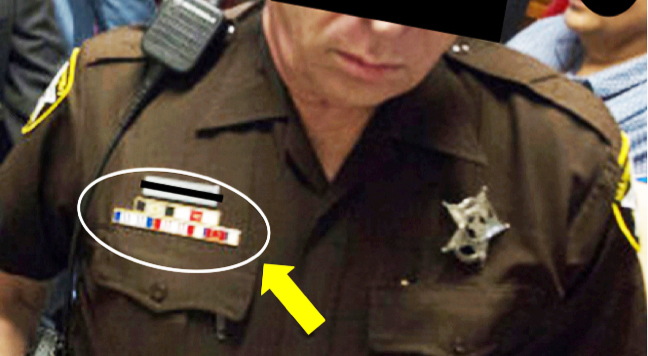
As an example of “military mindset,” I was recently startled by a news photograph of a police officer with what appears to be military style campaign ribbons on his uniform.  Campaign ribbons?  On a police uniform?  What’s up with that?  If this isn’t an indicator of a military mindset, what is?

Police Campaign Ribbons

If the situation calls for military intervention, then call in the National Guard.  That’s what they’re for.  But we just can’t have the “military” patrolling our streets and enforcing the law on a routine basis.

New Shaken Baby Syndrome Documentary – “The Syndrome”

A new, compelling documentary on the junk science of shaken baby syndrome, titled The Syndrome, will premiere at the Kansas Film Festival in October, 2014.

Synopsis:  The Syndrome tells the story of a group of doctors who say that shaken baby syndrome, the basis of hundreds of criminal cases every year, is not scientifically valid. The film focuses on three key doctors: A Georgetown University neurosurgeon, a former Minnesota state medical examiner, and the head of Stanford University’s Pediatric Neuroradiology Department. These doctors are part of a growing scientific movement coming to the defense of the some thousand people in prison for shaken baby. In an unprecedented criminal justice crisis, promoters of shaken baby syndrome are not backing down.

Watch the trailer here.

Editorial Comment:  Of course the promoters of this medical voodoo are not backing down.  For them, SBS has been their source of livelihood, notoriety, and power.

The Innocent on Death Row – NY Times Editorial

We (Martin Yant) recently reported here on the WCB about the North Carolina exoneration of death row inmate Henry Lee McCollum.  McCollum’s exoneration has prompted a highly compelling editorial by the The NY Times editorial board.  That editorial with active links appears here.  It appears below without embedded links (bolding emphasis is mine):

The Innocent on Death Row, by THE (NY Times) EDITORIAL BOARD, September 3, 2014

The exoneration of two North Carolina men who spent 30 years in prison — one on death row — provides a textbook example of so much that is broken in the American justice system. And it is further evidence (as though more were needed) that the death penalty is irretrievably flawed as well as immoral.

In late September 1983, an 11-year-old girl named Sabrina Buie was found murdered in a soybean field in Robeson County. She had been raped, beaten with sticks and suffocated with her own underwear.

Within days, police got confessions from two local teenagers, Henry Lee McCollum, 19 at the time, and his half brother, Leon Brown, who was 15. Both were convicted and sentenced to death.

The crime was so horrific that it has echoed for decades through North Carolina politics and beyond. In 1994, after Justice Harry Blackmun of the Supreme Court announced that he opposed capital punishment in all circumstances, Justice Antonin Scalia cited the Buie murder as a case where it was clearly warranted. “How enviable a quiet death by lethal injection compared with that!” he wrote.

On Tuesday, a state judge ordered both men freed after multiple pieces of evidence, some of which had never been turned over to defense lawyers, proved that neither Mr. McCollum nor Mr. Brown was responsible for the crime. DNA taken from a cigarette found at the crime scene matched a different man, Roscoe Artis, who is already serving life in prison for a similar murder committed just weeks after Sabrina Buie’s killing.

Virtually everything about the arrests, confessions, trial and convictions of Mr. McCollum and Mr. Brown was polluted by official error and misconduct.

No physical evidence linked either man to the crime, so their false confessions, given under duress, were the heart of the case the prosecutors mounted against them. Both men’s confessions were handwritten by police after hours of intense questioning without a lawyer or parent present. Neither was recorded, and both men have maintained their innocence ever since.

Equally disturbing, Mr. Artis was a suspect from the start. Three days before the murder trial began, police requested that a fingerprint from the crime scene be tested for a match with Mr. Artis, who had a long history of sexual assaults against women. The test was never done, and prosecutors never revealed the request to the defense.

It was not until 2011 that the North Carolina Innocence Inquiry Commission, an independent state agency that had taken on the men’s case, discovered the old fingerprint request. The commission also found that multiple statements in the two confessions were inconsistent with each other and with the facts of the crime. In July, the commission finally got the full case file and matched the DNA to Mr. Artis.

None of these pieces mattered to the prosecution in 1984. The prosecutor on the case, Joe Freeman Britt, was listed in the Guinness Book of World Records as the “deadliest prosecutor” for the nearly 50 death sentences he won during his tenure. Almost all have since been overturned.

Mr. McCollum and Mr. Brown, who are now middle-aged, have a hard road ahead. In addition to the difficulties of adapting to life after three decades behind bars, both are intellectually disabled. (Since their conviction, the Supreme Court has banned the death penalty for both juveniles and those with intellectual disabilities.)

Cases of capital prosecutions based on flimsy evidence or marred by prosecutorial misconduct, not to mention racial bias, are distressingly common. Yet, even as death-penalty supporters insist that only guilty people are sent to their death, it is now clear that Justice Scalia was prepared 20 years ago to allow the execution of a man who, it turns out, was innocent.

How many more remain on death row today? Can the American people be assured that none will be killed by the state? For this reason alone, the death penalty must end.

A version of this editorial appears in print on September 4, 2014, on page A26 of the New York edition with the headline: The Innocent on Death Row.


A Case for Mercy and Discretion in Criminal Justice

“I have always found that mercy bears richer fruits than strict justice.”

– Abraham Lincoln

So-called tough-on-crime policies in the United States over several decades have resulted in unanticipated changes in the criminal justice system that most Americans probably do not fully realize. Mandatory sentencing, policies such as “three strikes,” and increasing use of plea bargaining as opposed to jury trials have prompted an explosion in the prison population and unprecedented prosecutorial authority. With all due respect to those prosecutors who serve us well, we now know that increased power and immunity from abuses have enabled prosecutorial misconduct, a significant contributor to wrongful convictions.

While the Innocence Project and other organizations work to correct miscarriages and prevent others, and new models such as conviction integrity units seek to address the failure of the appeal process to correct conviction errors, a recent case demonstrated the appropriate use of an intact but rarely used remedy: mercy and discretion by public officials.

These capacities once broadly utilized by judges in sentencing may be the most efficient way to cure injustices whether wrongful convictions or unfair sentencing. In a recent illustration, no one questioned the guilt of Francois Holloway. The New York Times reported (here) and (here) that he was charged in 1995 with three counts of carjacking and using a weapon during a violent crime (he did not carry a gun but his accomplice did).

When the government prosecutor offered Holloway a plea deal with a prison term of 11 years, he declined. Holloway’s lawyer assured him that he would win at trial.

His attorney was wrong. Continue reading

Eyewitnesses Are Often Wrong

We’ve commented before on this blog about how unreliable eyewitness testimony can be — see here, here, here, and here.

The US justice system gives great credence to eyewitness identification, and an eyewitness identification will even trump an airtight alibi in court.  But according to the most recent data from the National Registry of Exonerations, false or mistaken eyewitness identification is a contributing factor in 36% of wrongful convictions:

NRE graph

Here is a brief CNN clip, featuring cognitive psychologist Prof. Elizabeth Loftus of the University of California, Irvine and the University of Washington, giving some examples of faulty eyewitness testimony: Eyewitnesses Are Often Wrong.

If you would like a real “eye opener” on the subject, I recommend the book Picking Cotton by Ronald Cotton and Jennifer Thompson-Cannino.  The book details an instance in which the victim had close, lengthy, one-on-one contact with the perpetrator, and still got the eyewitness identification wrong – multiple times.


25th Anniversary of First DNA Exoneration in the U.S.

Last week marked the 25th anniversary of the first DNA exoneration in the U.S.  Professor Daniel Medwed reflects:

Twenty-five years ago today, an Illinois court overturned Gary Dotson’s conviction for rape and aggravated kidnapping after DNA tests performed on the biological evidence in the original rape kit excluded him as the perpetrator. This was the first exoneration of an innocent prisoner in this country based on post-conviction DNA testing, and it was not the last. According to data compiled by the Innocence Project in New York City, post-conviction DNA evidence has since yielded 316 other exonerations in the United States.  

Relatively simple fixes can decrease the risk of error in a criminal case….Many states have yet to install these reforms.

What have we learned from these DNA exonerations? Scholars have examined these cases in search of what went wrong. Among the chief contributors to the conviction of an innocent defendant are: eyewitness misidentifications; false confessions; poor decision-making by police and prosecutors; ineffective assistance of defense counsel; and the use of dubious forensic science. Relatively simple fixes can decrease the risk of error in a criminal case. These include: altering the manner in which eyewitness identifications occur; videotaping police interrogations; and asking prosecutors to use checklists to ensure they comply with their constitutional obligations. Many states have yet to install these reforms.

Beyond DNA exonerations, there is the issue of wrongful convictions that cannot be overturned with DNA testing. Biological evidence such as blood, saliva, skin cells and semen is found in only an estimated 10 to 20 percent of criminal cases. What’s more, this evidence is occasionally lost, destroyed or degraded.

Even when biological evidence is available, prosecutors and other law enforcement officials are not always forthcoming in disclosing it to the defense. Add to this the hurdle of testing the evidence in compliance with legal requirements, and the challenge of proving a wrongful conviction using DNA technology is even greater.

For this reason, DNA testing has not and cannot solve the problem of wrongful convictions.  The same factors that led to the initial miscarriages of justice in the DNA exonerations appear in cases without any available biological evidence. Absent the authority of science, it is exceedingly difficult to overturn a wrongful conviction in these so-called non-DNA cases. Attorneys litigating them must often rely on subjective evidence of innocence. In doing so, they tend to encounter strict time limits, cumbersome burdens of proof and the pervasive skepticism of prosecutors and judges.

Absent the authority of science, it is exceedingly difficult to overturn a wrongful conviction in these so-called non-DNA cases.

The next phase of work in this field, then, is to implement lasting reforms to bolster accuracy in all criminal cases and to make it easier to present non-DNA innocence claims in post-conviction proceedings.

It may be fair to say that the Dotson exoneration a quarter century ago helped launch a revolution in criminal law: a legal, political and social campaign to rectify injustices that some have labeled a civil rights movement for this century. This revolution is far from over.

Sex Offender Registries (SOR’s): TIME-FOR-A-CHANGE

registry swamp

Editor’s Note:  Although this article is clearly editorial in nature, it contains a substantial amount of fact and data that have direct bearing on the subject.  It’s also a long article, and I hope you’ll have the patience to read it through to the end.

The article is in five sections:

The History of Sex Offender Registries in the US

Sex Offender Registries are Manifestly Unjust

Sex Offender Registries Don’t Work

Sex Offender Registries Cost a Lot of Money

Conclusion

Continue reading

Militarized Police

The militarization of police scares the hell out of me.

How about you?

This from the NY Times: Get the Military Off of Main Street.

Dredging the Prosecutorial Muck in Orange County

From the OC Weekly:

Superior Court Judge Thomas M. Goethals, is set to issue an Aug. 4 ruling about whether prosecutors in the Orange County (CA) district attorney’s office (OCDA) and local law enforcement, including OCSD (Orange County Sheriff’s Department) deputies, cheated in hopes of securing the death penalty for Scott Dekraai, the shooter in the 2011 Seal Beach salon massacre — and, if so, what penalties should be imposed.

This is subsequent to a three-justice panel at the California Court of Appeals based in Santa Ana observing that jail deputies at the Orange County Sheriff’s Department (OCSD) “engaged in abhorrent conduct and were derelict in their duties.”  That is:  committing perjury; doctoring logs; unnecessarily firing weapons at inmates sitting on toilets; ignoring medical emergencies; bolstering the power of incarcerated organized-crime bosses; encouraging inmate-on-inmate violence; and spending work hours running private businesses, sleeping, surfing the Internet, watching TV or texting love interests.

Read the OC Weekly story here.

A Blog on Junk Science Forensics – At Last!

cropped-bowers_capitol-small1

Here at the WCB, we’ve posted many, many articles dealing with the highly questionable scientific validity of most all forensic disciplines.  I’m very happy to report that there is now a blog dedicated to that issue.

Dr. Michael Bowers is a practicing dentist and forensic odontologist in Ventura, CA, and a long time forensic consultant in the US and international court systems. His newest book, “Forensic Testimony, Science, Law and Expert Evidence” with Elsevier/Academic Press is available on Amazon.

Dr. Bowers has some refreshing and insightful views on the validity of forensics, and maintains a blog addressing the “junk science” that so many in the justice system refer to as “forensic science.”  Please visit that blog here: Forensics in Focus.

[Editor’s note:  I, personally, refuse to call them forensic sciences.  They are not sciences.  Technologies? Disciplines?  Perhaps, but they’re not sciences.]

PS:  I have reviewed Dr. Bowers’ new book Forensic Testimony – Science, Law, and Expert Evidence, and you can read that review here.  I highly recommend it.

Robbery, Kidnapping, Extortion — and This Is the Police!

What can I say?

See the Philadelphia Inquirer story here.

Fire Science and SBS? Yes – The Child Abuse Experts Can Learn From This

Sue Luttner, editor of the blog OnSBS, has posted an article that points out the parallels between “old” and discredited arson science and the situation with child abuse experts who are stuck in a paradigm paralysis regarding shaken baby syndrome (SBS).

‘Hats off’ to Sue, because the parallels had never struck me before, but they are incredibly close.

Please see Sue’s article here.

Botched Execution in Arizona

Joseph Wood was put to death by the state of Arizona yesterday.

“It took one hour and 57 minutes for the execution to be completed, and Wood was gasping for more than an hour and a half of that time.”

See the AOL story here.

New Scholarship Spotlight: In Defense of American Criminal Justice

The Honorable J. Harvie Wilkinson III of the U.S. Court of Appeals for the Fourth Circuit has published the above-titled article in the Vanderbilt Law Review.  It argues that the system is not nearly as broken as many critics allege, some convictions of innocents is part of a necessary trade-off, and that the reforms pushed by the Innocence Movement often go to far.

Have a read here.

17, on Death Row …. and Innocent

Shareef Cousin was once the youngest person in the US on death row.

His case is yet another example of how mistaken (or false) eyewitness testimony can override an airtight alibi.  And this one was also compounded by a Brady violation regarding the eyesight of the witness, a lying detective, and coerced snitch testimony.

Cousin has recently authored a CNN article decrying the death penalty.

This quote from the article:  “It is hard to argue that the death penalty is applied fairly. Take it from me, someone who lived alongside guys on death row: The system does not identify and sentence “the worst of the worst” to death — just the most powerless.”

You can read the CNN article here.

Justice System Reform – Why We Can’t Get it Right. It’s All About Root Cause.

“Chicago police call for tougher penalties for firearm offenses after dozens of people were shot over holiday.”

You may have heard that dozens of people were shot in Chicago over this recent 4th of July weekend.  I just saw the headline above, which is the response from the Chicago police to the tragic weekend.  What struck me immediately is that this reaction is so stupidly human.  But sadly, it’s human nature.  To most, it would appear to be a quick-response, expedient solution to a terrible problem; and it’s the expediency of this “solution” that makes it attractive to both the politicians who make the laws and the constituency that elects them to office. The belief is that we can pass a law, make the penalties harsher, and then say, “There, we solved THAT problem.”  But guess what?  This will NOT solve the problem, and it NEVER will.  The US justice system has a culture of “punishment” and “revenge”.  We always seem to believe that the threat of more severe punishment will serve as a deterrent to future evil-doers.  The standard political response to the problem of “crime” has always been more cops, more prisons, and tougher sentences.  Well … the US already has the most draconian sentencing laws in the world, and yet, even though we have only 5% of the world’s population, we have 25% of the world’s prisoners (see Convictions  by the Numbers).

Doesn’t seem like super-tough sentences have done much to stem the US crime problem, does it?  And we know this.  Yet we, as an electorate, keep insisting from our legislators that there be more cops, more prisons, and ever tougher sentences.  It’s gotten to the point of being downright silly – tragic but silly.

So what should we do?  To fix any problem, you have to understand, and deal with, the root cause.  Unless you eliminate the root cause, the problem will not go away.  You can try to treat the symptoms of the problem (e.g. gun deaths in Chicago), but the problem will persist.  And I don’t believe we even know and understand what the root cause(s) of most crime are. I would expect that they’d have something to do with things like poverty, education, discrimination, culture, mental health issues, and more.

[Editorial observation:  I suspect that so-called “crimes of passion” are something that will always be part of the human condition, and we’re just stuck with them.]

Unfortunately, dealing with root cause is much, much more difficult than dealing with the obvious symptoms of a problem, and I believe this is largely why it doesn’t get done.  It takes lots of time, lots of money, and lots of effort – and who wants to do that when you can just pass a law making sentences harsher, and then tell yourself you’ve just addressed the problem?  It is absolutely human nature to jump to what seems to be the quickest, easiest solution, despite the fact that the “solution” may not cure the problem at all.

There ARE systematic ways to uncover root cause.  They involve structure, process, and data.  Please see our previous post on Six Sigma.  Root cause is at the very core of what Six Sigma is all about.  Unfortunately, given our justice system and our processes for enacting laws, I see no feasible way root cause analysis and corrective action could be applied to the US justice system – at least certainly not within my lifetime.  I expect that we’re just going to have to continue stumbling along with our electoral and legislative processes, and hope that some day enough voters and enough legislators eventually “get it.”