Category Archives: Reforming/Improving the system

Eyewitness Rules Ignored – Wrongful Convictions Result

eyeIt has been heavily documented that eyewitness misidentification is the single largest contributing cause of wrongful conviction.  The reasons for this are many, and range from the vagaries of how the human brain works, to the procedures used by law enforcement for establishing an eyewitness identification.  In court, an eyewitness identification will even trump a rock solid alibi, so it’s important to do everything possible to ensure the integrity of eyewitness identifications.  There’s not a lot we can do about the vagaries of the human brain, except try to understand how they impact a person’s memory and perception.  But there are lots of things we can do about how police go about establishing an eyewitness ID.  Federal guidelines have been issued, and a number of states have taken steps to improve the process, including mandating  the use of “blind” administration of lineups.  It seems, however, that what’s being done in practice is lagging far behind what’s being recommended or required.  A recent article by Kevin Johnson in USA TODAY brings this point home:

WASHINGTON — More than four out of five police agencies in the U.S. have no written policies for handling eyewitness identifications despite long-standing federal guidelines, according to a report obtained by USA TODAY.

The findings in the National Institute of Justice report, come as flaws in eyewitness identification represent the single greatest cause of wrongful conviction, contributing to 75% of convictions overturned through DNA testing, according to the Innocence Project, which uses DNA testing to challenge criminal convictions.

The report, which was produced for the Justice Department’s research arm by the Police Executive Research Forum, is the first national assessment of eyewitness identification standards. In it, 84% of police agencies reported that they had no written policy for conducting live suspect lineups, and slightly more than 64% said they had no formal standard for administering photo displays of potential suspects.

Read the full story by Kevin Johnson of USA TODAY here.

Shaken Baby Syndrome – Where Are We? – A Reality Check

The task of bringing true science to bear on the issue of shaken baby syndrome has proven to be incredibly difficult.  Progress has been meager and slow, and for those committed to seeing that true justice is done in these cases, the work is extremely frustrating.  The extant pediatric medical community continues to wrap itself ever tighter in their beliefs in the medical folklore that has resulted in so many wrongful convictions based upon rigid, unyielding diagnostic dogma that has been discredited.  For background on the SBS problem, please see previous WCB posts herehere, here, herehere, here, and here.

Dr. Steven C. Gabaeff is a California physician who has specialized in child abuse cases, and is a member of the Los Angeles Superior Court Expert Witness Panel.  Dr. Gabaeff is also one of those rare medical practitioners who is board certified in Emergency Medicine, and who understands the flaws in the currently prevailing views of SBS.  He recently responded to an SBS online bulletin board posting concerning an article about a man who has been charged for a second time with  infant abusive head trauma.  I believe that his response provides an insightful view of what the situation is today, and also reveals some of the frustration that so many of the people who are dedicated to this cause have to deal with.  That response is posted here with his permission.

___________________________________________________

Regarding the case … the likely etiology of the problems with the second newborn was perinatal subdural hematoma rebleed from moderate trauma, and probably other treatment failures that would never see the light of day in an article like this in the newspaper, that resulted in severe brain damage.

What can he do?  He should have moved to another country… until we solve this.

Most of the time we look like Don Quixote, and unfortunately we are not addressing the issues here on the scale required. The authorities’ MO (modus operandi) has not changed an iota in 40 years: they diagnose abuse and only abuse, repress contradictory evidence, and abuse their ill-gotten authority to accuse, convict, intimidate, and to clone a new generation prescreened to be the same or better at executing the same conviction-producing MO as the old timers. There really isn’t that much evidence that what we’re doing is preventing what happened to this guy already or even what will happen to him in the near future.

Continue reading

New Scholarship Spotlight: Judicial Gatekeeping of Suspect Evidence: Due Process and Evidentiary Rules in the Age of Innocence

findley_profile_resize-1Wisconsin Professor Keith Findley has posted the above-titled article on SSRN.  Download full version here.  The abstract states:

The growing number of wrongful convictions exposed over the past two-and-a-half decades, and the research that points to a few recurring types of flawed evidence in those cases, raise questions about the effectiveness of the rules of evidence and the constitutional admissibility standards that are designed to guard against unreliable evidence. Drawing on emerging empirical data, this Article concludes that the system can and should be adjusted to do a better job of guarding against undue reliance on flawed evidence. The Article first considers the role of reliability screening as a constitutional concern. The wrongful convictions data identify what might be called “suspect evidentiary categories” — a few types of evidence (eyewitness identifications, confessions, forensic science, and snitch testimony) that are both recurring features of wrongful convictions and not otherwise susceptible to correction through traditional trial mechanisms and that, therefore, can and should be subjected to heightened scrutiny for reliability under the Due Process Clause.

Recognizing, however, that the Supreme Court is moving away from using constitutional doctrine to screen for reliability, this Article considers other mechanisms for better ensuring reliable evidence and accurate trial outcomes. First, current trends in Supreme Court jurisprudence suggest a due process framework that focuses upstream of the trial process on regulating the police and prosecutorial conduct that generates some of the most suspect trial evidence. Second, the Article assesses new applications of non-constitutional evidence law that offer promise for filling the void in reliability review of such suspect types of evidence. Finally, the Article considers remedies in addition to exclusion that might aid in the enterprise of mitigating the harm from flawed evidence. Principal among these are broader use of expert witnesses and jury instructions to educate fact finders about the counter-intuitive but scientifically established qualities of these categories of suspect evidence. And because courts have proven reluctant to apply reliability-based exclusionary rules rigorously, the Article concludes by exploring partial exclusion — excluding the most objectionable parts of the evidence while permitting other parts — as a remedy that courtsmight be more likely to actually enforce.

Tuesday’s Quick Clicks…

click

Prosecutorial Misconduct – What’s to be Done? A Call to Action

pros-scale

                                                        (Graphic:  The Veritas Initiative,  link)

Let me begin this post with an apology to all the prosecutors out there who are personally committed to upholding the highest standards of ethics and the law.  That being said, you know what they say about “a few bad apples.”

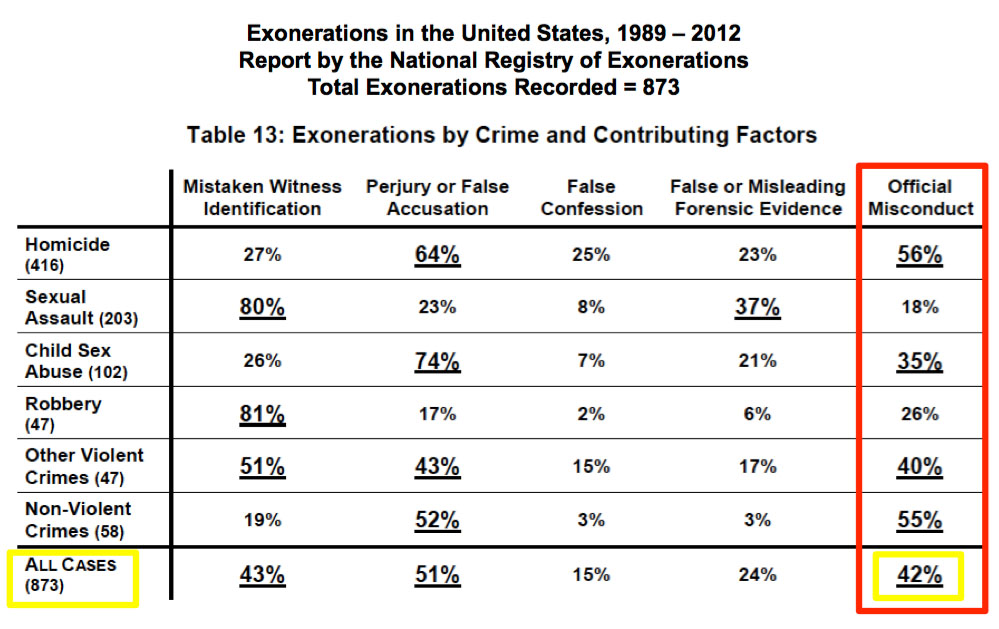
Prosecutorial misconduct.  Well folks, this one is a hot button of mine.  Ask the average citizen, and they are totally unaware that such a thing ever happens.  After all, prosecutors are honorable people who are committed to ethics, justice, upholding the law, and to helping protect the public by ensuring that the  “bad guys” are sternly dealt with, and if necessary, isolated from society, or even put to death.  At least this is what they tell us in their campaign speeches when they’re running for election or re-election.  But prosecutorial misconduct and misdeeds happen, and they happen more frequently than any normal citizen would imagine.  Let’s look at some data.  The National Registry of Exonerations has compiled detailed data for 873 exonerations (wrongful convictions) for the period 1989-2012.  You can see the full report here – exonerations_us_1989_2012_full_report.  Here is Table 13 from that report showing frequency of causes contributing to wrongful convictions:

Exoneration Table

The red box highlights the cause of “official misconduct.” (Note that the percentages for each type of case total to more than 100%.  This is because any wrongful conviction can have more than one contributing cause.)  The average for all 873 cases in which “official misconduct” was a contributing factor is 42%.  This figure includes both police misconduct and prosecutorial misconduct, and the table does not separate the data for the two.  However, if we assume a 50/50 split, this yields an occurrence of prosecutorial misconduct in 21% of wrongful convictions.  And keep in mind, this data set includes only data for known wrongful convictions.  Who knows how many more times this happens, and it doesn’t “get caught?”  I think we can safely say that prosecutorial misconduct is not an “ignoreably rare” phenomenon.

Continue reading

Open-discovery rules won’t necessarily stop prosecutors from cheating

Sunday’s New York Times hits the nail on the head in an editorial here in which it laments that violations of the U.S. Supreme Court’s 50-year-old Brady rule, which requires prosecutors to disclose exculpatory evidence to the defense, remain ”widespread.” The Times might be overly optimistic, however, in its belief that open-files reforms like those adopted in North Carolina and Ohio that require full disclosure of law enforcement’s investigative files in a case will necessarily solve the problem.
 
Such rules will work only if prosecutors and law enforcement agencies follow them, and that’s far from guaranteed. In an Ohio case I am currently investigating, for example, information about the identification of an uncharged suspect was disclosed only after we learned from a witness that she had picked the man out of a photo lineup. The identity of a second suspect, which a co-defendant says she gave to both a detective and the prosecutor before she pleaded guilty, has still not been disclosed, nor has a summary of her statement that the only other person charged in the crime was not involved.
 
Defense attorneys and investigators should remain skeptical that prosecutors will always follow open-discovery rules any more than they always follow the Brady rule.
 
They should also be aware that another reform — the use of blindly administered sequential photo lineups — can still lead to misidentifications in the era of social media. In this same case, a witness admitted that she and others looked up the defendant’s photo on Facebook once they learned his name, which made picking out his photo later fairly easy. She now admits she was wrong.

Judge Calculates New York’s Payment for Wrongful Imprisonment: About $5.5 Million

What financial number would you put on the loss of nine years, nine years of freedom exchanged for nine years in prison? What’s the price of family separation, damaged relationships, stress and anxiety? What’s fair compensation for health ramifications and ongoing required treatment? What about lost wages and impaired future earnings? As mentioned on this blog today (here), Nicholas V. Midey Jr., Judge of the New York Court of Claims, ruled on April 4, 2013, that for Daniel Gristwood, 46, a father of five who spent nine years in prison for a crime he did not commit, the appropriate compensation from New York state is $5,485,394.

Directly from Judge Midey’s 22-page ruling: Continue reading

Day One of California Innocence Project’s “Innocence March”

march

On April 27, 2013, the California Innocence Project started a march from San Diego to Sacramento with clemency petitions for 12 of its clients who are innocent yet remain incarcerated. The public was invited to join at any of the 2 public walking days, or the rallies hosted along the way.

View the Innocence March website here.

See the YouTube video here.

Medical ‘Folklore’ Yields Yet Another Shaken Baby Wrongful Conviction

Melissa Staas is a staff attorney with the Family Defense Center in Chicago, and has recently made the SBS (Shaken Baby Syndrome) defense community aware of a case in Chicago that exemplifies many of the problems with the extant pediatric medical establishment in dealing with medical conditions that are misread by uninformed doctors diagnosing abuse.  This is a classic case of what I call “dueling experts.”  See the previous WCB post addressing SBS medical expert testimony and “dueling experts” here.

Melissa sent an e’mail describing an appellate court brief recently filed by the Family Defense Center in a so-called “abuse” case in Chicago.  That e’mail follows:    (posted here with her permission)

Continue reading

Notes from the 2013 Innocence Network Conference: Inspiring, Instructive, Productive

Not many wrongfully convicted people will one day play professional football. In fact, so far, just one Innocence Project client, exonerated after wrongful conviction and imprisonment, has been drafted by the National Football League. Brian Banks’s story is inspiring and higher-profile than most, yet, as the 2013 Innocence Network Conference convened last week in Charlotte, North Carolina, attendees were reminded that every exoneration is an inspiring story of determination and indomitable human spirit demonstrated by an unguaranteed quest for freedom and true justice, however delayed. Continue reading

Hair Analysis Evidence About to Join CBLA as “Junk Science”

No HairThe FBI and the Department of Justice have announced that they are beginning an unprecedented review of over 10,000 cases involving microscopic hair analysis evidence.  They have conceded that, since at least 1985, FBI agents have been providing hair evidence testimony in court that is not scientifically supportable.  See previous WCB hair analysis evidence post here.

These actions result in large part from the work done by Washington Post reporter Spencer Hsu.  And in recognition of this, Spencer was awarded the Innocence Network 2013 Journalism Award last Friday evening (4/19/13) at the National Innocence Network Conference, being held this year in Charlotte, NC.  See one of Spencer’s articles on this subject from last July here.

The case reviews will be assisted by the Innocence Project and the National Association of Criminal Defense Lawyers.

The last time the FBI abandoned a forensic practice was in 2005 when CBLA (compositional bullet lead analysis) was debunked because its premise is not scientifically supportable.  See previous WCB CBLA post here.

The 2009 report by the National Academy of Sciences on the state of forensics in the US had this to say about hair analysis evidence –  “The report finds no scientific support for the use of hair comparisons for individualization in the absence of nuclear DNA.”

Innocence Network Conference Convenes in Charlotte, North Carolina

More than 500 attendees from around the world, including at least 100 exonerees, are arriving in Charlotte, North Carolina, for the 2013 annual Innocence Network Conference, which will begin Friday, April 19, at 7:00 a.m. EST with opening remarks at 8:00 a.m. from Peter Neufeld and Barry Scheck, co-founders of the Innocence Project, a model that has been emulated throughout the United States and internationally.  The sell-out conference will conclude at 5:00 pm on Saturday, April 20. Exonerees will gather at a preliminary reception Thursday evening. Continue reading

Judge Bans Personal Electronics From Courtroom to Prevent Witnesses Intimidation

scalenet

Witnesses being exposed to retribution for their testimony is not a new thing.  After all, the Witness Protection Program was established by the Organized Crime Control Act of 1970.  But this was primarily an “organized crime” phenomenon.  With today’s 24-hour news cycle fanning the flames of public indignation over high profile cases, and the ubiquity of electronic and social media, witnesses, and others involved in high profile cases, face a new kind of threat – harassment and intimidation by electronic media.  The Witness Protection Program provides physical security for those witnesses who may be in danger of bodily harm, or even death, and this protection is extremely expensive.  As for electronic intimidation and harassment, a solution, so far, evades us.

Electronic harassment has been an unfortunate byproduct of the internet age and social media.  The internet provides would-be harassers with a “cloak of anonymity,” which seems to encourage even casual harassers to send intimidating e’mail’s and texts.  And sometimes worse than that, hackers will publicly post the personal information of witnesses and others involved in a case whom they view to be contrary to their own beliefs.  This can happen both during an ongoing trial and post-conviction or post-acquittal; driving witnesses and even jurors into hiding to escape the onslaught wrought by the electronic blitz.

Things have come to the point where Cook County (IL) Chief Judge Timothy Evans is moving forward with a ban on personal electronics in courtrooms.  Starting Monday, the Cook County criminal courthouses begin their ban on electronic devices that include cell phones, smartphones, tablets, laptops and “all other electronic devices capable of connecting to the Internet or making audio or video recordings.”  Read the HuffPost article here.

One more example is the fact that Alyce LaViolette, a domestic abuse expert, who testified for the defense in the Jodi Arias trial had to be taken to the emergency room for “for anxiety attacks and palpitations” after an online barrage was launched against her.  Read the HuffPost story here.

We have previously decried what we’ve called “trial by media” or “trial by website.”  This is when the public forms strong opinions about guilt or innocence of a defendant based upon coverage by news media, or when someone becomes dedicated to the guilt or innocence of a defendant, and sets up a website to try to convince others of their beliefs.  Of course, the media and the general public cannot possibly have knowledge of all the facts and details involved in these cases, but these strong public opinions can, and do, have influence on the outcomes of cases.  For example, they can force a change of venue for a trial, and who knows how jurors might be influenced.

Two other high-profile cases that have also suffered from abuse of the electronic media are the  Casey Anthony capital murder trial, and the Steubenville football rape case.

The justice system is not supposed to be “trial and judgement by public opinion.”  One would hope that responsible citizens would understand that this activity is malicious, and produces no net positive end result.  But alas, I believe that this is largely founded in “human nature,” and what the solution might be is beyond my ken.  Perhaps just public knowledge that this kind of stuff happens may help.

Texas Legislature is Addressing Wrongful Conviction

An opinion (here) in The Stateman (Austin) yesterday commended the Texas legislature for pending legislation aimed at reducing wrongful conviction. After some challenge by district attorneys and a resulting amendment that protects witnesses and victims, the Texas Senate unanimously passed Senate Bill 1611, known as the Michael Morton bill, which would create a uniform “open file” policy in the state, thus requiring the prosecution to share all files with defense attorneys.

According to the opinion piece, the Senate has also passed a bill “that would give exonerated Texans four years from the date of their release from prison to Continue reading

Settlement Costs from Wrongful Convictions: $250+ Million and Climbing in Illinois

In 2011 the Better Government Association in Illinois reported that wrongful convictions had cost taxpayers $214 million in settlements. An update (here) indicates that, since the 2011 investigation—which was done with the Center on Wrongful Convictions at Northwestern University School of Law—government agencies have agreed to pay another nearly $39 million to settle lawsuits resulting from persons wrongfully convicted, primarily of murder and other serious felonies.  And according to an ABC7 report (here), at least ten cases are currently pending in Illinois courts, which could soon move the cost of wrongful convictions to $300 million or more in the state of Illinois alone.

Of course, the settlement costs do not include the cost of incarcerating 85 innocent people for a total of 926 years since 1989, nor the human costs of wrongful incarceration, nor the costs of crimes committed by the real perpetrators who escaped apprehension while innocent persons languished in prison. Continue reading

Babysitters and Shaken Baby Syndrome

Those of you who follow shaken baby syndrome cases may have noticed, as I have, that SBS charges seem to fall disproportionately upon babysitters, including family members.  However, this is strictly an anecdotal observation on my part, and I have no real data to back it up. But just ask Audrey Edmunds.

I’m sure this is a consequence of being a “lone caregiver” with no other adult witnesses who would be able to testify that the babysitter never abused the child.  This is typical of SBS cases.  If a child dies and presents SBS (triad) symptoms, the last person alone with the child is “automatically” charged.

If you’re not aware, Sue Luttner maintains an extraordinarily good blog about SBS – OnSBS.com.  She has recently posted an article addressing the cases of five babysitters and their travails with the justice system and SBS charges – Mary Weaver, Kelly Kline, Ashley Howes, Suzanne Johnson, and Marina England.

Here is a link to that post:

http://onsbs.com/2013/04/08/old-cases-new-cases-sad-cases-true-cases/

Four Years After Report Decrying Forensic Sciences, a Sign of Progress

Chemical & Engineering News has published an update of forensic science reform efforts entitled, “First Steps Toward Forensics Reform – New forensics commission to recommend guidelines, design policies.” The article provides a history of efforts taken thus far in response to the 2009 report by the National Research Council, which alerted the nation to many shortcomings in the reliability of the forensic sciences and their use in the courtroom.

According to the article (here) by Andrea Widener:

“Four years after the NRC report was released—and nearly as long as the White House has been studying it—the federal government has taken its first official steps to address the problem. The Department of Justice (DOJ) and the National Institute of Standards & Technology (NIST) have joined forces to create a National Commission on Forensic Science. That body will recommend guidelines for federal, state, and local forensics laboratories, as well as design policy on ethics, training, and certification for forensics professionals. Continue reading

Monday’s Quick Clicks…

click
  • Prosecutors across Northeast Texas expressed concerns last week about a Texas senator’s proposal to require DNA testing of all biological evidence before trials in state death penalty cases.
  • The Oklahoma Innocence Project ranks the state among the top 10 for wrongful convictions, which a report issued Friday said could be lowered by law enforcement officers, attorneys and judges.  The Oklahoma Justice Commission, formed by the Oklahoma Bar Association, unveiled its recommendations following a two-year study into convictions of people for crimes they didn’t commit. The 33-member group’s suggestions follow each step of the wrongful conviction process, from arrest to release.
  • Nearly nine years after being freed from prison, where he served 17 years for a double murder in the central Illinois city of Paris before being freed for lack of evidence, Gordon “Randy” Steidl has won a second multimillion-dollar judgment in his case against the people who put him behind bars.  A federal judge on Wednesday entered a $3.5 million agreed-upon judgment in a long-running wrongful conviction and malicious prosecution case against former Paris police Chief Gene Ray, former lead detective James Parrish and former Edgar County State’s Attorney Michael McFatridge.
  • Law enforcement in Buffalo, NY believe prisoner Josue Ortiz is innocent

Brian Banks’ Story to be Featured on CBS’s “60 Minutes”

BRIAN BANKS

BRIAN BANKS

The Brian Banks case has been reported on multiple times on this blog.  See the post covering his exoneration here.

Brian Banks’ inspiring story will be featured on this week’s episode of CBS’ 60 Minutes show (Sunday, March 24th, 7 pm PT/ET). From the 60 Minutes website: “Blindsided” – Brian Banks may yet play in the NFL, but he knows it’s a longshot after spending five years in prison on a rape charge for which he was later exonerated.  James Brown reports.”  Brown speaks with Banks, his family, and California Innocence Project director Justin Brooks about the case and what is says about our justice system.

Re-examination of Arson Convictions to Begin in Texas

Nine years ago Cameron Todd Willingham was executed in Texas after being convicted of killing his three children in a fire. Whether or not the tragic fire was a crime or an accident has been a haunting question in light of alternative explanations for the burn patterns once believed to be proof of the use of an accelerant. According to an Associated Press press in the Baylor Lariat (here), next month an ongoing collaboration of the Texas state fire marshall and the Innocence Project of Texas will proceed to it’s next task: reviewing the first six cases of arson conviction that have been identified as potentially problematic due to their dependance on questionable science. Continue reading