Author Archives: Phil Locke

The Child Abuse Pediatrician (CAP) – Just Another Term for Medical “Cop”

CAP Ethics

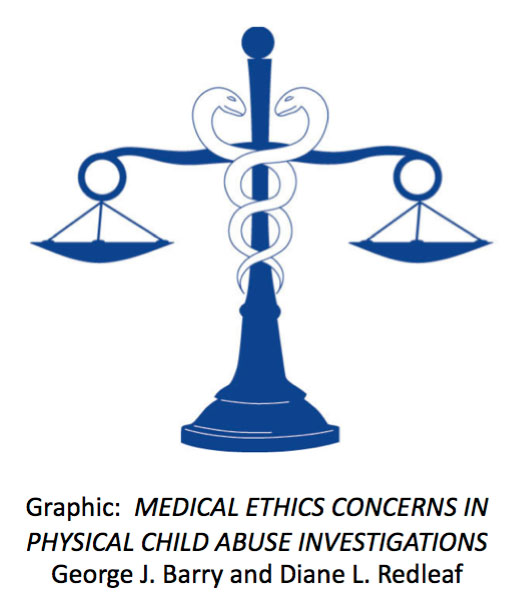
A new paper has recently been published by George Barry and Diane Redleaf of the Family Defense Center in Chicago.  The paper, titled  Medical Ethics Concerns in Physical Child Abuse Investigations, explores and reveals the extent of breeches of medical ethics by child abuse medical investigators (CAP’s).

This paper is a prodigious work, including five detailed case studies.

The title of Section I of Part III conveys the theme of the paper: “Physicians Have an Ethical Obligation Not to Become Law Enforcement Officers.”  And here is an excerpt from the Executive Summary:  “We submit, in this Paper, that this system of child abuse investigation and medical assessment is failing the children and families. We also submit that the failings are due at least in part to practices that are ethically questionable at best, or plainly unethical at worst. The harm of these practices occurs because, while the child may quickly recover from a toddler fracture, nursemaid’s elbow or subdural hematoma that is called in to child protection authorities as suspicious, the trauma families have experienced at the hands of the child protection system does not fade quickly or ever entirely disappear. Moreover, the Center is able to represent only a tiny fraction of the wrongly accused family members in medically complex cases and resources like the Center provides are not available to the vast majority of family members who encounter the child protection and medical care establishment in these cases. Unfortunately, we see little sign that the child protection and medical care establishment are addressing in a meaningful way the harmful impact of erroneous child abuse reports that have resulted from questionable ethical practices that this Paper documents. Indeed, for reasons this Paper documents, we believe that the medical profession has turned a blind eye to the treatment of children and families who are the victims of misplaced child abuse allegations and we are concerned about developments in the handling of medically complex allegations that make these problems worse, not better.”

Don’t get me wrong.  Child abuse is a horrific thing, but equally, if not more, horrific is when when innocent parents and care givers get thrown into prison or separated from their children for a child abuse “crime” they did not commit, and that did not ever happen.  This is a tragedy that occurs all too often when a medical diagnosis is made that does not recognize the new scientific understandings regarding symptoms that have traditionally (and wrongly) been attributed solely to abuse.

And here’s the scary part – the CAP’s, who are basically a medical cop, as part of their training, have been indoctrinated with the American Academy of Pediatrics medical dogma concerning causation of certain symptoms (the triad and long bone fractures) that they insist are pathognomonic (exclusively indicating) of abuse.  This is what the SBS Wars is all about.

“Chid Abuse Pediatrics” was established as a pediatric sub-specialty by the American Board of Medical Specialties in 2006. This definition of the discipline is from the website of the Council of Pediatric Subspecialties (ironically known as CoPS):  “Child Abuse Pediatricians are responsible for the diagnosis and treatment of children and adolescents who are suspected victims of any form of child maltreatment. This includes physical abuse, sexual abuse, factitious illness (medical child abuse), neglect, and psychological/emotional abuse. Child Abuse Pediatricians participate in multidisciplinary collaborative work within the medical, child welfare, law enforcement, and judicial arenas as well as with a variety of community efforts. Child Abuse Pediatricians are often called to provide expert testimony in the court systems. This field offers the opportunity for involvement and leadership roles in community, regional and national advocacy, and in prevention efforts and public policy.”  (emphasis is mine).

I would contend the very existence of the child abuse pediatrician specialty becomes something of a self-fulfilling prophecy.  “I’m here to diagnose child abuse, so that’s what I’m going to do.”

This would be my advice.  If you find yourself in the situation of taking your child to the emergency room, and you find yourself talking with a child abuse pediatrician (and they probably won’t tell you they are one), consider that you are under suspicion, and you are talking to the police.  How you choose to deal with that I must leave to you.
CNN Series – Death Row Stories

DRS

Death Row Stories is a CNN Original series of one-hour documentaries unraveling the truth behind capital murder cases. Executive produced by Alex Gibney and Robert Redford and narrated by Susan Sarandon, these stories call into question various beliefs surrounding America’s justice system and the death penalty.

The series starts tonight, Sunday, March 9 at 9:00 PM EDT.

See the CNN web page here.

“Flawed Convictions – Shaken Baby Syndrome and the Inertia of Injustice”

flawed conv

Sue Luttner has posted an excellent piece on her blog OnSBS about the new book by Prof. Deborah Tuerkheimer to be released in April – Flawed Convictions – Shaken Baby Syndrome and the Inertia of Injustice.

Please see Sue’s post here.

This book will be a must read for any involved in the SBS debate.

Prosecutor Misconduct in the Todd Willingham Case

Cameron Todd Willingham was executed in 2004 by the state of Texas for setting a fire that killed his three young children.

We’ve reported numerous times on this blog about the Cameron Todd Willingham case, and here is just one of those articles – Will Texas Admit It Executed an Innocent Man?

 It’s clear to even the casual observer of this case that Todd Wilingham was wrongfully convicted and wrongfully executed.  The State used now-debunked junk science in determining the fire that killed the Willingham children was arson.  The case is carefully documented in the award winning film Incendiary: The Willingham Case.

And now, another snake has just slithered out of the pit that the Texas justice system has made of this case.  It’s been revealed that the Willingham prosecutor, John Jackson, made a secret deal with jailhouse snitch, Johnny Webb, in return for his testimony that Willingham had confessed the crime to him in prison.  And further, that Jackson then concealed this deal from the Texas Board of Paroles and Pardons which was considering a stay of execution for Willingham.

Reported here by the Innocence Project – New Evidence Suggests Cameron Todd Willingham Prosecutor Deceived Board of Pardons and Paroles About Informant Testimony in Opposition to Stay of Execution.

Read the stories from the New York Times here, and the Manchester Guardian here.

Dog Scent Lineups – “The Worst of Junk Science”

pointerIt was just a year ago that we posted about dog scent lineups.  At the time, we called it “one of the junkiest of the junk sciences.”  This opinion is echoed in a law suit filed just this week by a Texas woman, Megan Winfrey.  Ms. Winfrey spent 6 years in prison before her murder conviction, based on a dog scent lineup, was overturned.  Her suit calls dog scent lineups “the worst of junk science.”

Interestingly, the primary defendant in Winfrey’s suit is former Fort Bend County Sheriff’s Deputy Keith Pickett.  Pickett was identified in our earlier post as being the most infamous and notorious dog handler performing bogus dog scent lineups.  Four other officers, including the San Jacinto County Sheriff, are also named in the suit as being complicit in her wrongful conviction.

You can read the NBC News story about the Winfrey suit here, which contains a link to the actual law suit.

Yet MORE Questions About Shaken Baby Syndrome (SBS)

Much has been written in recent years about the doubts that have arisen over the veracity of traditional “shaken baby syndrome” (SBS) theory.  And not only has that drumbeat continued, but it has also intensified.

The media has been awakening to the injustices visited upon too many innocent infant caregivers by a justice system and a pediatric medical establishment that have brainwashed themselves into blind, unquestioning belief in a 40 year old unsubstantiated theory.

An example of this coverage is a recent SBS case in the San Francisco bay area. Read the CBS Channel 5 San Francisco story here.

Clearly, the US has lagged behind other developed countries in its recognition of the new scientific realities regarding SBS.  Canada has been much more proactive in revisiting old SBS convictions because of new scientific knowledge.  In light of the new scientific understandings, the Ontario government ordered a comprehensive review of all SBS convictions in 2008.  See stories from the Toronto Star here and here.

This EXCELLENT article by Radley Balko for The Washington Post addresses not only the new science but also the barriers our justice system erects that prevent correction of wrongful SBS convictions.

Continue reading

Blatantly Coerced Confession Results in Conviction Reversal

Adrian Thomas was convicted of murdering his 4-month old son Matthew.  The conviction relied in part on a confession that Adrian Thomas made during a 9-hour interrogation during which he was lied to and coercively threatened by police investigators.  Despite the fact that other evidence may indicate guilt, there is no ethical, moral, or logical excuse for these police tactics.

This is a significant decision relative to false confessions.

The story from the Albany, NY Times Union follows:

Court of Appeals reverses Adrian Thomas murder conviction

Posted on February 20, 2014 | By Robert Gavin
 In a potentially landmark ruling, the state’s highest court on Thursday unanimously overturned the murder conviction of Adrian Thomas, who was convicted in 2009 of killing his 4-month-old son in Troy, and blocked his statements from any retrial.

Thomas is serving 25 years to life in Auburn Correctional Facility for second-degree murder.

Thursday’s 7-0 decision followed arguments before the Court of Appeals on Jan. 14 during which attorneys for Thomas, 31, questioned the extent that police lied to the defendant while questioning him about the condition of his son. Thomas was interviewed by Troy police for more than nine hours in what his attorney, Jerome K. Frost, said was a cruel hoax.

Police are allowed to lie to suspects, but not to  the extent that a confession is given involuntarily. To secure Thomas’ confession, a Troy police sergeant told Thomas his confession was needed to save the life of his son, Matthew, whose death was a certainty.

On Thursday, Chief Judge Jonathan Lippman wrote that evidence was sufficient to convict Thomas, but that the case must be sent back for retrial because “we conclude that defendant’s inculpating statements were not demonstrably voluntary.”

On Jan. 14, Frost told Court of Appeals that police falsely told his client 67 separate times that they knew the baby’s injuries were accidental — and 140 times that he would not be charged. A key part of Thomas’ appeal was his lawyers’ argument that the trial judge should have allowed an expert on false confessions and police interrogation techniques to testify on his client’s behalf. The judge rejected it.

“The rule is you don’t threaten a person’s vital interests, such as the freedom of his spouse, taking away his children,” Frost had argued.

The Appellate Division of state Supreme Court upheld Thomas’ conviction in 2012

New Data From the National Registry of Exonerations

The release of the new report (for year 2013) by the National Registry of Exonerations was recently posted on the WCB by Nancy Petro.  See her post here, which includes a link to the full text of the new report.

I’d like to reiterate that the most significant value of the Registry is that it provides hard, verifiable data on which reforms to the justice system can be based.  And anyone who studies this data can see that reforms are, indeed, sorely needed.

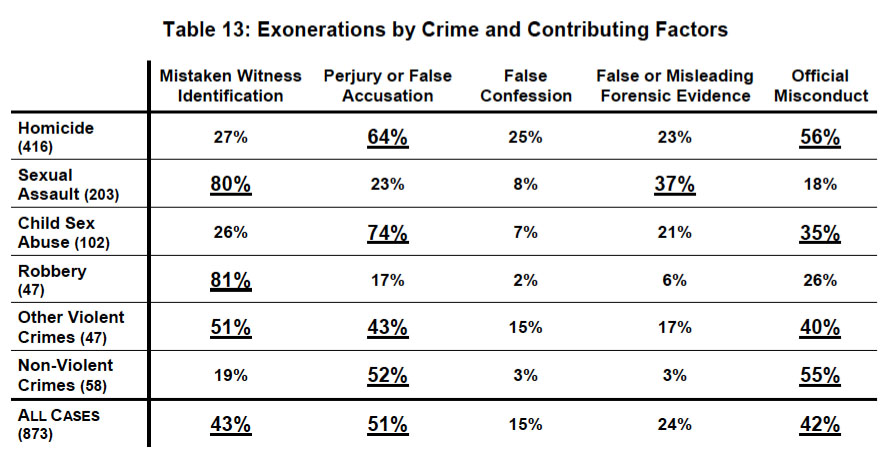
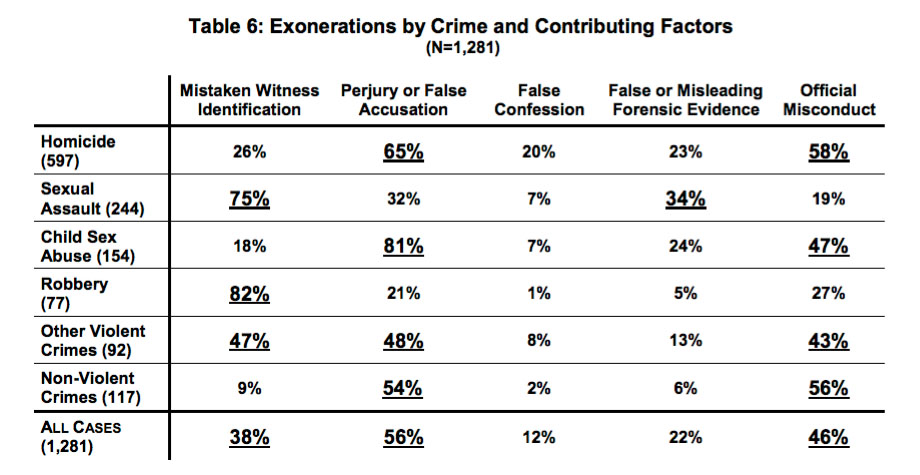
One of the things I find most interesting is the data that sorts out the major contributing factors to wrongful convictions.  This is a very good indicator of both the need for reform in general and the specific areas that are most ripe for reform and improvement.

I encourage you to dig through the full report on your own, but for your convenience, I’m attaching the data on major contributing factors to wrongful convictions for both years 2013 and 2012 below.

From the 2012 NRE report:

Table 13

From the 2013 NRE report:

Table 6 020414

Note that for each class of crime, the numbers add to more than 100%.  This is because any particular wrongful conviction can have more than one contributing factor, which they most often do.

Michigan Man Who Falsely Confessed Charged with Lying to Police

This one is mind boggling.

A mentally ill Lansing, Michigan man, Kosgar Lado, under interrogation by police, momentarily confessed to shooting a man.  Even though he subsequently withdrew that statement later in the interrogation, he was charged with the murder.  After further investigation, the police determined that Lado was not the shooter, and the murder charges were dropped.  But now the prosecutor has charged Lado with felony lying to the police!

Read the LSJ.com story here.

And here’s something else about this story.  The police chief commented to the media that officers went “above and beyond” in confirming that Lado was not the shooter.  B-A-L-O-N-E-Y!  The police have an official duty and an ethical obligation to pursue the facts to determine if their suspects are actually innocent.  I would say they were just doing their job.  The police are normally all too willing to determine if a suspect “might be” guilty, and then turn it over to the prosecutor; and false confessions are one of the major ways they do this.  It’s well known that the mentally ill and the mentally deficient are at high risk of making false confessions.

Thanks to WCB follower Jeremy Praay for forwarding this story.

US Seventh Circuit Rules Prosecutor Can Be Sued For Abusive Investigation and Misconduct

This is a very big deal.

The US Supreme Court had confirmed that prosecutors have absolute immunity from civil suit for their non-criminal actions as prosecutors.  This decision by the Seventh Circuit shines a very different light on the subject.

Read the story by Jonathan Turley here.

The Center for Prosecutor Integrity Announces the 2014 Innocence Summit

The Innocence Movement is gathering momentum, credibility, and clout. The Innocence Summit 2014, to be held in Washington DC, will be the first time that the issue of prosecutorial reform moves front and center to become the focus of national deliberation and debate.

Worthy of note is that among the featured speakers will be Jim and Nancy Petro.  Jim is a former Attorney General of the State of Ohio, and of course, Nancy, in addition to many other innocence related activities, is a contributing editor on this blog.  They are co-authors of the book False Justice – Eight Myths that Convict the Innocent.

Read about the 2014 Innocence Summit here.

Shaken Baby Syndrome ……. Progress for True Science?

It’s been a while since we’ve posted about SBS.  It’s a complex issue that is just not coverable in a single post.  So in case you’d like a “refresher,” or if you’re new to the topic, there are links to previous WCB posts on SBS at the end of this post.

There is new science emerging all the time in this field – science that largely disputes the classic and entrenched one-size-fits-all “triad” symptom diagnosis, along with the current views of “cause & effect” regarding triad symptoms.  There are, unfortunately, people who do shake or otherwise abuse their babies, and these babies may very well present with one or more of the triad symptoms, so they cannot be dismissed without further understanding.  However, the established medical profession (including the American Academy of Pediatrics) and the justice system (particularly prosecutors) have embraced the “triad can only mean abuse” theory of cause and effect; and they have so far refused – cogently, adamantly, and combatively – to consider giving it up.  They have turned a blind eye to much of the new understandings being created by true science.  What this means is that an alarming number of innocent people continue to get swept up in the “triad dragnet,” and sent to prison.

In my view, the medical establishment has been not just tone deaf and brain dead about accepting new findings in the area; they have put up the deflector shields and aggressively resist it.  The people who hold sway in pediatric medicine seem to have a religiously fanatic attachment to this 40 year old theory.  And the prosecutors are more than happy to go along with the medical establishment, because strict adherence to the triad theory makes for easy convictions – even though they may be wrongful.  There are lots and lots of doctors ready to testify that if triad symptoms are present, it can only be abuse.  Coupled with this is the fact that the prosecution can always afford to put more experts on the stand than the defense; thereby swaying clueless juries, because the side with more experts “must be right,” regardless of the veracity of their testimony.

Let me quote Dr. Waney Squier, a noted UK pathologist, who is one of the prominent SBS truth-seekers (writing for the journal Forensic Science, Medicine, and Pathology, Jan..8, 2014), “The critical issue is why, after more than 40 years, shaken baby syndrome/abusive head trauma (SBS/AHT) remains controversial.  The real controversy is over whether shaking or abuse may reliably be inferred from specific findings, classically, subdural and retinal hemorrhage with encephalopathy (the triad).”  And, “For four decades, the medical profession and the courts have largely accepted the SBS/AHT (triad) hypothesis as fact.  Today, we know that the hypothesis lacks a reliable evidentiary basis …..

The bright spots of true progress on SBS seem to come at an agonizingly and glacially slow pace — but here is one.  Reneé Bailey was convicted 13 years ago of shaking 2½ year old Brittney Sheets to death.  She has been in prison ever since.  Recently, NY State Supreme Court Justice James Piampianon granted an evidentiary hearing in the case to consider the new scientific findings regarding SBS.  This is a huge deal.  It means that at least some segment of the justice system is willing to look past the prevailing medical dogma.  Read the Rochester, NY Democrat and Chronicle story here.

And here is another recent article, this from USA Today, questioning the traditional “science” of SBS.

Science and truth will ultimately prevail, but to paraphrase Nobel physics laureate Max Planck, “Science advances one funeral at a time.”  It’s going to take time to work our way out of this modern day version of the medical dark ages, but it will happen.  As William Shakespeare penned in The Merchant of Venice, “….. at length, truth will out.”  In the meantime, I shudder to think of all the innocent people that will suffer tragic injustice until we get there.

Previous WCB SBS Posts:

The SBS Wars,  Hang Bin Li SBS Case,  Shaken Baby Science Doubts GrowSBS Expert Testimony – This HAS to Get FixedSBS Accusations – A Modern Day Witch Hunt?SBS – Politics and “Religion” vs. New ScienceDismissed Case Raises Questions on SBS DiagnosisWitnessed Baby ShakingsThe Latest in the Medical Debate Over SBSBaby Sitters and SBSMedical “Folklore” Yields Yet Another Wrongful SBS ConvictionSBS – Where Are We? – A Reality CheckSBS: Perspectives on a Controversial DiagnosisAre There Geographic “Hotspots” for SBS?

Anthony Graves, Exonerated Death Row Inmate, to File Grievance Against Former Texas Prosecutor Charles Sebesta

AGraves

Yet another case of egregious prosecutorial misconduct.

Anthony Graves was wrongfully convicted and sentenced to death for a gruesome multiple homicide that occurred in Somerville, TX in August of 1992.  He was ultimately exonerated and released from prison in 2010.

The prosecutor in the case, Charles Sebesta, under intense public pressure for a conviction of Graves with a death sentence, ignored all evidence pointing to his innocence,  pressed ahead, and, as the special prosecutor appointed to handle Graves’ retrial said, “Sebesta manufactured evidence, misled jurors and elicited false testimony.”  The special prosecutor laid the blame for Graves’ wrongful conviction squarely at the feet of Sebesta.

Anthony Graves and the Houston law firm of Bob Bennett & Associates will file a grievance with the Texas Bar’s Office of the Chief Disciplinary Counsel seeking sanctions against Sebesta for his central role in Graves’ wrongful conviction and imprisonment.

Read the case statement of facts here – Statement-of-Facts.

You can see the full press packet here.

And read the Texas Monthly story here.

Editorial PS:  I think it’s tragic that Mr. Graves has to pursue redress through the Bar Association.  He should have remedy available through the courts.

Jerome Morgan Wins New Trial in New Orleans

With the help of the New Orleans Innocence Project, Jerome Morgan, who has spent 19 years in prison for a murder termed the “sweet 16 birthday shooting,”
has been granted a new trial.

The prosecution withheld exculpatory evidence in the case, and in Judge Darryl Derbigny’s order he states, “the evidence presented before this court is wrought with deception, manipulation, and coercion by the New Orleans Police Department,” and that “such newly discovered evidence undermines the confidence of the verdict and is fit for a new jury’s judgment.”

Additionally, two prosecution witnesses have recanted, and it was also determined that Jerome had ineffective assistance of counsel.

Read the New Orleans Times-Picayune story here.

Ohio Executes Prisoner with Controversial Drugs

This morning, Ohio executed Dennis McGuire with an untried combination of drugs.  Witnesses report it took a gasping McGuire 15 minutes to die.

I leave it to the reader to decide if this is “cruel and unusual.”

Read the CNN article here.

Justice and Science — “Houston, We Have a Problem!”

sciencejustice.

It’s abundantly apparent that the nature of ‘evidence’ and ‘expert testimony’ has become increasingly more scientific as the decades have rolled by.  And this is a wonderful thing, because real science is a tool for discerning the real truth and the real facts.  It means that “junk science” forensics will ultimately give way to technologies and disciplines founded upon true science, and this is what the NAS Report was all about.

However, the continuing trend for evidence and testimony to become more scientifically based brings with it some “interesting” consequences of which we need to be aware — the impacts on juries and on judges & attorneys; and whether these people are prepared to cope with all this new scientific information and discipline.

We’ll cover the issues in three sections: Juries, Judges & Attorneys, and Experts.

Continue reading

“An Offer You Can’t Refuse” – How Prosecutors Force Plea Deals

This just in from the Center for Prosecutor Integrity:

In December, Human Rights Watch released a milestone report titled “An Offer You Can’t Refuse: How US Federal Prosecutors Force Drug Defendants to Plead Guilty.” The report appeared to get lost in the Holiday shuffle, because it didn’t garner much media coverage.  So CPI recently did a Summary of the report. The Summary details the 7 strategies that federal prosecutors use to pressure drug defendants to accept a plea, and also highlights a number of sizzling quotes from the report.  Our Summary concludes, ” The Sixth Amendment of the Constitution guarantees the right to trial by jury. This right should not be diminished or eviscerated by turning it into a trial “penalty.” Disproportionate sentences should not be imposed on the guilty, and the fear of a wrongful conviction should not be a burden to the innocent.”

The CPI summary can be seen here: http://www.prosecutorintegrity.org/reports/hrw-an-offer-you-cant-refuse/

The CPI summary has extracted a number of very telling quotes from the report, and they appear below:

1.      Prosecutors get the innocent to agree to a plea by threatening them with sentences that, in the words of Judge John Gleeson of New York, can be “so excessively severe, they take your breath away.”  In many cases, the prosecutor has complete discretion whether to use these bargaining tools (page 2).

2.      The “threat of a large trial penalty is unavoidably coercive, and contrary to the right to liberty and to a fair trial. In some cases, the sentences imposed on drug defendants who refused to plead are so disproportionately long they qualify as cruel and inhuman”  (page 11).

3.      “Mandatory minimum sentencing laws increased prosecutorial power, transferring sentencing power from judges to prosecutors” (page 31).

4.      “For the government, the guidelines are sacrosanct. Prosecutors insist they must be followed – except they will bend them whenever it suits their purposes.” – Attorney Gerald McMahon, New York (page 34)

5.      The “longer sentences exist on the books largely for bargaining purposes.” – NYU law professor Rachel Barkow (page 81)

6.      “It’s the luck of the draw with prosecutors in each office…some make deals, some won’t, some play fast and loose, charge big, and plead small.” – Anonymous assistant US attorney, Michigan (page 83)

7.      “While some federal prosecutors may reveal their evidence to defense counsel to stress the strength of their case and the wisdom of the plea, others do not. Defense counsel may have to evaluate the risks of ‘trial in the dark’” (page 84).

8.      “There is an inherent conflict of interest when prosecutors are de facto sentencers. They get reputations based on convictions. This is a big difference from federal judges who have no state in a case, who seek only to do justice.” – Judge Thelton Henderson, California (page 91)

9.      “Department of Justice policy has long encouraged prosecutors to charge defendants with the most serious offense (with the longest sentence) consistent with his conduct that is likely to result in a sustainable conviction” (page 92). This differs from the ABA ethical standard that prosecutors should not pursue charges if the punishment is likely to be disproportionate to the offense.

10.   “Prosecutors get kudos based on aggressive prosecutions. It’s not just convictions, but also length of sentence…That’s what earns you pats on the back.” – Former US Attorney (page 97)

11.   “Prosecutors try to be fair and offer good deals. But if you offer the defendant a good deal, and you’ve warned him about the consequences of going to trial, and the defendant doesn’t take the deal, then all bets are off.” – Former federal prosecutor, New York (page 99)

12.   “If you reject the plea, we’ll throw everything at you. We won’t think about what is a ‘just’ sentence.” – Anonymous former US attorney, Utah (page 100)

Let me add, as an editorial comment, that based upon my exposure to cases at the state level, these coercive strategies are not reserved to just federal prosecutors, but are also employed by prosecutors in general.

Registry of Prosecutorial Misconduct

The Center for Prosecutor Integrity has just launched its Registry of Prosecutorial Misconduct.  This is a significant step in documenting the hard data that will ultimately be required to effect some measures of accountability and sanctions for errant and unethical prosecutors.

Here is the press release from the Center for Prosecutor Integrity:

In Wake of NY Times Editorial, CPI Unveils Registry of Prosecutorial Misconduct

 WASHINGTON / January 8, 2014 – Today the non-profit Center for Prosecutor Integrity (CPI) announces the launching of the new Registry of Prosecutorial Misconduct. The unveiling comes three days after a New York Times’ editorial charged ethical violations by prosecutors have become “rampant” across the nation: http://nyti.ms/1hu7K7V

 The Registry is the first publicly available national online database to catalog judicial or legal disciplinary committee findings of prosecutorial misconduct. The Registry of Prosecutorial Misconduct will allow lawmakers, researchers, legal organizations, criminal justice reform groups, and others to identify common types of misconduct, assess trends, and compare jurisdictions.  The database includes over 15 fields such as Crime, State, Prosecutor Name, Trial Year, Misconduct Type, and Sanction Type. The Finding field features the opinion or determination by a disciplinary body or by a trial, appellate, or supreme court.

The Registry database can be viewed here: http://www.prosecutorintegrity.org/registry/database/A graph summarizing the most common types of misconduct committed by federal prosecutors is available here: http://www.prosecutorintegrity.org/registry/graph/numberbymisconducttype/

The database can be accessed by any individual at no charge using Sort, Filter, or Search functions. The Registry defines prosecutorial misconduct as the violation of any pertinent code of professional ethics or law, or other conduct that prejudices, or appears to prejudice the administration of justice.  The database currently features 200 cases of misconduct by federal prosecutors. Additional cases will be added to the database on a state-by-state basis. CPI will identify state-level partners to facilitate data access.

“As a former district attorney, I have become deeply concerned that the American public has begun to question the ethical commitment of prosecutors,” notes CPI chairman Phillip Kuhn. “The Registry of Prosecutorial Misconduct will promote accountability and help advance the integrity of prosecutorial practice.”

Additional information about the Registry can be seen here: http://www.prosecutorintegrity.org/registry/.  Persons may submit cases for consideration for inclusion: registry@prosecutorintegrity.org .

The Center for Prosecutor Integrity is working to preserve the presumption of innocence, assure equal treatment under law, and bring an end to wrongful convictions through the enhancement of prosecutor ethics: http://www.prosecutorintegrity.org/

Exoneree, LaMonte Armstrong, Receives Full Pardon

LaMonte Armstrong was exonerated in North Carolina in 2012 for a murder he did not commit.  He wrongfully spent 17 years in prison.  His exoneration came largely as a result of the efforts of professors Theresa Newman and Jim Coleman and the Duke Law Wrongful Convictions Clinic.

Yesterday, LaMonte received a call from NC Governor Pat McCrory telling him that he had been granted a full pardon.  This will allow LaMonte to seek up to $750,000 from the state of North Carolina for his wrongful imprisonment.

Read the full  Raleigh News & Observer story here.  And you can see the WFMY TV news story here.

Video

An Epidemic of ‘Brady’ Violations (Prosecutorial Misconduct)

Posted on December 18, 2013 by Phil Locke

An epidemic of Brady violations – those are not my words.  They are the words of Alex Kozinski, Chief Judge of the US 9th Circuit Court of Appeals in a recent decision in the case of US vs. Olsen.

Kozinski

If you don’t know what a ‘Brady’ violation is — it’s when the prosecution fails to turn over exculpatory evidence to the defense.  The US Supreme Court ruled in the case of Brady vs. Maryland (1963) that suppression of evidence by the prosecution violates the defendant’s due process rights.  Note, however, that the ruling does not specify sanctions for prosecutors who fail to comply with Brady disclosure.  It only stipulates that the defendant’s due process rights have been violated, thus making a Brady violation potential grounds for post-conviction relief.

Read the Huff Post story about Judge Kozinski’s opinion here.

This quote from judge Kozinski’s opinion:  “There is an epidemic of Brady violations abroad in the land. Only judges can put a stop to it.”  Kozinski’s statement is interesting, because it is recognizing that there is nothing in the law that punishes (sanctions) prosecutors for this unethical behavior.  They are supposedly subject to sanction from their bar association, but guess what – this just about never happens.

Continue reading