Author Archives: Mark Godsey

Tuesday’s Quick Clicks…

click
  • The legislature in the state of Washington has approved a measure that allows people who were wrongfully convicted to receive a minimum of $50,000 a year for each year they were behind bars.  The House on Monday unanimously concurred with changes made by the Senate last week when that chamber unanimously passed the bill. It now heads to Gov. Jay Inslee, who is expected to sign it into law, and Washington will join 27 states, the District of Columbia and the federal government with similar laws on the books.
  • Dr. Greg Hampikian, director of the Idaho Innocence Project, has developed a tool to help prevent DNA contamination in labs
  • Article about confirmation bias in the forensic sciences

New Scholarship Spotlight: Why Interrogation Contamination Occurs

Professor Richard Leo has posted the above-titled article on SSRN.  Download here.   The abstract states:

The problem of police interrogation contamination (disclosing or leaking of non-public facts) is pervasive in documented false confessions leading to wrongful conviction. The presence of unique and detailed crime facts in a false confession creates the illusion that the defendant volunteered inside information about the crime that “only the true perpetrator could have known,” thus seemingly corroborating a false confession as verifiably true. This article argues that confession contamination occurs because (1) the guilt-presumptive psychology of American police interrogation is designed to trigger and perpetuate confirmation biases that (2) lead investigators – seemingly inadvertently – to provide detailed case information to suspects as part of their pre- and post-admission accusatory interrogation strategies, but (3) has no internal corrective mechanism to catch or reverse investigators’ misclassification errors or their confirmatory interrogation techniques. American investigators presume not only the guilt of the suspects they interrogate, but also their guilty knowledge of the crime facts. Interrogators almost invariably disclose detailed case information to presumed guilty suspects through the use a variety of information-conveying techniques – accusations, attacks on denials, evidence ploys, feigned omniscience, inducements and scenarios. In the pre-admission stage, investigators convey and disclose detailed case information as part of their interrogation strategies to move the suspect from denial to admission, whereas in the post-admission stage, interrogators do so as part of their strategies to elicit a complete and persuasive narrative of his guilt. Interrogation contamination corrupts the truth-seeking process and increases the risk that a false confession will lead to a wrongful conviction. In order to eliminate it, investigators must dispense with the presumption of guilt that currently underlies interrogations, seek to better understand the multiple sources of their misclassification errors, and create internal corrective mechanisms that help them identify the confirmation biases and tendency toward tunnel vision that lie at the heart of American-style police interrogation.


California IP Kicks Off 600 Mile March for Freedom

SAN DIEGO (CBS 8) – Attorneys and students with the California Innocence Project at California Western School of Law have kicked off a two month, 600 mile march from San Diego to Sacramento.

Founded in 1999, the project’s mission is to reverse wrongful convictions and help release innocent people from prison.

“In some of these cases, I have actually had judges declare my clients innocent, and yet they are still sitting in prison,” said project director Justin Brooks.

Including the “California 12,” a dozen current inmates throughout the state whose individual cases, according to Brooks, show compelling evidence of innocence.

“Each one is a different reason, but there is one common theme and that is an innocent person who has been wrongfully convicted,” he said.

Among those showing their support Saturday was Ken Marsh. He spent 21 years in prison after being convicted in the death of a child who fell off a couch and hit his head.

“It’s so easy to incarcerate somebody. It’s an act of God to get them out of prison basically. And the California Innocence Project is doing just that,” he said.

Thanks to the efforts of the California Innocence Project, new evidence proved Marsh’s innocence. He has been free since 2004 and is now living in Colorado.

“Every day you spend in prison an innocent person just takes a day away from your life you never should have lost in the first place,” said Marsh.

NFL football player Brian Banks knows this all too well.

Last year, the Innocence Project made international headlines when it succeeded in getting his conviction on rape charges overturned, after he had spent five years behind bars for a crime he did not commit.

Just this month, Banks signed with the Atlanta Falcons.

“The idea we could exonerate a guy and get his entire life back, and now he’s in camp with the Falcons…That’s just incredible,” said Brooks.

Banks, as well as other exonerees, like Ken Marsh, will be joining parts of this 55-day trek to the state’s capital to show their support.

Friday’s Quick Clicks…

click
  • Texas moves one step closer to establishing an exoneration review commission
  • Kevin Curtis, the Elvis impersonator falsely accused of mailing letters laced with ricin to Barack Obama and U.S. Senator Roger Wicker, was released Tuesday night and gave an exclusive, and bizarre, interview to CNN’s Piers Morgan.
  • In Canada, man wrongfully convicted of rape sues government 43 years later
  • California Innocence Project supporters soon to begin their 600 mile walk for justice
  • Great DNA access decision by Kentucky Supreme Court
  • Spotlight on new West Virginia Innocence Project
  • The U.S. Court of Appeals for the Second Circuit has refused to hear en banc a 2012 decision affirming a grant of habeas corpus where the panel referenced scientific literature submitted by amicus curiae, The Innocence Project, on ways in which in-court identifications can be tainted by the facts of the crime, prior identification procedures and other factors.

New Scholarship Spotlight: Innocence Compensation: A Comparative Look at the American and Canadian Approaches

260981_1027077731_6977685_n-1Myles Frederick McLellan from the University of Ottawa Department of Criminology has posted the above-titled article on SSRN.  Download article here.  The abstract states:

The plight of the wrongfully convicted is gaining prominence with the growing awareness of the prodigious harms to innocent persons at the hands of the criminal justice system. Most of the attention, both scholarly and legislatively, has been focused on the causes of miscarriages of justice. What needs to now be addressed more comprehensively is the issue of how to provide redress to those persons whose lives have been inexorably damaged; and how to best compensate them in their efforts to rebuild a life. Virtually all western democracies have turned their attention to this issue, some more effectively than others. This paper looks at the similarities and the differences in the approaches between the United States and Canada in this regard. Lessons can be learned from both.

Tuesday’s Quick Clicks…

click
  • Statute of limitations issues may haunt prosecution of former prosecutor now judge Ken Anderson, charged with criminal offenses for his conduct leading to the wrongful conviction of Michael Morton.
  • After 24 years in prison, Wyoming man gets retrial, taste of freedom, and a cookie
  • Georgia needs a method to compensate the wrongfully convicted.
  • Yesterday, the Texas House voted on HB 166, a bill that would create the Timothy Cole Exoneration Review Commission.  This so-called innocence commission would investigate past exoneration cases to find out why the wrongful conviction happened in the first place. The group would not intervene in pending cases or open cases without an exoneration.

  • A Vancouver man suing for compensation for 27 years in prison for sex assaults he didn’t commit has won a preliminary round in court against the provincial government.  The government opposed Ivan Henry’s application in B.C. Supreme Court to change his legal claim that would spell out the circumstances where the province can be held liable for breaching his rights under the Charter of Rights and Freedoms.  The government claimed the rule of prosecutorial immunity only allows claims for charter breaches to succeed if they arose from malicious conduct by the prosecutor.  But Justice Richard Goepel ruled in Henry’s favour, finding “that a claim lies against the province for charter damages if the plaintiff can establish that Crown counsel acted in a marked and unacceptable departure from the reasonable standards expected of Crown counsel.”

  • Nice profile of Donna McKneelen of the Innocence Project at Cooley

Northern California Innocence Project Wins Release for Innocent Man Wrongly Convicted of Arson and Triple Murder Based on Faulty Fire Science

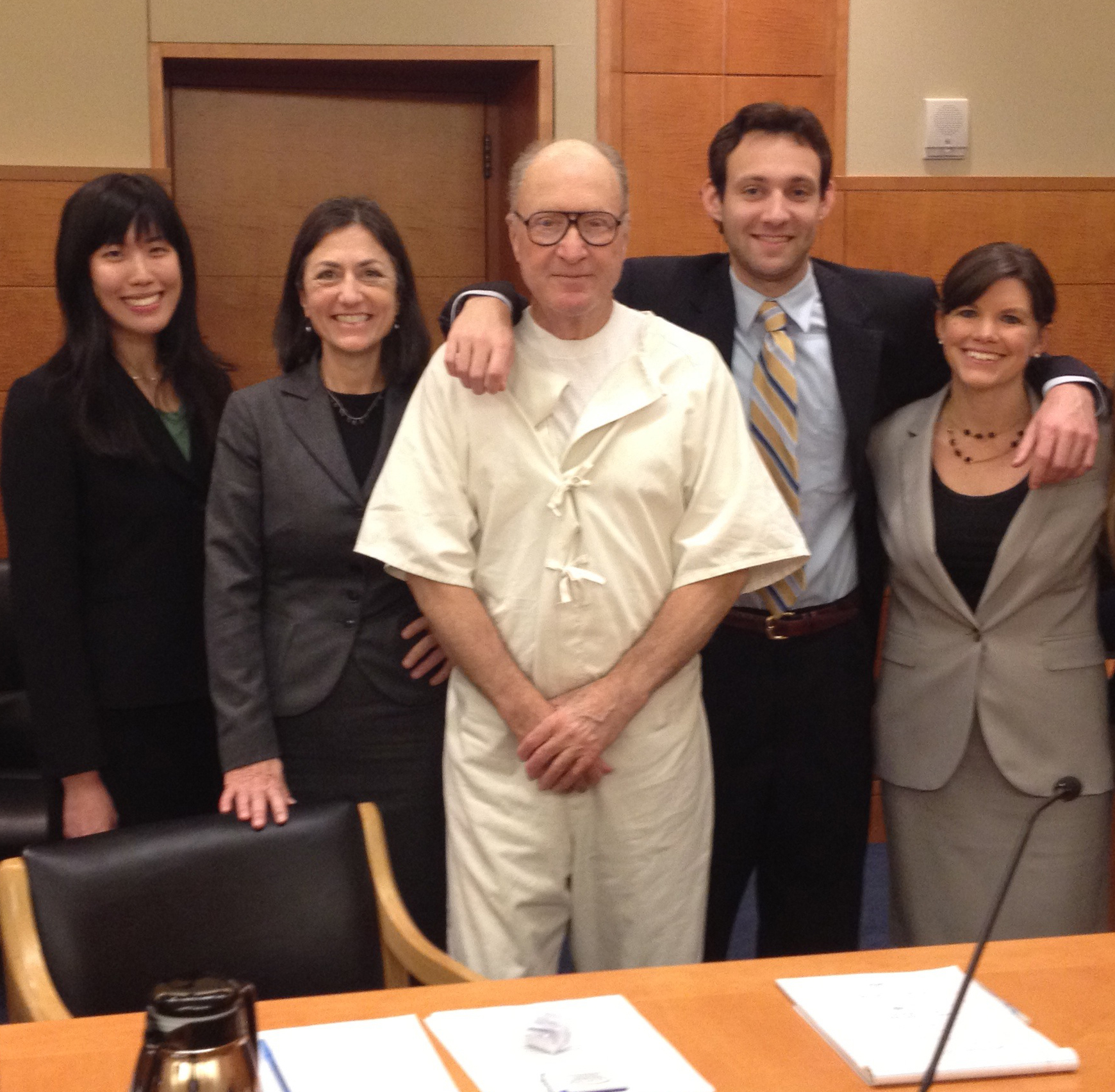
George Souliotes and his legal team (from left): Orrick Attorney Shannon Leong, NCIP Legal Director Linda Starr, George Souliotes, Orrick Attorney Jimmy McBirney and former Orrick Attorney Megan Crane

George Souliotes and his legal team (from left): Orrick Attorney Shannon Leong, NCIP Legal Director Linda Starr, George Souliotes, Orrick Attorney Jimmy McBirney and former Orrick Attorney Megan Crane

SANTA CLARA, Calif., April 15, 2013 –The Northern California Innocence Project (NCIP) at Santa Clara University School of Law and Orrick, Herrington, & Sutcliffe, LLP announced that on April 12, a California federal district court judge overturned the wrongful conviction of George Souliotes for arson and triple murder.  Souliotes, 72, has served 16 years of his sentence of three life terms without parole.

 In granting his release, District Judge Anthony W. Ishii found Souliotes had received ineffective assistance of counsel at trial.  That finding came a year after his attorneys persuaded the judge of Souliotes’ “actual innocence,” successfully arguing his conviction was based on faulty fire science and that no reasonable juror today would convict him.

The judge ordered his release unless the State of California not only notifies the court that it intends to retry Souliotes, but also takes concrete and substantial steps to do so within 30 days.  The order does not specify when he is to be released, but his attorneys expect it to be within 30 days.

“After more than 10 years of fighting for Mr. Souliotes’ freedom we are gratified that the court has found him innocent and ordered his release,” said Linda Starr, NCIP’s legal director.  “Mr. Souliotes’ conviction was a tragedy, and we now know it was based on faulty fire science that has since been discredited.  We hope the California Attorney General will honor the judge’s ruling and not take any further action that might needlessly delay Mr. Souliotes’ long overdue return home. ”

Background

On January 15, 1997, a rental property owned by Souliotes in Modesto, Calif., burned to the ground in the middle of the night and three tenants died in the fire.

The prosecution’s case against Souliotes was based almost entirely on two forensic pieces of evidence that new developments in fire science have since discredited:  First, investigators based their arson determination on certain indicators that were long believed to be evidence of arson — but developments in modern fire science have shown these indicators are just as consistent with accidental fires or any fire where the temperature reaches “flashover” conditions.

Second, forensic tests revealed a chemical compound known as a medium petroleum distillate, or “MPD,” was found at the fire scene and on Souliotes’ shoes.  MPDs are a chemical compound that exist in some ignitable liquids such Continue reading

Monday’s Quick Clicks…

click
  • Article about torture during interrogations in South Africa, exposed by the Wits Justice Project
  • Some lawmakers in the Florida want to speed up executions
  • How the Retrial Act (which allows old cases to be reopened when new evidence of innocence surfaces) has given hope to the innocent in Thailand
  • In California, walking 600 miles for the innocent
  • Connecticut Innocence Project gets new director
  • The Mississippi Supreme Court has thrown out the testimony of the prolific and controversial medical examiner Steven Hayne and ordered a new trial for convicted murderer David Parvin in a unanimous decision. It’s the second time in 20 years that the court has found problems with Hayne’s testimony in a murder case and may foreshadow things to come.
  • Editorial on the need to compensate exonerees in the state of Washington
  • Dallas DA Watkins discusses freeing the wrongfully convicted
  • This month marks the 50th anniversary of one of the most significant Supreme Court decisions this country’s criminal justice system has ever known – Gideon V. Wainwright. The case, along with later decisions, cemented the 6th amendment right to counsel for anyone, regardless if they have the ability to pay.But in a quick scan of the media today of monthly magazines to news dailies on the topic, readers will find one unified reflection expressed — half a century after Gideon, we are far from realizing effective representation for all.  Keep reading here

  • Exoneree and football player Brian Banks talks about signing with the Atlanta Falcons
  • Details on Innocence Project New Orleans’ upcoming 12th annual gala

Update on Knoops Innocence Project….the Netherlands…

knoopslogoHere is an update on a new case of interest handled by the Knoops Innocence Project in the Netherlands:

Knoops’ lawyers request re-opening in the case of the “Hilversum showbiz murder”

A Knoops’ lawyers defense team acting on behalf of Martien Meijer-Hunnik requested the Supreme Court to open the case of the “Hilversum showbiz murder.”

Mr. Hunnik was convicted by the Court of Appeal in Amsterdam for manslaughter on Bart van de Laar, a producer from Hilversum, the Netherlands, on November 10, 1981.

The conviction was mainly based on the “confession” of Mr. Hunnik on November 17, 1983. At that time, there was no other direct evidence linking Mr. Hunnik to the crime. Mr. Hunnik withdrew his confession on April 14, 1983, but the judicial authorities did not give credibility to his withdrawal.  A clear motive for the manslaughter was lacking. From 2002 onwards, after he had been detained from 1983 to 1990, Mr. Hunnik tried to obtain his case file, however, to no avail. In 2011 he requested Knoops’ lawyers to investigate his case regarding a revision procedure.

A specialized team of Knoops’ lawyers conducted their own research into the case (2011-2013). Early 2013 the team took notice of “new” material. It turned out that this material was already known to the public prosecution service since 2002 and had resulted in a 2004-police analysis that exculpated Mr. Hunnik.

All these new facts justify the conclusion that Mr. Hunnik was wrongfully convicted in 1984 for the murder on producer Bart van de Laar. The new material shows that Mr. Hunnik is factually innocent to the manslaughter he was convicted for. Also, a not previously known police analysis concludes that it is unlikely that Mr. Hunnik shot Mr. Van de Laar on Tuesday November 10, 1981.

The request to review this case is based on six new facts that are outlined in new pieces of evidence proving that Mr. Hunnik cannot have committed the crime in question. The new material includes a convincing alibi, a new time reconstruction of the events, evidence indicating that his confession was false and a new witness statement.

The defense has urged the Attorney-General of the Dutch Supreme Court to decide speedily on the review request, since the prosecution – as has been shown – was already in the possession of the exculpatory material since 2002.

Mr. Hunnik prays that his conviction will be overturned and that he will be rehabilitated, since he is severely damaged, both mentally and physically, through his conviction by the Court of Appeal in Amsterdam. It had and continues to have a great impact on his personal and family life.

The defense and Mr. Hunnik are – despite the fact that (new) exculpatory material was already known to the judicial authorities since 2002 – very grateful for the efforts made by Mr. Van Straelen, the chief Attorney General of the Court of Appeal in Amsterdam, to reconstruct the course of events and to establish the truth in this case.

Defense counsel: Mr. Geert-Jan Knoops, Ms. Lizette Vosman, Ms. Carry Knoops-Hamburger

Monday’s Quick Clicks…

click
  • The Manhattan district attorney will not reverse the conviction of a New York City man found guilty of killing a retired police officer during a botched 1998 robbery in Harlem, saying its re-investigation of the high-profile case found no evidence to warrant tossing the verdict. Defense attorneys called the decision “unjust” and a “tragedy” and vowed to continue their fight to free the man.  Jon-Adrian “J.J.” Velazquez was convicted of second-degree murder and sentenced to 25 years to life for the shooting death of Albert Ward at the illegal numbers parlor the former NYPD officer operated.
  • A review of the film L’Affaire Dumont, about a wrongful conviction in Canada
  • Alabama set to pardon Scottsboro Boys
  • In Arizona, Louis Taylor experiences shock upon release and looks forward to starting his new life
  • After 30 years, Jeffrey MacDonald, who was notoriously convicted of murdering his family, may be freed from prison. A celebrated filmmaker explains why he believes in MacDonald’s innocence.
  • Bill in Pennsylvania to compensate the wrongfully convicted

Wednesday’s Quick Clicks…

click
  • In St. Louis, Rodney Lincoln’s lawyers, from the Midwest Innocence Project, argue that DNA results contradict faulty science and misleading testimony that was key to sending him to prison three decades ago on a double life sentence.
  • Karen A. Goodrow, former Director of the Connecticut Innocence Project, appointed to the bench in CT.
  • The Illinois Appellate Court on Friday granted an evidentiary hearing to a Chicago man, Charles Johnson, who has long claimed he was wrongfully convicted of a 1995 double murder, saying new evidence that defense attorneys claim implicates another man “would probably” lead to his acquittal at a retrial.  The appeals court also took the unusual step of assigning the case to a new trial court judge, agreeing with defense attorneys that Cook County Judge Joseph Kazmierski “appears to have prejudged a central issue” regarding the evidence. Kazmierski had presided over the original trial.
  • New Jersey bill would raise compensation for wrongfully convicted
  • A woman who served 27 years of a life sentence for her husband’s murder — despite not being present when he was killed — was among 87 people granted clemency by Gov. Pat Quinn on Friday.  Peggy Jo Jackson left the Logan Correctional Center on Friday and headed to South Carolina, where she’ll live with her sister and mother and complete her parole, said Erica Nichols-Cook, an attorney with the Illinois Innocence Project at the University of Illinois-Springfield.

National Registry of Exonerations to Hold Tweet Q&A Tomorrow….

The National Registry of Exonerations will be hosting a Twitter Q&A on April 3 from 1 to 1:30 PM EST.

Did you know that prosecutors and police are assisting with exonerations at record high levels?

This trend and other news from the National Registry of Exonerations will be discussed during a Twitter Q and A on Wednesday, April 3 at 1:00 p.m. Eastern Time. That day, the Registry will release a report on 2012 exonerations data.

Michigan Law Professor Samuel Gross, the editor of the Registry, and Maurice Possley, the Registry’s lead writer/investigator and a Pulitzer Prize-winning journalist, will host a Twitter Q & A on their findings. The media and the public are invited to participate and ask questions by following #NRE12 or #innocence or @exonerationlist.

What is a Twitter Q and A?

It’s a time for Twitter users to gather online for a designated amount of time and discuss a particular topic organized around a common hashtag. This Q and A will run from 1:00 to 1:30 p.m. Eastern Time. Grab your lunch and join us!

How can I participate in the Twitter Q and A?

At 1:00 p.m. Eastern on Wednesday, log in to your Twitter account. Tweet your questions to @exonerationlist. Use the hashtags #NRE12 or #innocence to follow the conversation.

Monday’s Quick Clicks…

click
  • Prosecutors across Northeast Texas expressed concerns last week about a Texas senator’s proposal to require DNA testing of all biological evidence before trials in state death penalty cases.
  • The Oklahoma Innocence Project ranks the state among the top 10 for wrongful convictions, which a report issued Friday said could be lowered by law enforcement officers, attorneys and judges.  The Oklahoma Justice Commission, formed by the Oklahoma Bar Association, unveiled its recommendations following a two-year study into convictions of people for crimes they didn’t commit. The 33-member group’s suggestions follow each step of the wrongful conviction process, from arrest to release.
  • Nearly nine years after being freed from prison, where he served 17 years for a double murder in the central Illinois city of Paris before being freed for lack of evidence, Gordon “Randy” Steidl has won a second multimillion-dollar judgment in his case against the people who put him behind bars.  A federal judge on Wednesday entered a $3.5 million agreed-upon judgment in a long-running wrongful conviction and malicious prosecution case against former Paris police Chief Gene Ray, former lead detective James Parrish and former Edgar County State’s Attorney Michael McFatridge.
  • Law enforcement in Buffalo, NY believe prisoner Josue Ortiz is innocent

New Scholarship Spotlight: Prosecution (Is) Complex


Alafair S. Burke

Alafair S. Burke

Alafair S. Burke has posted the above titled-article, a book review of Prosecution Complex, on SSRN.  Download here.  The abstract says:

Post-conviction DNA testing has led to the exoneration of nearly three hundred defendants. As the number of exonerations grows, we are in an era where the once unthinkable is now undeniable. We convict the innocent. We imprison the innocent. We place the innocent on death row. Daniel Medwed brings this reality to life in his captivating book, Prosecution Complex, which carefully documents the myriad ways that prosecutors can contribute to wrongful convictions at every stage of a criminal case. From the charging decision to plea bargaining to trial to post-conviction, Medwed argues, prosecutors face an “ongoing schizophrenia” as they seek to balance dual roles in the criminal justice system, trying to serve both as zealous advocates for the government and as neutral ministers of justice.

This book essay offers three lessons that can be gleaned from Medwed’s central thesis that prosecutors must struggle to balance their dual roles as advocates and ministers of justice. Two of these lessons are for prosecutors: 1) that the protection of justice means not only the protection of the innocent, but also the fostering of a fair process, and 2) that prosecutors can mitigate the possibility that they will contribute to a wrongful conviction by seeking out contrary voices that foster neutral decision-making. The third lesson, aimed at the wrongful convictions movement, is to avoid a language of fault, which has a tendency to focus reform efforts on intentional misconduct and to signal to virtuous prosecutors that they need not worry that they may contribute to a wrongful conviction. Prosecution Complex is a significant book that should be read by any scholar, lawyer, or layperson who cares about criminal justice. But its most essential audience is prosecutors themselves, who hold the key to the most feasible and important reforms in the prevention of erroneous convictions.


Commentaries Regarding the Overturning of Amanda Knox’ Acquittal

A couple of interesting stories here and here.  NY Times article here.  Amanda’s reaction and a discussion of whether she will return to Italy for the trial here.

Thursday’s Quick Clicks…

click

Wednesday’s Quick Clicks…

click

Friday’s Quick Clicks…

click

New Scholarship Spotlight: Destruction of Innocence: The Friedman Case: How Coerced Testimony & Confessions Harm Children, Families & Communities for Decades after the Wrongful Convictions Occur

Gavin DeBecker and Emily Horowitz have posted the above-titled article on SSRN.  Download full article here:  The abstract states:

Between 1984 and 1995, at least 72 individuals were convicted during the national hysteria of mass child molestation and satanic ritual abuse cases. Almost all thoseconvictions have since been overturned. This paper analyzes the present-day, on-going impact from wrongful convictions, focusing on the Friedman case, well-known as the subject of the landmark documentary film, Capturing the Friedmans. Though the US Appeals Court has ruled that Jesse Friedman was likely wrongfully convicted, the case has not yet been overturned. The impact on wrongly-imprisoned defendants is obvious, however the impact on hundreds of children has rarely been considered. Initially sure they were not sexually abused, and confident in their perceptions of reality, these children were dragged to a place of confusion, mistrust of adults, and uncertainty about themselves and the world. This paper provides new evidence and insight from extensive interviews with people police alleged were molested – and who now as adults confirm they were coerced into making false accusations. Also revealed are new witnesses who were present during alleged crimes against others, and now confirm there was no molestation. Child sexual abuse does happen, of course, and is a profound social issue; at the same time, false and hysteria-driven prosecutions robbed resources from cases of actual sex crimes, reduce the public’s faith in the legitimacy of such prosecutions, and interfered with the protection of children. The Friedman case provides a unique opportunity to heal a community still suffering from the wounds of false accusation, confusion, and deceit.

Book Review: Manifest Injustice…

UntitledBy Rob Warden for the Chicago Tribune:

Courting reflection on justice

By ROB WARDEN

“Manifest Injustice” is an apt, allegorical title for Barry Siegel’s latest book, which makes three points didactically: First, the law can be an ass — to a greater extent than Charles Dickens imagined. Second, when it comes to administering justice, the courts can be at an utter loss. Third, plea bargaining can be just a kinder, gentler form of torture, with the same result — manifest injustice.

Manifest Injustice

By Barry Siegel, Henry Holt, 385

pages, $28

Siegel’s book is journalism at its best, a haunting, lucid, rigorously researched account of a multifaceted tragedy born of the murders of a young couple off a lovers’ lane in the desert near Scottsdale, Ariz., on a warm May night in 1962. Over the next five decades, the case took one vexing turn after another, each time skirting any semblance of common sense.

It is a story of the worst and best of humanity — from a woman whose scorn for her estranged husband led to his conviction for the murders, to a psychopathic killer who repeatedly confessed to the crime, to prosecutors and judges who relied upon a legal principle of dubious applicability to prevent two juries from learning about those confessions, and to dedicated lawyers who relentlessly championed justice for a man they believed innocent.

At the time of the murders, Seigel tells us, Bill Macumber and his wife, the former Carol Kempfert, had been married a little less than a year — happily by all accounts. They lived in Phoenix, where Bill, an Army veteran who had never been in trouble, operated a filling station with his father. In short order, Carol gave Continue reading