Tag Archives: Japan

Prosecutors Argue for Mainali’s Innocence

My previous post on Govinda Mainali’s Case here. This is a 1997 case where a Nepalese man was convicted of killing a woman in Tokyo.
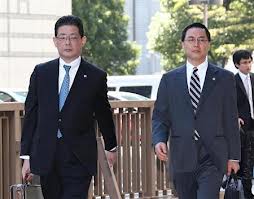
 
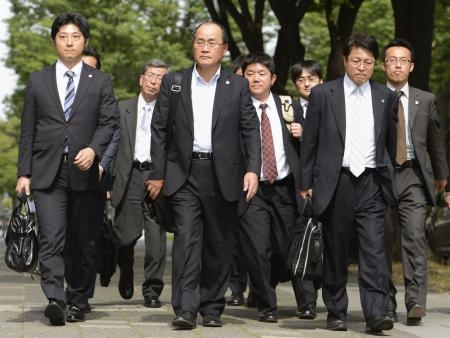
Prosecutors entering Tokyo High Court for the Mainali Retrial Hearing (From Sankei Shimbun News).

The retrial was held on October 29th at the Tokyo High Court.  The prosecutors argued for Mainali’s innocence, saying that Mainali was accused of a crime he did not commit. The court will hand down the ruling next week, on November 7th. The prosecution will not appeal the not-guilty ruling, and the decision will be finalized soon.

Mainali’s case will be the 8th case in Japan after WWII where the defendant was declared innocent after the retrial in a death penalty/ life imprisonment case.

Takayuki Aoki (Tokyo High Prosecutor’s Office) made a comment after the retrial. He said that the investigation and the first trial itself were not problematic. He did state that he is sorry that Mr. Mainali was wrongfully accused and detained for a long time as the perpetrator. However, there was no apology given from the prosecution at the retrial hearing. They still take the position that the their accusation was inevitable, and the circumstances have changed since the new DNA testing results became available.

Typical problems surrounding the Japanese criminal justice system were present during the course of the trial and the retrial of the Mainali case: lengthy detention during investigation, interrogations coerced by the police and prosecutors, prosecutors appealing the decision to grant retrial, and non-disclosure of exculpatory evidence by the prosecution. It is reported that the police and prosecutors will not hold a thorough investigation of what went wrong in this particular case. If we sincerely regret what happened and are determined to never let it happen again, shouldn’t we thoroughly examine the cause of wrongful conviction in each and every case?


Stories on Mainali’s retrial here and here (in English).

Breaking News: Another Exonerating DNA Testing Result Revealed in Mainali Case

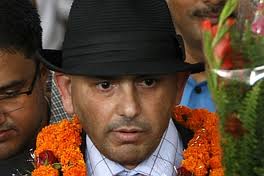
From Asahi Shimbun Digital News.Mr. Govinda Prasad Mainali (middle).

Previous posts on the Mainali Case here, here and here.

This is a 1997 robbery-murder case where Govinda Prasad Mainali, a Nepali national, was convicted and sentenced to life in Tokyo, Japan. Mainali was granted a retrial in June this year. The prosecution did not appeal the decision of the Tokyo High Court which rejected the prosecution’s objection against the decision to grant a retrial. Mainali has already gone back to his home country, Nepal.

It was revealed yesterday that an additional testing by the prosecution brought another exonerating result. A third person’s DNA profile has already been found on and inside the victim’s body during previous testings (hairs left near the victim’s body and semen). This time, the same person’s DNA was found on victim’s fingernail clippings. Scrapings from victim’s right thumb fingernail and left middle fingernail were concluded to have matched that person, and scrapings from other fingernails also might have come from him. The redundant DNA results from many different items found at the crime scene suggest that the DNA came from the actual perpetrator.

It is reported that the prosecutions will argue that Mainali is innocent of the crime during the retrial. The retrial will start on October 29th.

Read the news in Japanese here.


More on Recent Executions in Japan

As I posted here, two executions were carried out in Japan on September 27. Here are details of the executions.

From the Japan Times (Sept. 29, 2012):


Two hanged, including a female cult leader

By Hiroko Nakata
Staff writer

Two inmates were executed Thursday, including a female cult leader convicted of murdering six of her followers.

It was the second round of hangings in two months and the third set since Prime Minister Yoshihiko Noda took office in September 2011.

The latest hangings brought the total under his administration to seven. In the previous round on Aug. 3, two convicted murderers were hanged.

One of the prisoners put to death Thursday was 65-year-old Sachiko Eto, who was hanged in Sendai. Records indicate she was the fourth woman executed since 1950. Continue reading

Two Executions in Japan Today…

Two executions were carried out in Japan on September 27, 2012…

These were the sixth and seventh executions this year (three were carried out in March and two in August).

My previous post on the death penalty debates and recent executions in Japan here. Are we going to continue sending people to the garrows without an open and reasonable debate?

I will post the details later.

Supreme Court Denies Release in Higashi-Sumiyoshi Case

Previous posts on Higashi-Sumiyoshi Case here (part 1) and here (part 2).

This is an arson case where a couple (Tatsuhiro Boku and Keiko Aoki) was convicted in 1999 of setting their house on fire and killing an 11 year old girl (Aoki‘s daughter) in Higashi-Sumiyoshi Ward, Osaka Prefecture.

Boku and Aoki each filed a petition for retrial to the Osaka District Court in 2009, and were granted a retrial in March 2012.  The presiding Judge stated in the decision that the petitioners’ confessions were unreliable and unreasonable from a “scientific viewpoint”, taking into consideration the result of the new experiment.

The prosecutors instantly appealed the ruling, and the retrial petition is currently being reviewed by the Osaka High Court.

Osaka District Court had also ordered Boku and Aoki’s immediate release. The prosecution also appealed this ruling. Osaka High Court agreed with the prosecution and reversed the District Court’s decision. The petitioners then filed a special appeal to the Supreme Court, but it denied the appeal on September 18th. The Supreme Court merely stated that the conditions of special appeal did not meet in the case. It did not even go into the actual facts of the case…

Even in the rare instances where a retrial is granted, the appeal process may take years. After the lengthy appeals process, the actual retrial process may take even longer…

A statement by the supporters can be found here (in Japanese).

Fabrication of Reports by Police Forensic Science Lab Scientist Revealed

Forensic Science Lab in Wakayama.– from TBS News.

It was reported today that a scientist at Forensic Science Laboratory in Wakayama Prefectural Police Headquarters had been fabricating reports in criminal cases (Read the news in Japanese here and here).  It was revealed that the scientist wrote up reports although he never tested the actual evidence, using  his previous reports and copied charts from them. The Wakayama Prefectural Police had been looking into the case since July, after an accusation by fellow scientist.

The alleged scientist works in the chemical division of the lab, which handles the analysis of evidence such as drugs or vehicle paint left at the scene of a traffic accident. The police determined that there had been fabrication of reports in 8 cases between May 2010 through June 2012. These cases include cases involving death of victims and hit-and-run cases. However, the Wakayama Police Department is claiming that the impact of false evidence in actual cases was minimal.

If in fact the scientist had been fabricating evidence, he may face criminal charges. There might have been trials where the reports of the scientist’s “testing” results were introduced and admitted into as evidence. If so, it could be a reason for a retrial.

There have been several incidents of fabrication of evidence by police investigators recently. In Osaka, an officer fabricated results of alcohol testing during enforcement of drunk-driving. In Fukushima, officers lost cigarette butts left at the crime scene and logged in unrelated evidence in their place. Continue reading

Two Executions in Japan……

A very disappointing news from Japan…

There has still been no wide and open debate on the issue of death penalty in Japan, but executions are being carried out…

Statements from various organizations ensued. Read the statements by Japan Federation of Bar AssociationsCenter for Prisoner’s Rights, and Amnesty Japan (in Japanese).

Read about the death penalty issues in Japan here and here.

*************************

Here is an article on Friday’s executions by Japan Times staff writer Mizuho Aoki:

Two death-row inmates were hanged Friday, in Tokyo and Osaka, in the second round of executions this year after three men went to the gallows in March.

Friday’s hangings were the first ordered by Justice Minister Makoto Taki, who assumed the post June 4. Prisoners on death row now number 130.

Junya Hattori, 40, and Kyozo Matsumura, 31, were hanged because “there was no uncertainty surrounding their convictions,” said Taki, who supports the death sentence.

Hattori, who was hanged at the Tokyo Detention House, raped a 19-year-old university student in the city of Mishima, Shizuoka Prefecture, in his car and burned her to death in January 2002.

Matsumura was executed in the Osaka Detention House for the robbery-murders of a 57-year-old aunt in the city of Nagaokakyo, Kyoto Prefecture, and a 72-year-old uncle in Sagamihara, Kanagawa Prefecture, within eight days in January 2007.

“I signed documents authorizing the executions after carefully considering each case,” Taki told journalists Friday afternoon.

“As I said when I assumed the post, unless there is any uncertainty concerning a conviction, a justice minister should respect the trial process and the decision of the court,” he said. Continue reading

Breaking News: Mainali Case will Go to Retrial

Tokyo High Prosecutor’s Office stated on August 2nd (JST) that it will not appeal the Tokyo High Court’s decision affirming the ruling to grant a retrial for Govinda Prasad Mainali.  The Prosecutor’s Office commented that it could not find a compelling reason to file a Special Appeal to the Supreme Court (since the grounds for Special Appeal are limited). However, they will not change their argument that Mainali is guilty of the 1997 murder in the retrial process.

Division 4 of Tokyo High Court granted Mainali a retrial in June this year, but the Prosecutor’s Office immediately filed an objection. Objection was denied by Division 5 of High Court on July 31st. Read more in my previous post here.

Division 4 of the Tokyo High Court, which also granted a retrial for Mainali, will handle the retrial process. In all the cases where a retrial took place in the past, “not guilty” decisions followed.

Read a detailed report in English from the Daily Yomiuri Online Staff writers Katsuro Oda and Chihiro Iwasaki here.

Excerpt:

The Tokyo High Court’s rejection of objections by prosecutors regarding the granting of a retrial to a Nepalese man convicted of murder has made it nearly certain a retrial will be held and that the defendant, who was released from custody in June, will be found not guilty. Continue reading

Breaking News: Tokyo High Court Denies Prosecution’s Objection in Mainali Case

Mr. Govinda Prasad Mainali.

Division 5 of the Tokyo High Court denied the objection filed by Tokyo High Public Prosecutor’s Office in Mainali Case, a 1997 murder case, on July 31st (JST). Previous posts about the Mainali Case here, here and here.

Division 4 of the Tokyo High Court granted the petition for retrial for Govinda Mainali, as well as his release from custody last month. The Prosecutor’s Office immediately filed an objection, but the objection was denied today by Division 5 of the same court. The Prosecutor’s Office has until August 6th to file a Special Appeal to the Supreme Court. If the Prosecutor’s Office does not appeal or loses appeal at the Supreme Court, Division 4 of the Tokyo High Court will hold a retrial for Mainali. It has been reported that it is unlikely that the Prosecutor’s Office will appeal.

Mainali was convicted for a murder in 2000.  In March 2005, Mainali filed for a retrial to the Tokyo High Court. Later, a new DNA testing was conducted. The new test focused on the semen found on and inside the body of the victim. Fifteen samples from the crime scene were tested, but none of the DNA type matched Mainali’s. The unknown profile from the semen did match that of the two pubic hairs found in the crime scene.

The decision which granted Mainali a retrial in June stated that it was likely that the third person whose DNA was on the victim had a sexual intercourse with the victim and later killed her. In the Objection, the prosecution stated that this new evidence only suggests that the victim had sexual intercourse with this unknown third person on the evening of the incident, but the court today denied this claim as unreasonable. The prosecutors also sought a new DNA testing of a substance on victim’s hand, but the court denied the request.

Media report about today’s decision in Japanese can be found here and here.

Audio and Visual Recording of Interrogations by Public Prosecutors, Part II

The Supreme Public Prosecutor’s Office (SPPO) issued a report on audio and visual recording of interrogations last week (on July 4th, JST).

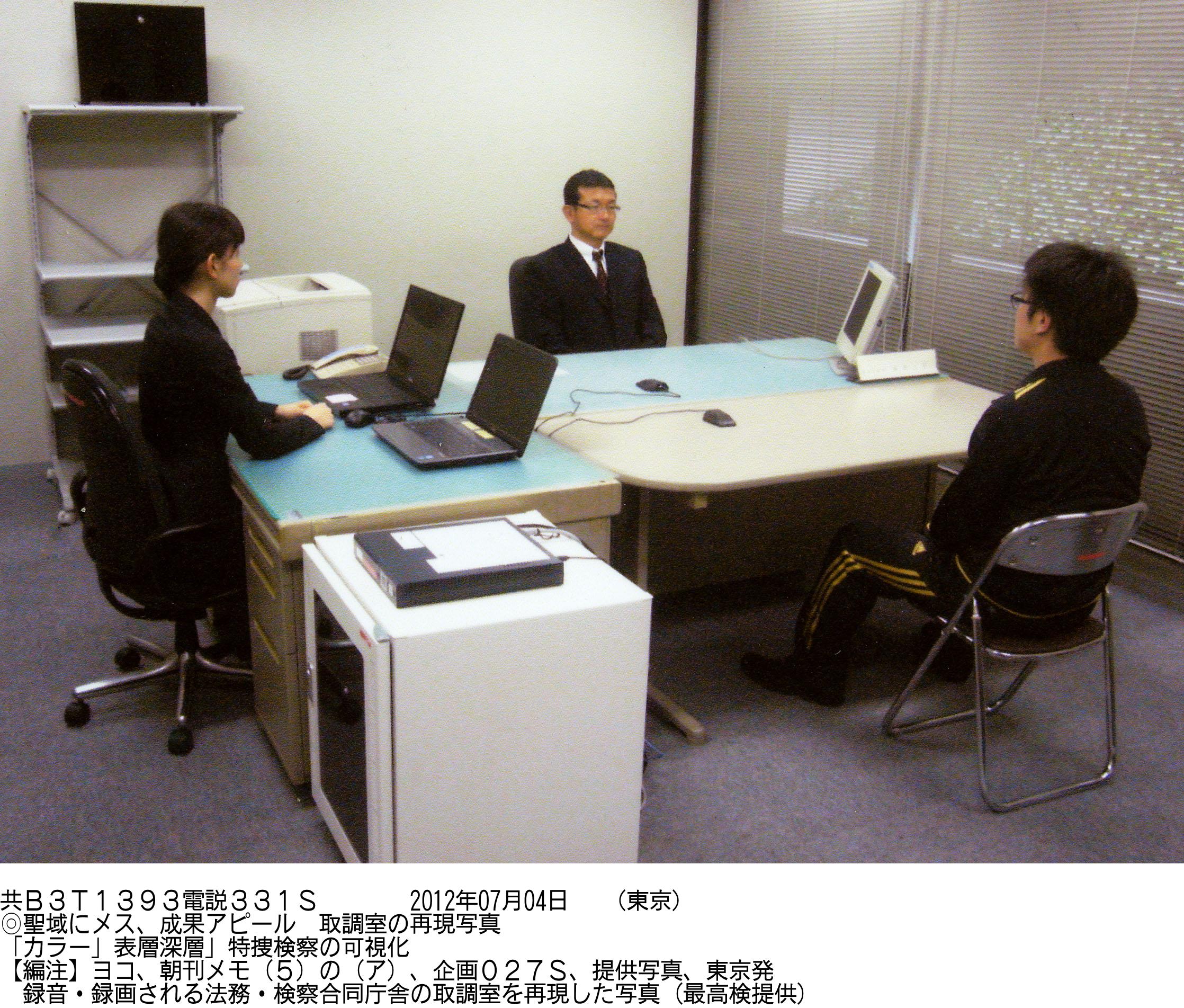
Demonstration of how the recording would take place during interrogation by prosecutor.

As I posted earlier, the SPPO started recording some interrogations on an experimental basis in 2006. Last week’s report  focused on the experimental recording in three Special Investigation Units and ten Special Crime Devision Public Prosecutor’s Office, which took place in 91 cases from March 2011 through April 2012 (note that these offices or branches in the Public Prosecutor’s Office usually involve only white collar crimes). The report revealed what the prosecutors in Japan have to say about the recording of interrogations.

Below are the points worth noting:

1)  Interrogations in 91 cases out of 98 were either partially or entirely recorded. The entire interrogation process was recorded in 39 cases.  30 of the cases concerned tax violations.

2) In seven cases, the suspects refused the recording from the beginning of interrogations. In 12 cases, the suspects refused the recording halfway through. The reasons for their refusal include: they were ashamed of being arrested and incarcerated, and they did not want to provide discussions in front of the camera.

3) Recording took place in other prosecutor’s offices in 946 cases out of 1,005 cases, where the charge was a serious offense and the case was to be disposed of by a Lay Judge trial, such as murder. In cases involving persons with intellectual disabilities, 540 cases were recorded (this was all of the cases in this category except where the accused refused). Continue reading

Another False Confession Case — Fukawa Case

Takao Sugiyama and Shoji Sakurai

As I posted here, false confessions account for many, if not the majority of, wrongful convictions in Japan. Yet another case illustrates this: the Fukawa Case, in which two people were finally exonerated in 2011 for a 1967 robbery-murder.

The crime occured in August of 1967, in the town of Fukawa, Ibaraki Prefecture, about 40 miles outside of Tokyo. A carpenter was found dead in his home.  His legs were tied with a towel and a shirt, a pair of underpants were stuffed in his mouth, and he was strangled. There were signs of struggle in the house, but it was unclear if anything was taken from the house, except for a white purse the victim supposedly used daily. 43 fingerprints were found but none of them connected to perpetrator(s). There was no physical evidence at the scene.

However, there were several eyewitness statements that two men (one tall man and another shorter man) were near the victim’s house on the evening that the victim was supposedly murdered. This statement lead the police to think there were two perpetrators.

Based on this information, the police investigated more than 180 men in the area, until they found the two men, Shoji Sakurai and Takao Sugiyama,who did not have an alibi on the date of the crime. In October of the same year, both of them were arrested on separate charges, and were interrogated.

Sakurai and Sugiyama were held in police jails (“Daiyo-Kangoku“), and interrogated for hours and days. After 5 days of interrogations, Sakurai confessed to the crime. Based on Sakurai’s confession, the police also forced Sugiyama to confess. They retracted their confession during the interrogation by the prosecutors, but the prosecutors sent them back to police jails, and after continuous interrogations that ensued, they finally gave in and confessed again.

The two contested their guilt at trial. The prosecutors had no direct evidence of their guilt. All they had were: their confessions made during interrogations by police and prosecutors (with the  testimony of interrogators and the partial tape recordings of the interrogations which recorded only the part after they confessed to the crime), and testimonies of eyewitnesses who saw two men on the day of the crime.

There was no physical evidence, including the white purse which was never found. Their confessions during investigation changed repeatedly, Sakurai and Sugiyama’s confessions contradicted each other’s in important parts, they did not match the circumstances of the crime scene, and there was no information revealed in the confessions which unknown to investigators.

Nevertheless the trial court declared that their confessions made during investigation were reliable and sentenced them to life in 1970. The High Court as well as the Supreme Court denied the appeal. Their sentences were finalized in 1978. Continue reading

False Confessions as Major Cause of Wrongful Convictions in Japan

A Police Jail in Tokyo.

One of the major causes of wrongful conviction in Japan is definitely false confessions.

Why? Obviously, since a confession is still the “King of evidence” in Japan.  And since the law permits long period of detention (23 days!) before the formal charge (indictment) of a suspect, and since during this pre-charge detention period, there are lengthy interrogations by the police and prosecutors.

When and How Long can a Suspect be Detained?

In Japan, a suspect can be detained when there is a “reasonable cause” that he/she committed the crime, and there is a risk of flight or he/she might tamper with the evidence in the case.  When a judge issues an arrest warrant and once the suspect is arrested (“Taiho“), the police has 48 hours to transfer the suspect and the case to prosecutors.

When prosecutors receive the suspect and if they think he/she should be detained further, they must ask a judge within 24 hours of receiving the case to issue a warrant for up to 10 days of additional detention (“Koryu“). This is when the suspect appears before a judge for the first time.  Additional 10-day extension of Koryu is possible after the initial 10days. Judges almost always issue the arrest/ detention warrant. Less than 1 % of the warrant claim is denied. For violent crimes, it’s almost 0%.

To sum up, police and prosecutors can detain a suspect for up to 72 hours before the suspect has to appear before a judge, and then for additional 20 days  before the formal charge (23 days in total!).

Interrogation During Detention

During this 23-day period, police and prosecutors usually interrogate the suspect for a long period of time. Conducting the interrogation is critical, even for prosecutors. Continue reading

Yet Another Police Misconduct Revealed in Mainali’s Case

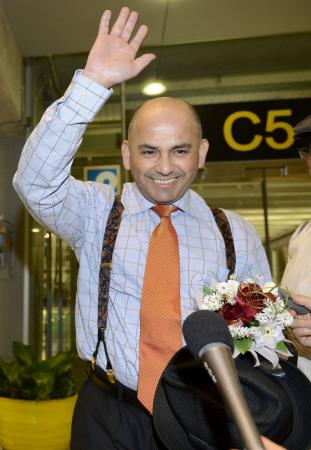
Mr. Mainali, on his way back home.

Previous posts on Govinda Mainali’s exoneration in Japan here, here, and here.

While Mainali went back to his home contry (Nepal) after the Tokyo High Court granted his new trial, yet another misconduct by the police in his case was revealed.

From the Japan Times.

Roommate says police forced him to sign false statement indicating Mainali’s guilt

DHULABARI, Nepal — A Nepalese man who shared a Tokyo flat with compatriot Govinda Prasad Mainali, 45, said Monday he was coerced while in detention in Japan to sign a false statement indicating his roommate had murdered a Tokyo woman in 1997 in order to rob her…….

Khadka said he and Mainali were among five Nepalese migrant workers who lived in a building in Tokyo’s Shibuya Ward adjacent to the vacant apartment where the woman was murdered. Police found her body 11 days after her death.

“Japanese police wanted to establish that Mainali was desperately in need of money at the time of the murder. They made me sign a statement that said Mainali returned to me a few days after the murder a sum of ¥100,000 that he had borrowed from me in February that year,” Khadka told Kyodo News at his residence in Dhulabari, about 300 km southeast of Kathmandu. Continue reading

Did Japan Execute the Wrong Man? – Iizuka Case

Photo taken near Iizuka CIty

Michitoshi Kuma was executed at the Fukuoka Detention Center in October 2008. He had always maintained innocence to the crime of which he was found guilty. Kuma’s family filed for a retrial in October 2009.

Kuma was found guilty of abducting, killing and dumping the bodies of two 7-year-old girls in 1992 in Iizuka, Fukuoka Prefecture. He was arrested in 1994, but maintained his innocence.

Since there was no direct evidence linking Kuma to the crime, they relied on circumstantial evidence, including a testimony by an eyewitness that he saw the dark-blue vehicle which belonged to Kuma near the place where the victims’ bodies were found, and a fiber analysis which revealed that some pieces of fiber on the victims’ clothing was the same fiber from the seat from Kuma’s vehicle.

Another evidence against him was the result of a DNA testing conducted by the Police crime laboratory. Blood on the ground from where victims’ bodies were found were tested for a DNA profile, and they said that the DNA type matched Kuma’s.

The Fukuoka District Court sentenced him to death in 1999. The High Court as well as the Supreme Court affirmed the conviction and his sentence was became finalized in 2006. He was hanged in 2008 at the age of 70.

Then, in 2009, the country was stirred by a finding in another high profile case, the Ashikaga Case (read about this case here). Continue reading

Mainali Case Reveals Flaws of Japanese Criminal Justice System

Mainali’s wife and his two daughters.

Here is an article by Minoru Matsutani of the Japan Times on the Mainali Case and the flaws of the Japanese criminal justice system that it highlights (read about the Mainali Case here and here).

It points out some of the problematic features of the Japanese system including: (1) prosecutors withholding evidence which would have cleared the defendant (no Brady rule in Japan), (2) not enough disclosure of the prosecution’s evidence, (3) no law to limit the appeal by the prosecution to a not guilty decision by the court, etc. In addition, there were apparently even more hardships for Mainali, who is a Nepalese.

Mainali is expected to leave Japan for his home country this week.

Excerpt:

Mainali case exposes flaws, bias in judicial system –Prosecutors withheld evidence, detained Nepalese after acquittal

Facing retrial, exoneration and freedom after spending 15 years in prison for the 1997 murder of a Tokyo woman — a crime for which he was initially acquitted — Govinda Prasad Mainali could be a case study in the flaws in the nation’s judicial system.

Like other foreigners in violation of their visa status, the Nepalese was placed in immigration detention after his acquittal, pending deportation. But prosecutors had other plans: They made sure he stayed in immigration custody as they retried his case on appeal, bent on a conviction.

To this end, they withheld evidence that would strongly establish reasonable doubt of guilt. In short, they presented, as a spokesman for the state said, what was needed “to prove their case.”

……Mainali lawyer Shozaburo Ishida faulted prosecutors for withholding vital evidence that could have upheld Mainali’s acquittal. Continue reading

Recent Developments in Death Penalty Debates in Japan

Since I last posted about the country’s death penalty debates, there have been some developments.

(1) The process of the issuance of death warrants (for the 12 people who were executed since 2009) was revealed for the first time in history. The Ministry of Justice disclosed related documents including the Order of Execution. It became clear that the Minister of Justice (who orders the execution) does not sign the Order him/ herself. Even the official seal of the Minister is done by a staff member. The Minister’s sign appears on another document named “Conclusion of Review of Death Penalty Case (Suitable for Execution)“. How the candidates for the next executions are chosen remained unclear.

The issuance, review, approval and order documents were all on the same date and the actual execution was carried 2 to 4 days thereafter. The process is extremely fast.

(2) New Minister of Justice, Minoru Taki was appointed on June 4th. He is a member of a group of supporters for Iwao Hakamada, a death row inmate. He told the media that now that he is the Minister, he  may withdraw from the membership. In addition, he told the media that he will consider executing death row inmates, since that is his job as the Minister.

(3) Ministry’s top three officials have been discussing (closed from the public) about the method of execution. On June 6th, they decided that they will consider the lethal injection method, currently employed in the United States. They are to conduct a research on why the U.S. decided to employ the lethal injection method in the 1970s.

(4) Meanwhile, the opponents to death penalty are raising their voices. Read an excellent report by the Japan Times on an International Symposium which was held in Tokyo on June 1st here (in English).

Excerpt:

……With international pressure growing against Japan to scrap the system, abolitionists, scholars, lawmakers and law enforcement officers from Japan, Norway and the U.S. recently gathered in Tokyo to spread their message that capital punishment neither prevents crime nor comforts the victimized. Continue reading

Role of Prosecutors in Postconviction Proceedings

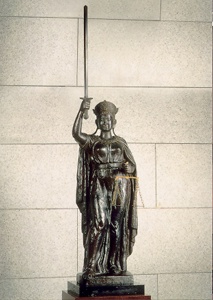
Lady Justice, in the Supreme Court of Japan

As I posted on Thursday, there was a decision by the Tokyo High Court to grant a retrial to Govinda Mainali. The High Court also ordered his release. He was finally released after 15 years of confinement. Since he has a conviction for visa violations, he is placed in immigration custody, and will be sent back home to Nepal, to his family.

However, the Tokyo High Public Prosecutor’s Office immediately filed an objection to the High Court. Even if the Court denies the objection, they can still file an appeal to the Supreme Court. Deputy chief prosecutor of the Tokyo High Public Prosecutor’s Office was quoted as saying that the Court’s decision to grant Mainali a retrial was “absolutely unacceptable”.

Meanwhile, Asahi Shimbun news reported on June 3rd that the Supreme Public Prosecutor’s Office will be holding the first meeting ever with the public prosecutors who deal with postconviction claims of innocence. They are apparently alarmed about the relatively high number of recent court decisions to retry cases. Of the eleven decisions (in death penalty or life sentence cases) to grant a retrial since the end of WWII, five  were handed down after 2009 (decisions in Ashikaga, Fukawa, Fukui, Higashi Sumiyoshi, and Mainali cases. Note that four of these involve false confessions).

The court decisions in these cases were made possible in part by the state-of-the-art DNA testing. As the exonerations all over the world have made it clear, DNA is a strong tool to prove innocence of the wrongfully convicted.

However an exoneration means the police and prosecutors who investigated, prosecuted, and helped to convict an innocent person will be criticized by the public. Thus, it was reported that the prosecutors are worried that these decisions to retry cases “will undermine the public’s trust to the investigation process, and therefore worrisome from the standpoint of public safety”. An executive prosecutor said that they “will do their best to battle these retrial claims by developping prosecution’s scientific knowledge.”

If the prosecutors truly believe what they said in these media reports, it is an evidence that the public prosecutors are worried more about “winning” postconviction cases than finding out the truth. Continue reading

Breaking News: Tokyo High Court Grants Retrial for Mainali

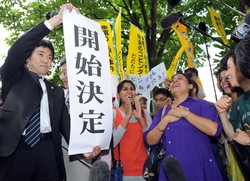
“Retrial Granted!!” — from Mainichi Shimbun News.

The Tokyo High Court granted the petition for retrial for a 1997 murder case today (Friday June 7, 2012, JST). It also granted petitioner Govinda Mainali‘s release from custody.

Of the cases where a death sentence or a life sentence were imposed in Japan since the end of World War II, it is said to be the eleventh case that a court granted a retrial.

The Court ruled that if the new DNA evidence was presented at the original proceeding, Mainali would not have found guilty of the crime. News can be found here and here (in Japanese).

However, the prosecutors may file an objection within three days (and they likely will). Even if the Court rejects the objection, the prosecutors can still file a special appeal to the Supreme Court…

Here is what happened in this case:

The victim was found strangled to death in a vacant apartment in Shibuya, Tokyo on March 19th 1997.  She was also robbed 40,000 yen, and it was said that she was murdered on the night of March 8th, 1997. The case became well known since the victim was said to have lead a double life: a graduate of one of the top colleges in Japan, she worked on weekdays at a then very prestigious company, but worked as a prostitute on weekends.

There was a used condom in the toilet of the empty apartment that the victim’s body was found. DNA testing of the semen in the condom revealed that the sperm came from Govinda Mainali, a Nepali national Continue reading

Attorneys for Okunishi File Special Appeal to Retry Nabari Case

Attorneys for Okunishi on their way to the Nagoya High Court to file a Special Appeal.

Since the Nagoya High Court rejected Okunishi’s retrial last week, there has been much criticism against the decision in the press in Japan. Meanwhile, attorneys for Okunishi filed a special appeal to the Supreme Court today.

There is also a concern about Okunishi’s health. 86-year-old Okunishi has lost appetite, and now has other health issues. He is being treated at a hospital outside the detention center.

At the hospital, his right hand is tied to the bed with a handcuff, his left hand also handcuffed with a rope tying the handcuff to a guard’s hand. Four guards are constantly watching him aroun the bed……  Read about this inhumane treatment here (in Japanese).

Additional story on Nabari Case Continue reading

High Court Rejects Request for Retrial in Nabari Case…

Attorney for Okunishi: “Unjust Decision” — From Chunichi Shimbun

The Nagoya High Court rejected the appeal for a retrial by Masaru Okunishi today. 86-year-old Okunishi has been on death row for 40 years. Previous posts about the Nabari Case here and here.

This is the seventh petition for retrial for Okunishi, filed in 2002. The key new evidence for this petition is a testing result by a chemist. The result concluded that the pesticide in the wine that the victims drank was not “Nikkarin-T”, the chemical with which Okunishi confessed he poisoned the wine.

Division 1 of the Nagoya High Court granted a retrial based on the new evidence in 2005, saying that Okunishi’s confession obtained during 5 days of intense interrogation was unreliable. However, this decision was vacated in 2006 by Division 2 of the same High Court after the prosecution appealed. Okunishi filed a special appeal to the Supreme Court, which referred the case back to the Division 2 of the Nagoya High Court in 2010, saying that “it did not decide on the case based on science”.

Today, Division 2 of the High Court vacated the 2005 decision to grant retrial yet again. Presiding Judge Yasuo Shimoyama stated in the decision Continue reading