Author Archives: Phil Locke

The Debra Milke Lawsuit – A Perspective

Camille Tilley, whose daughter Courtney was wrongfully convicted in Maricopa County, was kind enough to post a link to the lawsuit recently brought by Debra Milke against a number of Phoenex and Maricopa County, AZ officials regarding her wrongful conviction for the murder of her 4 1/2 year-old son. This post was contained in a comment to our recent story about the Debra Milke case.

If you haven’t had a chance to read the lawsuit, I think it deserves some special comment. You can access it directly here:  Debra Milke-lawsuit. It’s very interesting to note that Milke is represented in her suit by the firm of Neufeld Scheck & Brustin. You probably know that Peter Neufeld and Barry Scheck are the founders of the original Innocence Project.

I’ve read the suit, and if you think this kind of thing can’t happen to you, you need to read it too. It reads like a bad crime novel, but the really scary part is that it actually happened, and the people who are supposed to be the “good guys” are actually the criminals. Joe or Jane citizen has absolutely no defense against this.

The official misconduct in this case is sordid, stomach turning. Could it possibly be that this case, and this suit, will be the crowbar that finally pries the lid off the slimy justice system snake pit called Maricopa County?

Debra Milke Case — She Remains Free — and IT’S DONE !!

Today, the Arizona Supreme Court refused to grant the prosecution a retrial for Debra Milke. Milke’s conviction had been overturned by the US 9th Circuit for prosecutorial misconduct, and sent back to the Arizona courts.  See the AZ Central story here.

We’ve covered this case extensively. See here, here, here, and here.

And …….. Debra Milke has filed suit against Maricopa County, AZ, the prosecutor (Bill Montgomery), the detective (Armando Saldate), and twelve other officials. See the Courthouse News Service article here.

All I can say is …. YOU GO, GIRL!

EVERYBODY Is Supposed to Tell the Truth in Court ……. Right??

The genesis of this post was the recent action by the US 9th Circuit in California, in which the court recommended perjury charges against a prosecutor who had lied to the court. Please see our previous post on this case here.

When I first saw this, my initial reaction was “holy smoke!” This is precedent shattering. But when you read the details, the potential perjury charges were recommended because the prosecutor in question had lied while testifying. This situation does not cover a prosecutor’s lying in court when not officially sworn in and under oath, which is basically all the time.

That’s when I had the epiphany. Here’s my idea. Let’s have all trial counsel, prosecutors and defense attorneys, sworn in at the beginning of each trial. It’s so SIMPLE, and would COST NOTHING. At most, this would take 60 seconds of the bailiff’s time at the beginning of a trial, and then it’s done.

EVERYBODY is supposed to tell the truth in court, right? Any citizen who testifies swears an oath to tell the truth, and if they lie, they’re subject to perjury. Why should prosecutors be any different than the citizen? Of course, they will say they have a “code of ethics” that governs their behavior, but apparently this code of ethics has no legal teeth to it, because prosecutors lie in court routinely without consequence. Why should they not be exposed to the same legal rules as anyone else? What’s the big deal about just promising to tell the truth? Any truly honest, ethical person should gladly agree.

Here’s an example of how that could work. The judge asks the prosecutor, “Have you turned all relevant and germane evidence over to the defense?” The prosecutor will answer, “Yes, your honor, to the best of my knowledge.” THEN, if it is later determined that the prosecutor knowingly withheld evidence, it’s not just a Brady violation (which seems to have no penalty for the prosecutor), it’s perjury. The same situation would apply if the judge’s question is “Have you offered any incentives to this witness for his testimony?”

The LOGIC and FAIRNESS of this is undeniable and inescapable. How can anyone argue against it? It takes no time and it costs no money, and it levels the playing field.

Now, I’ve bounced this idea off a number of colleagues, and the uniform response has been, “Great idea, but it will never happen.” Of course the reason for this response is because of the politics involved. I seriously question whether you could ever get a state legislator to even sponsor such a bill, unless maybe they had a death wish. So I looked into what it would take to get such an issue on the ballot for a general election. Here in Ohio, this is called an Initiated Statute, and there is a constitutional process by which to undertake it. This process is positively daunting, and well beyond my meager capabilities. There has been only one such Ohio statute enacted within the last 10 years that I could find – the statewide smoking ban.

There must be a way. If you like the idea, I encourage you to run with it. Take it as your own. There must be a way. This is only fair.


Conviction Integrity Units – A Skeptic’s Perspective

Anyone who has followed me at all on this blog must know that, as a group, prosecutors are not my favorite people. But it’s almost, kind-of not their fault. It’s just that the position has been institutionalized with so much power, and with no accountability, and with no consequences for misdeeds; any mortal human would succumb to the seductive temptations of such power. As I’ve noted several times before on this blog, Lord Acton’s words fit exactly – “Power tends to corrupt, and absolute power corrupts absolutely.” I am sure there must be prosecutors out there who are dedicated to the mission of being a “minister of justice,” and who will work tirelessly to see true justice done, no matter the consequences or impact to their personal career.  I just haven’t come across any yet (with one, single, notable, extraordinary exception). With that being said, there has been much favorable press lately about the establishment – by prosecutors – of “conviction integrity units.” CIU’s are resource (people and funds) within a prosecutor’s office who are tasked with seeking out and rectifying wrongful convictions. The CIU’s of which I am aware at this point in time are:

CIU's

We can do nothing but applaud these efforts. After all, a wrongful conviction corrected is a wrongful conviction corrected. If nothing else, the CIU’s are an admission by prosecutors that the justice system does fail. But there are aspects of these units that trouble me.  They are all totally contained within the prosecutor’s office. They are not subject to any kind of independent, objective oversight. The prosecutors have total control over which cases they choose to review and which they don’t. Case in point: Lake County, IL State’s Attorney Michael Nerheim’s decision not to have his conviction integrity unit review the case of Melissa Calusinski, that was recently featured on CBS “48 Hours.” If the prosecutor decides whom to indict and the prosecutor decides whose case the CIU will review, what’s the difference? The prosecutor decides in either case. There’s still no independent review, no accountability, and no consequences. Wouldn’t it be much, much better just to get justice right in the first place?

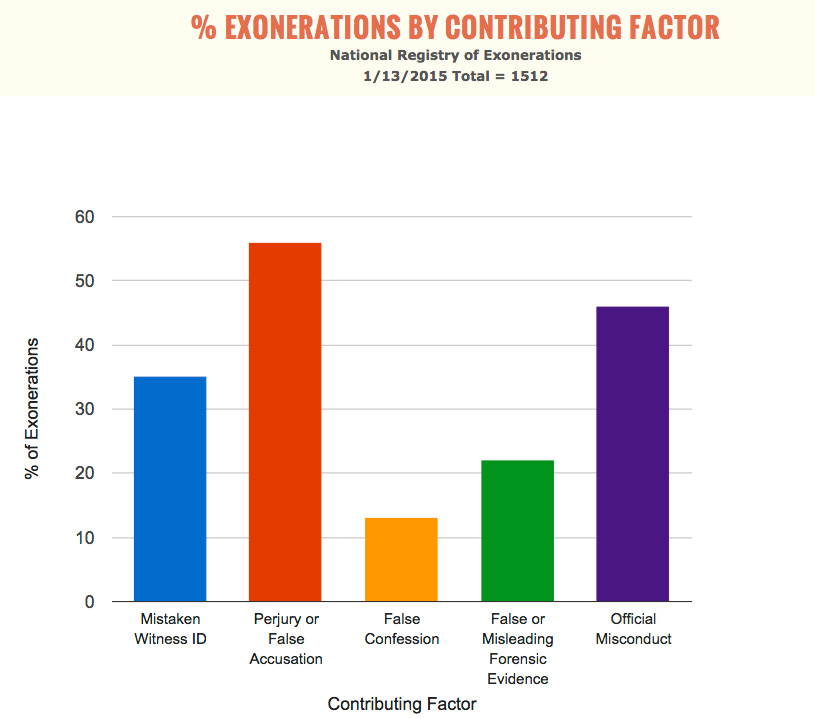
My strong suspicion is that, because of increasing publicity about wrongful convictions, prosecutors are establishing these things to politically bolster their public image. Call me cynical – and we should welcome every step toward true justice – but I tend to see a fox guarding the hen house and a wolf in sheep’s clothing. Over the past decade, people and organizations within the “innocence movement” have made noticeable and laudable progress.  As of this writing, the National Registry of Exonerations has logged 1,555 exonerations of people who were wrongfully convicted – and anyone who does this work can tell you that this is just a drop in the bucket. The media have done a pretty decent job of making these exonerations known to the public. After all, it makes for a good “story.” And one of the interesting facts that often comes out in many of these stories is that 46% of those 1,555 wrongful convictions had “official misconduct” as a contributing factor. Official misconduct includes both police misconduct and prosecutorial misconduct. The data in the registry does not distinguish between the two, but clearly, prosecutorial misconduct is a significant contributing factor to wrongful convictions. The Center for Prosecutor Integrity has begun building a data base of such misconduct – the Registry of Prosecutorial Misconduct.  I look forward to the day when this registry will provide the kind of hard data that can be used to drive justice system and legislative reform.

This negative publicity over the last several years has put political pressure on prosecutors; particularly in jurisdictions that have a demonstrated history of wrongful convictions. Prosecutors are political animals. They hold elected political office, and they will do just about anything to maintain their credibility with the electorate in order to be re-elected, or to be elected to higher office. Prosecutors are pointing to these things, and saying, “See. We’re being proactive about wrongful conviction.” My expectation is that they are cherry picking the easy, obvious cases, and reaping the good publicity. It remains to be seen how many wrongful convictions they will overturn that involved egregious prosecutorial misconduct, particularly if the subject prosecutor is still with the prosecutor’s office.

CIU’s have yet to stand the test of time. Can they last? Can they actually be apolitically dedicated to true justice, no matter the circumstances?  Perhaps time will tell, but my current view is that CIU’s are the prosecutors’ public relations gimmick du jour, and that they are transparently political.

Just watch. When the CIU’s eventually start being dismantled, I predict we’ll hear one or both of the following justifications:

1) We’ve fixed everything there was to fix, and we promise to behave ourselves in the future, so the CIU is no longer needed.

2) Budget constraints and the requirements of ongoing prosecutions force us to apply the resource devoted to the CIU to more urgent business.

It would be nice if the CIU’s keep motoring along, overturning wrongful convictions, even if they’re very politically and self-protectively selective in which cases they review. How could anyone object to that?  Again, a wrongful conviction overturned is a wrongful conviction overturned. But to achieve true objectivity, fairness, and impartiality, this function must be separated from the prosecutor’s office. To think anything else is farcical – they have a vested interest in their own convictions. I hold up as a model for how this should be done – the North Carolina Innocence Inquiry Commission. Of course, the problem here is one of throughput. A single commission in a state with many, many counties just cannot possibly deal with all the potentially wrongful convictions that the justice system produces. Maybe there’s a way to solve this throughput problem, but I don’t think anyone knows what it is right now, or should I say “yet.”

I am not advocating that the CIU’s go away, but there must be a better, more objective way to do this. I fear that many cases that deserve review will not be reviewed, because the prosecutor decides it would not be in his/her best interest. And let’s be careful about how much “credit” we give the prosecutors, because these things are clearly politically self serving. In the meantime … prosecutors will continue doing what they do – which is whatever they want, with no fear of sanction.

Let me end, however, with the note that there is a very interesting experiment unfolding in New Orleans. The New Orleans Parish District Attorney and the Innocence Project-New Orleans have agreed to jointly establish a “conviction integrity unit,” although I’m not sure what they’re going to call it yet.  Details of how this will operate are yet to come clear, but it bears very careful watching.

Shaken Baby Syndrome (SBS) – A CBS Report: Blaming Melissa

Melissa Calusinski was convicted in 2012 of murdering 16-month-old Benjamin Kingan at a day care center in Lincolnshire, IL by throwing him to the floor.

She “confessed” after a 10-hour interrogation, but has always maintained her innocence.

CBS “48 Hours” will air a report on the case Saturday, Feb. 28 at 10:00 PM EST.  See a preview here.

See the Chicago Tribune story from March, 2012 here.

Prosecutorial Misconduct and Brady Violations – From a Forensic Perspective

Benjamin-Brady Viol

Dr. David Benjamin is a world renowned clinical pharmacologist and forensic toxicologist. Consequently, he has substantial experience involving forensic evidence and “expert” testimony. He recently gave a presentation at the American Academy of Forensic Sciences annual meeting in the Jurisprudence Section focused on Brady violations from a forensic perspective.

There is a mountain of material contained in the presentation, including some specific recommendations for how to combat and counter Brady violations involving forensic evidence and expert testimony.

If you would like to investigate this further, you can contact Dr. Benjamin through his website, and request a copy of the presentation by e’mail.


Dog Scent Arson Detection – and Charging

pointerWe’ve posted before about “dog scent lineups.”  See those posts here and  here.  They’ve been called “the worst of the junk sciences.”

I can do naught but shake my head.  I thought we had seen the last of it, but this stuff is still going on. In Maricopa County, AZ, not one, but two, people were charged with setting their own houses on fire, based upon bogus dog scent evidence which was solely the result of unethical conduct by the Phoenix Fire Department investigators involved. An independent, professional fire investigator confirmed without question that the fires were NOT arson.  The charges against both were eventually dismissed, but not before one of them spent 16 months in jail.

See the aol.com Inside Edition story here … it should make you angry.

And here’s the kicker.  Despite the recommendation of six felony charges, the prosecutor declined to bring any charges against the dishonest fire department employees, and they are both still employed by the department.

Looks like the “good ol’ boy” network is alive and well in Maricopa County.

Why a Wrongful Conviction is Like a Plane Crash – or Should Be

The civil aviation system and the justice system are two ubiquitous systems on which we absolutely depend daily; even with our lives.  When either of these systems fails, the consequences are invariably tragic, impacting families and lives.

When a plane crash occurs, the NTSB (National Traffic Safety Board) and the FAA (Federal Aviation Administration), along with local police, fire, and medical examiners, literally swoop in, and investigate the crash down to the minutest detail.  Sometimes, even the FBI gets involved. See the article “Inside the Aircraft Accident Investigation Process” here. As a result of the investigation, there can be changes made to the air traffic control system, and orders can go out to aircraft manufacturers and airlines requiring design changes or inspections of aircraft, and whole fleets of airplanes can be grounded until changes or fixes are implemented.  New training requirements can be established. All this is the absolutely proper and necessary thing to do.  When a system that we all depend on fails, we need to understand what happened, understand why it failed, and make changes so it never happens again.

If this is true for the air travel system, and I cannot believe anyone would disagree with that, why should the same not be true for the justice system? It’s a system on which we all depend.  When it fails, lives are shattered, children are taken from parents, families are separated, innocent people are put in prison, and innocent people are even executed.

When a failure of the justice system occurs, what happens? Based upon my years of working in this, absolutely nothing. A wrongful conviction may be overturned, but nothing changes in the system as a result of it, and indeed, there is not even an investigation by an authoritative body to determine what went wrong, and how to fix it. My experience tells me that when the justice system fails, the response from the system is, “Oh well, too bad. Now on with business as usual.” And the same failures keep happening over and over and over.

Why can’t there be an “NTSB” for the justice system? — a body with the authority and responsibility to examine justice system failures, and to take the necessary actions to ensure they don’t happen again. This could absolutely be done on the state level. I find the logic of this inescapable. You cannot possibly build a credible, supportable argument against it. But knowing what I know about politics, legislatures, and human nature, I’m not optimistic. But how can you possibly argue that this wouldn’t be the right thing to do?

A Major Cause of Wrongful Convictions …….. POLITICS !?

[Editor’s note: this piece has been very difficult to write.  I’ve been working on it for months, and have deliberated about publishing it at all; I think because the objective it advocates is so daunting.  But I do think it goes to the heart of so much that is wrong with the justice system. I do not have hard data to support my position, and I doubt such data will ever exist, but I do have decades of study and careful observation.  I only report what I observe. Please read it, and just think about it.]

This article will be both editorial and somewhat philosophical, at least to the extent that it expresses conclusions on my part, so please bear with me. But it does address an issue that I believe is one of the key flaws in the justice system – and one that seems to be universally overlooked, not recognized, or dismissed. My hypothesis is that having “prosecutor” be an elected political position has a very deleterious influence on their performance of that job, and that this circumstance is not merely a contributor, but a root cause contributor, to wrongful conviction.                                                        (Note:  We are not considering federal prosecutors here, because they are not elected, and they need to be a whole separate subject.)

First, some personal background.  I grew up in an intensely political family.  I’ve seen politics at work “up close and personal.” My father was an elected official for over 30 years, until he retired.  My mother was very active in both state and local politics, and had seriously considered running for Congress.  We even used to have the Congressional Record delivered to our home.  I have very clear memories of, as a youngster, being down in the basement stuffing “sample ballots” into envelopes for delivery to voters.  My mother once told me about how intoxicating and addicting politics can be, and how easy it was to get caught up in it.  And (in my opinion) this is not driven by an overwhelming and compelling desire to serve the public – it is driven by an overwhelming and compelling desire for power and personal gain. No politician would ever admit this – probably not even to themselves; but you just can’t convince me otherwise. My apologies to the politicians out there, but that’s how I see it.  There may be some virtuous motives to start, but once you’re in it, you’re hooked. So what’s the point of all this?  It’s that I have observed and learned throughout my life that political positions, by their very nature, create a set of pernicious personal motivations for the office holder that can be, and usually are, contrary to the intent and spirit of the office.

Continue reading

Growing Number of Inmates in US Prisons Found Innocent

Here’s a neat YouTube video featuring both the National Registry of Exonerations and the Center for Prosecutor Integrity.

See the YouTube video here.

Editorial comment:  The video praises the recent creation of “conviction integrity units” within prosecutors’ offices.  These have received much good press in general. We can only applaud the effort and the results so far. After all, the correction of a wrongful conviction is the correction of a wrongful conviction. However, I remain skeptical. My view is that the CIU’s are cherry picking the easy, obvious cases, and what will happen when they start to run out of these? I also believe that the CIU’s are being established driven by political expediency, not some fundamental desire to serve true justice.  When the CIU’s start to be dismantled, I suspect there will be very little, if any, publicity about that.


An Open Letter on Shaken Baby Syndrome and Courts: A False and Flawed Premise

A group of 34 esteemed doctors, medical professionals, and international experts has jointly published a letter regarding the problem of how SBS is currently being prosecuted in the courts.

See the Argument & Critique website posting here.     Or access a .pdf copy here: Open letter on SBS

This is a very big deal.

One excerpt from the letter: “It has to be said that there are powerful vested interests in suppressing any open discussion in, or outside, the courts about the viability of the SBS construct. The motives are financial and the preservation of reputations. One of the consequences has been the vilification of experts prepared to advance competing theories and the suppression of sensible debate.” (And if I may just interject – this is exactly what I have been saying on this blog for the last three years.)

It’s notable that Dr. A. Norman Guthkelch is one of the signatories to this letter. It was his initial study, two pages long, published in the British Medical Journal in 1971, that started the whole SBS/triad “religion.” Dr. Guthkelch has been quoted as saying he is appalled that his early study has led us to the situation we experience today with criminal prosecution of SBS based solely upon triad symptoms. Please see the National Public Radio article, Rethinking Shaken Baby Syndrome, here.


Constructing Rich FALSE Memories of Committing Crime

We have reported numerous times before about how malleable human memory can be (here and here) and on the dangers of the Reid Technique of interrogation that arise from this (here and here).

On Feb. 3, Mark Godsey posted this article from the LawTimesNews describing the resesarch of Prof. Stephen Porter and Julia Shaw.  The study demonstrated that it is relatively easy to get people to “remember” details of a crime they never committed.

Our sincere thanks to the publisher of the study, SAGE Publications, for allowing us to post a link to the full text of the research article.  The link will be active until March 5, 2015.  See the full text here:  Constructing Rich False Memories of Committing Crime.

This excerpt from the abstract of the article:  “It appears that in the context of a highly suggestive interview, people can quite readily generate rich false memories of committing crime.”  And of course, for the term “highly suggestive interview” we can substitute “Reid Technique.”


Perjury Prosecution for Lying Prosecutors?

I am not an attorney, but in my layman’s, non-legal opinion this is potentially (and I say only potentially) huge.

The US Ninth Circuit has advocated criminal perjury prosecution for a prosecutor who lied to the court.  See our previous post about lying federal prosecutors here – in this case, the offending prosecutor got off with just a stern rebuke by the judge, which is sadly typical.

The Ninth Circuit has “recommended” perjury prosecution for a prosecutor who lied about benefits offered to a jailhouse snitch for his testimony.  Incentivizing testimony from snitches is nothing new.  It happens routinely.  But think about this.  If a defense attorney offered benefits to a witness for their testimony, it would be bribery, and the attorney could be prosecuted.  If a prosecutor offers benefits to a witness (snitch), it’s called “cooperation.”  What’s wrong with this picture?!

Now, here’s the “catch” about the recent Ninth Circuit lying prosecutor incident. The case involves a prosecutor who lied while testifying under oath.  So, the big question in regard to this is – what happens if a prosecutor lies in court at times when he’s not actually testifying under oath?  As I said, I’m not an attorney, but one would think that, logically, lying in any capacity in any court proceeding would be considered perjury, but ….. sadly, “the law is not always logical, but the law is always the law.”

See the full Observer story on the Ninth Circuit action here.

Connecticut Makes First Ever Compensation Payment to an Exoneree

Exoneree compensation was approved by the CT legislature in 2008, but the state has just made its first ever compensation payment to Kenneth Ireland who spent 21 years in prison after being wrongfully convicted of rape and murder.

Ireland was awarded $6 million on Thursday by the state’s Office of the Claims Commissioner.

See the aol.com story here.


Marissa Alexander Out of Prison – But It’s Not Over

We’ve previously reported on the Marissa Alexander case here.

This is one of the stupidest prosecutions I’ve seen in my years of doing this.  Angela Corey, the Florida State’s Attorney in the case, should be ashamed for setting such a shining example of prosecutors run amok.

Marissa fired a warning shot at her enraged and abusive husband, who had threatened to kill her, in fear for her life.  She was charged, tried and, despite the fact that Florida has it’s infamous “stand your ground” law, was convicted and originally sentenced to 20 years. She successfully appealed, and was facing a new trial — with a potential 60 year sentence.

Please see the Daily Kos story here.

“Friendship Nine’s” Convictions Vacated

F9

Pioneers of the civil rights lunch counter sit-in’s in South Carolina, known as the Friendship Nine, have had their convictions vacated and their names cleared.

See the CNN story here.

Debra Milke Trial on Hold Pending Appeal

DM

We’ve been following the Debra Milke case on this blog.  See here, here, and here.

Here is a recent update from TV5 KPHO in Phoenix, AZ.

Shaken Baby Syndrome Decision in Sweden

Score one for sanity, logic, reason, and science.

There has been a recent decision (October, 2014) by the Swedish Supreme Court that calls into question the scientific validity of the classic “triad” SBS diagnosis. According to the triad diagnosis, the symptoms of retinal hemorrhage, subdural hematoma, and diffuse edema of the brain are pathognomonic (exclusively indicative) of violent shaking or abusive head trauma.  The “triad” has been the mainstay of SBS prosecutions for decades, but in recent years, has come under increasingly critical scrutiny.

These quotes from the testimony of experts before the Swedish court:

It can be concluded that, in general terms, the scientific evidence for the diagnosis of violent shaking has turned out to be uncertain.”

The controversy is not about whether it is harmful to shake a child violently. The issue under discussion is with what scientific certainty it can be established how various injuries found in a child have arisen. The claim that the occurrence of the triad is strong evidence that violent shaking has occurred goes back to the late 1960s; however, the medical evidence for it was relatively thin. But the claim became generally accepted and grew into medical truth over several decades, even though the situation in terms of evidence did not change. It is known that a very large share of fundus haemorrhages are not linked to violence and arise in another way. Nor has it been shown that nerve fibers are torn, and that the brain therefore begins to swell, in connection with violent shaking. It can also be asked whether violent shaking can occur without neck injuries arising… To sum up, it can be said that the scientific support for the diagnosis of violent shaking is uncertain.

Sue Luttner, who edits the blog OnSBS, has done an excellent job of summarizing this decision and the case it involves, and has posted it on her blog here.


Federal Judge Blasts Yet Another Federal Prosecutor for Lying to the Court

On a recent occasion, this was a federal judge to an Assistant US Attorney:

“You’re branded a liar, and you’ll remain a liar for the rest of your life.”

For the rest of the story … see the New York Observer story here.

Update on the National Registry of Exonerations

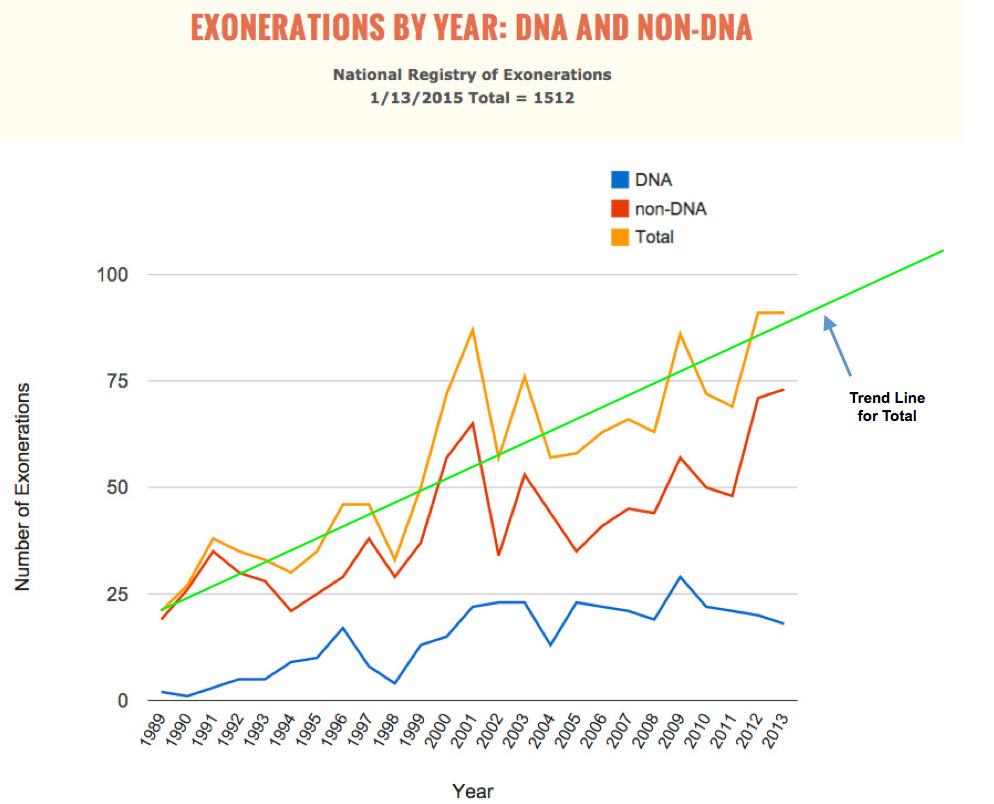
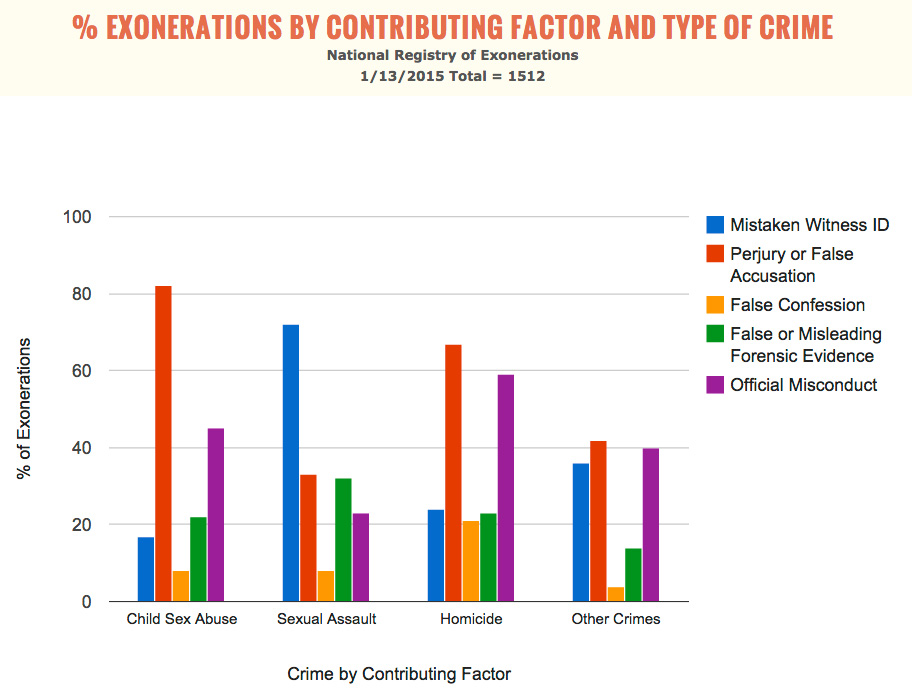
In case you haven’t been able to check in on the National Registry of Exonerations lately, here’s an excerpt from the most recent data.  Note the total is now up to 1,512, and the trend line is definitely UP.

exon dna non

exon cont fact

exon fact crime

I won’t belabor you by pointing out some of the more obvious observations.  Just a few minutes of study will (should) lead you to some very clear conclusions.

It has been reported that the folks at the Registry are hard at work trying to incorporate the exonerations being generated by the newly formed “conviction integrity units” (CIU’s).  For these cases the prosecutors running the CIU’s may not be very motivated to have their exonerations logged into the Registry.

I can’t gush enough about how critical and important this data is.  It is this kind of HARD DATA that will provide the foundation for much needed and long overdue justice system reform.