Category Archives: Reforming/Improving the system

Update on the National Registry of Exonerations

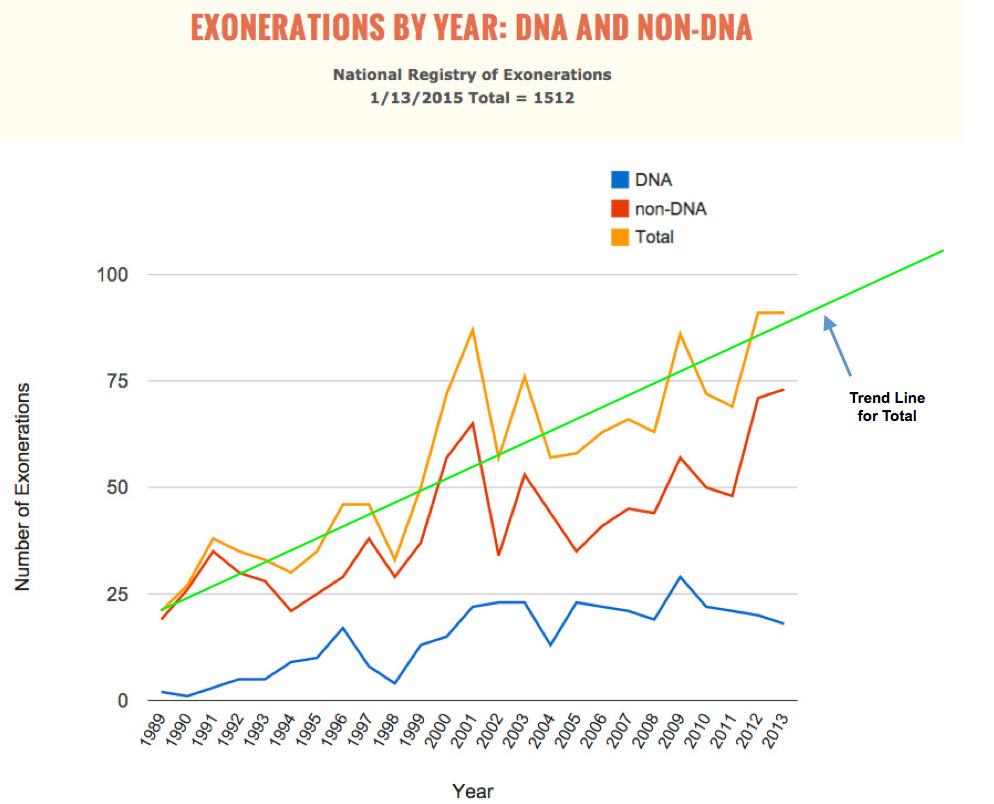
In case you haven’t been able to check in on the National Registry of Exonerations lately, here’s an excerpt from the most recent data.  Note the total is now up to 1,512, and the trend line is definitely UP.

exon dna non

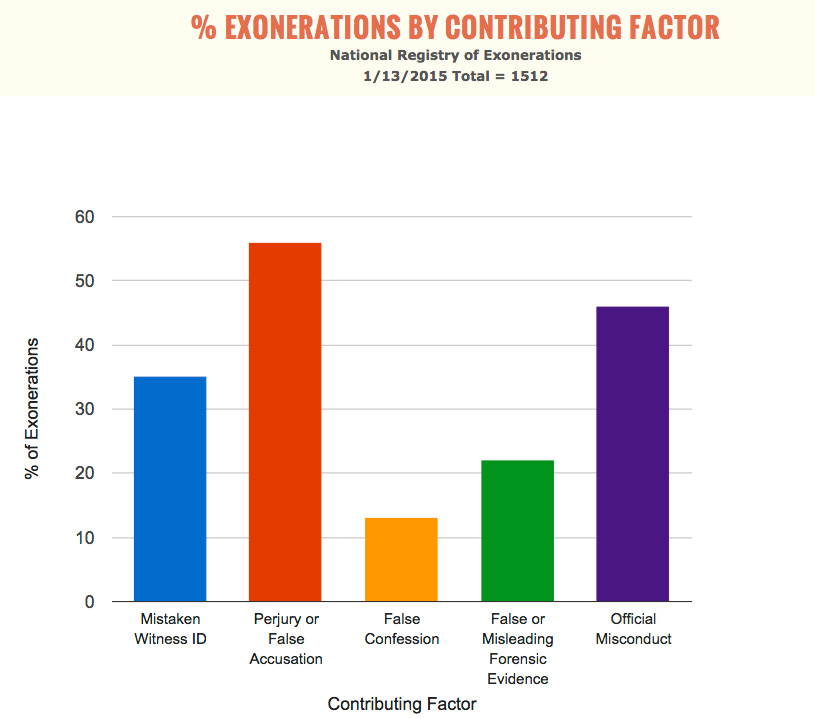
exon cont fact

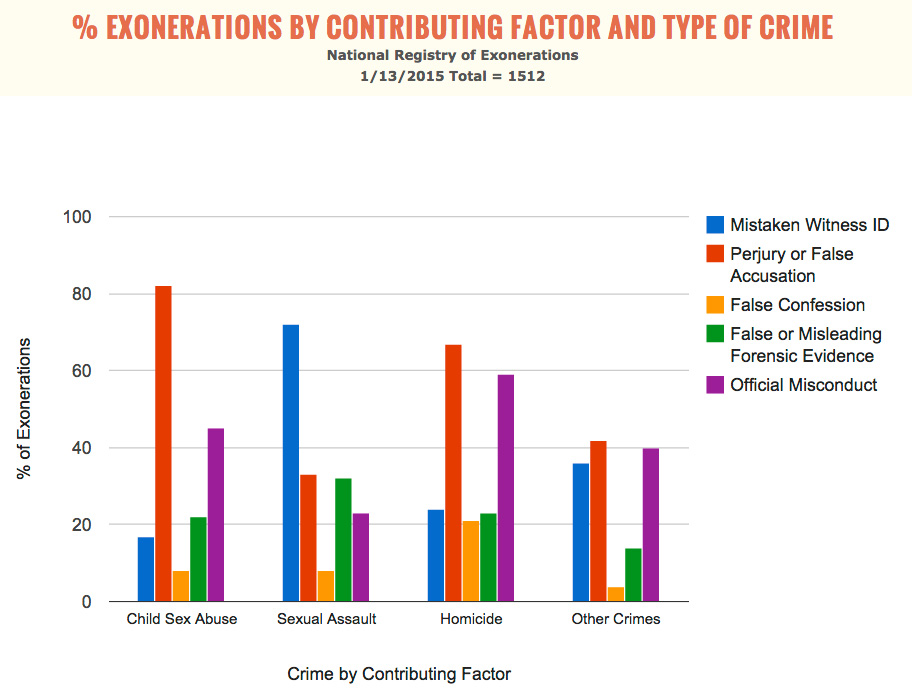
exon fact crime

I won’t belabor you by pointing out some of the more obvious observations.  Just a few minutes of study will (should) lead you to some very clear conclusions.

It has been reported that the folks at the Registry are hard at work trying to incorporate the exonerations being generated by the newly formed “conviction integrity units” (CIU’s).  For these cases the prosecutors running the CIU’s may not be very motivated to have their exonerations logged into the Registry.

I can’t gush enough about how critical and important this data is.  It is this kind of HARD DATA that will provide the foundation for much needed and long overdue justice system reform.

DA to Appeal Shaken Baby Conviction Reversal

We have previously reported on the Reneé Bailey case here.

Reneé Bailey, a day care provider in Greece, New York, was convicted in 2001 of shaking 2½ year old Brittney Sheets to death.  She was confined in prison until NY State Supreme Court Justice James Piampiano granted an evidentiary hearing in the case to consider the new scientific findings regarding SBS.  She was released without bail in December, 2014, and her conviction was reversed; the first SBS conviction reversal in New York state.  See the Rochester Democrat & Chronicle story here.

Now, in a recent announcement, the Monroe County, NY District Attorney, Sandra Doorley, has declared her intention to appeal the conviction reversal.

See that Rochester Democrat & Chronicle story here.

While this is certainly not good news for Ms. Bailey, who has already served 13 years in prison, there could be a silver lining to this ominous dark cloud. If the conviction reversal is upheld on appeal, this will establish some substantial legal precedent in favor of true science, rather than outdated medical dogma, in the evaluation and disposition of SBS cases.

Stay tuned.

Wrongly Convicted NY Man Dies 4 Months After $7.5M Compensation

Dan Gristwood was convicted in 1996 of attempted murder for beating his wife with a hammer.  He signed a confession, that he did not write, after 16 hours of interrogation by the NY State Police.

In 2003, the real attacker, Mastho Davis, came forward and confessed. Gristwood was released in 2005, and ultimately awarded $7.5M for his nine years of wrongful incarceration.

Sadly, on January 3, 2015, four months after receiving payment, Dan Gristwood died from lung cancer.  See the ABC News story here.

The syracuse.com story about the case here is definitely worth a read, and reads like a script for the prototypical coerced confession.

In light of all the recent public – and police – furor about police conduct, and how they relate to the community, and how they should be respected, I can do naught but shake my head.  When the police do stuff like this, how can they claim any high ground in this discussion?  Dan Gristwood, after his release, said he thought the problem was a “few bad apples.”  That may very well be so, but guess what? Those “few” bad apples make the whole barrel stink.  And this problem belongs to the police – not the public.

Another Shaken Baby Syndrome Acquittal

An Iowa District Judge has dismissed the case against Peter Ranke, who was accused of injuring his 3-week old baby by shaking.  And further, the judge sharply criticized the diagnosing doctor for mishandling the investigation into the child’s injuries

This case highlights the proclivity of child abuse pediatricians to jump immediately to an SBS diagnosis; without giving due consideration to possible differential diagnoses.

See the Iowa City Press-Citizen story here.

New York Law Journal – New Medical Knowledge Debunks Shaken Baby Conviction

Yesterday, Dec. 22, 2014, in a Monroe County, New York court, Rene’ Bailey was ordered released from prison without bail, and is expected to return home today.  See the Rochester Democrat and Chronicle story here.

We highlighted the Rene’ Bailey case in a previous WCB post, “Shaken Baby Syndrome ……. Progress for True Science?” last January here.

She was convicted in 2002 of murdering a 2½ year old child in her care, and the conviction was based upon medical testimony of “shaken baby syndrome.”

The actual cause of death is believed to have been a short fall from a piece of play equipment onto a carpeted garage floor.  The prosecution has yet to decide upon appeal or retrial.

See the New York Law Journal article here.     Note: accessing the article requires registration with the site.

Mississippi Supreme Court Overturns Conviction Involving Steven Hayne, Shaken Baby Syndrome

We’ve posted previously about Dr. Steven Hayne here.  Hayne was the now-discredited, long-time medical examiner for the state of Mississippi; notorious for his questionable forensic testimony.

Dr. Hayne’s cases keep unraveling; however, this case does not center specifically on Hayne’s credibility, but rather on the defendant’s being denied the ability to hire an expert to challenge Hayne’s credibility in court.

See the story by Radley Balko of the Washington Post here.

Center for Prosecutor Integrity’s 2015 Innocence Summit – Call for Session Proposals

CPI Logo

2015 Innocence Summit – Invitation for Workshop Proposals

Crowne Plaza Hotel, Arlington, Virginia              June 12-13, 2015

 The Center for Prosecutor Integrity (CPI) is announcing its Invitation for Workshop Proposals for the 2015 Innocence Summit, themed “Forging Best Practices for Innocence Reform.” CPI invites individuals and organizations throughout the criminal legal system to submit a proposal.

Workshops are designed to educate attendees on issues of substantive law and practical interest. Recent research findings, program descriptions, case studies, legal analyses, advocacy strategies, and innovative solutions are all welcome.

Proposals must include the following:

  • Workshop title
  • Three learning objectives
  • Description of the workshop content (maximum 500 words)
  • Presenter biography (maximum 250 words)

Proposals are welcome from a variety of presenters and using a variety of presentation formats. Workshops will be 60 minutes in length.

Proposals should be submitted here: summit@prosecutorintegrity.org. Applications are due no later than Friday, January 16th, 2015.

Applicants will be notified whether their proposal has been selected by February 20th. Presenters are responsible for their own conference registration, travel, and lodging expenses. Further information about the Innocence Summit can be found here: http://www.prosecutorintegrity.org/summit/2015-3/

Last year’s Innocence Summit was a great success, and we invite you to participate in this exciting opportunity to advance best practices for innocence reform!

If you have any questions, contact Gina Lauterio, CPI Program Director, at summit@prosecutorintegrity.org .

Thank you,

Gina R. Lauterio Esq., Program Director, Center for Prosecutor Integrity (CPI)

P.O. Box 1221, Rockville, MD 20849

Office: 301-801-0608, Cell: 908-783-3542

Email: glauterio@prosecutorintegrity.orgInternet: www.prosecutorintegrity.org

The Center for Prosecutor Integrity, a 501(c)3 organization, works toward preserving the presumption of innocence, assuring equal treatment under the law, and ending wrongful convictions.

Plea Bargaining – An Effective Tool for Prosecutorial Abuse of Power

pros-scale

                                                                                                        (Graphic:  The Veritas Initiative)


“97 percent of federal convictions and 94 percent of state convictions are the result of guilty pleas.” (USSC, Missouri vs. Frye, 2012)

Think about that for a minute — 19 out of 20 criminal cases never-go-to-trial.

These cases are disposed of through a guilty plea that resulted from a plea agreement.  The defendant never gets a trial, and goes directly to jail.

It’s called “plea bargaining,” but there is little-to-no actual bargaining that takes place.  A plea offer can be made even before the case goes to a grand jury, and the defendant has no idea how strong, or weak, the prosecutor’s case might be. The prosecutor has a very, very long list of often-overlapping charges to pick from that can be “stacked” to build a breathtakingly long anticipated sentence, which he can use to “bargain” (read threaten) with the defendant.  And the ability to “stack” is further augmented for charges that carry mandatory minimum sentences.  It’s pretty much a “take it or leave it” deal.  The ONLY bargaining power the defendant has is to refuse the plea offer, forcing the prosecutor to take the case to trial.  This is the genesis of the so-called “trial penalty,” which has been well covered on this blog here and here.  The defendant can take whatever the prosecutor offers, or expose himself to an exceedingly long sentence at trial.

In accepting a plea agreement, the defendant obviously gives up his constitutional right to a jury trial, but he may also have to give up his right to appeal, or to file civil suit, or to even talk about the case.  And then once convicted of a felony, there is a whole list of other collateral consequences as well.

Amelia Whaley is a JD candidate at the Duke University School of Law.  While working as an intern for the Center for Prosecutor Integrity, she wrote a paper summarizing the practice of plea bargaining as it exists today in the US.  I think it is just excellent, and is the best overall synopsis of plea bargaining I have seen. If you want to understand what plea bargaining is all about, and how it really works, please read Ms. Whaley’s paper here:  (paper temporarily taken down for edit by author)

If you’re interested in a little further reading, this article by Timothy Lynch at the Cato Institute, Cato – Plea Bargains, covers the 1978 US Supreme Court case (Bordenkircher v. Hayes) that established the precedent for plea bargaining – a case in which a man wound up in prison for life – for passing a bad $88 check.

How the Courts Trap People Who Have Been Convicted by Bad Forensics

Radley Balko, investigative reporter for the Washington Post, has just published an article dealing with the justice system’s refusal/inability to deal appropriately with false, fake, unscientific, and discredited forensic evidence post conviction.

The focus is on a case that involves the infamous Dr. Steven Hayne, a now thoroughly discredited expert witness, who was sole medical examiner for the state of Mississippi for 20 years.  I urge you to read the entire article, but I’ve extracted a few particularly telling quotes:

•  “The courts and the people who operate in them seem to feel that the integrity of the system demands the preservation of verdicts.”

Addressing the fact that the body of scientific knowledge grows as a process, rather than an event; coupled with the legal time restrictions for introduction of new evidence  ————

•  “From the perspective of the wrongly convicted, you can see the trap here. File too soon, and the court may conclude that you haven’t presented enough evidence that the forensic theory upon which you were convicted has been discredited. If you then try to file more petitions as more evidence comes out to bolster your argument, you risk the court concluding that this is an  issue you’ve already raised, you lost, and you’re therefore barred from raising it again.”

•  “Koon was convicted due to testimony from an expert the court now admits isn’t credible. For the same court to nevertheless uphold his conviction because he missed a deadline is to keep him in prison on a technicality. It’s a cynical outcome that suggests the criminal justice system values process more than justice.”

Read the story by Radley Balko of the Washington Post here.


New York Taxpayers to Pay $9 Million in Wrongful Conviction Settlement

New York City, its Housing Authority, and the State of New York have agreed to pay $9 million to Danny Colon, 50, and Anthony Ortiz, 44. Both men spent 16 years in prison before their convictions in a 1989 double murder — a drive-by shooting — were overturned in 2009.

The New York Court of Appeals reversed an earlier Appellate court decision and ordered a new trial for the men after finding that the Manhattan prosecutor had knowingly utilized false testimony from a key witness, a felon and drug dealer. The prosecutor denied in her final argument to the jury that the witness had been compensated for his testimony, but he subsequently received a Continue reading

Red Inocente Conference 2014

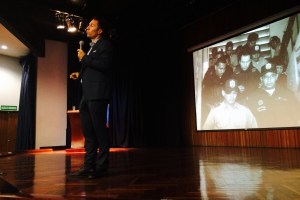
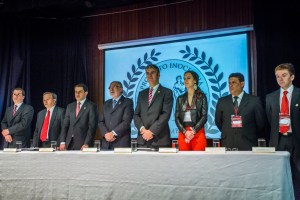
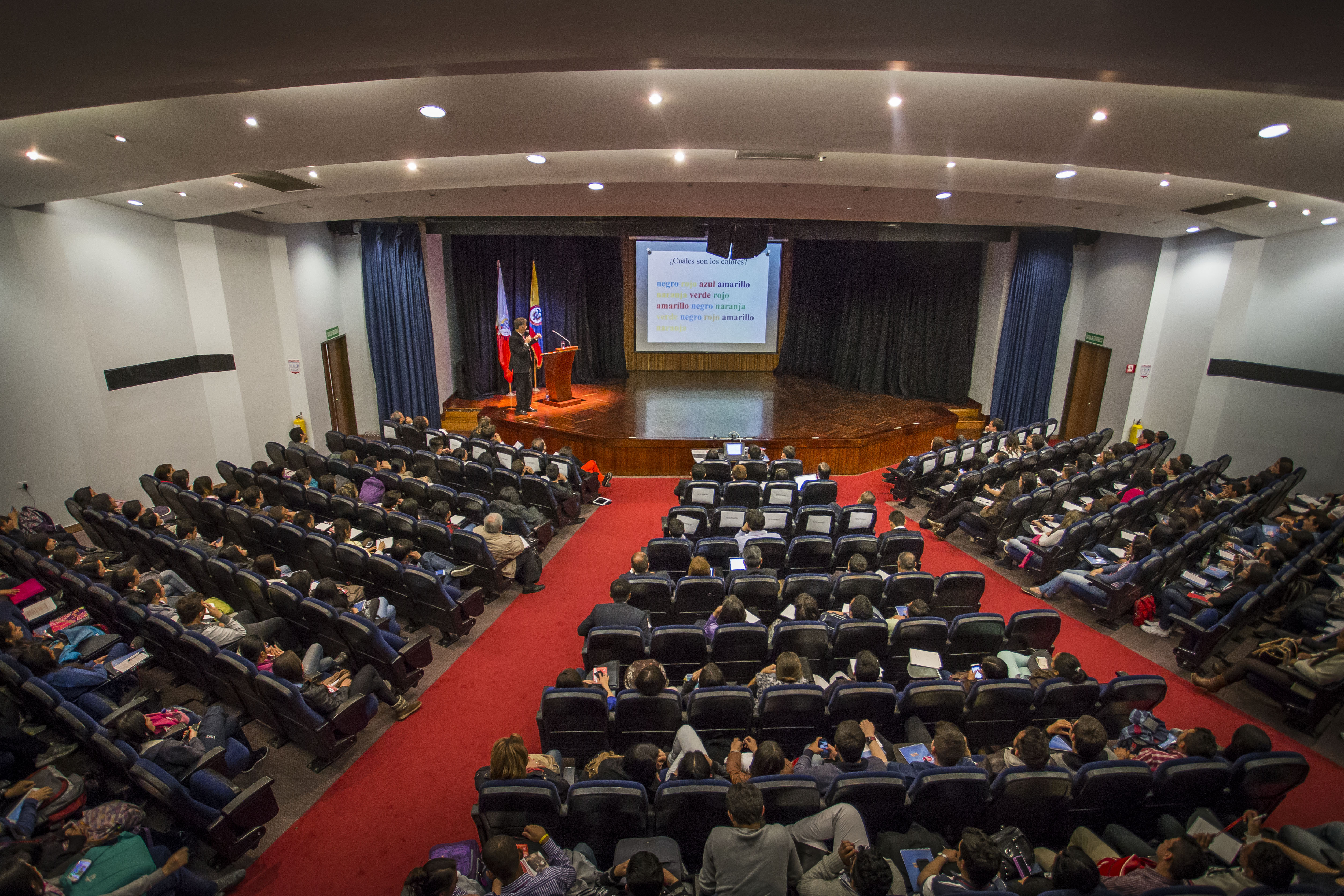
The Red Inocente conference in Bogota, Colombia this past weekend was an incredible success.  We had over 800 participants attend, including Angelino Garzon, the former ex-president of Colombia.  Staff attended from international innocence projects in Argentina, Chile, Costa Rica, Mexico, and Peru.  The conference was hosted by the Colombia Innocence Project at the Universidad Manuela Beltrán, which boasts 8 exonerations in the past 5 years.

EricOpening Table

Red Inocente is a legal education program that offers assistance to legal professionals in Latin America to create projects dedicated to the release of those wrongly convicted.  We also create and develop legislative reforms to reduce the number of wrongful convictions.  Red Inocente was based on more than a decade of success by the both the California Innocence Project and Proyecto ACCESO.

Martha ColombiaJustin from Above

National Academy of Sciences Releases Landmark Report on Memory and Eyewitness Identification, Urges Reform of Police Identification Procedures

The Innocence Project has posted a notice on its website, with a link to a press release, about the recently released report by the Nation Academy of Sciences on memory and eyewitness identification.

From the report:  “the legal standard that most courts use regarding the admissibility of eyewitness testimony was established before most of the scientific research was conducted.”

The report endorses the following procedures for police lineups:

  • Blind Administration — Research shows that the risk of misidentification is sharply reduced if the police officer administering a photo or live lineup is not aware of who the suspect is. This prevents the witness from picking up intentional or unintentional clues from the officer conducting the lineup.
  • Confidence Statements — Immediately following a lineup, the eyewitness should be asked to describe in his or her own words how confident he or she is in the identification. As the report notes, the level of confidence a witness expresses at the time of trial is not a reliable predictor of accuracy. Having the witness describe their level of confidence at the time an identification is made will provide juries with a useful tool for judging the accuracy of the identification.
  • Instructions — The person viewing the lineup should be told that the perpetrator may not be in the lineup and that the investigation will continue regardless of whether the witness identifies a suspect.
  • Videotape the procedure — The report recommends that police electronically record the identification procedure to preserve a permanent record of the procedure.

Most recent data from the National Registry of Exonerations shows that for the 1,467 wrongful convictions currently in the registry, 35% had mistaken eyewitness identification as a contributing factor.

See the Innocence Project posting here.

Justice for Sale at the Highest Level?

Lobbyists Pursue State Attorneys General

From an October 28, 2014 NY Times story:

“Attorneys general are now the object of aggressive pursuit by lobbyists and lawyers who use campaign contributions, personal appeals at lavish corporate-sponsored conferences and other means to push them to drop investigations, change policies, negotiate favorable settlements or pressure federal regulators.”

See the NY Times article here.

This is yet another reason why ‘prosecutor’ should not be an elected political position.  It exposes the position to a host of pernicious incentives.

Progress on the Road to Valid, Reliable Forensics

NASNCFS

The National Academy of Sciences of the United States published it’s Congressionally commissioned report,  “Strengthening Forensic Science in the United States – A Path Forward,” in 2009.  This was in response to the realization that a lot of what goes on in forensics can be called “junk science.” That is, much of it is not scientifically proven, is not statistically valid, is not reliable, and is very subject to the biases of individual examiners. We have featured the NAS report previously on this blog here, here, and here.

Not surprisingly, the NAS report was met with “stonewall” and dismissive resistance from the extant forensics community, as well as the National Association of District Attorneys.  However, the report succeeded in bringing forensics under the scrutiny of scientific discipline, and made the public aware of its many shortcomings and failings.  Subsequently, it was announced in 2013 that the US Department of Justice and the National Institute of Standards and Technology (NIST) would jointly form the National Commission on Forensic Science to provide guidelines and recommendations for the conduct and use of forensic technology.  The first meeting of the Commission was in February, 2014.

Continue reading

Update on the Hannah Overton Case

Five days ago, we happily posted here that the Texas Court of Criminal Appeals had overturned Hannah Overton’s conviction for murdering her 4-year-old stepson by salt poisoning.  The basis for the ruling was ineffective assistance of counsel, and we bemoaned the fact that the court let the prosecutor off the hook for egregious Brady violations.

Well … the happy ending is still a long way off.  The day after our posting, on October 18, 2014, Nueces County DA Mark Skurka announced that his office will retry Hannah Overton.

Given the evidence that the prosecutor had early on, and did not disclose to the defense, Overton never should have been charged in the first place. This was a “crime” that never happened.

Read the full story by Pamela Colloff for the Texas Monthly here.

If you can read Colloff’s article through, and not be bristling with anger, then you just don’t understand, or you need to read it again, or you’re just on the wrong blog.

Shaken Baby Syndrome (SBS) – Bad Science and the Race for Massachusetts Governor

In an op-ed piece that will appear in tomorrow’s (10/19) print edition of the Boston Globe, Lee Scheier takes former prosecutor Martha Coakley to task for her “deft misuse of science” in the SBS conviction of Louise Woodward, a British nanny who was working for the Eappen family when their 8-month-old son Matthew died in 1997.

Coakley is currently running for governor of Massachusetts, and recently set up a photo op with Deborah Eappen, Matthew’s mother, trying to defend her record on “protecting children.”

This quote from the article:  “Coakley’s odd invocation of this case demands that we look at the facts. What cannot be lost in all of this political maneuvering is the truth about the Woodward case and all the thousands of shaken-baby cases before and since Woodward. The truth is that Martha Coakley’s deft misuse of science actually came very close to sending an innocent caretaker to prison for life.” (emphasis mine)

See the Boston Globe op-ed here.

Thanks to Dr. John Plunkett for passing this along.

Texas Appeals Court Grants New Trial … but Lets Prosecutor “Off the Hook”

The Texas Court of Criminal Appeals has granted Hannah Overton a new trial based upon her claim of  “ineffective assistance of counsel” (IAC).  She has served seven years of a life sentence for capital murder in the death of her 4-year-old stepson who died of a sodium overdose (salt poisoning).  She truly did have ineffective assistance of counsel, because her attorney did not present the videotaped deposition of a salt poisoning expert saying that the overdose was likely unintentional, and there was nothing she could have done.

But here’s the part of the story that really gets me.  Overton had also filed a claim that the prosecution had withheld exculpatory evidence (Brady violation), and the court was presented with both the IAC claim and the Brady claim.  In it’s ruling, the court declined to rule on the Brady claim, saying it was unnecessary since they had granted a new trial based upon the IAC claim.  They let the prosecutor off the hook.

Story from KRIS TV (Corpus Christi, TX) here.

For a current update, see the KRIS site here.

Magazine tells how prosecutors became ‘kings of the courtoom’

“Most prosecutors are hard-working, honest and modestly paid,” The Economist says. “But they have accumulated so much power that abuse is inevitable.” The magazine explains how prosecutors became “the kings of the courtroom,” and how this contributes to wrongful convictions, here.

California Governor Vetoes Bill to Protect the Innocent

Jerry Brown, the same California Governor who recently signed an ‘anti-junk science forensics bill‘ into law, has vetoed a bill that would provide protection for the innocent, and hold prosecutors “mildly” more accountable.

The vetoed bill would have allowed judges to inform juries when prosecutors had been caught intentionally withholding exculpatory evidence, which is already a breach of ethics and arguably illegal.  Note that the bill did not even include sanctions for ethics-breaching prosecutors.

See the San Francisco Examiner story here.

See the Washington Post story here.


California Anti-Junk Science Forensics Bill Signed Into Law

Mike Bowers, on his blog Forensics in Focus, has posted the news that a new “anti-junk science forensics” bill has been signed into law in California.

The law permits post conviction defendants the ability to contest expert testimony that was presented against them at trial. In other words, convictions in which experts have either repudiated their past testimony, or used forensic “science” that is later deemed faulty by legitimate research, are subject to later proceedings reversing that conviction.

This is a huge deal, because it prevents prosecutors and judges from just using old case law as an excuse for ignoring habeas corpus appeals expressing new forensic research and attitudes.